The Capy Series
The Harvest of the Singing Bananas
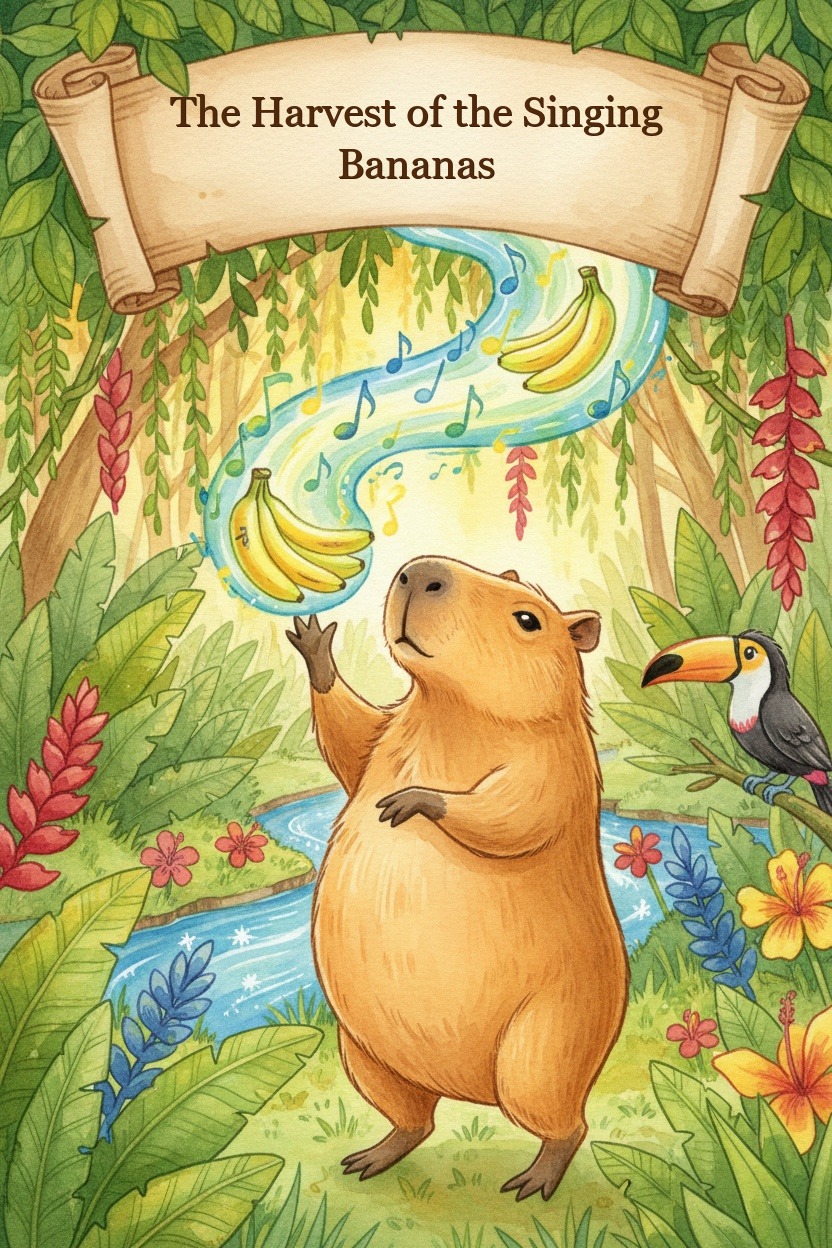
The valley was a green cup nestled between two humpbacked hills, and at the bottom of the cup lay a grove of banana trees. But these weren’t just any banana trees. Their leaves were the colour of emeralds, and their trunks were smooth as polished river stones. And they hummed.
Not a buzz, mind you. A tune. A tinkling, music-box tune that drifted on the warm air like a secret.
“Ooh, ooh, did you hear that? It’s a song! A songsong of bananabananas!” Squeaky the squirrel monkey was practically vibrating. He hung upside-down from a vine, his tail curled in a question mark. “Maybe it’s a happy song! Maybe it’s a dancing song! Let’s dance!” He did a little jig on the vine, making it sway.
Caper the capybara, who was padding along the forest floor with his usual careful steps, paused. His big, dark eyes looked up at the grove. “It’s pretty,” he admitted. “But it’s strange. Music doesn’t just… grow.”
“Everything grows in the rainforest, Caper!” chirped Flora, the resplendent quetzal, as she landed on a low branch, her long rainbow tail feathers cascading behind her like a living rainbow. She preened one feather absently. “But I must say, this is a new one.”
From the thick mud beside a small stream, a long, scaled head emerged. Hisss, the anaconda, let out a long, grumbly sigh. “It’s too loud. It will scare away the good napping spots.” He slithered out, his massive body coiling and uncoiling lazily. “And it’s not even a good tune. It’s the same thing, over and over.”
He was right, in a way. The tune was simple, a loop of notes that sounded like a tiny, wooden ballerina dancing on a glass table. But there was something else underneath it, a deeper, pulsing rhythm, like a slow heartbeat.
Caper was the first to spot it. “Look,” he whispered, pointing a wet nose towards the base of a large banana trunk.
There, marching in a perfectly straight line, were ants. But they weren’t just any ants. They were a glorious, shiny black, and they were marching in a pattern. One group went around the trunk clockwise. Another group went counter-clockwise. And a third group marched back and forth in a criss-cross.
As they marched, their tiny feet made a soft tapping sound on the hard bark. Tap-a-tap, tap-a-tap, tippy-tap, tap. Combined with the other two groups, it created the tinkling melody!
“The ants are the musicians!” Flora gasped.
“They’re not just marching,” Squeaky said, his eyes wide. “They’re playing the tree! They’re drumming on the bark!”
Caper watched, fascinated. “But why? Why would ants do that?”
The four friends watched for a long time. They saw the ants collect a tiny drop of nectar from a small, purple flower near the roots, then march up the trunk, tapping their feet in the rhythm. Each time they reached a certain spot, they’d stop, tap a special, triple-tap beat, and then march back down.
“It’s like they’re telling the tree a secret,” Squeaky whispered.
Suddenly, Caper remembered the map they’d seen – the one that showed the Star-Fortress, the floating islands, and the seven golden seeds. They had already found three of them, hidden in strange places. The map had hinted that the fourth seed was hidden near a “door of bark that sings a story.”
A door! A bark door!
“The vines!” Caper said, his voice rising with excitement. “Squeaky, you remember those vines that grow up the sides of the hills? The ones that make a hollow sound when you tap them?”
Squeaky’s eyes lit up. “You mean the boom-vines! They’re nature’s drums! I once used them to call a family of tapirs for a pancake party!” He was already scrambling up a nearby tree. “What’s your plan, Capybara-Caper?”
Caper explained quickly. “If the ants are making the music by tapping the tree, maybe we can make a different sound. A sound that answers the tree’s song. My idea is to make a ‘vine-microphone’ to listen to the tree’s special tapping spot very closely. Then, we can figure out if we can tap back.”
Squeaky loved the idea. He disappeared for a few minutes into the leafy canopy and returned holding a long, thick, hollow vine and a few smaller, brittle twigs. He also brought back a big, round seedpod from a brazil nut tree.
Using some sticky tree sap and spider silk for string, he attached the seedpod to one end of the hollow vine. “This is our listening cone!” he chattered. “It collects the sound and sends it right to your ear!”
Caper took the contraption. It was clunky and heavy, but he lifted it carefully and pressed the open end of the seedpod against the trunk of the banana tree, right where the ants did their special triple-tap.
He put his ear to the open end of the vine.
Woof-woof-woof. It wasn’t just a tap. It was a low, wooden bark. And under it, he heard a faint, echoing sound, like a stone door sliding.
“Try tapping it with a twig,” Flora suggested.
Caper tapped the trunk with a twig, but the sound was swallowed by the loud music-box melody.
Hisss, who had been watching with one lazy eye, spoke up. “Tap it like the ants,” he grumbled. “Not with your paw. The ants have six feet. Make it a six-part rhythm.”
Squeaky, of course, understood instantly. He grabbed a small, hard nut in each hand and two more under his feet. He hopped over to the tree and began tapping out the ants’ rhythm on the vine-microphone: TAP-tap-tap, TAP-tap-tap. TAP-tap-tap, TAP-tap-tap.
A deep hum vibrated through the vine-microphone, down through the seedpod, and into the trunk of the banana tree.
The music-box melody paused. The ants stopped in their tracks.
Then, very slowly, the pattern of the ants’ march changed. Instead of looping around the trunk, they began to spiral, circling higher and higher, their feet tapping a new, faster rhythm.
“They’re dancing!” Squeaky squealed. “They’re dancing a new dance!”
The spiral of ants climbed all the way up the trunk, and then, right at the top, they all marched in a circle.
The entire banana tree shook. A crack, thin as a spider’s web, appeared on the bark, right where Caper had put his ear. The crack widened, and the bark began to peel, not from outside in, but from inside out, as if the tree was unzipping itself.
A section of the bark, about as tall as Squeaky, swung open on a hinge of twisted wood and vine. It wasn’t a real door, but a perfectly camouflaged flap.
Behind it was a dark, hollow space, and in the centre of that space, resting on a bed of soft, yellow moss, lay a small, golden seed. It pulsed with a warm, soft light.
“The fourth seed!” Flora cried. “The map was right. The door of bark that sings a story!”
Caper carefully reached in and lifted the seed. It felt warm in his paw, and it was warm in a way that felt like hope.
The music-box melody started up again, but it was different now. It was faster, brighter, and it had more notes. The ants were marching to a new tune—a happy, triumphant tune.
Hisss uncoiled himself, looking almost impressed. “Hmph. A singing door. That’s a new one. At least it’s a better tune now.”
Squeaky puffed out his chest. “My vine-microphone! I shall call it the Ear-of-the-Jungle 3000!” He hugged the hollow vine.
As they turned to leave, Caper stopped. He looked back at the banana grove. The ants were still marching, still playing their song. “I wonder why they do it?” he said.
“Maybe they like music,” Flora said simply, admiring her shiny reflection in a dew-drop.
“Maybe they’re just keeping the door’s song alive,” Caper said. “They were the guardians, without even knowing it. They were playing the secret, so it wouldn’t be forgotten.”
He looked down at the tiny golden seed in his paw. “It reminds me of something.”
“What?” asked Squeaky, bouncing up and down.
“The forest,” Caper said. “It’s full of music. It’s full of tiny wonders, like ants and their songs. And all we have to do is listen carefully enough to hear them.”
“Even when they play the same boring song over and over again?” Hisss grumbled, but there was a hint of a smile in his voice.
“Even then,” Caper said, tucking the seed safely into a pouch of soft leaves they carried. “Because you never know what wonderful secret they’re singing about.”
And as the four friends walked away, the song of the banana trees followed them, a little piece of the forest’s heart, playing its beautiful, living tune for anyone who cared to stop and listen.