Inside Out Academy
THE SKELETON MAP
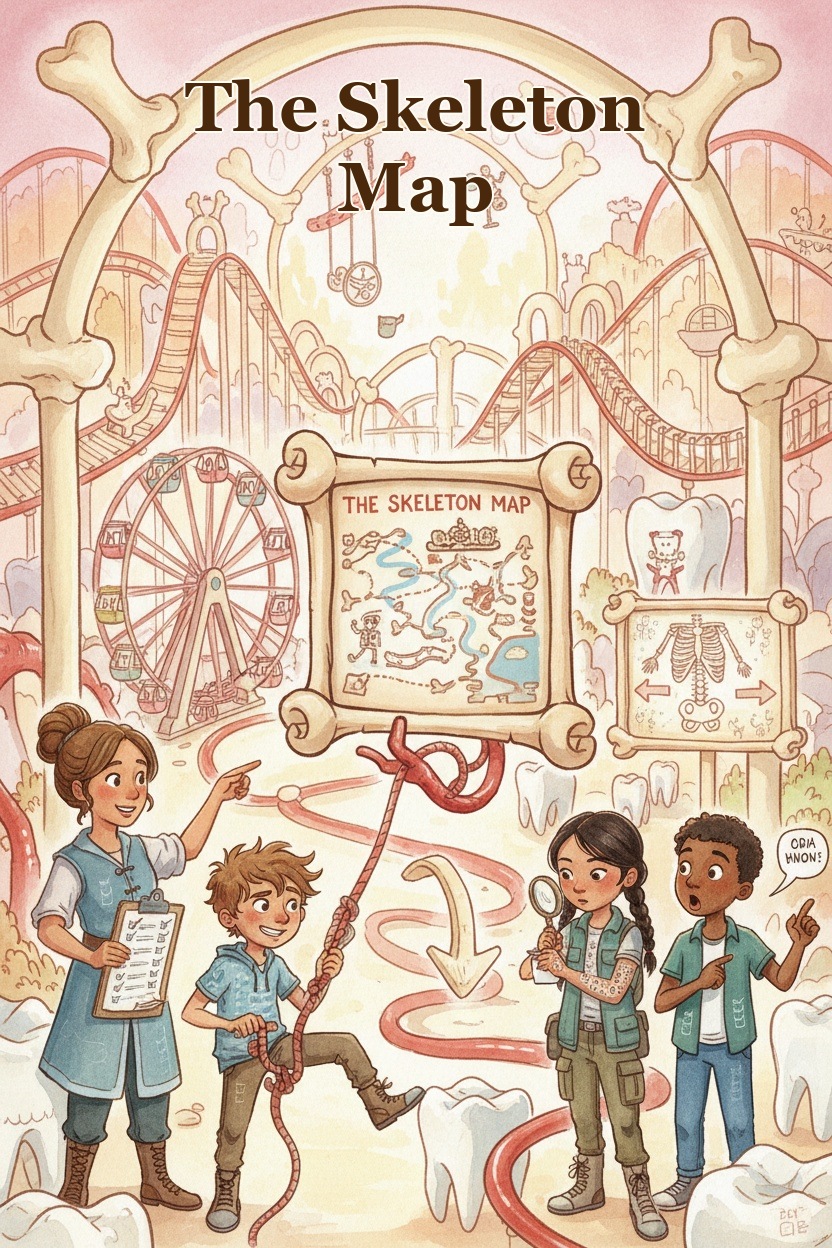
Ms. Vance's Current Checklist
Location: Godzilla (that's what Sadie named the femur—she says it's the biggest, strongest bone in the whole skeleton, and she's technically right)
Day: 4 of the journey
Students accounted for: All 22, plus Ms. Vance
Special note: Leo is currently standing on a bone chip and calling it a surfboard. This will not end well.
Part One: The Longest Bone
The class stood at the bottom of the femur and looked up.
"Okay," Marcus said, craning his neck. "So this is the largest bone in the human body. It's called the femur. It's the thigh bone. It connects the hip to the knee."
"Thank you, Marcus," Ms. Vance said, consulting her checklist. "And what you're all noticing right now—"
"It's HUGE," Leo shouted. He had already started climbing.
The femur rose above them like a white cliff, smooth and gleaming in the light of their lamp. It was impossibly long—taller than any building they'd ever seen, and they were standing at its base like ants at the foot of a skyscraper.
"It's the length of about a quarter of Mr. Gomez's height," Sadie said, pulling out her notebook. "So roughly—and I'm approximating here—it's about fifty centimeters long. That's about the length of a baseball bat."
"A baseball bat," Fatima repeated softly. She was standing very still, just looking. "That's what's holding him up."
"All of him," Sadie agreed. "Well, both femurs together. And they're incredibly strong. They can support about thirty times the weight of the human body."
Leo had found a small ridge on the bone's surface and was trying to stand on it.
"What's this?" he called down. "It's like a—a bump—"
"That's the linea aspera," Sadie said. "It's where the thigh muscles attach. You know, the ones from Books 7 and 8. We haven't met them yet, but they live on that bump."
"I'm going to name this surfboard," Leo declared.
"It's not a surfboard, Leo," Ms. Vance said wearily.
"It's Godzilla," Leo decided anyway.
Sadie opened her mouth, then closed it. "Actually," she said, "I was going to name it that."
"You can share it," Leo said magnanimously.
The class began to move along the femur's length, traveling upward toward the hip. Katia, who was walking next to Fatima, said, "It's so smooth. I thought bones would be—I don't know—bumpy?"
"That's the periosteum," Ms. Vance said, running a hand along the bone's outer surface. "It's a membrane that covers the bone, and it's full of blood vessels and nerves. And beneath that—"
"Is the hard part," Marcus finished. "Compact bone. But we saw that yesterday, in Book 4."
"Spoilers," Leo shouted from somewhere above them. He had climbed to a ridge that overlooked the bone's shaft. "I missed Book 4 because I was in the marrow cavity."
"You got stuck in the marrow cavity," Sadie corrected.
"I was exploring the marrow cavity."
The class moved on, following the femur's massive shaft toward the hip joint. The bone was so long that walking its length took time, and Fatima kept stopping to look at it from different angles.
"What are you thinking?" Marcus asked her.
"Think about it," Fatima said quietly. "Every person has two of these. They carry everything—the weight of the body, the force of walking, the impact of jumping. The entire weight of who you are, supported by these two columns."
Marcus looked at the bone with new respect.
"Huh," he said. "So it's like—"
"A bridge," Fatima said. "But better."
"Better than a bridge?"
"A bridge has to hold the weight of cars," Fatima said. "This has to hold the weight of a whole life. And it bends slightly when it takes impact. It's flexible."
"It is?"
"The periosteum and the shape of the bone—they're designed to absorb force. If bones were completely rigid, they'd break constantly. But they're slightly springy."
"Because they're alive," Sadie said, catching up to them. "Bone is living tissue. It's mostly collagen and calcium phosphate—collagen gives it flexibility, calcium gives it hardness. When you're a kid, you have more collagen, so your bones are more flexible. That's why kids can fall down and not break things as easily."
"Adults have more calcium," Marcus said.
"Adults have less collagen," Sadie corrected. "So their bones are more brittle. Not more calcium. The ratio changes."
Marcus wrote this down, frowning. "I was going to say that."
"You were going to say something wrong."
"Dr. Sadie strikes again," Leo announced from above. "Now come on! I want to see where this thing starts!"
Part Two: The Climb
The femur ended at the hip joint—a deep socket that looked, from the inside, like a bowl. The class gathered at the edge and looked up.
"The pelvis," Ms. Vance announced. "The hip bones. And this is where we need to make a decision."
"I vote we climb it," Leo said immediately.
"Nobody voted yet, Leo."
"I'm voting now. I vote we climb it."
"What we're looking at," Ms. Vance said, ignoring him, "is the transition between the appendicular skeleton—the bones of the limbs and their attachments, like the femur and the pelvis—and the axial skeleton, which is the central framework of the body: the skull, the spine, and the rib cage."
"The axis and the appendages," Fatima said. "Like a tree."
"Exactly like a tree," Ms. Vance said approvingly. "The axial skeleton is the trunk. The appendicular skeleton is the branches."
"So we've been on the branches," Marcus said. "Now we go to the trunk."
"We climb the spine," Leo said. "To the top. To the skull."
"We're not going into the skull," Ms. Vance said firmly. "Not without a full class vote."
"Right," Leo said. "So we climb the spine to get to the skull, and then we vote."
The vertebral column rose above them like a giant's staircase. Each vertebra was a distinct block of bone, stacked one on top of the other, with small spaces between them where disc-like structures sat.
"Intervertebral discs," Sadie said, pointing to the gel-filled cushions. "They're made of cartilage and they act like shock absorbers. When Mr. Gomez jumps or runs, these discs cushion the vertebrae so they don't grind against each other."
"How many are there?" Marcus asked.
"Thirty-three vertebrae," Sadie said. "But they're grouped. Seven cervical—that's the neck. Twelve thoracic—that's the chest, where the ribs attach. Five lumbar—that's the lower back. And then the sacrum and the coccyx."
"The coccyx," Leo repeated. "That's the tailbone."
"Correct."
"Where we were. In the booty."
"Leo, please."
The climbing began. It was slow work, moving from vertebra to vertebra, and the class quickly discovered that the spine was not a simple ladder. Each vertebra had a central opening—the spinal canal—where the spinal cord ran, and the class had to stay carefully on the surface of the bone, away from the opening.
"Don't worry," Sadie said, seeing the nervous looks. "The spinal cord is protected by the vertebrae. That's actually the point. The spine isn't just for support—it's a protective tube for the most important pathway in the nervous system."
"A bridge for information," Fatima said.
"Exactly."
From their position on the lumbar vertebrae, the class could look sideways and see the ribs branching off like the arches of a great building. Each rib curved forward and down, connecting to the sternum. The rib cage stretched away from them, huge and luminous.
"It looks like a cathedral," Fatima said.
Everyone stopped climbing and looked.
"It does," Marcus said quietly. "It's got the arches, the columns—"
"The ribs are the columns," Fatima said. "And the sternum is the altar."
"The sternum is the breastbone, class," Ms. Vance added. "The flat bone in the center of the chest. Twelve pairs of ribs attach to it—well, most of them do. The last two pairs are what we call floating ribs. They don't attach to the sternum at all."
"They're just floating?"
"They're attached to the spine in the back, but they don't connect in the front. They're like the flying buttresses of this particular cathedral."
Leo looked at the rib cage with new eyes. "And it's protecting his heart and lungs?"
"That's exactly what it's doing," Ms. Vance said. "The rib cage is a protective cage. It surrounds the most important organs in the chest and keeps them safe."
"Every breath," Fatima said. "Every heartbeat. All inside this cathedral."
"It's beautiful," said Priya, who rarely spoke but who had stopped to look at the arch of the ribs. "It's like we're walking through the inside of a poem."
The class continued their climb, and as they moved up the spine, the vertebrae changed. They were smaller now, lighter, and once they passed the cervical region, the space around them began to feel different. The air was warmer up here, and they could see the curve of the skull, shining like a great white dome in the distance.
"We're close to the top," Leo said. "We're going to make it to the skull."
"Just to look," Ms. Vance said firmly. "Just to look inside. We aren't going in."
"Ms. Vance," Leo said, "why not?"
The class had been asking. The class had ALWAYS been asking, since Book 2, when Leo had first voted for the brain.
"Because the brain is the command center of the entire body," Ms. Vance said. "It's the most important structure in everything we've seen. And we're not going to barge into it without thinking carefully about what we're doing there."
"I'm going to vote to go in," Leo said.
"I know you are."
"I'm going to vote to go in, and I'm going to convince everyone else to vote to go in."
"Leo," Sadie said, "your entire argument for going into the brain is 'it would be cool.'"
"It WOULD be cool."
"That's not a good reason."
"What's a better reason?"
Sadie opened her mouth. Closed it. Opened it again.
"...Okay, so technically there isn't one," she admitted.
"HA."
"But that doesn't mean—"
The class reached the top of the spine and stepped onto the base of the skull. The bone curved above them, great and smooth, and at the opening where the spinal cord entered, the class could see the beginning of a vast and mysterious darkness.
"The foramen magnum," Sadie said quietly. "That's the opening at the base of the skull where the spinal cord connects to the brainstem."
The class stood at the threshold and looked in.
The darkness was warm. It was deep. And somewhere beyond it, they could sense—or thought they could sense—the faint, rhythmic hum of something enormous and busy.
"The brain," Marcus whispered.
"The brain," Ms. Vance agreed.
"So we vote," Leo said. "Right now. We vote."
"We vote," Ms. Vance said. "But first, everyone needs to understand something important. The skull is a repository. It stores calcium and other minerals that the body needs to function. It's the site where blood cells are made—in the marrow cavity, which Leo has already fallen into once. And everywhere we've traveled, every bone we've seen, has been doing work that's absolutely essential to keeping Mr. Gomez alive."
"Minerals," Fatima said. "Blood cells. Support. Protection."
"Movement," Sadie added. "Muscles attach to bones. The skeleton isn't just a structure—it's a machine."
"And now we've seen it all," Leo said. "Everything except the brain."
"Everything," Ms. Vance agreed.
"So we vote."
"We vote," Ms. Vance said. "All in favor of entering the skull—"
Leo's hand shot up.
"All opposed—"
More hands than Leo's went up. He counted. His face fell.
"It's a lot more," he said. "It's a lot more opposed than in favor."
"The class has spoken," Ms. Vance said gently. "We will not enter the brain. Not today. Not yet."
"But someday?"
Ms. Vance looked at the darkness beyond the opening, at the warm, humming dark that seemed to pulse with a rhythm that matched—exactly matched—the rhythm Mr. Gomez's foot had tapped while he was waiting for the principal's phone call yesterday.
"Someday," she said. "If we all agree. And if we all understand what we're doing."
Leo looked at the skull for a long, long moment.
"It's so quiet," he said finally. "The brain is so quiet. I thought it would be loud."
"It's loud in here," Fatima told him. "All the other systems are loud. The heart is loud. The lungs are loud. The bones are quiet."
"Because bones are the architecture," Leo said slowly. "You don't hear a building."
"Exactly," Ms. Vance said. "The building is what allows everything else to happen."
Leo put his hand on the smooth, warm bone of the skull.
"Okay," he said. "I'll wait. But I'm going to be really annoying about it."
"We know," Sadie said. "We know you will be."
Part Three: The Map We Carry
The class climbed back down the spine, and as they went, Fatima stopped one more time at the lumbar curve to look at the vertebrae stacking and angling below her.
"A map," she said aloud.
Marcus stopped, too. "A map of what?"
"An 'S' curve," Fatima said. "The spine curves in an 'S' shape. It's not straight."
"Right," Marcus said, "because the curves absorb shock—"
"No, I mean—a map. We've been climbing for hours. We've been walking along the femur, climbing the spine, looking at the ribs. And when you see it all at once, it's a map."
"A skeleton map," Leo said from below, where he was trying to rappel down the vertebral column using the rope Ms. Vance had told him not to tie to anything. "Of where everything goes."
"Of where we are," Fatima said. "Right now. Inside Mr. Gomez."
"The map of his whole body," Sadie said, catching up to them. "The femur tells you where the leg is. The ribs tell you where the lungs are. The skull tells you where the brain is. Every bone is a landmark."
"Godzilla is a landmark," Leo said.
"Godzilla is a femur, Leo."
"Godzilla is a GODZILLA."
The class laughed, and the sound bounced off the vertebrae, and somewhere outside, Mr. Gomez felt a tickling in his spine that he couldn't quite explain.
Mr. Gomez's External Log
Tuesday, or maybe Wednesday. The days have started running together a little.
The professor—that's what I call Ms. Vance when I'm talking to myself—asked me to stand up straight for about four hours while the class explored my bones. I didn't know that's what they were doing, but I felt it. There was this constant, light fizzing along my legs and my back. It wasn't uncomfortable. It was more like—like my spine was having a conversation with itself.
They told me they saw the vertebrae and my ribs and my skull. They asked me if I'd ever broken a bone. I told them no, which I'm grateful for. They told me that was a good thing.
The principal called again. She wants to know when I'm coming back to work. I told her I had a medical thing. She asked what kind of medical thing. I looked at my arm, where I know twenty-three tiny people are living, and I said, "The kind that takes time."
She said, "Healthy people don't need a week for a medical thing."
I said, "It's a very unusual medical thing."
I think she's starting to suspect. Which is fine. She's the one who let the miniaturization demonstration go catastrophically wrong. I don't think she gets to ask questions.
My knee is a little stiff from standing so long, but it's fine. I'm eating a banana. I'm drinking water. I'm being good.
The tickle in my spine came back, and I sat down for a second to let it pass. It felt like someone was jumping on my vertebrae. Which, I'm told, is exactly what was happening.
I'm not going to think about that too hard.
— Mr. Gomez
P.S. The kids named my femur Godzilla. I'm choosing to be flattered.