Chef Sparks Kitchen Lab
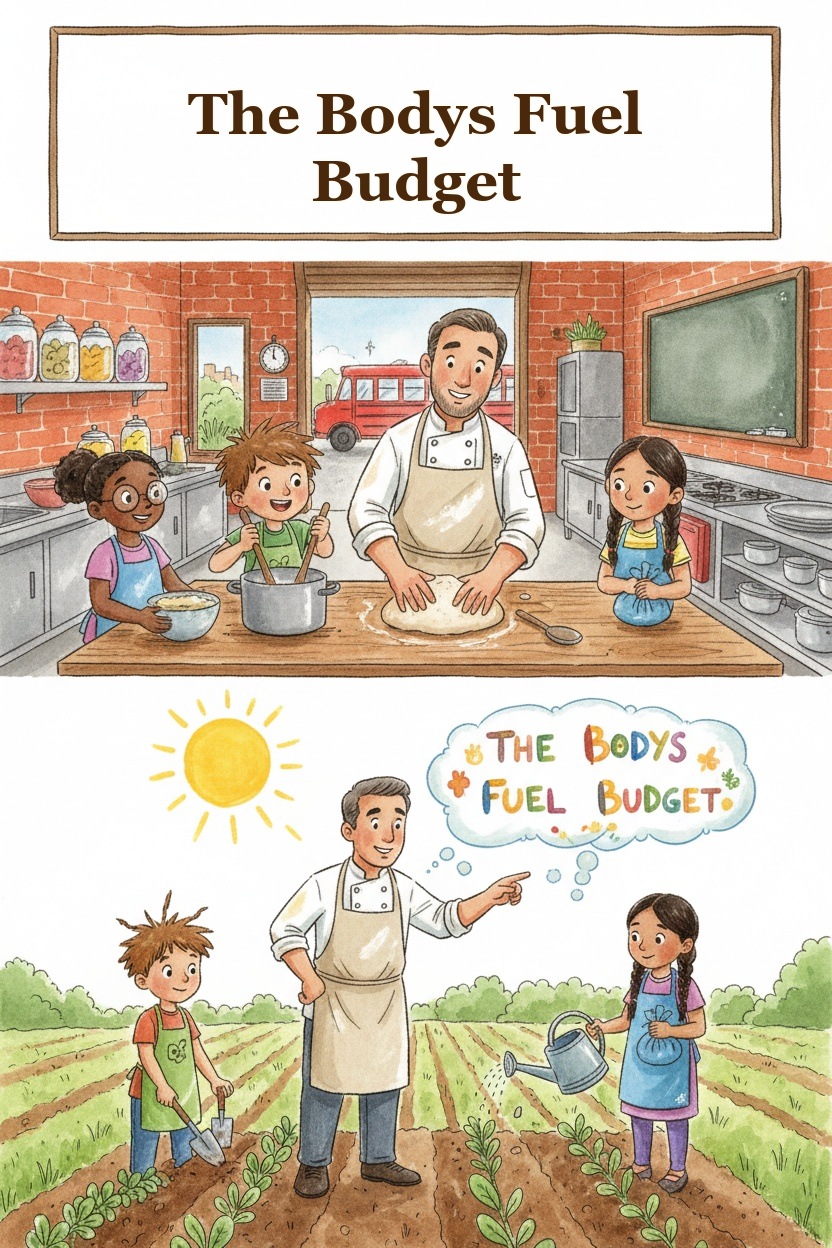
THE BODYS FUEL BUDGET
Section 1: The Engine on the Chalkboard
The Riverside Fire Station kitchen smelled like toast. Not the good kind of toast—the kind that happens when someone tests the toaster settings and forgets to write down which level they used. Iggy Spark was standing at the chalkboard wall, erasing yesterday's diagram of the Maillard reaction with an expression of deep concentration.
"Alright, team," he said, turning to face the assembled students. Maya had already checked the kitchen counters twice, Tommy was sniffing the air with concern, and Priya was pulling her hair back into a ponytail with practiced efficiency. "Today we're going to talk about something that connects everything we've learned this year. Something that every single one of you uses every single day."
"Is it the toaster?" Tommy asked hopefully.
"It is not the toaster, Tommy." Iggy picked up a piece of white chalk and turned to the board. "Today we're talking about energy."
Dev raised his hand. "Like electricity?"
"Like food energy," Iggy said. "The energy that your body actually uses. The fuel that keeps your heart beating, your brain thinking, and—" he glanced at Tommy, "—your legs running to the kitchen when you smell pancakes."
He drew a big circle on the board. In the middle, he wrote: THE HUMAN ENGINE.
"Your body is an engine," Iggy said, drawing pistons and gears around the edges. "A remarkably efficient, constantly running, self-repairing engine. And like any engine, it needs fuel."
"Gasoline?" Tommy suggested.
"Better than gasoline," Iggy said. "Your body runs on food."
He wrote on the board: CALORIES. KILOJOULES.
"Two words you've probably heard," he said. "On food packages, in grown-up conversations about eating. But what do they actually mean?"
Maya read from memory, the way other people recited song lyrics. "A calorie is the amount of energy needed to raise the temperature of one gram of water by one degree Celsius."
"And a kilojoule?" Iggy prompted.
"Four point one eight four kilojoules equals one calorie," Maya said. "If you see kilojoules on a food label, you can divide by four to get the approximate calories."
Iggy beamed. "Maya is absolutely right. These are both measurements of energy. The same way we measure distance in kilometers or centimeters, we measure food energy in calories or kilojoules. Different countries use different units—the United States tends to use calories, while Australia and New Zealand use kilojoules."
He drew a small flame in the corner of the board. "When you eat food, your body doesn't burn it like a campfire. It doesn't produce flames or smoke. But it does break down the molecules in food, and in the process, it releases energy. The energy was always there, stored inside the food. It's the same energy that the plant captured from sunlight, or that the animal got by eating the plant."
"And your body uses that energy to..." Priya trailed off, trying to find the words.
"To do everything," Iggy said. "To pump blood. To breathe. To think. To grow. To heal a cut. To keep your body at the right temperature. Every single cell in your body is doing work all the time, and all of that work requires energy."
He wrote on the board: ENERGY BUDGET.
"Now, here's the thing," Iggy said, turning back to his students. "Your body has a budget. Every day, it has a certain amount of energy it needs just to function. We call this your basal metabolic rate—your BMR."
Section 2: The Cost of Being You
Iggy drew a stick figure on the board and began labeling it with arrows.
"Your BMR is the energy your body needs just to stay alive if you were lying completely still, doing absolutely nothing," he explained. "It's the cost of being you. The energy your heart needs to beat, the energy your lungs need to expand, the energy your brain needs even when you're asleep."
"Wait," Lucia said, looking puzzled. "You're saying we burn energy even when we're not moving?"
"All the time," Iggy confirmed. "Your body is never actually idle. It's always repairing cells, filtering blood, growing hair, regulating temperature. For most people, their basal metabolic rate is about sixty to seventy percent of the total energy they use in a day."
"That's most of it!" Sam said, pulling out his notebook. "So moving around doesn't use as much as just existing?"
"Maya, what do you think?" Iggy asked.
Maya frowned thoughtfully. "Well, the body has to do all that background work no matter what. So moving is like... extra spending on top of the basic budget?"
"Exactly right." Iggy wrote on the board: TOTAL ENERGY EXPENDITURE = BMR + ACTIVITY + FOOD PROCESSING.
"Your total energy expenditure is the whole amount of energy you use in a day. It's made of three parts. The biggest part is your BMR. The second part is physical activity—walking, running, playing, dancing, even sitting up and paying attention." He winked at the class. "Thinking burns energy, too. Not as much as running, but it's not nothing."
"What's the third part?" Dev asked.
"Food processing," Iggy said. "Digesting food actually takes energy. Your body has to break down and absorb the nutrients, and that process burns calories. Different foods take different amounts of energy to process—protein takes the most, then carbohydrates, then fat."
Tommy's hand shot up. "So if I eat something that's mostly celery, and celery takes energy to digest, could I eat celery and get negative calories?"
Iggy laughed. "Tommy, I love that question. And the answer is no. The energy cost of digestion is much smaller than the energy you get from food, even for celery. There is no such thing as a negative-calorie food. But you're thinking exactly the right way—you're thinking about the budget, about the flow of energy in and out."
He erased the stick figure and drew something new: a large balance scale.
"This is what people mean when they talk about energy balance," Iggy said. "The energy you take in through food, and the energy you use through living. When they're equal, your weight stays steady. When you take in more than you use, your body stores the extra energy. When you use more than you take in, your body uses its stored energy."
Priya nodded slowly. "So weight gain and weight loss are just about energy in versus energy out?"
"Careful," Iggy said, holding up a finger. "This is where it gets complicated. Because 'calories in, calories out' is a real thing, but it's not the whole story. It's like saying that your allowance is about money in and money out—of course it is. But that's not the full picture of how you spend your money, is it?"
He drew the balance scale again, but this time he added arrows around it, pointing in all directions.
Section 3: The Complicated Ledger
"Why isn't it just calories in, calories out?" Maya asked. She had her label-reading face on, the one she used when she was carefully examining ingredients. "Isn't the math simple?"
"The math is simple," Iggy agreed. "But the math is not simple to calculate. Because the numbers on both sides of the equation aren't fixed. They change based on what you eat, when you eat, how you sleep, how stressed you are, even what time of day it is."
He drew a small figure next to the scale. "Let me give you an example. Imagine two children of the same age, the same height, the same weight. They both eat exactly the same food, and they both do exactly the same amount of activity. Will they both gain or lose the same amount of weight?"
Dev thought about it. "I guess so? If everything's the same?"
"Not necessarily," Iggy said. "Because their bodies might process the food differently. One child might have a naturally higher BMR, so their body burns more energy at rest. Another child might have different hormones, or different sleep patterns, or different stress levels."
He drew a moon on the board. "Sleep matters. When you don't get enough sleep, your body produces different amounts of certain hormones—some that make you feel hungrier, some that make your body more likely to store energy instead of using it."
He drew a small storm cloud. "Stress matters too. When you're stressed, your body produces cortisol, which can affect how your body manages energy. And stress can make you feel like eating even when you're not actually hungry."
Sam looked up from his notebook. "So the same food could have different effects on different people?"
"Exactly," Iggy said. "And the same food could have different effects on the same person on different days. Your energy balance isn't a simple bank balance—it's a living system. It responds to your environment, your emotions, your biology."
He wrote on the board: CALORIES IN ≠ SIMPLE EQUATION.
"That doesn't mean the math is wrong," Iggy said quickly. "Energy balance is real. If you consistently take in more energy than you use, you will store that energy. That's thermodynamics, and that's true. But the hard part is that both sides of the equation are influenced by so many things." He paused. "So many things that we can't just reduce it to counting numbers on a package."
Tommy looked slightly disappointed. "So all the numbers on the nutrition labels are useless?"
"Not useless at all!" Iggy said. "They're incredibly useful. They tell you how much energy is in the food, which is real information. But they're the starting point, not the whole picture. A nutrition label can tell you how many kilojoules are in a food, but it can't tell you how your body will respond to that food on any given day."
He looked at the board, covered in his diagrams and arrows and scales. The equation stretched across the middle, with energy in on one side and energy out on the other, surrounded by all the factors that influenced both sides.
"This is the part I want you to remember," Iggy said, his voice getting more serious. "Your body is not a calculator. It's an engine, yes—but it's a living engine. It's constantly adjusting, constantly making decisions, constantly responding to what's happening around you and inside you. When you eat, you're not just putting numbers into an equation. You're fueling a system that is incredibly complex and incredibly smart."
Maya was quiet for a moment. "So when I see something that says 'zero calories' or 'diet' on the package..."
"It's just a label," Iggy said. "It's information, but it's not the whole story. The whole story is about how your body uses that food, and that depends on so much more than just a number."
Section 4: The Spark Effect and the Fuel of Life
Iggy gestured at the chalkboard, where his diagrams had grown into a sprawling map of the body's energy system.
"Here's what I want you to take away from today," he said. "Your body takes energy from food. Different foods provide different amounts of energy—we call them macronutrients. Carbohydrates provide about four calories per gram. Protein also provides four calories per gram. Fat provides about nine."
"Fat has more than double!" Lucia said, her pencil flying.
"Fat is more energy-dense," Iggy agreed. "That means a small amount of fat has a lot of energy in it. That's why oil and butter can flavor a whole dish—they're concentrated energy. And alcohol also provides energy—about seven calories per gram—but that's a topic for another day."
Tommy was doing mental math. "So if I eat a bowl of rice, it's mostly carbohydrates, so it's about four calories per gram. And if I add butter to it, the butter is mostly fat, so it's about nine calories per gram. So the same bowl of rice with butter has way more energy than without."
"Correct," Iggy said. "And that's useful information to have, because it helps you understand what different foods are providing to your body. Not good or bad—just information. Energy-dense foods are helpful when you need lots of energy in a small amount. They're also the foods that give you energy for a longer time, because fat takes longer to digest."
He picked up his chalk again, ready to draw one final diagram. "So when we think about food and energy, we need to think about it like a budget. Your body has a certain amount of energy it needs each day. It has a certain amount it can store. And everything that you do—sleeping, playing, thinking, growing, even digesting your food—plays a role in how you use that energy. Can you see why counting every single calorie or kilojoule is not the best strategy for health?"
Sam nodded. "You'd have to keep track of everything. And even then, the numbers wouldn't be perfectly accurate."
"Exactly," Iggy said. "Understanding energy is important—it's the difference between knowing what food is and understanding what food does. But using that knowledge to obsess over every single number is like trying to measure a river with a spoon. You might get a few cupfuls, but you're missing the current."
He turned to the board and began writing what he called "The Body's Energy Budget Equation":
ENERGY IN (FOOD AND DRINK) = ENERGY OUT (BMR + ACTIVITY + DIGESTION + GROWTH + HEALING + TEMPERATURE REGULATION + THINKING + FEELING +...) + ENERGY STORED
"See that?" Iggy said, tapping the three dots at the end. "The list of things your body uses energy for goes on and on. That's why energy balance is so complicated. Your body is always working, always spending energy, always adjusting. And the food you eat is what keeps the whole system going."
Maya looked up at the equation, her eyes moving across the terms. "So the labels tell us the energy in part. But the energy out part is different for everyone, and even different for the same person on different days."
"That's right," Iggy said. "Your body is not a simple machine, even though I drew it as an engine. It's a dynamic, living system. The most important thing is to give your body the fuel it needs, to listen to what it tells you, and not to fixate on making every number perfectly balance."
Priya spoke softly. "My grandmother always says it's about the whole meal, not the individual parts. The dal by itself isn't enough—it's the rice, the vegetables, the yogurt on the side. The whole thing together."
Iggy turned and looked at her with a warm smile. "Your grandmother is wise. She's describing something that modern nutrition science is only beginning to understand—that the context of food matters. Not just what you eat, but how you eat it, who you eat it with, how you're feeling, what you did earlier that day."
He gestured around the room. "This is why I love studying food. It's never simple. It's never just numbers. And the more we learn about it, the more we realize how much there is to learn."
He took a step back from the chalkboard to admire his diagram. His hand was resting on the wooden tray beneath the board, where a neatly placed piece of chalk sat balanced at the edge.
"It's like my grandmother used to say," Iggy continued, gesturing broadly with his other arm. "When you understand what you're feeding, you feed it better. And when you understand what your body needs—"
As he spread his arms wide, his sleeve caught the tip of his chalk bag, which swung gently. The chalk rolled off the tray, bouncing once on the counter below, and rolled across the floor in a smooth white arc.
"Chalk!" Tommy shouted. "I had chalk!"
"You didn't have chalk," Maya said. "You had gravity."
Iggy looked down at the chalk, then at the board, then back at the class. "Anyway," he said, as if nothing had happened. "That's what we'll be cooking today."
Section 5: The Recipe
Fifteen minutes later, the entire kitchen smelled like warm oats and cinnamon.
"The perfect breakfast for thinking about energy budgets," Iggy announced, ladling a scoop of cooked oatmeal into a bowl. "This oatmeal has everything your body needs for a morning of learning: complex carbohydrates from the oats to provide slow, steady energy; protein and fat from the milk and nuts; fiber to keep your digestive system working."
"Plus honey and cinnamon," Tommy added.
"Plus honey and cinnamon," Iggy agreed. "Which are delicious, and also provide quick energy and natural sweetness."
Maya was carefully measuring her portion. "How many kilojoules do you think are in this bowl?"
"That's a good question," Iggy said. "And here's my answer: I don't know exactly. I could add it up—I know roughly how many kilojoules are in the oats and the milk and the nuts and the honey. But the exact number would be different based on how I measured, what brand of oats I used, how the food was processed, so many factors."
He paused. "And even if I knew the exact number of kilojoules in the bowl, I wouldn't know exactly how your body would use them. Because that depends on you—your growth, your activity level, your sleep last night, even your mood."
Sam was writing in his notebook. "So the limit of calorie counting is that the accuracy isn't real."
Iggy smiled. "That's a smart way to put it, Sam. The numbers are real information—genuinely useful. But they're approximate, and they're only part of the story. The full story of how food becomes energy in your body is a story about living systems, not simple math."
He served each student a bowl of oatmeal, topping it with a sprinkle of cinnamon. Then he served himself the largest bowl, as usual.
"Eat this breakfast, and think about your body's energy budget," he said, sitting down with the students at the prep table. "Feel the food going in. Know that it's fueling your heart, your brain, your muscles. And remember that you're not a calculator. You're a living engine, and you need real fuel, real rest, and real care."
Tommy took a huge spoonful and made the two-note hum that the class recognized as high praise. "This is good," he said, mouth half full. "And I feel the energy already."
"That's partially the oatmeal," Iggy said, winking at Maya. "And partially the fact that you, in particular, are very eager to feel energy."
The class laughed, and for a moment, the kitchen filled with the sound of spoons clinking against bowls, oatmeal being enjoyed, and the warmth of a room full of people who had just learned something beautiful about how their bodies work.
Recipe: Iggy's Energy-Budget Breakfast Oatmeal
Serves 4-6 hungry learners
Ingredients:
-
2 cups rolled oats
-
4 cups milk (or your preferred milk alternative)
-
1/4 teaspoon salt
-
1/2 teaspoon cinnamon
-
2 ripe bananas, sliced
-
1/2 cup chopped nuts (walnuts or almonds work well — skip if nut-free)
-
1/4 cup honey or maple syrup
-
Optional toppings: berries, seeds, a drizzle of extra honey
Instructions:
-
In a large pot, combine the oats, milk, and salt. Set over medium heat.
-
Stir occasionally until the oats are soft and creamy, about 5-7 minutes.
-
Stir in the cinnamon.
-
Divide the oatmeal into bowls and top with sliced banana, chopped nuts, and honey or maple syrup.
-
Add any other toppings you like, and eat while warm.
Chef's Note from Iggy: "This oatmeal is all about sustained energy — the complex carbohydrates in the oats release energy slowly, so you feel fueled for longer than you would with sugary cereal. When you eat this, think about where the energy comes from: the sun, the soil, the plants, and then your body. That's a chain worth understanding."
Kitchen Lab Notes from Iggy
"Dear students,
Today we learned that your body is like an engine, but a much more complicated engine than any machine. It needs fuel to keep running, and that fuel comes from food. The energy in food is measured in calories and kilojoules, and different foods provide different amounts of energy. But the story doesn't end with the numbers.
Energy balance — the relationship between the energy you take in and the energy you use — is real, but it's influenced by so many things: sleep, stress, hormones, activity, growth, even your mood. The limits of calorie counting are real, too. The numbers on food labels are information, not judgment. They're a starting point, not the whole picture.
The best thing you can do for your body's energy budget is to eat nourishing food, get enough sleep, move your body in ways that feel good, and listen to what your body tells you about what it needs. Your body is wise. Trust it.
Here's a question for you to think about until next time: What do you notice about how your body feels when you eat different kinds of food? Not just whether you're full — but where you feel energy, where you feel comfortable, where you feel tired? Paying attention is the first step to understanding your own body's fuel budget.
Until next time,
Chef Spark"