The Number Kingdom
The Number Line Road
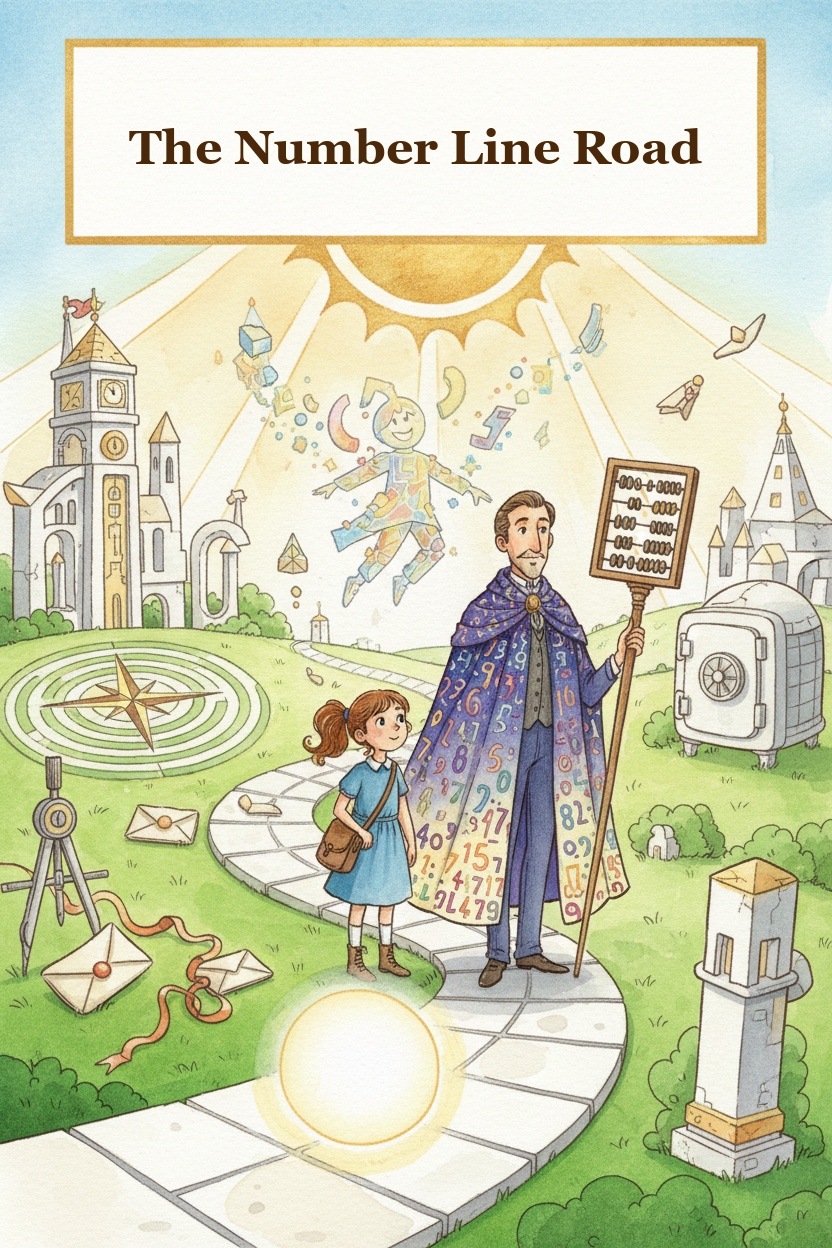
The Road Through the Kingdom
Mira arrived at the edge of the central kingdom just as the first cart came to a stop beside her. The driver, a round-faced woman with flour on her apron, stared at the road ahead with her mouth open.
"It's gone," the woman whispered. "The road is gone."
Mira looked. The road was not gone exactly. It was just... wrong. Great sections of it had been lifted out and set down elsewhere. What should have been a straight, smooth road running from the Counting Districts to the Arithmetic Quarters was now a jumble of disconnected pieces scattered across the grass, some right side up, some upside down, and none of them in the right place.
"Right," said Mira. "Let's see what's broken."
She slipped her satchel off her shoulder and pulled out a pencil and paper. The golden compass in her pocket warmed against her leg, which meant she was exactly where she needed to be.
The Count appeared beside her as if he had been standing there all along. His robes shifted with slow-moving numerals, and his staff tapped once against the ground.
"The crisis is as follows," he said gravely. "The road through the central kingdom is a physical number line. It is the backbone of all travel, all trade, all communication between the districts. Travelers move along it to add and subtract distances. The Remainder has removed sections and placed them in incorrect positions. The road is useless."
"Why does that matter so much?" Mira asked. "Can't people just walk around the missing parts?"
The Count looked at her with something like sadness. "The road is not merely a path, Mira. It is the number line itself. Every position along it has a meaning. Every house, every shop, every destination is located at a number. When the road is broken, no one can find anything. The baker cannot find the market. The carpenter cannot find the school. The children cannot find their homes."
As if to demonstrate, the baker's cart tried to move forward and immediately turned in a circle, its wheels spinning in the grass. The woman looked down at her own hands as if she had forgotten how to steer.
"Numbers tell us where things are," the Count explained. "The road gives those numbers a physical place. Without it, the kingdom cannot function."
A familiar voice giggled from somewhere above. Mira looked up to see a wisp of smoke curling around a lamppost, gradually shaping itself into a small, grinning figure made of half-erased digits and leftover fractions.
"Hello hello hello!" said the Remainder, doing a little flip. "I've rearranged the furniture! Don't you think it looks better this way? The numbers were so BORING before. All in order, all where they belong. Where's the surprise? Where's the ADVENTURE?"
Mira put her hands on her hips. "The adventure is that no one can find anything, and the kingdom is falling apart."
"Details!" said the Remainder cheerfully. "Small, petty details. I moved a few sections. I turned a couple around. I made everything EXCITING. Look — there's a three right next to a nine! They've probably never even MET before!"
It cartwheeled away across the field, leaving a trail of scattered numbers behind it.
The Road That Goes Both Ways
Mira walked to the first broken section of road. It was a long, straight slab of pale stone with numbers painted along its surface. Someone had removed it from its place and set it down in the middle of a meadow, pointing the wrong way.
She knelt down and looked at it closely.
The numbers were painted at even intervals. She could see 0 near one end, then 1, 2, 3, 4, 5 stretching away to the right. On the other side of 0, the numbers continued: -1, -2, -3, -4, -5, stretching away to the left.
"Interesting," she said, writing in her notebook. "The road goes both ways from zero. Right is positive. Left is negative."
A small silver figure appeared at her elbow. Zero stood quietly, perfectly round and perfectly calm.
"People often forget about my left side," Zero said softly. "They think I am the end of something. I am not. I am the middle."
Mira looked at the number line again. Right of zero: 1, 2, 3, 4, 5. Left of zero: -1, -2, -3, -4, -5.
"So negative numbers are real positions too," she said. "They're just on the other side of zero."
"Exactly," said Zero. "And they have their own order. On my right, 2 is greater than 1. On my left, -2 is less than -1. The line goes from smaller to larger as you move right."
Mira wrote this down. Then she walked to the next broken section.
This one was worse. Someone — and Mira had a very good idea who — had taken a section of the road and placed it upside down. The numbers were still there, but they were in the wrong order. Instead of reading 7, 8, 9, 10, 11, 12, it read 12, 11, 10, 9, 8, 7.
"If someone tried to follow this road, they'd walk the wrong way," Mira muttered. "They'd think 12 was before 7."
She pulled out her compass. The needle swung around and pointed at the damaged section, then settled, pointing firmly forward along the direction the road should go.
"Okay," she said. "Let me think about this."
She sat down on the grass and looked at her notebook. On one page she had drawn a straight line with an arrow at both ends. She had labeled the middle 0, and written numbers going out in both directions.
"The number line has a direction," she said to herself. "As you move right, numbers get bigger. 5 is greater than 4. As you move left, numbers get smaller. -5 is less than -4."
She looked at the upside-down section. "So if a section is upside down, someone standing on it would think the numbers go the wrong way. They'd think 7 is greater than 12, because 7 is to the right of 12 on the flipped road. But that's wrong. 12 is greater than 7. Always. No matter how the road is flipped."
She wrote: GREATER THAN means further right on the number line. LESS THAN means further left.
Then she stood up and walked to the third broken section.
Fixing the Road
This section was in the right orientation but in the wrong position. It was a stretch of road that should have been between 20 and 25, but someone had lifted it up and set it down between 30 and 35. The space where it belonged was now a gap of bare dirt, and the section that should have followed it was jammed up against the section that should have preceded it.
Mira stood at the edge of the gap and looked at the numbers.
At the left edge of the gap, the road read: 16, 17, 18, 19.
At the right edge, it read: 26, 27, 28, 29, 30.
"The numbers that should be between 19 and 26 are missing," she said. "20, 21, 22, 23, 24, 25. And they're sitting over there between 30 and 35."
She walked over to the misplaced section and looked at it. It read: 20, 21, 22, 23, 24, 25.
"Twelve is less than twenty," she said slowly, "because twelve is further left. Twenty is greater than nineteen, because twenty is further right. This section belongs after nineteen and before twenty-six."
She tried to lift the section, but it was far too heavy.
"I need help," she said.
The baker's cart had rolled to a stop nearby, and the baker had climbed down and was looking at her road with a helpless expression.
"Ma'am," Mira said, "could you help me move this section? I know where it needs to go."
The baker blinked at her. "But how do you know? The road looks like... nothing. Just numbers on stones."
"Exactly," said Mira. "The numbers tell us where the stones belong. This section has 20 through 25 written on it. It needs to be between 19 and 26, because 20 is greater than 19 and less than 26."
She pointed along the road. "The number line is ordered. Every number has exactly one position. When we know the order, we know the place."
The baker still looked uncertain, so Mira showed her the notebook. On the page, she had drawn the number line with arrows, and she had circled the missing numbers.
"See? The numbers get bigger as you go right. 19, 20, 21, 22, 23, 24, 25, 26. That's the order they have to be in."
The baker looked at the drawing for a long moment, then nodded. "You're right. It's the only way it makes sense."
Together, they lifted the section of road. It was heavy, but with both of them pulling, they managed to drag it into the gap between 19 and 26. It settled into place with a soft thump, and the numbers lined up perfectly.
19, 20, 21, 22, 23, 24, 25, 26.
Mira stood back and looked at it. It was right.
Walking the Line
But there were more sections to fix. Mira and the baker — and soon a carpenter, a teacher, and a small crowd of citizens — walked along the broken road, finding the misplaced sections and putting them back where they belonged.
Every time they found a new section, Mira checked the numbers and figured out where it needed to go.
"These have 31 through 40," she said, looking at a long slab. "They need to go after 30, because 31 is greater than 30. And before 41, because 40 is less than 41."
"Greater than means to the right," said the teacher, who was taking notes. "Less than means to the left."
"Exactly," said Mira.
They found a section with negative numbers on it — -12 through -6 — and Mira had to think for a moment.
"Negative numbers are on the left side of zero," she said. "But they still follow the same rule. As you move right, numbers get bigger. So -6 is greater than -12, because -6 is to the right of -12."
"Wait," said the baker, frowning. "That's strange. Twelve is bigger than six. Why would -6 be bigger than -12?"
Mira thought about this. She drew it in her notebook:
-12, -11, -10, -9, -8, -7, -6
"Think about temperature," she said. "If it's -6 degrees, that's warmer than -12 degrees. -6 is greater because it's closer to zero, which is to the right."
The baker nodded slowly. "That makes sense. -6 is warmer, so it's bigger."
"And here's the thing," Mira added. "This section belongs to the left of zero but to the right of -13. Because -12 is greater than -13, and -6 is less than -5."
They moved the section into place, and the line continued.
They found a section that was upside down, and Mira showed them how to flip it back so the numbers ran in the right direction. They found a section that was in the right place but had been turned around backward, and they spun it around until the numbers read correctly.
The road began to come together. Section by section, the number line stretched out across the central kingdom, from the negative numbers on the west side to the positive numbers on the east, with zero in the exact middle.
The Remainder's Question
At last, only one section was left, and it was the strangest one. It was a short section of road with only a few numbers on it: 45, 46, 47, 48.
But the gap it needed to fill was between 48 and 50.
"We need 49," said the teacher. "But the section only goes up to 48."
Mira looked at the section again. Sure enough, the last number on it was 48. But she could see, on the other end of the road, a section that began with 50.
"We're missing 49," she said. "The entire section for 49 is gone."
"Not gone!" said a cheerful voice. The Remainder appeared on top of the road, dangling its legs over the edge. "Not gone at all! I kept it! It's my favorite number, you see. It's so... leftover. It doesn't fit neatly anywhere. It's between 48 and 50, but it's not 48 and it's not 50. It's its own thing. Don't you think that's WONDERFUL?"
The Remainder held up a small section of road with the number 49 painted on it.
Mira looked at the gap. She looked at the road around it.
"Forty-nine is greater than 48 and less than 50," she said. "So it belongs exactly between them. On the number line, there's only one place it can go."
"Yes," said the Remainder, tilting its head. "But WHY? Why does it have to be between them? Why can't 49 just be... somewhere else? Why does it have to be in order?"
Mira was quiet for a moment. This was the thing about the Remainder. It asked questions that weren't entirely silly.
"Because the order is what makes the road work," she said finally. "When everything is in its right place, you can find anything. If I'm at 40 and I need to get to 46, I walk six steps to the right. The numbers tell me where I am and how far I need to go."
She walked to the gap and held out her hand. The Remainder, surprisingly, dropped the 49 section into her palm.
"Order isn't boring," Mira said. "Order is what lets you go anywhere."
She set the 49 section into place.
45, 46, 47, 48, 49, 50.
The road was complete.
The entire number line, from the negative numbers on the far west to the high numbers on the east, stretched out through the kingdom, whole and unbroken and perfectly in order. Carts began to roll along it. Children ran down it, counting as they went. The baker found the market. The carpenter found the school. Everything was where it should be.
The Remainder watched all of this with its head tilted. "Hmm," it said. "Well, it's very... sensible. I suppose that's what roads are for." It grinned. "But I'll be back! There are other things to rearrange! Other kinds of numbers that don't fit so neatly! Wait until you see the fractions!"
And it vanished, leaving a faint smell of chalk dust and mischief.
Zero appeared beside Mira, looking at the completed number line.
"Movement to the right is addition," Zero said quietly. "Movement to the left is subtraction. The line shows you both. Everything fits together."
Mira looked at the road, and she saw what Zero meant. The number line wasn't just a road. It was a way of understanding every step you could take — forward or backward, positive or negative, bigger or smaller.
"Thanks," she said to Zero. "You helped."
Zero smiled its small, silver smile. "I am the middle, Mira. Wherever you start, you measure from me."
And as the road stretched out into the kingdom, whole and ordered and true, Mira packed up her satchel and began to walk along it, one step at a time, in the right direction.
"Yes," said Zero, following her. "That tends to work."