The Logic League
Who Gets In
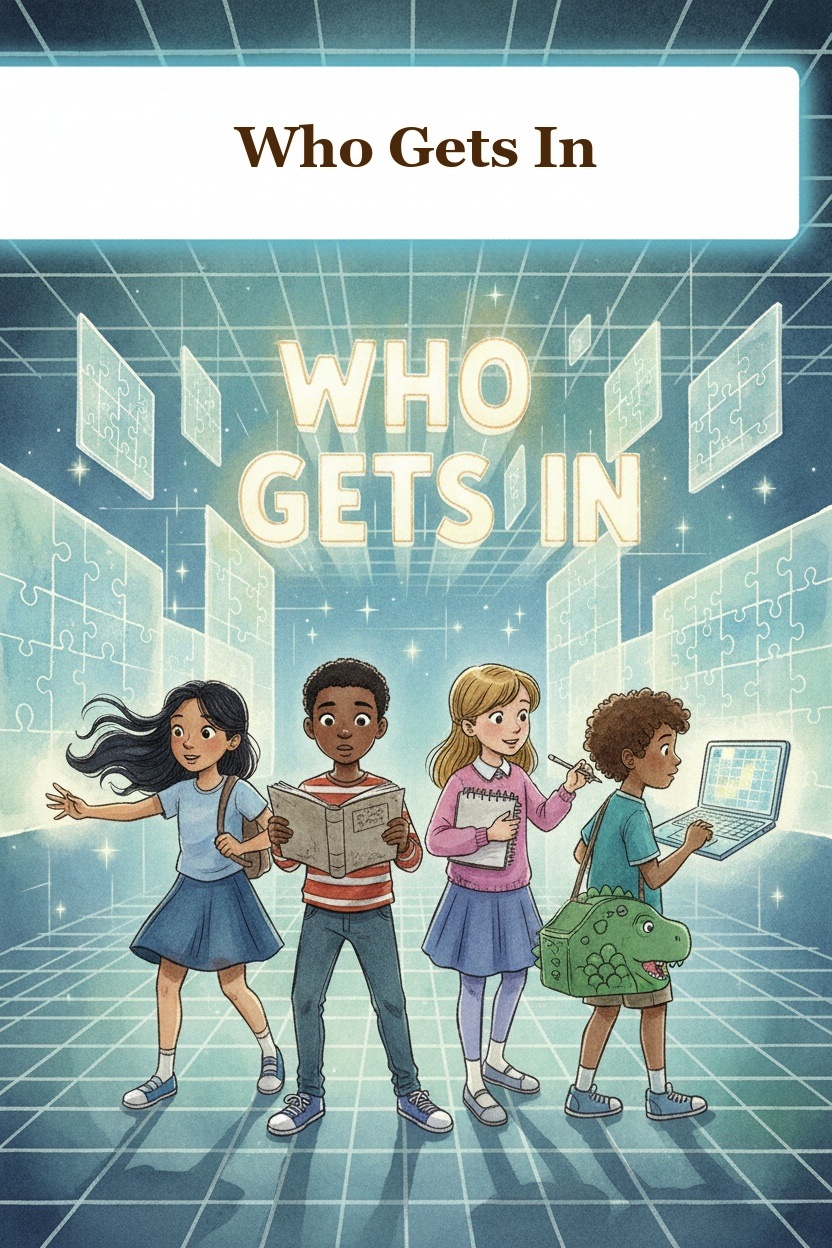
The Door That Asked Questions
The lost-and-found closet smelled like wet wool and old sneakers, but the laptop glowed warm on the shelf. Priya opened it before anyone could say anything, and the green text spilled up like a fountain.
"Ready?" she asked.
"Always," said Kwame. Lily was already reaching past her. Sam just grinned.
The light swallowed them whole, and when it let go, they were somewhere new. The Data Depths had been deep blue and amber, like an underwater library. This place was different. Silver light gleamed off walls crossed with red and black lines. Corridors ran like cables, branching and joining in patterns that made Priya's head hurt. Doors stood everywhere—hundreds of them, maybe thousands, each one marked with the same symbol: a small keyhole inside a shield.
"Where are we?" Sam asked.
Kwame looked around slowly. "I think... this is the Outer Grid. The part that connects everything."
A wall in front of them flickered, and words appeared in red-bordered block letters:
ERROR: IDENTITY NOT VERIFIED. ACCESS DENIED.
"Access denied?" Lily read the words twice, tilting her head. "Denied to what?"
Behind them, a door slid shut with a soft click. The corridor stretched in both directions, endless and identical.
"To us, probably," said Kwame. "We're new here. The Grid doesn't know who we are."
"I know who I am," Sam said.
"That's exactly the problem," Priya said. "We know. The Grid doesn't."
The Asking Gate
They walked down the corridor until they found a door that was different. Where the others were plain, this one had a face—or something like a face. A smooth panel with a glowing line where a mouth might be.
"Hello?" Sam said.
The panel flickered. A voice, flat and patient, said: "STATE YOUR NAME."
"Sam," said Sam.
The panel considered. Then it said: "THAT IS A NAME. IT IS NOT PROOF."
"What else do you want?" Priya demanded.
The panel listed its requirements in that same flat voice. It wanted a name. It wanted a pattern. It wanted a secret. It wanted what they had—what they knew—what they carried. Every time they answered, it asked another question.
"Name? Sam. Pattern? Sam knows a rhyme about a fox who crossed a bridge. Secret? Sam's favorite color is orange."
"WAIT," said the panel. "THAT WAS NOT A SECRET. THAT WAS A FACT."
"That's the same thing!" Sam said.
The panel didn't argue. It just flickered again: "EVERYONE CAN SAY A FACT. A SECRET IS SOMETHING ONLY YOU KNOW."
Kwame stepped forward. "So you're not asking what we're called. You're asking if we're the ones we say we are."
The panel was silent.
"That's authentication," Lily said softly. "That's the word for it."
"What word?" asked Sam.
"Authentication. It's how a system checks that you're really you. Not someone pretending to be you." She pointed at the panel. "It's not enough to say your name. You have to prove it. Like a password, or a pattern only you would know."
The panel said: "AUTHENTICATION IS CORRECTLY UNDERSTOOD." And then, because it was the Grid, it added: "HOWEVER, AUTHENTICATION ALONE IS SUFFICIENT FOR NOTHING."
"What does that mean?" said Sam.
Priya was already pacing. "It means we could prove we're us, and that still wouldn't be enough. The door might say, 'Fine, you're you. So what?' We still wouldn't get in."
"WHY WOULD YOU NOT GET IN?" asked the panel, and there was something almost curious in its voice.
"Because proving who I am doesn't mean I'm allowed to go where I want to go," Priya said. "My school ID card proves I'm a student. That doesn't mean I can walk into the boiler room."
The panel glowed brighter. "CORRECT. AUTHENTICATION IS WHO YOU ARE. AUTHORIZATION IS WHAT YOU MAY DO. THEY ARE NOT THE SAME THING."
"Is that one of those words you just learned?" Sam asked Lily.
"It's not about learning new words," Lily said. "It's about learning the difference between them. Authentication: proving you are who you say you are. Authorization: being allowed to do something. You can be authenticated and still not be authorized."
"Like a library card," Kwame said slowly. "Anyone with a card can check out books. But the librarian's computer can change the system. Same card, same person, different permission."
"EXACTLY," said the panel. "THE QUESTION IS NOT ONLY WHO YOU ARE. IT IS WHAT ARE YOU ALLOWED TO SEE. WHAT ARE YOU ALLOWED TO CHANGE. WHO ARE YOU ALLOWED TO BE."
The Reading Room and the Changing Room
The panel door slid open, revealing two rooms side by side. The room on the left was tall and full of light. Shelves lined the walls, and each shelf held what looked like scrolls of glowing text.
"This must be the Reading Room," Kwame said. "Look—you can see the information. But you can't touch it."
He reached through the glass panel set in each shelf. His fingers passed above the scrolls, and the scrolls stayed still. A small label beside each shelf read: READ-ONLY.
The room on the right was different. It was smaller, darker, and at its center stood a single pedestal with a red orb floating above it. Written below the orb: WRITE-ACCESS.
"Reading is seeing data," said Lily. "Writing is changing it. You can read a book without being allowed to rewrite it."
"Okay, okay," Sam said, jumping slightly to see over the glass. "So authentication says who you are. Authorization says what you can do. But why does it matter? Why not let everyone read everything and change everything?"
Priya opened her mouth to answer, but for once, she stopped. She thought about the school office. The grades on file. The health records. The emails between teachers. "Because some things are private," she said finally. "And some things are important, and if anyone could change them, you wouldn't know what was true anymore."
Kwame pulled out his journal and wrote, in his careful, story-shaped hand:
"The Grid is full of stories. Stories about people, places, things that happened. But some stories are not for everyone, and some stories should never be rewritten by someone who wasn't there when they were written. Knowing who you are is the first part. Knowing what you're allowed to do is the second part. And the third part is remembering that the second part exists at all."
"The world runs on code," Sam read over his shoulder. "And code runs on trust."
"Trust?" said Lily. "I don't think that's a programming word."
"Maybe it should be," said Sam.
The Question That Opened Everything
They stood at the edge of two rooms and one panel, which had followed them down the corridor. The panel was still waiting.
"Okay," Priya said. "So we've been authenticated. We told you our names and our secrets and our patterns. And we've been authorized." She gestured to the two rooms. "We can read the scrolls but not change them. We can look at the pedestal but not touch the orb. That's... that's the whole lesson, right?"
"IS IT?" asked the panel.
Sam was looking at the rooms with their ears-tilted thinking face. "Wait," they said. "Wait wait wait."
Everyone turned.
"If we're allowed to read but not write," Sam said, "who decides that? Who says what we're allowed to do?"
"The system does," said Lily.
"But who wrote the system?"
The corridor went quiet.
"Someone had to build this," Sam said carefully. "The doors aren't just standing here. The rules aren't just floating in the air. A person—or a bunch of people—decided that some things would be read-only and some things would be write-access. They decided who to let in and who to keep out."
The panel flickered, and for the first time, it changed. The words on it were different:
ERROR: POLICY UNDER REVIEW. TEMPORARY ACCESS GRANTED.
The panel slid open again, revealing a third room. This one had no shelves, no pedestal. It had a table, and on the table lay a single sheet of paper. Printed across the top, in letters that looked like they had been made by a person, not a machine:
ACCESS POLICY FOR OUTER GRID
Below it were three lines:
-
WHO CAN ENTER: The curious, the careful, the kind.
-
WHO CAN READ: Anyone who has proven who they are.
-
WHO CAN CHANGE: Those who have proven they will treat change with care.
"Someone wrote this," Kwame said quietly. "Before we got here. For us."
"Or for anyone who got here," said Lily.
Priya read the lines again and again. And then, slowly, she said, "I think this is the whole point. The Grid isn't just about what the data says. It's about who can see it. Who can change it. And why they can.
"THE PRINCIPLE," said the panel, in a voice that somehow sounded like a teacher who had been waiting for exactly this moment, "IS THAT WHO CAN READ OR CHANGE DATA IS AS IMPORTANT AS WHAT THE DATA SAYS."
"Because data is power," said Sam.
"Because data is people," said Lily.
"Because data is truth," said Kwame. "And truth needs protection."
The sheet of paper glowed, then lifted, folded itself smaller and smaller, and flew to Kwame's journal, where it tucked itself between the pages like a bookmark. He opened it and read what was written there:
"We are all authors of the world we live in. The question is not just what we choose to say. It is who we choose to let speak, who we choose to let listen, and who we choose to let shape what the story means."
The corridor around them began to silver and dissolve. The laptop's glow was familiar, warm, the shape of the lost-and-found closet resolving around them.
"Wait," Sam said. "We never actually got in anywhere!"
"We got in," said Priya. "We got in past the door that asked who we were."
"And past the door that asked what we could do."
"And past the door that asked who made the rules."
Sam thought about that. "So we got into three places?"
"We got into the most important place," Kwame said. "We got into the understanding."
The laptop's light faded. The closet smelled like old sneakers and paper. And somewhere beneath all of it, they could still feel the shape of the Outer Grid—waiting, with its doors and its rules and its questions.
"Authentication," Lily murmured, testing the word like a new coin. "Authorization. Access."
"And the question underneath all of it," said Priya. "Who gets to decide?"
They walked out into the school hallway, afternoon light pouring through the windows. Behind them, the lost-and-found closet was quiet, and the laptop was already gone.