The Logic League
The Code to Go Home
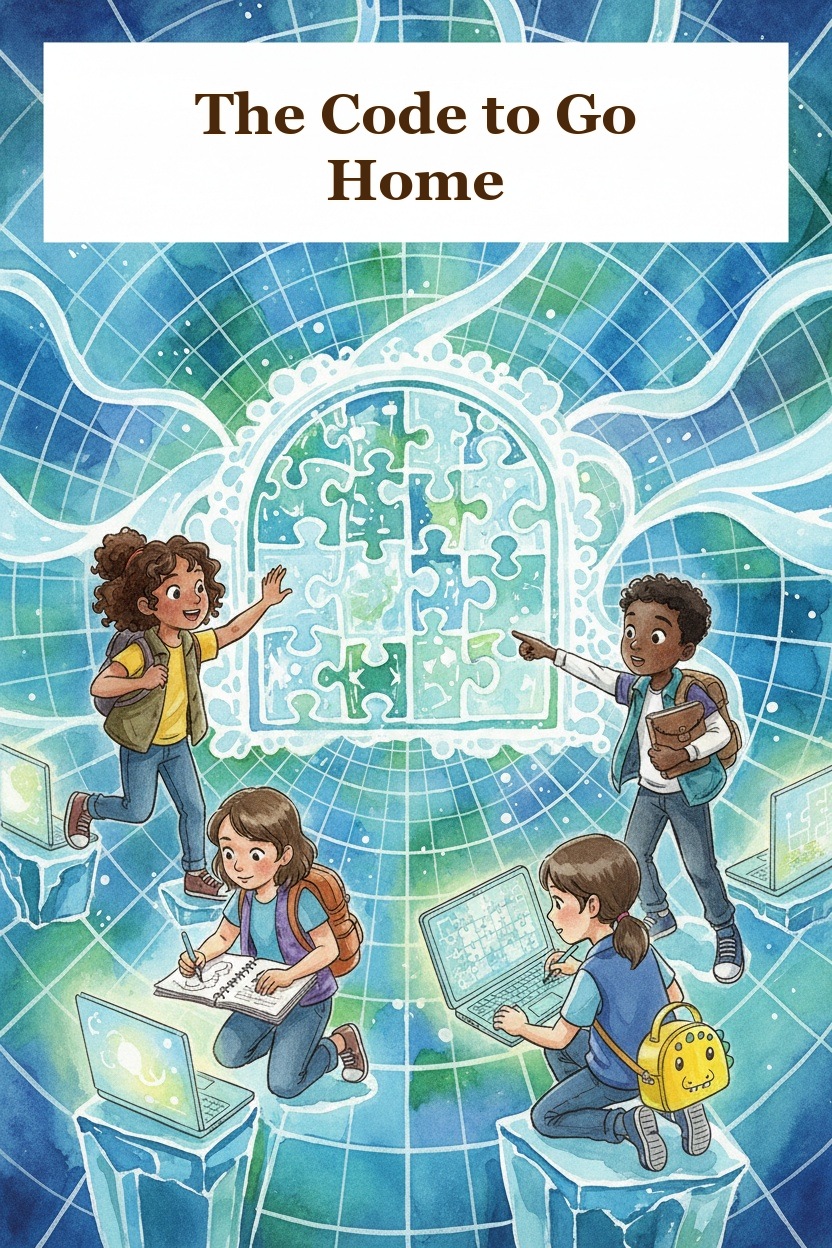
The Portal at the Edge
The Outer Grid hummed with silver light as the four friends stood before the portal. It wasn't a door. It wasn't a gate. It was a blank white rectangle, like a screen waiting for something.
"So that's it," Priya said. "After forty books. After everything. That's the way home."
Lily stepped forward and touched the surface. Nothing happened. She touched it again. Still nothing.
"I don't understand," she said. "We found the portal. We're here. Why isn't it opening?"
Sam walked around the rectangle, peering at its edges. "Maybe it needs a key like the other doors? We got the four Keys from the Entry Zone, the Loop Lands, the Data Depths, and the Outer Grid. Shouldn't that be enough?"
Kwame pulled out his journal and flipped to a blank page. "The Keys got us here. But the portal itself..." He looked at the blank white surface. "Maybe it doesn't want a key. Maybe it wants something else."
Priya was already pacing. "We need instructions. How do we know what it wants?"
As if answering her, words appeared on the white surface:
ERROR: No program detected.
"What's a program?" Sam asked.
Nobody answered. They were all looking at the words.
Writing the Story of the Journey
Kwame sat down and opened his journal to a page he'd been thinking about for a long time.
"I think I know what this is," he said slowly. "A program is like a story you tell the Grid. Not a story in words — a story in steps. Instructions that tell it exactly what to do, in order, so it can follow along."
"But we don't want it to do anything," Priya said. "We want it to open."
"No," Kwame said. "We want it to let us pass through. And to do that, we have to prove we understand how the Grid works. The portal doesn't want a key. It wants us to write the code that describes our journey. The whole thing. Every step."
"The sequence of everything we did," Lily said. "Step by step, in order."
"Exactly."
Sam raised their hand. "So we just tell it everything? Like, all forty adventures?"
"That's too much," Priya said. "We'd be here forever."
"Then what do we write?" Sam asked.
And the question hung in the air like it always did when Sam asked something simple and perfect.
Kwame's face lit up. "We write the structure of the journey. Not every detail — the pattern. The parts that happened over and over. The choices we made. The loops. The things we took with us."
Priya's pacing stopped. "We write the program that is our journey. Not the story of it — the logic of it."
The portal flickered, almost like it was listening.
The Structure of Everything
Lily went first because she always went first with problems now.
"We need to break it into parts," she said. "Like we break any big problem down. What did we do in the Entry Zone?"
"We moved step by step," Kwame said. "We learned that order matters. First one thing, then another, then another."
"Sequence," Lily said. "That's the first part."
She walked to the portal and stood in front of it. She didn't touch it — she just looked at it, hard. The way she looked at anything that was broken.
"Then the Loop Lands," she said. "We did the same thing over and over until something changed. Like the rivers that kept circling until we found the exit condition."
"Loop," Priya said.
"And the Data Depths?" Kwame asked.
"We made choices. If this, then that. If the door is locked AND we have the key, open it. Else, find another way."
"Conditionals," Priya said. "If-then. If-then-else."
"And the Outer Grid?" Sam asked. "What did we do there?"
Lily was quiet for a moment. "We learned to build. To create. We made processes that could be reused. That's what functions are — solutions you package once and use anywhere."
Kwame was writing furiously in his journal. When he looked up, his eyes were bright.
"Sequence. Loop. Conditional. Function. That's the skeleton of every program ever written. That's what we've been learning the whole time. The portal doesn't want us to tell it our story. It wants us to write our story in the language it understands."
The Code to Go Home
But even with the pattern, the portal stayed blank. They needed to put it together — and they needed to do it together.
"We can't just say 'sequence, loop, conditional, function,'" Priya said. "We have to write out what they were."
She started pacing again, but this time it was different — she was building something in her head.
"We need to write it like a recipe. First, the beginning. What do we do first?"
"Open the laptop," Sam said.
The portal flickered.
"Glow," Kwame added. "Follow the light."
The portal began to glow with a soft blue light, just like the laptop in the lost-and-found closet.
Start
Open laptop
Follow glow
Arrive in Grid
The words appeared on the portal's surface as they spoke them. It was working.
"Now the loop," Lily said. "The part that repeated."
"We learned things," Sam said. "Over and over. Every book, we learned something new."
"But that's not a loop," Priya said. "A loop needs a stopping condition."
"Until we understood," Kwame said quietly. "That's the exit condition. We kept learning until we understood."
Loop
Learn new thing
Try to use it
Understand it
Until understanding is true
The words glowed brighter. The portal was warming.
"Now the conditionals," Lily said. "The choices we made."
"If we were lost, we looked for patterns," Kwame said.
"If the path was blocked, we decomposed the problem," Priya said.
"If the answer was wrong, we debugged," Lily said. "We changed one thing at a time and tried again until we found the bug."
If lost: look for pattern
If blocked: break it down
If wrong: debug and try again
"And the function," Sam said. "The thing we do with everything we've learned."
"When we get back," Kwame said, "we teach. That's the function. We turn our learning into something other people can use."
Function teach:
Package what we learned
Share it with others
Return stronger
The portal was fully white now, glowing warm and bright like the laptop screen. The kids stood in front of it, their program complete.
Priya read it back to herself. All of it. The sequence. The loop. The conditionals. The function.
"It's beautiful," she said quietly.
Kwame opened his journal one more time and wrote:
The Grid doesn't teach you rules. It shows you how the rules of the world work — if you're willing to look closely enough. Starting in order, repeating what matters until it sticks, making choices when the path splits, and packaging what you learn so you can carry it with you. That's not just code. That's how you live.
Coming Home
The portal opened — not like a door, but like a screen glowing brighter than the sun, then settling into light the same color as the laptop's glow in the lost-and-found closet.
One by one, they stepped through.
The school smelled like floor wax and old backpacks. The lost-and-found closet was exactly as they'd left it — the same dusty shelves, the same forgotten lunchbox, the same closed door.
The laptop sat on the bottom shelf. Its glow was soft now, like a lamp turned low.
Kwame reached to close its lid. But Sam stopped them.
"Wait," Sam said. "I have a question."
Priya made her face. The one that said, I can't believe you have another question. But she waited. They all waited.
"The portal opened because we wrote the program," Sam said. "But that means the Grid was ready for us the whole time. That's why the laptop found us, right? It didn't pick us by accident."
Kwame looked at the laptop. "We were ready to learn. That's what the Grid does — it finds people who are ready to think."
Lily reached down and closed the laptop gently.
"Ready to think," she repeated. "And ready to go home when we understood how."
The laptop's glow faded. When they looked again, it was just a laptop — closed, quiet, waiting on the bottom shelf of the lost-and-found closet.
"Does this mean we won't see it again?" Sam asked.
But nobody answered. Because in the final moment before the glow disappeared entirely, they all saw something — a tiny blinking cursor at the corner of the screen, patient and waiting. Not saying goodbye. Just saying: until next time.