Just Like Me
My Special Thing About Trains
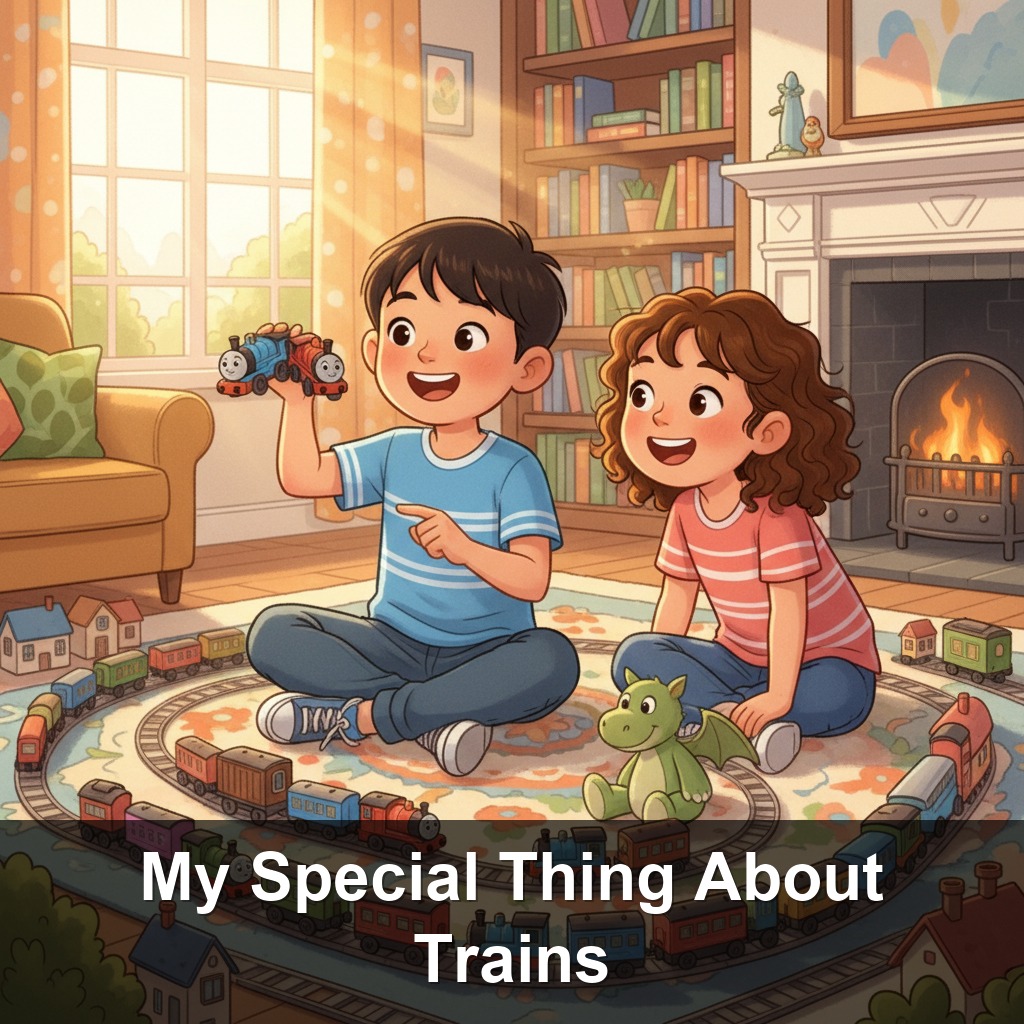
Sam sat on the living room floor with Jordan, both of them surrounded by Sam's train collection. Not the tracks—those were in a special box, sorted by size. Today was about the trains themselves.
"Why do you have two of the same one?" Jordan asked, pointing to two nearly identical blue engines.
Sam's hands paused over the train in their lap. "They're not the same."
Jordan tilted their head. "They look the same."
"No." Sam picked up both trains, one in each hand. "This one is the Northern Pacific 1861. It has a 4-6-2 wheel arrangement." Sam turned the other train around. "This is the Southern Pacific 2472. It has a 4-6-2 wheel arrangement too, but the boiler is thirty-three inches longer, and the tender has curved sides instead of straight ones."
Jordan blinked.
"Also," Sam continued, "the 2472 made its first run in 1928. The 1861 was built in 1902. That's twenty-six years apart. Sound." Sam held both trains to their ears and shook them gently. "The 2472 rattles. The 1861 doesn't."
Jordan leaned closer, listening. "I can hear it!" Jordan said. "It does rattle!"
Sam smiled. It was a small smile, but it was real.
Jordan pointed at another train, a sleek silver one. "What about that one?"
Sam's whole body shifted. They sat up straighter. Their voice got quicker, brighter, like a switch had been flipped. "That's the Flying Scotsman. It's famous. It was the first train to officially go one hundred miles per hour, in 1934. But before that, in 1928, it did something even more important." Sam paused for effect. "It was the first train with a corridor tender."
"A corridor what?"
Sam pulled the train closer, running a finger along its side. "The tender is the part that holds the coal and water, behind the engine. Normally, the crew could only get to the cab by climbing around the outside while the train was moving. But the Flying Scotsman had a corridor through the tender so the crew could walk from the cab to the train without going outside. That meant they could change crews without stopping."
Jordan's eyes went wide. "They could swap drivers while going fast?"
"Ninety miles per hour," Sam corrected gently. "But yes."
"Whoa."
Sam's hands moved in the air now, drawing shapes Jordan couldn't see but Sam could. "The steam pressure builds up in the boiler. The pistons push, and the wheels turn. It's like—" Sam paused, searching for the right words. "It's like a giant metal heart, breathing. Chuff, chuff, chuff. And when it goes through a tunnel, the whistle bounces off the walls and comes back. It doesn't sound the same outside as inside."
Jordan sat cross-legged, chin on hands. "You really know everything about trains."
Sam stopped. The air went still. Sam's hands dropped to their lap. "I'm talking too much," Sam said quietly. "Sorry. I know I do that."
"Why are you sorry?"
Sam looked up. Jordan's face wasn't scrunched up or impatient. Jordan just looked... interested.
"People tell me I talk too much about my things," Sam said. "They say I get too excited."
"Who says that?"
"People."
Jordan picked up the Flying Scotsman and turned it over carefully. "I think it's cool. I didn't know any of this. I thought trains were just trains." Jordan held it up. "You make them sound like stories."
Sam's chest did something funny. It felt warm. Like holding a mug of hot chocolate on a cold day.
"Do you want to know how the signal system works?" Sam asked, and even Sam could hear the hope in their own voice.
"YES," Jordan said.
For the next twenty minutes, Sam explained everything. About semaphore signals and how they used to be pulled by cables. About how a red light doesn't always mean stop—it depends on the shape of the arm. About how train wheels make that click-clack sound because of the gaps in the rails, and why the gaps have to be there for the metal to expand in summer.
It was the most Sam had ever said at once. And Jordan listened the whole time. Leaning in. Asking questions. Laughing at Sam's joke about the train that had to stop because of a cow on the tracks (Sam was very careful to explain that the cow was fine).
At the end, Sam looked down at their hands. They were shaking a little. They always shook when they talked about their thing, like the words needed to escape faster than Sam's body could carry them.
"I'm not usually this loud," Sam said.
"You're not loud," Jordan said. "You're you."
Sam frowned. "What does that mean?"
Jordan shrugged. "You smile more when you talk about trains. You move your hands. You look..." Jordan thought about it. "You look like you're at home."
Sam thought about that. At home. Not in the house. In their own body.
"Oh," Sam said. "I like that."
"Can you show me the yellow one?"
Sam looked at the yellow train and then back at Jordan. "There's something important about this one. It has a special nickname."
"What is it?"
"Old Rusty."
Jordan laughed. "Why?"
Sam was already launching in—boilers, rust coatings, why some trains turn orange and others turn brown—and Jordan sat forward, ready to hear every single word.
When Sam's parent came in later to check on them, they found Sam and Jordan side by side, both of them holding trains up to their ears, listening for rattles.
"Winchester No. 12 rattles," Jordan announced proudly.
"Very good," Sam said. "It's a very old model. The rivets are loose."
Sam's parent smiled and slipped out without interrupting.
On the walk home, Jordan said, "Teach me more tomorrow?"
Sam nodded, and the warm feeling came back.
"Definitely," Sam said. And they meant it.
Author's Note for Parents and Readers: This book is about special interests—the things that light up a child's whole body with excitement. For many autistic children, these interests aren't hobbies; they're doorways to safety, joy, and connection. When we take them seriously, we're not just tolerating a child's passion—we're honoring how they make sense of the world. A child who shares their special interest is sharing a piece of their heart. That's worth asking about.