The Number Kingdom
The Fraction Race
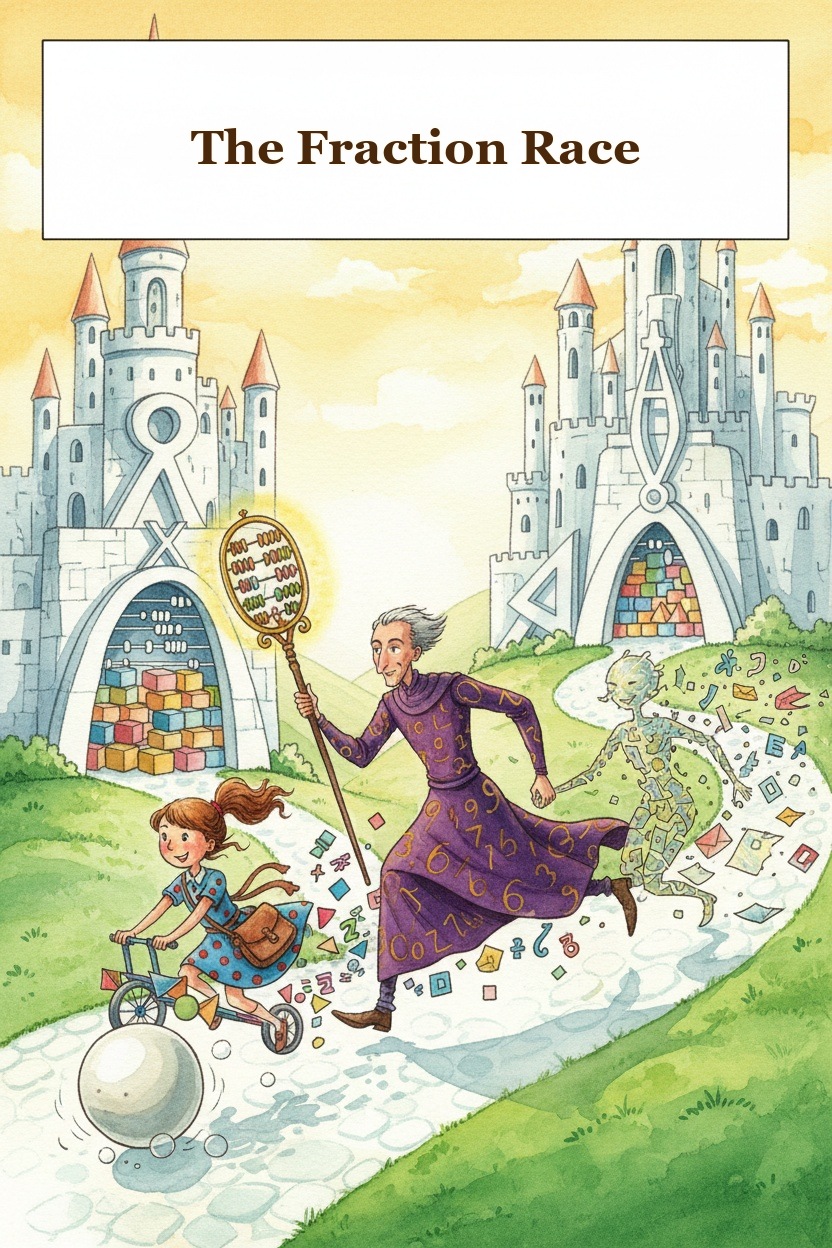
The Announcement in the Highlands
The morning sun spilled gold across the Fraction Highlands, where the mountain roads curved in smooth, careful arcs and the bridges stretched between peaks like ribbon. Mira stood at the edge of the Valley of Comparison, her ponytail whipping in the wind, her satchel thumping against her hip.
She had been called here by the Count himself, who stood waiting at the valley's rim with his abacus staff planted firmly in the earth. His robes shifted with their pattern of moving numerals—today, they seemed to be arranging themselves into fractions.
"Right," Mira said, tightening her satchel strap. "Let's see what's broken."
The Count inclined his head. "The crisis is as follows, Mira of the Number Kingdom. The Royal Race of the Highlands is to be run today—a tradition older than the counting districts themselves. The winner receives the Golden Sliver, a prize that has not been awarded in living memory."
Mira looked around. The valley stretched before her, marked with two long tracks that curved side by side, their starting line painted crisp and white. At the finish line, far below, she could see something glittering—a thin wedge of gold set upon a pedestal.
"And the problem?" Mira asked.
"The problem," said a voice like a popped bubble, "is that I am running the race."
The Remainder materialised between them—a shimmering shape assembled from half-finished numbers and leftover pieces. Today it looked like a small, sharp-edged triangle with two spindly legs and an enormous grin.
"I have entered my champions," the Remainder announced, gesturing grandly at the starting line. "And I am certain they will win. Absolutely, mathematically, undeniably certain."
Mira walked to the edge of the valley and peered down at the starting line. Two creatures stood there, shifting and fidgeting. One was a flat, wide shape painted in thirds—three equal segments, two of them glowing bright blue. The other was slightly smaller, divided into fourths, with three of its four parts glowing warm orange.
"The racers!" the Remainder declared. "Two-thirds and three-fourths! Both fine fractions, both ready to run, both certain the Golden Sliver belongs to them!"
Mira studied them. Two-thirds looked confident, shifting its weight from segment to segment. Three-fourths stood quietly, its three lit segments humming with readiness.
"But who is faster?" the Remainder asked, its grin widening until it nearly split its triangular face. "Who runs the greater distance? The larger fraction wins the Golden Sliver. That's the rule! The bigger one gets the prize!"
The Count stepped forward. "The Royal Charter of the Highlands states that the Golden Sliver shall go to the greater fraction. The Remainder has interpreted this as a straightforward matter of which fraction is larger."
"And it is straightforward!" the Remainder crowed. "Three-fourths has a four! Two-thirds has a three! Four is bigger than three, so three-fourths is bigger! Ha! The race is over before it begins!"
Mira blinked. "That's... not how it works."
"OH NO?" asked the Remainder, delighted.
"No," Mira said firmly. "The denominator—the bottom number—tells you how many parts make a whole. It doesn't tell you how big the fraction is. If you split something into four pieces, each piece is smaller than if you split it into three."
The Remainder tilted its pointy head. "Interesting theory. Prove it."
Mira reached into her satchel and pulled out a piece of paper and her worn pencil.
"Right," she said. "Let's think."
The Star Paper
Mira's fingers brushed against something smooth—a folded stack of star-shaped papers the Head Baker had given her in Book 13, when they were working on the Fraction Kitchen. She pulled one out and unfolded it.
"A star," the Remainder observed. "How festive."
"It's a whole," Mira said, holding it up. "One complete star. If I cut it into three equal pieces—"
She folded the star carefully, using the lines the Head Baker had shown her, and cut it into thirds. Three slim, equal pieces fanned in her palm.
"Each of these is one-third," she said. "Two-thirds is two of them."
She set those aside and unfolded another star.
"Now," she said, folding it differently, "if I cut this one into four equal pieces..."
Three-fourths of the second star lay in her palm, its pieces smaller and thinner than the first batch.
"Wait," Mira said, holding them up side by side. She frowned. "Two pieces of one star versus three pieces of another—that's not a fair comparison. They're from different wholes."
The Remainder clapped its spindly hands. "Oh, wonderful! The great detective, confused! And so early in the day!"
Mira ignored it. She laid the two-thirds pieces in a row at the bottom of her paper and the three-fourths pieces above them, drawing a line to mark where each group ended.
"Different wholes are a problem," she said slowly. "If the wholes are different sizes, the fractions can't be compared. But in the Race, both fractions are running the same track. The whole is the same."
She drew a long rectangle on her paper. "Let's pretend this is the race track. One whole track."
She divided the rectangle into three equal sections and shaded two of them.
"Two-thirds of the track."
Below it, she drew another identical rectangle and divided it into four equal sections, shading three.
"Three-fourths of the same track."
She stepped back and studied her drawing. The shaded parts didn't line up—the lines were different, the pieces different sizes. It was still hard to tell.
"Same wholes," she said, "but different-sized pieces. It's like comparing apples and... well, apples cut into different numbers of pieces. I need a better way."
The Remainder leaned over her shoulder, dripping glee. "Perhaps you should just accept my genius and hand over the Golden Sliver now?"
"Not yet," Mira said. "I have another idea."
The Common Ground
Mira flipped her paper over and drew two more identical rectangles.
"If I cut one into thirds and the other into fourths, the pieces are different sizes," she said. "But what if I cut both into pieces of the same size?"
The Remainder squinted. "Same size? How? Three and four don't go together—they don't share anything!"
"They don't share a factor," Mira said. "But they don't need one. I can find a number that both three and four divide into evenly."
She tapped her pencil. "Three, six, nine, twelve..."
"Four, eight, twelve," the Remainder finished, its voice dropping to a curious murmur. "Twelve."
"Twelve," Mira agreed. "If I take the two-thirds track and cut each third into four smaller pieces—"
"Wait," the Remainder said. "You can't just cut things. Math doesn't work like paper."
"Fractions do," Mira said. "That's the beautiful part. I'm not changing the fraction—I'm just cutting it into smaller pieces. Two-thirds is the same amount whether it's two big pieces or eight small ones."
She drew it. The top rectangle, originally divided into three pieces, now had lines cutting it into twelve equal parts, with eight of them shaded.
"Two-thirds is equal to eight-twelfths. Because I multiplied both the numerator and the denominator by four—two times four is eight, and three times four is twelve."
She underlined the numbers. "I didn't change the amount. I just changed how finely it was cut."
Below it, she took the three-fourths track and divided each fourth into three smaller pieces.
"Three-fourths is equal to nine-twelfths. Three times three is nine, and four times three is twelve. Same track, same fineness of cut."
Mira straightened. "Now I can compare them. Eight-twelfths versus nine-twelfths. Nine-twelfths is bigger."
"Because when the denominators match," the Count said quietly, "only the numerators need be compared."
The Remainder stared at the paper. Its triangular face went through an extraordinary sequence of expressions—outrage, curiosity, disbelief, and then, unexpectedly, something that looked almost like respect.
"There is a problem with your proof," the Remainder said.
Mira braced. "Which is?"
"You used multiplication. Multiplication is performance-enhancing. Of course you get the results you wanted—you did the math."
Mira laughed. "That's how math works. You do it, and you get the answer."
"Oh, very well. But I still don't fully believe it. Show me again. Show me differently."
Mira considered. Her pencil hovered over the paper.
"All right," she said. "Let me show you something a bit sneakier."
The Halfway Trick
Mira turned to a new page. She drew two rectangles.
"What's a good reference point?" she asked. "A fraction I can compare both of them to?"
"Mmm," the Remainder said, "I'm not in the habit of helping."
"Half," Mira said anyway. "One-half. We already know two-fourths is the same as one-half, and I can see from my drawing that two-thirds is more than half—there's more than half the rectangle shaded in." She shaded the second third just past the halfway line. "Three-fourths is also more than half—three out of four pieces, and each piece is half of half. Three-quarters is exactly one quarter over half."
"Both more than half," the Remainder said. "A dead end! HA!"
"Wait," Mira said. "But are they more than half by different amounts?" She studied her rectangles. "Two-thirds is only a little bit more than half—just that little sliver past the halfway mark. One-sixth more, actually, because two-thirds minus one-half is one-sixth. But three-fourths is one-fourth more than half."
"One-fourth is bigger than one-sixth," the Remainder said slowly.
"So if three-fourths is further past the halfway point than two-thirds is," Mira said, "then three-fourths must be bigger."
The Remainder was silent.
"Also," Mira said, "I can compare them to one. Three-fourths is only one-fourth away from being a whole. Two-thirds is one-third away from being a whole. One-fourth is a smaller distance to go than one-third is, which means three-fourths is closer to one, which means it's bigger."
"Hm," said the Remainder.
"Hm," agreed Mira.
"Hm," said the Count, which was, from him, an explosion of enthusiasm.
"That's clever," the Remainder admitted. "Comparing them to something you already understand. I admire that. Truly. And yet—"
It leaned closer, its triangle-point nose nearly touching Mira's paper. "Why three-fourths and two-thirds specifically? They're such fiddly numbers. Why do you insist one is bigger than the other? If you ask me, they're both running the race. Why not let them run?"
"The track is the same," Mira said patiently. "They're running the same race. If they both run the full track, they cover the same distance, and the race is a tie. But that's not what's happening here—they're representing fractions. Which fraction is greater gets the Golden Sliver. They're not running at each other. They're running to show which is larger."
"HA!" The Remainder spun in a little circle. "A race to be larger! But if they both run the whole track, they're both the same size! The track is ONE. The whole is ONE. And they're parts of the whole."
It stopped spinning. "Unless... the race is not a full track."
Mira blinked. "Not a full track?"
"I may have altered the track length," the Remainder admitted, suddenly looking shifty. "A slight underestimate. A subtle miscalculation. The track is exactly the length that one of the fractions will complete—and one will not."
The Count's staff struck the ground. "The track is the whole distance between the starting line and the Golden Sliver. If a fraction cannot span the full distance—"
"—then it loses," the Remainder said. "That's the race! That's the whole point! Fractions have to be big enough to reach the finish. Small ones dry up and get left behind!"
Mira looked at the track with new eyes. "Then the race isn't between two equal things. The race is about which fraction covers the distance to the Golden Sliver. If three-fourths is larger, then three-fourths will reach the finish while two-thirds falls short. The track is the comparison—not the fractions."
She picked up her paper. "We already proved it. Three-fourths is bigger. Three-fourths wins."
"Did you though?" the Remainder asked, but its voice had lost its glee. It sounded genuinely curious now. "You proved it with multiplication. You proved it with benchmarks. But here, in the real world, on a real track, with real fractions—do you think it will hold? Are you willing to race for it?"
Mira looked at the Count. The Count looked at the Remainder.
"I am," Mira said.
The Golden Sliver
The sun had climbed higher by the time Mira reached the starting line. Two-thirds and three-fourths stood waiting, their parts shimmering with excitement.
"Racers," Mira announced, "this track has been set to the exact distance of one comparison—not to a full whole, but to the distance that matters. The winner is the fraction that reaches the Golden Sliver. The larger fraction, as measured by the Royal Charter, is the fraction that can span the full distance."
Three-fourths shuffled its segments. "So the track is—?"
"The length of the larger fraction. The length of three-fourths of the Golden Sliver's pedestal."
"Not a full whole?" Two-thirds asked, sounding frightened. "But then I have to be—"
"Big enough," Mira said. "Or not. That's the nature of comparison. Some fractions are bigger than others. That's fair."
The Remainder drifted to the starting line, materialising a flag in its spindly hand. "Shall we?"
Mira nodded. "On your marks..."
The fractions leaned forward.
"Get set..."
Two-thirds seemed to stretch, its two lit pieces thickening as if trying to grow. Three-fourths stood steady, its three pieces spreading evenly, ready to cover ground.
"GO!"
Three-fourths moved smoothly and steadily, its three parts flowing across the track like water, covering the distance in clean, even strokes.
Two-thirds fought. Its two parts stretched and strained, but there was a gap, a thin shrinking space between its second piece and the finish line. It scampered and scrambled, but it couldn't quite spread far enough.
Three-fourths reached the pedestal first. Its third segment touched the Golden Sliver with a soft, musical chime, and the prize slid free, catching the light and throwing rainbows across the valley.
Two-thirds stopped at the finish line, its edge just short, panting and flat.
"I'm... not... big enough," it said, and there was genuine sadness in its voice.
Mira knelt beside it. "You're a whole fraction of a different whole," she said gently. "Two-thirds of a larger whole can be bigger than three-fourths of a tiny one. It's not about being big or small overall. It's about what whole you're part of, and how much of it you cover."
"But today," the Remainder said, floating close, "with this whole, on this track, three-fourths is larger. And that is—"
It paused.
"That is correct," the Remainder said, and there was something strange in its voice. It sounded almost proud.
"Three-fourths is larger than two-thirds," Mira said. "Even though four is a bigger number than three. The denominator is how many parts you split the whole into, not how many parts you have. Three out of four is a bigger share than two out of three."
"I knew that," the Remainder muttered. "I simply hoped you couldn't prove it."
Mira picked up the Golden Sliver. It was warm in her hand, a thin, perfect wedge.
"The prize," she said, "belongs to three-fourths."
Three-fourths glowed. Two-thirds sighed, but then Mira stepped forward.
"However," she said, "the Royal Charter says the Golden Sliver goes to the larger fraction because the larger fraction demonstrated greater size. But you weren't faster, three-fourths. You were larger. The race was a comparison, not a speed test. And while three-fourths is indeed the winner—"
She looked from three-fourths to two-thirds.
"—both of you are real numbers. Both of you represent true amounts. Two-thirds of a pie is still pie. Three-fourths of a plate is still a meal. The comparison doesn't make one of you irrelevant."
The Remainder floated to her shoulder, its pointy head cocked. "Are you proposing a tie?"
"No," Mira said. "I'm proposing a snack."
She drew a circle in the dirt with the toe of her boot—a perfect whole—and divided it into four equal parts.
"Three-fourths," she said, drawing a line past three of them, "is this much."
Then she drew another circle, larger, and divided it into three.
"Two-thirds of a bigger whole," she said, "can be bigger than three-fourths of a smaller one. That's the magic of fractions. They're not absolute. They're about relationships. And that's not a failure."
The Remainder was quiet for a long moment.
Then, very softly: "Yes. That's what I've always thought."
The Count stepped forward, his abacus staff clicking. "Mira of the Number Kingdom, you have determined the larger fraction through three separate methods: common denominators, visual models, and benchmark comparisons. The Golden Sliver is correctly awarded to three-fourths. The remainder of the matter is yours."
Mira held out the Golden Sliver. "To the winner."
Three-fourths accepted it, its segments glowing. "But what about two-thirds?"
Mira smiled. "Two-thirds can have a bigger whole next time. That's the thing about fractions. There's always another whole."
In the shade of the valley, Zero appeared—small, silver, perfectly round, having been utterly unremarkable in the background all along.
"I noticed," Zero said quietly, "that you didn't need me at all today."
Mira looked at it. "You were here."
"I watched," Zero said. "That's a useful property of zero. Taking up no space while paying close attention."
The Remainder laughed—delighted, surprised. "That's a new one."
"Oddly accurate," the Count observed.
Mira tucked her papers back into her satchel. She looked at the two fractions, now sitting together at the finish line, sharing the shade of the Golden Sliver's pedestal.
"I wonder," Mira said, "if there's a fraction even bigger that can beat three-fourths. Five-sixths, maybe."
The Remainder's eyes widened. "Five-sixths? Five out of six? Why, that's—that's almost a whole! That's almost everything!"
Mira grinned. "Looks like we're going to need another race."
"Yes," Zero said softly. "That tends to work."