Professor Plunks Impossible Lab
The Pressure Problem
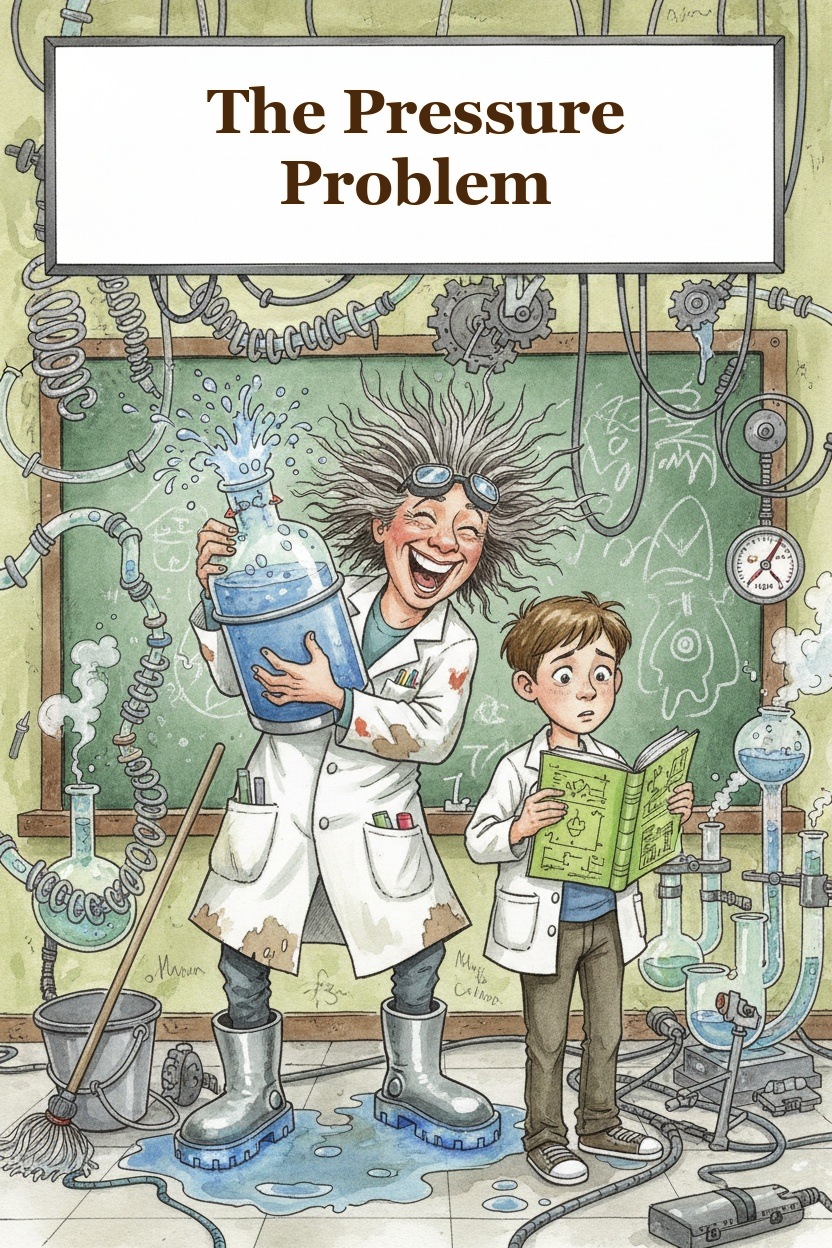
Chapter 1: The Very Important Announcement
Otto Finch was sorting his coloured pencils by exact shade gradient when the lab door burst open with its usual dramatic flair.
"MAGNIFICENT NEWS, MY CAREFUL COLLEAGUE!"
Otto looked up. Professor Plunk stood in the doorway wearing her lab coat (three new burn marks since Tuesday), her goggles on her forehead, and an expression of absolute certainty that Otto had learned to recognize as the beginning of trouble.
"We are going to demonstrate PRESSURE!" she announced, spreading her arms wide. "The invisible force that shapes our world!"
Otto opened his notebook to a fresh page and wrote in his careful handwriting:
Tuesday, 10:15 AM. Professor Plunk has announced a pressure experiment. I have concerns.
"So we're going to use—" Otto began.
"THE CHAIR!" Plunk interrupted, pointing dramatically at something behind Otto.
Otto turned. There, in the middle of the lab, sat a perfectly ordinary wooden chair. It had four straight legs, a flat seat, and no visible cushioning.
"That's just a chair," Otto said.
"It's not just a chair! It's the Pressure Demonstration Apparatus, Mark One!" Plunk patted it fondly. "Today, we will prove that pressure is simply force divided by area. I will sit on this ordinary chair, and nothing will happen, because my weight is spread across four sturdy legs. Four! And the seat itself!"
Otto wrote:
Prediction: Something will happen.
"Let me be clear about the physics," Plunk continued, pacing around the chair. "Pressure equals force divided by area. P equals F over A. The force is my weight. The area is the surface it presses on. Watch!"
She swept her coat aside and sat down with a confident flourish.
The chair wobbled.
Otto leaned forward.
Nothing else happened.
"See!" Plunk beamed. "The area of the seat supports me perfectly. The legs spread the force to the floor. It's simple physics!"
Otto wrote:
Experiment one: successful. Suspiciously successful.
"NOW," Plunk said, rising with a gleam in her eye, "let's make it interesting!"
Chapter 2: The Nail Problem
Otto's heart sank in the way it had learned to sink over the past four books. "Interesting how?"
Plunk led him to the workbench and swept aside a cloth, revealing something that made Otto's stomach drop.
It was a board covered in nails. Not a few nails. Dozens of nails. Hundreds of nails. They stuck up from the board like a metal porcupine that had decided to become a weapon.
"Behold!" Plunk declared. "The Nail Bed of Scientific Inquiry!"
Otto counted the nails. Then he stopped counting because there were too many. "Where did you get that?"
"I made it!" Plunk said proudly. "In preparation for this very experiment!"
Otto opened his notebook.
The professor has constructed a board of nails. She seems pleased. I am doing math.
"How many nails are on that board?" he asked carefully.
"One hundred and forty-four!" Plunk said cheerfully. "Now, here's the beautiful thing about pressure, Otto. One nail pressing on my hand would hurt a great deal. The force of my hand would be concentrated on one tiny point. That means HUGE pressure!"
She picked up a single nail and pressed it gently into her palm. "Ouch! See? Force divided by tiny area equals big pressure!"
Otto wrote:
Confirmed: one nail is painful. We have established this.
"But with ALL these nails," Plunk gestured to the board, "my hand's force spreads across one hundred and forty-four points. The force per nail becomes tiny! I can press on the whole board and feel almost nothing! It's the same reason fakirs can lie on beds of nails! Well, with many more nails, but the principle—"
"The principle being that spreading force over a larger area reduces pressure," Otto said slowly.
"EXACTLY!" Plunk beamed. "You've got it, my careful colleague! So I will demonstrate this dramatic truth by sitting on the Nail Bed of Scientific Inquiry, and my weight will spread across all one hundred and forty-four nails, and I will be completely fine!"
Otto looked at the board. He looked at Professor Plunk. He looked at the ordinary chair.
"Why not just sit on the chair?" he asked.
"The chair is boring! The chair doesn't demonstrate anything! The chair is a SITTING APPARATUS, not a PRESSURE APPARATUS!" Plunk was already dragging the nail board toward the center of the room. "Don't you see, Otto? This will show pressure viscerally! Dramatically! Unforgettably!"
Otto wrote in his notebook:
The professor is about to sit on nails. This was not in my predictions. I had predicted a balloon, perhaps, or a plastic bottle. Nails were not in the prediction. THIS WAS NOT IN THE PLAN.
Chapter 3: The First Demonstration
"Watch closely!" Plunk announced, positioning herself above the nail board.
Otto covered his eyes with one hand but left a gap between his fingers. Science required observation.
Plunk lowered herself onto the board.
For one beautiful moment, the nails held her, one hundred and forty-four tiny points distributing her weight perfectly.
Otto exhaled.
"HA!" Plunk cried. "You see! The force spreads across—"
And then Professor Plunk sneezed.
It was not a gentle sneeze. It was a Professor Plunk sneeze, the kind that knocked papers off walls and made the building's windows rattle. She jolted, shifted her weight, and suddenly the force of her body concentrated on the wooden frame of the board instead of the nails.
There was a crack like a tree branch failing.
The frame splintered.
Plunk's weight crashed through the center of the board, collapsing the nails into a crumpled metal pancake beneath her. She hit the floor with a sound like a bag of hammers landing on a bag of potatoes.
Otto was on his feet. "Professor!"
From the wreckage, Plunk raised a hand. There were nail-shaped dents in the wood around her, but she was unharmed.
"WELL!" she declared, her voice slightly muffled from the floor. "That demonstrated pressure rather more vividly than I intended!"
Otto helped her up. "What happened? The nails should have held you!"
"The NAILS held me!" Plunk said, examining the wreckage with professional interest. "But when I sneezed, my weight shifted onto the FRAME—the wooden edges between the nails. The frame's area was much smaller than the combined area of all the nail tips! So the pressure on the frame spiked dramatically, and the wood couldn't take it!"
Otto wrote:
The pressure problem: force must spread across area. When the area shrank, the pressure grew. The frame broke. The professor is fine. The nails are not fine.
"But the experiment was a success!" Plunk announced, dusting off her lab coat. "We proved the principle! Pressure equals force divided by area! When you reduce the area, the pressure goes up!"
Otto looked at the mangled nail board. "And when you reduce the nails, the board goes down."
"EXACTLY!" Plunk beamed. "You're learning! Now, for the second demonstration!"
"There's a second demonstration?"
"Of course there's a second demonstration! We haven't done the OUTDOOR portion of the experiment yet!" Plunk was already heading for the door, her boots clanking on the floor. "This way, my careful colleague!"
Chapter 4: The Snowshoe Situation
The outdoor portion of the experiment turned out to be a field near the lab, where Gloriana had—without being asked—laid out a long strip of soft, fresh mud.
Otto looked at Gloriana. Gloriana looked at Otto. She nodded once, slowly, as if to say, I knew it would come to this.
"Observation one!" Plunk called, already striding toward the mud. "I will walk across this mud in my ordinary boots and demonstrate what happens when force is concentrated on a small area!"
Otto grabbed his notebook and ran after her. "Wait—are you sure the mud is—"
But Plunk was already walking. Her first step sank immediately. Her boot disappeared into the muck with a wet, sucking sound. Her second step sank deeper. By the third step, the mud was up to her ankles, and by the fourth, she was stuck entirely, her boots firmly planted, her arms waving for balance.
"MUD!" she announced, as if this were a discovery rather than an obvious fact. "MY BOOTS ARE STUCK! THE PRESSURE OF MY WEIGHT IS CONCENTRATED ON THE SMALL AREA OF MY BOOT SOLES, AND THE MUD CANNOT SUPPORT ME!"
Otto stood at the edge of the field. "Should I find a rope?"
"NOT YET!" Plunk pulled one foot free with a massive schlurp and took another step. She sank again. "Observe! The area of my boot is small, so the pressure is high, so I sink! This is why—"
She paused, staring down at the mud.
"This is why ANIMALS with heavy bodies have BIG feet!" Otto said, catching on. "Elephants have huge feet. Camels have wide toes. Their weight spreads out!"
"AND THIS IS WHY SNOWSHOES EXIST!" Plunk's face lit up. "Exactly! But I, being a physicist, will now demonstrate the SOLUTION!"
She waved toward Gloriana, who produced—from her apparently infinite tool belt—two wooden snowshoes, each roughly the size of a small pizza.
Otto's eyes went wide. "Wait. You're going to—"
Plunk strapped the snowshoes to her boots. "With these, my weight spreads across a much larger area! The pressure on the mud will drop dramatically! I will walk across without sinking! WATCH!"
She stepped back onto the mud.
The snowshoes spread her weight perfectly. She did not sink. She took another step, then another, walking across the field with the ease of a duck crossing a pond.
"SEE!" she cried, arms spread wide in triumph. "The pressure is reduced because the area is increased! P equals F over A! Same force, more area, LESS PRESSURE!"
Otto scribbled in his notebook:
Snowshoes work. The professor is walking on mud. This is not a disaster. I am suspicious.
And then Professor Plunk decided to demonstrate how well the snowshoes worked by attempting a celebratory jump.
Chapter 5: The Splash
"Professor, I wouldn't—!" Otto called, but it was too late.
Plunk leaped into the air with the enthusiasm of a woman who had just proved a physics principle. For a single, beautiful moment, she hung suspended above the mud field in her snowshoes, weightless and triumphant.
Then she landed.
The snowshoes hit the mud with twice the force she had applied when walking. The mud, which had been supporting her perfectly at normal pressure, now received a sudden spike of force concentrated on exactly the same area.
P equals F over A.
Otto watched the math happen in real time.
The mud gave way. Both snowshoes plunged downward with a sound like a sighing whale, and Professor Plunk disappeared up to her waist, one snowshoe perpendicular to the ground, the other pointing at the sky, and her lab coat draped over the mess like a flag of surrender.
There was a pause.
"MUD!" Plunk's voice echoed from the hole.
Otto sighed and opened his notebook.
Observation: Jumping in snowshoes increases the force at the moment of impact. Same area, bigger force, bigger pressure. The mud did not appreciate the physics.
Gloriana walked past him, carrying a very long rope.
"Did you know she was going to jump?" Otto asked.
Gloriana paused. She looked at the mud hole containing Professor Plunk. She looked at Otto. She said, "Told her so."
Otto helped Gloriana pull Plunk free. The professor emerged covered in mud from her waist down, her goggles somehow still on her forehead, and her hair pointing in seven different directions.
"WELL!" she declared, wiping mud off her chin. "That demonstrated the relationship between force and area rather more vividly than I intended!"
Otto helped her out of the snowshoes. "You didn't sink when you were walking," he said. "The snowshoes worked. The pressure was lowered, the area grew, and you stayed on top of the mud. And then... you jumped."
"I added FORCE!" Plunk said, delighted. "I increased the force without changing the area! And the pressure went up! P equals F over A—if you want LESS pressure, you need MORE area OR LESS force. And if you want MORE pressure, you need MORE force OR LESS area!"
"Right. But also, maybe don't jump into mud."
"Where's the discovery in that?" Plunk winked.
Chapter 6: The Beautiful Truth
Back in the lab, Otto dried his notebook pages in front of the heater while Professor Plunk changed into her spare lab coat (which had only two burn marks).
"So," Otto said, writing carefully, "let me make sure I understand."
"Go ahead, my careful colleague."
"Pressure equals force divided by area," Otto said. "Force is how much you're pushing. Area is how much space you spread it over. When area is big, pressure is small. When area is small, pressure is big."
"Correct!"
"And that's why—" Otto thought hard. "That's why a knife cuts better when it's sharp. The blade edge has a tiny area, so all the force of my hand goes into one thin line, and the pressure cuts through the bread."
"YES!"
"And it's why heavy things have wide feet. And why snowshoes exist. And why the nail bed worked when it was all the nails together, getting their collective surface area to hold up weight that one nail couldn't handle."
"Exactly!" Plunk beamed. "Also why bed frames don't collapse under the mattress—the force of the mattress spreads across many, many points of contact. And why a robot with normal boots gets stuck in sand but a robot with tank treads doesn't. The treads spread the weight!"
Otto wrote it all down. Then he paused.
"But there's something I still don't understand," he said.
"What's that?"
"Everything presses down, right?" Otto gestured to the chair, the desk, the lab around them. "The chair presses on the floor. I press on the chair. The lab presses on the ground. The ground presses on... the earth? Why doesn't everything just sink?"
"AH!" Plunk nearly shouted, making Otto jump. "That's the BEAUTIFUL part! Because the ground presses BACK!"
Otto blinked. "It does?"
"From Newton's third law—every action has an equal and opposite reaction!" Plunk clapped her hands together. "When I sat on the nail board, the nail board pressed up on me with the same force! The ground pushes up on the building, the building pushes up on the stairs, the stairs push up on the chair, the chair pushes up on you! Every single square centimeter of ground is holding up the force of everything above it, all the time!"
Otto looked down at the floor beneath his feet. He tried to feel it. The floor, pushing up on him. As if the whole world were a giant hand, holding him up, pressing back against his weight.
He wrote in his notebook:
The ground presses up on me. I did not know this. I have been standing on a giant invisible push the entire time. This is the best thing I have learned this week.
"And here's the most beautiful thing of all," Plunk said, her voice softening. "That push is happening everywhere, all the time, under everything. The grass is being held up by the soil. The soil is being held up by the rock. The building is being held up by its foundations. And if you spread out your force, if you increase your area, you can walk across mud that would swallow you whole."
Otto looked out the window at the field, with its mud crater still steaming in the afternoon sun. He could see the snowshoe footprints, the long line of perfect shallow imprints where Plunk had walked, and then the great deep hole where she had jumped.
"Pressure is kind of like... the universe asking you how politely you're touching things," he said slowly. "If you poke it with one tiny point, it pokes back hard. If you press with a whole big flat surface, it presses back gently."
Plunk stared at him.
"Otto," she said, "that's the best description of pressure I've ever heard."
Otto beamed. Then he opened his notebook to a fresh page and wrote, in his most careful letters:
Pressure equals force divided by area. Spread the force out, and it's gentler. Concentrate the force, and it's sharper. The universe is always pressing back, and if you're smart, you'll press back gently.
THIS WAS NOT IN THE PLAN. BUT I THINK I LIKE IT BETTER.
The Notebook Page
Otto's lab notebook, page 47:
EXPERIMENT: THE PRESSURE PROBLEM
Goal: Demonstrate pressure = force ÷ area
Materials:
-
1 ordinary chair (fine)
-
1 board with 144 nails (NOT fine)
-
1 field of soft mud
-
2 wooden snowshoes (surprisingly effective)
-
1 professor with a sneezing problem
Procedure:
-
Professor sat on ordinary chair. Worked fine.
-
Professor sat on nails. Worked FINE until sneeze.
-
Sneeze shifted weight onto wooden frame. Frame broke.
-
CONCLUSION: Smaller area = bigger pressure.
-
Professor walked in snowshoes on mud. Did NOT sink!
-
CONCLUSION: Bigger area = smaller pressure.
-
Professor jumped on snowshoes. Sank up to waist.
-
CONCLUSION: Bigger force = bigger pressure.
WHAT I LEARNED:
-
Pressure = Force ÷ Area
-
Same force + bigger area = less pressure
-
Same force + smaller area = more pressure
-
Same area + more force = more pressure
-
Snowshoes work. Jumping in snowshoes doesn't.
-
The ground presses back on me all the time and I never noticed before.
NEXT STEPS:
-
Build a pressure demonstrator that does not involve my own body sinking into anything
-
Check the ground is still pressing up. (It is. I checked.)
THIS WAS NOT IN THE PLAN.
The Final Wonder
Later that evening, Otto and Professor Plunk sat on the roof of the lab, watching the sun set over the city.
The mud had been cleaned up (Gloriana had appeared with a hose before anyone asked). The nail board had been recycled into something vaguely artistic (Plunk had hung it on her office wall and called it "Pressure Study Number One"). And Otto's notebook had dried, though the pages were slightly wavy.
"Otto," Plunk said, "look at the city."
Otto looked. Below them, buildings rose and fell in concrete blocks, metal towers, and wooden houses. Traffic moved along the streets. People walked on sidewalks.
"Every single building," Plunk said, "is held up by its foundation spreading loads across the ground. Every single person is walking with their weight spread across the soles of their feet. Every car has tires that spread its weight across the road. And none of them think about it. None of them know they're doing physics."
Otto thought about that. All those people, walking around, pressing on the earth. And the earth, pressing back. A silent, constant conversation between everything and the ground beneath it.
"The snowshoes were kind of magic," he said quietly.
Plunk nodded. "The best physics is kind of magic, until you understand it. And then it's better than magic."
"Why?"
"Because magic is make-believe. Physics is real. Snowshoes work. The ground presses back. And the more you learn about the real world, the more you realize it's full of beautiful things you never noticed before."
Otto looked down at his hands, feeling the roof pressing up on him through the chair he was sitting on.
"So that mud patch in the field," he said. "It's going to be there for a while."
"Probably. We might have to fill it in."
"With what?"
Plunk thought. "More mud."
Otto laughed, and the laugh echoed across the rooftop, and somewhere below, a woman named Gloriana felt the familiar, impossible certainty that Professor Plunk's latest experiment had been, in its own absolutely unpredictable way, a complete and spectacular success.
"Professor?" Otto said.
"Yes?"
"Tomorrow, what are we learning?"
Professor Plunk's goggles slid down from her forehead onto her nose, and she smiled the smile of a scientist who had never once doubted that the impossible was worth trying.
"Tomorrow, my careful colleague, we are learning about floating," she said. "And I have an absolutely magnificent idea."
Otto reached for his notebook.
He had a feeling he would need it.
THE END
Next in the series: Book 6: The Floating Fiasco — Professor Plunk attempts to float an iron boat, with disastrous and buoyant results.