Inside Out Academy
THE DRUM AND THE HAMMER
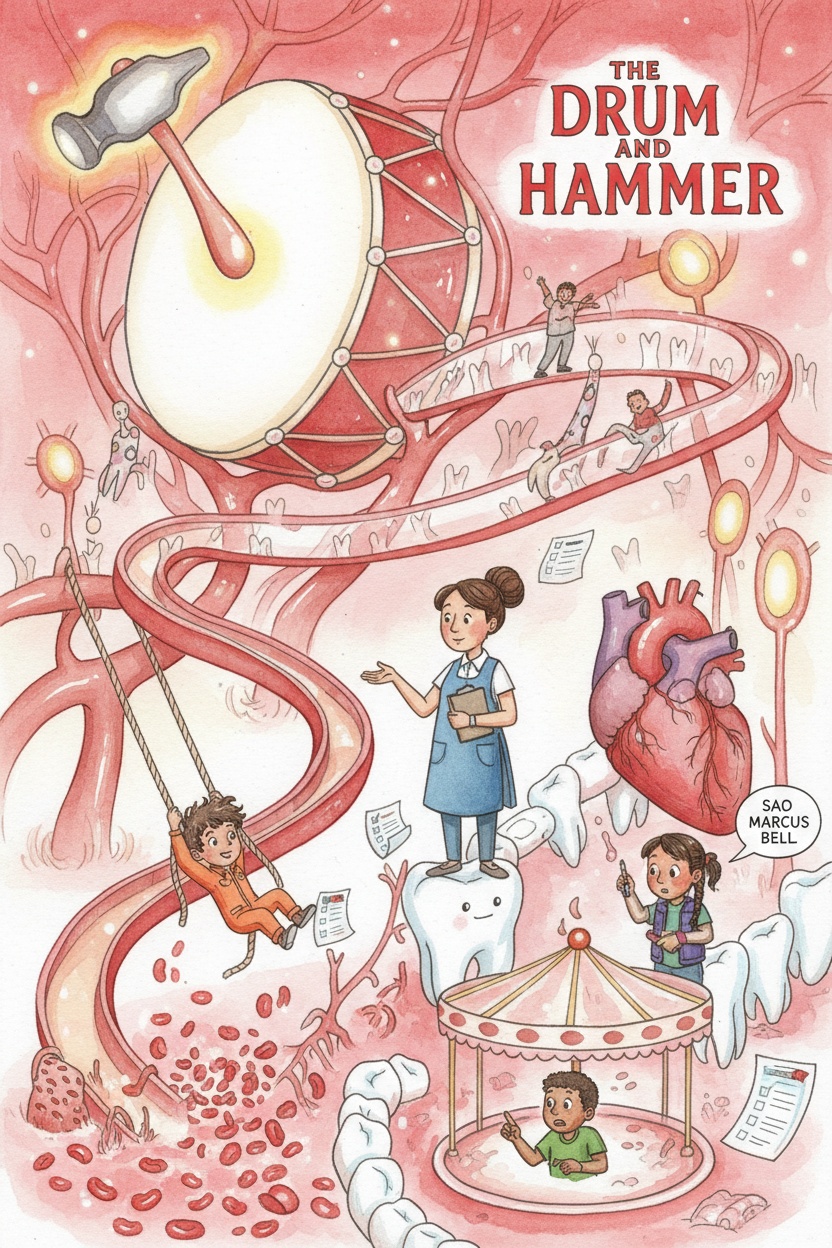
Ms. Vance's Current Checklist Status:
-
Location: Mr. Gomez's left ear canal (approaching the eardrum)
-
Date: Day 14 of the Incredible Shrinking Field Trip
-
Students accounted for: 22 of 22
-
Students currently doing something inadvisable: Leo (1 — he's tapping the eardrum with his finger)
-
Checklist revision count: 41
PART ONE: THE CAVERN OF SOUND
The walkie-talkie crackled. "We're approaching the end of the ear canal," Ms. Vance said into it. "Everyone stay close. The ground is covered in something sticky."
"It's earwax," Sadie said. "Cerumen. It's protective — it traps dust and keeps bugs from crawling in."
"Great," Marcus said. "So we're walking through bug glue."
The class was navigating a long, curved tunnel — the ear canal — which was dark, warm, and lined with tiny hairs that swayed gently. Leo had already tried to swing from one of them. It had not gone well.
"Mr. Gomez," Ms. Vance said into the walkie-talkie, "can you hear me?"
A moment later, Mr. Gomez's voice came through, slightly distorted but clear. "Loud and clear, Ms. Vance. Also, it feels like something is tickling the inside of my ear. Is that you?"
"That's Leo," Ms. Vance said. "He's swinging from your ear hairs."
There was a pause. Then Mr. Gomez said, "Okay. That's fine. Tell him to be careful up there."
"LEO," Ms. Vance called, in her special voice that made Leo's name sound like a fire alarm. "GET DOWN."
Leo dropped from the hair he was holding and landed on the tunnel floor. "I was testing the acoustics," he said.
Fatima looked at him. "You were testing your grip strength."
"The acoustics thing is also true," Leo said.
The tunnel began to slope. The walls changed texture — softer, more flexible. The class could feel something in the air, a pressure, a vibration that was just barely perceptible. It was like standing near a speaker at a very low volume, feeling the bass in your chest before you could hear the music.
"Stop," Ms. Vance said, holding up her hand.
Everyone stopped.
"Feel that?" she asked.
They all felt it. A subtle trembling in the floor beneath their feet, a pulse in the air.
"That's sound," Ms. Vance said. "We're inside the ear, so we're experiencing something people never normally feel — sound as vibration, before it becomes sound as hearing."
"Whoa," Leo said.
"Mr. Gomez," Ms. Vance said into the walkie-talkie. "Could you hum something? Just a low note."
There was a pause. Then, from outside, a low hum — like a distant engine starting.
The effect from inside was immediate. The air around the class began to shimmer with vibration. The floor hummed beneath their feet. It wasn't a sound yet — it was a feeling, a movement, a pressure that swept through the space in waves.
"THAT'S SO WEIRD," Marcus said, because he was having trouble hearing his own voice over the sensation.
"Sound is just vibrations in the air," Ms. Vance said, raising her voice. "When Mr. Gomez hums, his vocal cords vibrate, which vibrates the air, which travels down the ear canal and hits…"
She gestured ahead.
The class emerged from the tunnel into a space that stopped everyone cold.
It was a drum.
PART TWO: THE DRUM AND THE HAMMER
The eardrum — the tympanic membrane — stretched across the end of the ear canal like an enormous translucent drumhead, slightly inclined, pearly gray and exquisitely thin. It was alive with motion. Every vibration in the air made it ripple, flex, tremble. It was the most sensitive surface the class had ever seen — it moved with sounds so faint that from the inside, they were barely perceptible.
"It's beautiful," Fatima said quietly.
"The eardrum," Ms. Vance said, her voice taking on that special quality it got when she was about to explain something extraordinary. "About the thickness of a sheet of paper. But it can detect vibrations that move by less than the width of a single atom. Mr. Gomez, could you talk? Just a normal sentence."
From outside, Mr. Gomez's voice came through, muffled by the membrane but perfectly understandable: "I'm reading from the back of this cereal box. It says it contains twelve grams of protein per serving, which seems like a lot for cereal."
The class watched the eardrum as he spoke. It danced. Every word, every syllable, every consonant and vowel produced a different pattern of ripples across its surface — some broad and slow, some rapid and small. The membrane was translating sound into movement with impossible precision.
"This is where hearing begins," Ms. Vance said. "Sound waves travel through the air and strike this membrane. And now we need to see what happens next. There's a chamber on the other side — the middle ear. And it's empty."
"Empty?" Marcus said. "Like, air-filled?"
"Air-filled," Ms. Vance confirmed. "And it contains the three smallest bones in the human body. They have a very important job."
"How do we get through?" Sadie asked.
"We don't," Ms. Vance said. "That's the eardrum. We go around. There's a passage."
She led the class along the edge of the membrane, following a narrow opening that led into the middle ear cavity. As they entered, the class's mouths fell open.
The middle ear was a small, air-filled chamber — like the inside of a drum. And bridging across it, from the eardrum toward the inner ear, were three tiny bones, arranged in a chain.
They were extraordinary. They looked like something a jeweler would make — delicate, articulated, perfectly fitted together.
"The malleus," Ms. Vance said, pointing to the first bone, which was attached to the inner surface of the eardrum. "The hammer. It's attached to the eardrum and picks up its vibrations."
Then she pointed to the second. "The incus. The anvil. It sits between the other two and passes the vibration along."
And the third. "The stapes. The stirrup. It's the smallest bone in the human body — about the size of a grain of rice. It's attached to the wall of the inner ear, and it passes the vibration through a membrane-covered opening called the oval window."
"The HAMMER," Leo said, already moving toward it. "We've got a hammer."
"Leo—" Ms. Vance began.
But Leo was already climbing onto the malleus. He scrambled up the bone's smooth surface and stood on top, arms spread, like a sailor at the top of a mast.
"I'M ON A BONE!" he shouted.
And then the malleus moved.
It was a slow, steady motion — not violent, but completely irresistible. The bone tilted, carrying Leo with it, then returned to its original position. It felt like standing on a gently rocking boat.
"That's the sound we just made," Sadie said. "The vibration of our voices. The bones — they're mechanical amplifiers. They take the eardrum's vibrations and magnify them about twenty-two times before passing them to the inner ear."
"Twenty-two times?" Marcus said. "Why so much?"
"Because the inner ear is filled with fluid," Sadie said. "And sound travels differently through fluid than through air. If the vibration reached the inner ear without amplification, it would barely register. The ossicles — that's the collective name for these three bones — turn the air vibration into a fluid vibration, made stronger so the inner ear can detect it."
Leo, still standing on the malleus, looked down at the bone beneath his feet. "These bones are ALIVE," he said. "They're MOVEABLE."
"They move every time they hear a sound," Ms. Vance said. "Every word anyone has ever said to Mr. Gomez has made this bone move. Every song he's ever heard. Every laugh. Every alarm clock."
The class was silent.
"Mr. Gomez," Ms. Vance said into the walkie-talkie. "Can you make some different sounds for us?"
"Sure," Mr. Gomez said. "What do you want to hear?"
"Anything. But try different kinds of sounds."
There was a pause. Then, through the eardrum, came a sound — a window-rattling, deep, resonant sound. The eardrum flexed hugely, and the malleus surged beneath Leo's feet, carrying him through a wild arc.
"WHAT WAS THAT?" Leo shouted, clinging to the bone.
"The principal's car," Mr. Gomez said. "I'm in the parking lot. It backfired."
"He's in the PARKING LOT?" Marcus said.
"Mr. Gomez, please walk back toward the school," Ms. Vance said. "We don't need that much vibration."
"Got it."
The class watched as Mr. Gomez moved away from the loud sound. The rapid, intense vibrations faded into softer, slower waves.
"Okay," Ms. Vance said. "Now we need to see the final part of the journey. The stapes transmits the vibration to the inner ear — and that's where sound becomes something the brain can understand."
PART THREE: THE SHELL
The class carefully made their way along the bone chain, climbing from the malleus to the incus to the tiny stapes. At the far end of the stapes, there was a membrane-covered opening — the oval window.
"This is where it gets strange," Sadie said. "Everything so far has been mechanical — sound as movement. But on the other side of this window is fluid, and the vibration becomes a wave in liquid."
"Like dropping a stone in a pond," Fatima said.
"Exactly," Sadie said. "And that wave travels through the cochlea — the inner ear structure that turns it into a nerve signal."
The class peered through the oval window. Beyond it, they could see the beginning of an extraordinary structure — something that looked like a snail shell, coiled into a spiral of about two and a half turns.
"The cochlea," Ms. Vance said. "It's a spiral tube filled with fluid. The stapes pushes against the oval window, creating a wave in the fluid that travels through the entire spiral."
"Can we go inside?" Leo asked.
"No," Ms. Vance said, a little too quickly. "The cochlea is very delicate. And it's filled with fluid. We would damage it."
Leo looked disappointed. But he didn't argue — even he could tell that the cochlea, with its tiny spiral and its fragile walls, would not survive twenty-two miniature students exploring it.
"Instead," Ms. Vance said, "we're going to see the other thing the inner ear does."
She led them around the edge of the vestibular system — a set of structures adjacent to the cochlea, near the balance-regulating parts of the inner ear. Here, the chamber opened into a wider space with three distinct structures — semicircular tubes oriented in three different directions.
"These are the semicircular canals," Ms. Vance said. "They detect rotation — whether your head is turning, tilting, spinning. Inside each canal is fluid, and when the head moves, the fluid moves. Tiny sensors detect that movement and send a signal to the brain."
"So the ear does balance too?" Marcus said.
"The ear does balance too," Ms. Vance confirmed. "Hearing and balance are the two halves of the inner ear. They work together seamlessly."
"Mr. Gomez," Sadie said into the walkie-talkie. "Could you turn your head from side to side? Slowly?"
There was a pause. Then the class felt it — a subtle shift in the space around them. The fluid in the semicircular canals began to move, carrying a gentle current through tubes that angled in different directions.
"Faster," Ms. Vance said.
The current grew stronger. The class felt the pull of the fluid as it swirled through the canals, carrying information about motion and position.
"I'm dizzy," Leo said, wobbling.
"That's exactly what the semicircular canals detect," Sadie said. "Rotation. When they stop moving, they tell the brain that the head has stopped — but sometimes the fluid keeps moving for a moment, and the brain gets confused. That's why you feel dizzy after spinning in a circle."
"OH," Leo said. "THAT'S WHY."
"Exactly," Sadie said.
PART FOUR: THE SOUND OF EVERYTHING
For the rest of the afternoon, the class stayed in the middle ear, listening to the world through Mr. Gomez's ears.
They felt the sound of his footsteps as he walked through the hallway (a rhythm of heavy, regular beats). They felt the sound of a door closing (a sharp, quick crack). They felt the sound of the school secretary's voice as she asked Mr. Gomez how his stomach was feeling (a rapid pattern of vibrations, some higher, some lower, all dancing across the eardrum).
"Can you understand what she's saying?" Marcus asked.
"Not from here," Ms. Vance said. "The vibration has to travel to the cochlea, become a nerve signal, go to the brain, and get interpreted. What we're feeling is the sound before it's heard. It's the raw material of hearing."
"And then the brain makes it into words," Fatima said. She was watching the eardrum with complete absorption. "Everything is just vibrations. The brain tells the difference between a voice and a car and a song."
"It's decoding the vibration patterns," Sadie said. "The brain is remarkably good at it. It can tell a friend's voice from a stranger's. It can tell if someone is happy or sad just from the pattern of the vibrations."
The class was quiet for a moment. On the other side of the eardrum, Mr. Gomez was humming again — the same low note from before, but this time, with the class paying closer attention, it felt different. It felt like a message. Like the vibration meant something.
"There's a language," Ms. Vance said, "that the human body speaks fluently. Light becomes an image. Vibration becomes sound. Pressure becomes touch. The body is always translating the world into a language the brain can understand."
"Whoa," Leo said. And for once, nobody argued with him.
That night, after the class had set up camp in the outer ear canal (Ms. Vance had decided it was the safest place available — it was near an exit, and the earwax provided surprisingly comfortable bedding), Mr. Gomez's voice came over the walkie-talkie.
"You still awake in there?"
"We're here," Ms. Vance said.
"I just wanted to say — I was walking through the parking lot today, and I heard a bird singing. Just a regular bird. And I thought about how you were all in my ear, feeling the sound of it. And I don't know. It made the bird feel more important."
Ms. Vance smiled. "Mr. Gomez, do you know how many times your eardrum has moved today?"
"Not a clue."
"Millions. Every sound, every word, every breath you took that made a sound. Your ears have been translating the world all day, and you barely notice it."
"Huh," Mr. Gomez said. "Well. That's something."
"It is," Ms. Vance agreed.
She switched off the walkie-talkie and looked around the ear canal. Leo was asleep — or pretending to be. Fatima was lying on her back, staring at the ceiling with her eyes open. Marcus was writing in his notebook.
"Marcus," Ms. Vance said, "what are you writing?"
Marcus looked up. "The book I read says the stapes is the smallest bone in the body. But it's also the one that lets you hear. The smallest bone in your body is the one that lets you hear music and voices and stuff."
"Yes," Ms. Vance said. "That's right."
"I just think that's the coolest thing," Marcus said.
And he meant it.
MR. GOMEZ'S EXTERNAL LOG — ENTRY 32
I keep forgetting that they're in my ear. Not in a bad way — but I'll be walking around, doing normal things, and then I remember that there are twenty-three people inside my head, close enough to hear my thoughts. This afternoon I got a call from the principal asking about my extended sick leave. I said I was having trouble with my sinuses. It was the first excuse I could think of. The inside of my ear tickled for a while after that. I'm not sure if they were laughing at me. Probably.
The good news is that I remembered to turn off my car's engine before I went to the parking lot. The bad news is that the car backfired when I started it. The kids felt it. Ms. Vance says they're all right, but I feel bad about it. I'm going to be more careful about sounds.
I've started noticing sounds more now. Birds. The hum of the refrigerator. The sound of my own breathing when it's quiet. I never thought about how much my ears do just by existing.
Also, the earwax situation is something I'm never going to be able to forget. Thanks for that, Sadie.
Tomorrow: the eye from the inside. I'm supposed to look at a chart of some kind. I'll practice my reading.
— Mr. Gomez