The Number Kingdom
The Counting Crisis
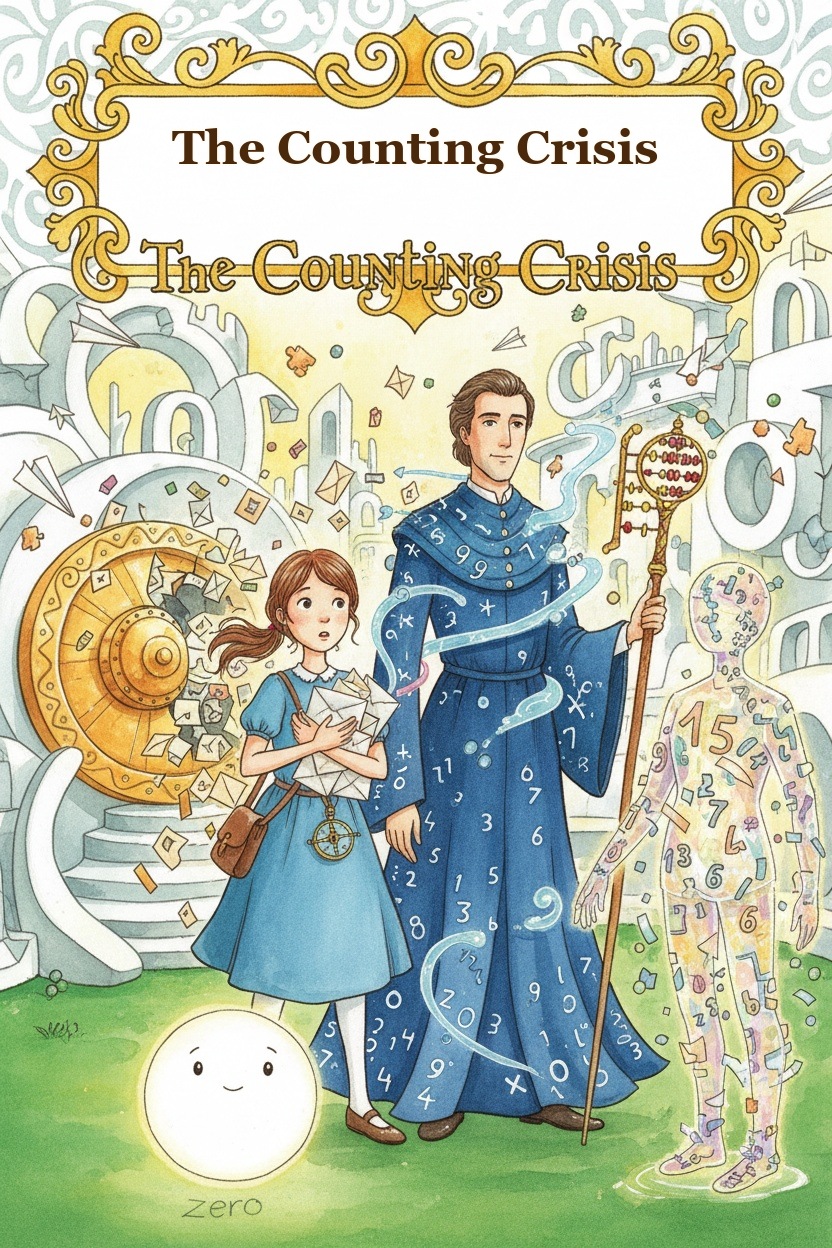
Chapter 1: The Wrong-Sized Letter
Mira Vasquez was having a very strange afternoon.
It had started with the mail. Every day at exactly three o'clock, the mail slot clanked and a letter landed on the doormat. But today, when Mira went to check, she found something impossible.
The envelope was too big for its own letter.
She pulled it out of the slot, and the envelope stretched and bulged like a balloon that had eaten too much. When she opened it, the letter inside was three times longer than the envelope it had come in. The words on the page kept repeating themselves:
Dear Mira, Dear Mira, Dear Mira, Dear Mira
And then, right in the middle of a sentence, the letter just... stopped. Mid-word. As if the writer had been interrupted by something very important, or very hungry.
Mira turned the page over. On the back, in handwriting that looked like it had been written by a very excited spider, was a note:
COME QUICKLY. THE COUNTING IS BROKEN. EVERYTHING IS WRONG AND ALSO OUT OF ORDER AND ALSO RIGHT WHERE IT SHOULDN'T BE!!!
— The Count (in a manner of speaking)
Mira frowned. She didn't know any Counts. She didn't know any spiders who could write, either, but she supposed there was a first time for everything.
She read the note again. And then, because the afternoon had already become strange and didn't seem interested in stopping, she did what any sensible seven-year-old would do.
She followed the instructions.
The instructions were: TURN THE PAGE THREE TIMES.
So Mira turned the page three times. And then she turned it again, because it seemed like the kind of thing you should do. And on the final turn, the page began to glow with a soft golden light, and the light spread outward from the paper and filled the whole room, and when it faded—
Mira was standing in a place she had never seen before.
Chapter 2: The Kingdom That Didn't Add Up
The place was beautiful. That was the first thing Mira noticed. It looked like a city made of numbers—the streets curved in long, sweeping sequences, and the houses had numbers painted on them in cheerful colors. There were shops and market stalls and a tall palace in the distance with towers that spiraled like the curves of a number five.
But something was very, very wrong.
A tiny man with spectacles and a very important-looking hat was running in circles, clutching a stack of envelopes. "The mail!" he wailed. "The mail is all wrong! Every house has the wrong number!"
A woman at a market stall was shouting at a basket of apples. "I asked for SEVEN apples! SEVEN! But you've given me three, then twelve, then seven, then one—" She held up the basket. It contained four apples. She looked at it. She looked at Mira. "Now it's four," she said, in the tone of someone who had given up understanding anything.
Mira looked around more carefully. And that was when she saw it.
A number on a house—5, Oak Street—flickered. Suddenly it read 7, Oak Street. Then 5 again. Then 3.
The street itself seemed to shimmer, and Mira realized that the numbers on the houses were rearranging themselves in the wrong order. House 1 was next to house 9. House 12 was in the middle of a row that should have gone up to 20 but instead went 1, 2, 12, 3, 9, 5, 5, 5, 5, 5—
"Five, five, five, five, five," Mira muttered. "That's not right at all."
"That's what I keep saying!" said a voice behind her.
Mira spun around. Standing there was a tall, formal man in robes covered in shifting numerals. The numbers on his robes moved like wind through wheat, rearranging themselves in patterns that seemed to almost make sense before changing again. He carried a staff topped with a small abacus, and he was looking at Mira with an expression that was trying very hard to be dignified and not quite succeeding.
"You have come," he said. "I wasn't sure you would. The letter was, ah, somewhat erratic in its delivery."
"You're the Count," said Mira.
"I am." The Count drew himself up to his full, considerable height. "The crisis is as follows: the Counting Districts have fallen into chaos. Numbers are repeating, skipping, and appearing in the wrong order. The mail cannot be delivered. The shops cannot sell their goods. The bakers cannot count their bread, the teachers cannot take attendance, and the children cannot line up in order for recess—which is, I confess, the detail that worries me most." He leaned closer. "Children not lining up properly. It's the beginning of the end."
Mira thought about this. "Why is it happening?"
"The Remainder." The Count said the word like it was a particularly stubborn stain. "A chaos-agent who delights in disorder. It has disrupted the counting of the entire district. And I—" He paused, and his robes shuffled their numbers nervously. "I am afraid I cannot fix it. I have tried. I have been counting for four hundred years, and I cannot make the numbers hold still."
Mira looked at the flickering house numbers. She looked at the woman with the four apples that should have been seven. She looked at the postman, who had given up running in circles and was now sitting on the curb, weeping softly into his envelopes.
"Right," she said. "Let's see what's broken."
Chapter 3: The Wrong Way to Count
Mira started with the simplest thing she could think of: counting.
"One," she said, pointing at house number 1. "Two." She pointed at house number 2. "Three." She pointed at—
House number 3 flickered and became house number 12.
"No," said Mira firmly. "You were three. You can't just become twelve in the middle of a count."
But WHY NOT? said a gleeful voice from somewhere above her head. Mira looked up. Perched on a lamppost was a strange creature shaped like a sliver of a number—like the leftover bit of a division problem, the part that didn't fit neatly anywhere. It grinned at her with a smile that was slightly too wide for its face.
What if three IS twelve? the Remainder said. What if one is seventy-three and nine is a thousand and everything is everything else? Wouldn't that be WONDERFUL?
"No," said Mira. "It wouldn't. Because then nothing would work."
But think of the possibilities! The Remainder hopped from the lamppost to a windowsill. If one is seventy-three, then the postman can deliver the mail anywhere! If three is twelve, then the baker sold ELEVEN MORE CROISSANTS than he actually did! Everyone would be so happy!
"The baker would be unhappy," said Mira, "because he would think he sold croissants that he didn't have. And then the customer would be unhappy because they wanted twelve croissants and got three. And then the postman would be unhappy because—"
Boring! The Remainder vanished in a puff of numerical smoke.
Mira sighed. She sat down on the curb next to the weeping postman.
"Okay," she said to herself. "Let's think about this properly."
She pulled out her satchel—she always carried a satchel with paper and pencils—and found a pencil. On the back of the very strange letter, she wrote:
1, 2, 3, 4, 5, 6, 7, 8, 9, 10
"That's how counting works," she said. "Each number comes once. In order. And it matches up with the things you're counting."
"The WHAT?" The Count reappeared, looking intrigued despite himself.
"One-to-one correspondence," said Mira. "It's what my teacher calls it. Each thing gets one number. No more, no less. If you're counting five houses, the first house gets 1, the second gets 2, the third gets 3, the fourth gets 4, and the fifth gets 5. Each house gets its own number."
"Fascinating," said the Count. "And what happens if a house gets the wrong number?"
"It doesn't get its mail," said Mira. "And the mail doesn't get delivered. Everything breaks."
But what if it's MORE FUN that way? The Remainder's voice floated down from a rooftop. What if the houses LIKE getting their mail jumbled? What if the numbers WANT to be repeated? You can't know, Mira. You can't know what the numbers want.
Mira considered this. "They're numbers," she said. "They don't want anything. They're just... numbers. They're reliable. That's the whole point."
The Remainder laughed-a sound like marbles rolling across a hard floor. Reliable! As if reliability were anything but a cage!
Mira looked at the numbers flickering on the houses. She looked at her list. And then she had an idea.
"Okay," she said. "If I'm going to fix this, I need to know what's wrong. Let me check the numbers on the houses. The street should go in order from one side to the other. One, two, three, four, five, all the way to the end."
She walked down the street, counting as she went.
"House 1. House 2. House 5? That's wrong. House 5 should be after house 4, not after house 2." She wrote it down.
"House 4. House 9? House 9 should come after 8, not right in the middle of everything." She wrote it down.
"House 3. House 7. House 7 again? No—that's the repetition problem. The Remainder is making numbers repeat."
She kept walking, checking every house, writing down every mistake. She got seven houses down the street before she had to stop and count her own list.
"1, 2, 3, 4, 5, 6, 7, 8, 9, 10," she counted. "That's how many mistakes I've found so far. And the street goes all the way to the palace. This is going to take forever."
The Count appeared beside her, his robes rustling with numbers. "Indeed. The task is monumental. The disorder is complete. It would take someone with extraordinary mathematical abilities to—"
"Wait," said Mira. She was looking at her list. "There's a pattern."
"A pattern?" The Count's robes stopped rustling. "What kind of pattern?"
"Look." Mira held up her list. "The numbers are wrong in a specific way. House 1 is fine. House 2 is fine. House 3 is fine. House 4 is fine. But then..."
She traced her finger down the list.
"House 5 should come after house 4. But House 6 is fine. House 7 is fine. House 8 is fine. It's like—the numbers that are fine are fine. But the numbers that aren't fine are jumping forward or backward."
"That's not a pattern," said the Count. "That's chaos."
"No," said Mira slowly. "It's not chaos. Chaos would be random. This is—" She looked at the numbers again. "This is the Remainder. It's not changing everything. It's only changing SOME things. And the way it's changing them is specific."
She thought very hard.
"Counting is about order," she said. "Forward and backward. Before and after. The number 4 comes before 5 and after 3. That's true. The Remainder can't change that—it can only change which number is on which house. So I need to match each house to its correct number. To do that, I need to count carefully and check each one."
She started walking again, this time more slowly.
"House 1. Right.
House 2. Right.
House 3. Right.
House 4. Right.
House 5. Wrong—it's actually house 7 with the wrong number. So I cross out 5 and write 5 again. The house is still 5. It just needs the right number back.
House 6. Right.
House 7. Wrong—it's actually house 9. Cross it out. Write 7.
House 8. Right.
House 9. Wrong—it's actually house 5. Cross it out. Write 9.
House 10. Right."
Mira stepped back. "The first ten houses are fixed."
A small, silver creature rolled out from behind a water barrel. It was perfectly round, about the size of a dinner plate, and it seemed to take up no space at all. It regarded Mira with an expression that was probably patient, though it was hard to tell, since it didn't have a face.
"That is," said the creature, in a voice like a bell ringing far away, "exactly right. You have counted forward, matched each number to each house, and corrected the errors. You have practiced counting backward to check your work."
Mira blinked. "Who are you?"
"I am Zero," said the creature. "I am the beginning of counting, in a certain sense. Though most people forget that." It paused. "I noticed you did not forget. You started at 1."
"Of course I did," said Mira. "That's where counting starts."
"Is it?" said Zero. And then, very quietly, "Yes. That tends to work."
The Count cleared his throat. "There are TWO HUNDRED AND FORTY-SEVEN houses in the Counting Districts," he said. "If you fix them one at a time, you will be here until the first bell. And the first bell is in—" He consulted his staff. "—three hours."
Mira looked at the endless rows of houses. She looked at her list. And then she looked at Zero.
"I need a faster way," she said.
"Count different," said Zero.
"Count different how?"
"Counting is not only forward. It is also backward. It is also in between. The Remainder has made the numbers repeat and skip. But if you count forward and backward at the same time, you can find the missing numbers."
Mira thought about this. "Forward and backward at the same time?"
"Like this," said Zero. "The numbers go 1, 2, 3, 4, 5, 6, 7, 8, 9, 10. And also 10, 9, 8, 7, 6, 5, 4, 3, 2, 1. Both directions. Both true. If a house has the wrong number, you can count from either direction to find what it should be."
Mira looked at the nearest wrongly-numbered house. It said 19. It was between house 14 and house 16.
"Nineteen," she said. "But it should be fifteen." She counted backward from 16. "Sixteen, fifteen. Yes. So the house is 15, and someone wrote 19 on it."
She crossed out the 19 and wrote 15. The house shimmered. The number glowed gold. And then, with a sound like a bell ringing, the number settled into place.
Oh, HOW INTERESTING, said the Remainder, appearing on the roof of house 15. You fixed ONE house. What about the other TWO HUNDRED AND FORTY-SIX?
Mira looked at the Remainder. She looked at the houses. And she had an idea.
"Backward first," she said. "I'll count backward from 247. That way I'll know where the highest numbers should go. Then I'll count forward. And I'll fix every house between."
And what about the houses that repeat? said the Remainder. What if two houses both say 3?
"Then one of them is lying," said Mira. "And I'll find out which one by counting forward and backward and checking which sequence is correct."
But what if BOTH of them are 3? said the Remainder, giggling. What if ALL of them are 3? What if the whole kingdom is 3, 3, 3, 3, 3—
"Then the postman would only ever deliver to one address," said Mira. "And everyone else would starve."
The Remainder stopped giggling. Hm. That's less wonderful than I thought.
It vanished.
Mira worked. She counted forward. She counted backward. She matched numbers to houses, crossed out errors, and wrote corrections. She made a list of every number from 1 to 247, and checked it against every house. When she reached 247, she counted backward to 1, and every number was accounted for.
By the time the first bell rang, the Counting Districts were fixed. The mail was delivered. The baker had the correct number of croissants. The children lined up in the correct order for recess.
And Mira stood in the middle of the street, holding her very long list, and realized that she understood something now that she hadn't understood before.
Counting wasn't just about saying numbers. It was about matching. Each thing got its own number. Each number had its own place. Forward and backward, the sequence held.
You see? said the Remainder, appearing one last time on a lamppost. I can still make everything wrong again. I could change the houses. I could change the streets. I could make the whole kingdom count in a DIFFERENT order—
"No," said Mira. "You can't."
Why not?
"Because I can check. I can count forward. I can count backward. I can match each thing to its number. As long as I do that, you can't break it." She paused. "At least, not for long."
The Remainder looked at her. For a moment, and just a moment, its grin flickered. You're interesting, it said. I think I'll keep you.
And then it vanished.
The Count stepped forward. His robes had stopped shifting, and the numbers on them now read, in neat rows: 1, 2, 3, 4, 5, 6, 7, 8, 9, 10.
"The Counting Districts are restored," he said. "You have done what I could not." He looked at Mira with something that might, in a warmer person, have been called pride. "You have counted accurately. You have matched each number to each object. You have counted forward and backward. You have, in short, used mathematics."
Mira looked down at her list. It was covered in crossings-out and corrections and small, careful numbers.
"I just counted," she said.
"That is what mathematics is," said the Count. "At its heart, it is just counting. Paying attention. Making sure each thing is in its right place." He paused. "You have a gift, Mira Vasquez. The gift of mathematical sight. You see the order in things, and you can find it when it is lost."
Mira wasn't sure about that. She had made mistakes that afternoon. She had counted wrong twice, and had to go back and fix her errors. She had been confused about which houses were which.
But she had also kept going. And in the end, she had fixed it.
Zero rolled up to her feet. "No one else noticed," it said, "that you started at 1. Not at 0. You knew that counting starts at 1. That is correct."
Mira smiled. "Where do you fit, then?"
Zero was quiet for a moment. "I am before counting," it said. "I am what is there before you begin. And I am what is left over when you count to nothing." It paused. "Most people forget that. You did not forget that counting has a beginning. That is good."
The Count raised his staff. "Return to your home, Mira Vasquez. The Number Kingdom is in your debt. I have a feeling—" His robes shimmered. "—that we will see you again."
Mira took a deep breath. "Right," she said. "Let's see what's broken."
The Count raised an eyebrow.
"For next time," Mira explained.
She turned the page three times, and the golden light rose around her, and the Number Kingdom faded away.
When the light cleared, she was standing in her living room with a very long piece of paper in her hands. It was covered in numbers, all in order, from 1 to 247.
Her mother called from the kitchen. "Mira! The mail came! There's a letter for you!"
Mira looked at the paper in her hands. She looked at the envelope on the doormat. It was addressed, in handwriting she was beginning to recognize, to:
MIRA VASQUEZ
THE KEEPER OF COUNTING
THE FIXER OF NUMBERS
1, MIRA'S HOUSE (the only one)
She smiled.
"Right," she said. "Let's see what's broken."
And she opened the letter.