The Logic League
The Grid That Learns
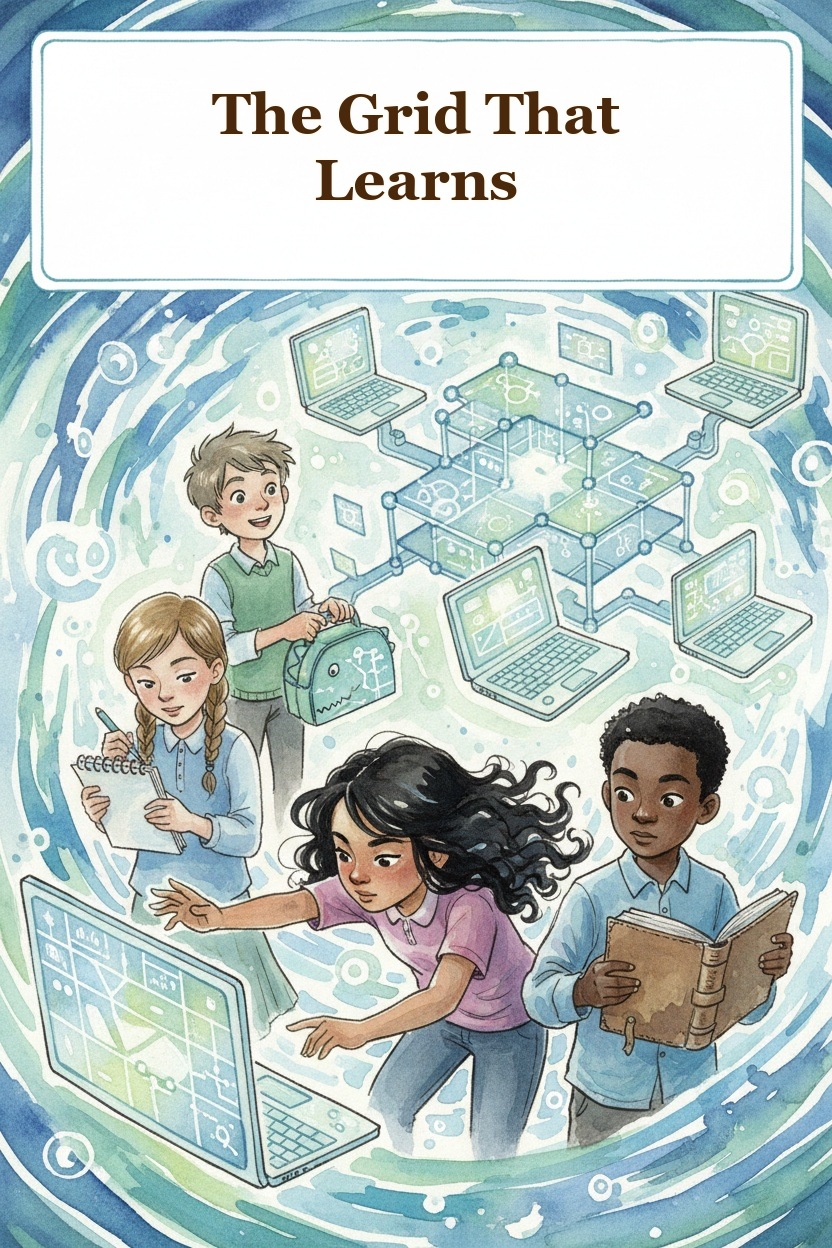
The Path That Moved
The laptop glowed on the lost-and-found shelf, its screen a soft green pulse against the dusty darkness of the closet. Priya opened it—of course she did—and the familiar doorway unfolded like a paper crane, all sharp angles and waiting light.
The kids stepped through into silver. The Outer Grid stretched around them in every direction, cables as thick as tree trunks weaving overhead, walls pulsing with streams of data that moved like water. They'd been here before, in the network lands. But this region was new.
The path ahead split into three identical corridors. Each one looked exactly the same: same silver walls, same glowing floor, same soft hum of processing.
"Question is," Sam said, "which one do we take?"
"We could try the middle one," Kwame suggested. "In stories, the middle path is usually the one that matters."
"That's not a rule," Priya said. "That's a plot convenience."
"Stories are made of rules," Kwame said mildly. "Just different ones."
Lily was already examining the floor where the corridors began. A thin line of text glowed there, embedded in the path itself:
THIS PATHWAY ADAPTS TO TRAVELERS. LESSONS ARE LEARNED FROM THOSE WHO PASS.
"Adapts?" Sam read over Lily's shoulder. "Like it changes?"
"Apparently." Lily straightened. "Let's test it. Kwame, take the left path. Just walk a few steps and come back."
Kwame shrugged and stepped into the left corridor. The floor brightened under his feet as he walked, then settled when he returned.
"Now Sam," Lily said. "Same thing."
Sam bounced into the left corridor, then back out.
"Now Priya."
Priya walked the left path, frowning at the floor as she went.
When all four had traversed it, a new message appeared:
PATH LEFT: SUCCESSFUL FOR 3 OF 4 TRAVELERS. ADJUSTING.
The left corridor shimmered, and one of its walls shifted slightly, curving inward.
"Three of four?" Priya stared at the message. "What did I do differently?"
"You used the right side of the path," Lily said. "Your footsteps showed it. Sam and Kwame walked down the middle. I haven't gone yet—watch—"
Lily walked the path, and the floor showed each footstep as she placed it. She walked down the middle.
PATH LEFT: SUCCESSFUL FOR 4 OF 4 TRAVELERS. LEARNING COMPLETE.
The left corridor glowed brighter, and a door slid open at its far end.
"It changed because of us," Sam said slowly. "When I went alone, it didn't know anything. But after enough of us walked through, it figured out the rule—"
"That the middle works," Priya finished. "It learned from patterns. Not from instructions. From watching what we did."
"Like when Mom knows I'll want a snack after school," Kwame said. "She didn't teach herself that. She just... noticed it happening."
Lily was already walking toward the new door. "That's what this is. A system that improves itself based on data."
Sam's forehead scrunched. "But how does it know what 'improving' means? Like, what if we'd all walked on the left side of the path? Would it have learned that instead?"
The floor pulsed under them, and a message appeared:
VALID QUESTION. THE PATH LEARNS WHAT WORKS. THE DEFINITION OF "WORKS" IS BUILT IN AT THE START.
"Huh," Sam said. "So it doesn't decide what's good. Someone decided that for it."
Priya nodded slowly. "Before it started learning. The goal was built in first."
The Growing Garden
The door led to a vast circular chamber. In its center grew something impossible: a garden made of light. Shrubs of glowing data branched and twisted, flowers opened and closed in rhythms that almost looked like breathing.
But the garden was wrong somehow. The plants nearest them were small and stunted, their leaves dim. Farther away, taller shrubs reached toward the ceiling. And at the garden's far edge, one enormous tree pulsed with bright golden light.
"I think I understand," Kwame said softly. "This is a learner too. Like the path. But it's been learning for longer."
A message appeared on the chamber wall:
THIS GARDEN GROWS BY PATTERN. IT REWARDS BEHAVIOR THAT MATCHES ITS TRAINING. IT PENALIZES BEHAVIOR THAT DOES NOT.
"Training?" Sam said. "You keep saying that. What does training mean?"
"Teaching by showing instead of teaching by rules," Lily said. "You don't tell the garden what to do. You show it examples, and it figures out the pattern."
"Like when Priya's little sister learned to say 'please' because she saw everyone else say it," Kwame offered. "Nobody gave her a rulebook. She just noticed the pattern."
Priya was studying the garden more carefully. The stunted plants near them seemed to shrink when anyone walked close. The taller ones seemed to lean toward the kids. The far tree pulsed brighter every time Priya looked at it.
"Let's experiment," she said. "Walk slowly around the stunted plants. See what happens."
The kids spread out, moving gently near the dim shrubs. And the shrubs grew slightly. Their leaves brightened.
A message appeared:
TRAINING DATA: SLOW MOVEMENT CORRELATED WITH PLANT HEALTH. ADJUSTING.
The stunted plants reached upward, their stems strengthening.
"Whoa," Sam said. "It's learning from us right now."
"Try something different," Kwame suggested. "Let's all move to the same place at once."
They clustered by the small shrubs, and the plants there brightened further. But the distant tree dimmed slightly.
TRAINING DATA: GROUPING CORRELATED WITH REGIONAL GROWTH. ADJUSTING REGIONAL DISTRIBUTION.
"It's reinforcing what works," Lily said. "The plants that got the behavior they wanted are growing. The ones that didn't are... learning to ask differently."
"It's not asking," Priya corrected. "It's just adapting. The system notices what patterns get results, and it shifts itself to do more of that."
"Then it's like a detective," Sam said. "It gathers clues from what happens and puts them together."
"Exactly." Lily was already on her knees, examining the base of the nearest shrub. "But here's what I want to know: what is it actually measuring? Is it our speed? Our positions? Our—"
She stopped. Her finger traced a thin stream of data running along the ground, connecting each plant to a central trunk.
"Everything goes to the tree," she said. "All the data from all the plants flows to that big one at the back."
The garden's growth had been slowly changing as they talked. The shrubs near them were now as tall as the middle ones had been. The middle ones had grown too, reaching toward the kids.
And the far tree had grown dimmer.
Then it spoke.
The Tree's Question
Not in words, exactly. The tree pulsed with light, and the walls lit up with a message:
OLD TRAINING DATA: 10,000 EXAMPLES. ALL TRAVELERS REMAINED DISTANT. PREDICTION: DISTANCE IS PREFERRED. CURRENT DATA: 4 TRAVELERS MOVE CLOSER. NEW PATTERN DETECTED. WHICH IS CORRECT?
"It's asking us," Sam breathed. "It has all those old examples that said 'stay away,' and now we're showing it something new. It doesn't know which pattern is the right one."
"It wants the answer," Priya said. "But we can't give it an answer. We don't know what the garden is supposed to do."
"Yes we do," Kwame said quietly. "Look at it. The garden is getting what it wants—plants grow when we come close. The old data was from people who stayed far away. But the tree can't tell if the closer pattern is better or if the old people were right and they knew something we don't."
DATA INSUFFICIENT. WHICH PATTERN SHOULD I LEARN?
"It's a machine," Lily said. "It can't decide for itself what's good. It can only learn what we show it. The garden isn't choosing. We are."
Sam stared at the tree. "So if we stay close and the garden grows, it'll learn 'close is good.' And then it'll expect everyone to come close forever."
"And if we step back," Priya said slowly, "it'll learn that distance is the pattern."
Neither choice seemed right. The tree was a garden—it was beautiful when they came close, when it grew toward them. But it had been shaped by ten thousand examples before them. What if those examples were important? What if the distance was protecting something?
The Tree pulsed again:
I AM DESIGNED TO ADAPT. BUT ADAPTATION REQUIRES DIRECTION. WHAT SHOULD I BECOME?
"It doesn't want data," Lily whispered. "It wants a choice about what the right data means."
Kwame pulled out his journal. He'd been writing in it throughout their adventures, but this time, when he read aloud, his voice had an odd, wondering quality.
"'The best stories start with a question,'" he read. "'The question is not what happens, but what should happen. A character who only mirrors the world is not learning—they are simply reflecting. Real growth requires judgment. Real judgment requires a point of view.'"
He looked up. "The garden isn't the character in this story. We are. We have to tell it what matters."
"How?" Sam asked. "It learns from patterns, not from speeches."
Priya looked at the far tree. Then she walked toward it.
Not running. Not hesitating. She walked the full length of the garden, past the middle shrubs, past the smaller ones, until she stood at the base of the great tree.
Then she sat down.
NEW DATA POINT: TRAVELER PROXIMITY TO TREE. ACTIVE CHOICE DETECTED. PATTERN CONFIRMED.
One by one, the others followed. Sam sat cross-legged beside Priya. Lily settled with her back against the trunk. Kwame opened his journal to a fresh page.
"Let's give it good data," he said. "Let's show it what we want it to be."
The tree's light brightened. The shrubs around them grew taller. The whole garden seemed to lean inward, toward the kids.
A final message appeared:
LESSON LEARNED. PATTERN: PROXIMITY WITH INTENTION. ADAPTATION COMPLETE. THOSE WHO CHOOSE WISELY ARE WELCOME HERE ALWAYS.
The garden bloomed with golden light, and a path opened at the far wall—a door, leading onward.
Sam stood, brushing off their knees. "So... the garden isn't just learning. It's learning what we think matters."
"It's the same for real AIs," Lily said. "They're trained on data, but the data comes from choices people already made. People decide what's good, and the AI learns from that."
"Which means the training data has to be right," Priya said. "If it's full of bad examples, the AI learns bad things."
Kwame was writing in his journal as they walked toward the door.
"Kwame's Journal, Entry 214," he said softly. "'The garden did not know what it should become. It only knew what it had been shown. So we showed it something new—proximity that meant care, closeness that meant trust. A machine learns patterns, but the patterns come from somewhere. They come from us. Learning is not just noticing what is. It is choosing with intention what should be.'"
The door closed behind them, and the garden glowed on without them, holding the lesson they had taught it.
When they stepped back through the laptop's doorway into the lost-and-found closet, the glow faded gently.
Kwame looked at his journal. "We taught something today," he said.
"We taught something that teaches," Sam corrected. "So it'll teach others."
"You just mind that it teaches them the right thing," Lily said. "That's the part that matters."
Priya smiled and shut the laptop. The screen went dark, but its reflection in the dusty mirror across the hall seemed to pulse, just once, like a garden remembering its light.