Chef Sparks Kitchen Lab
THE FLAVOR TRANSFORMER
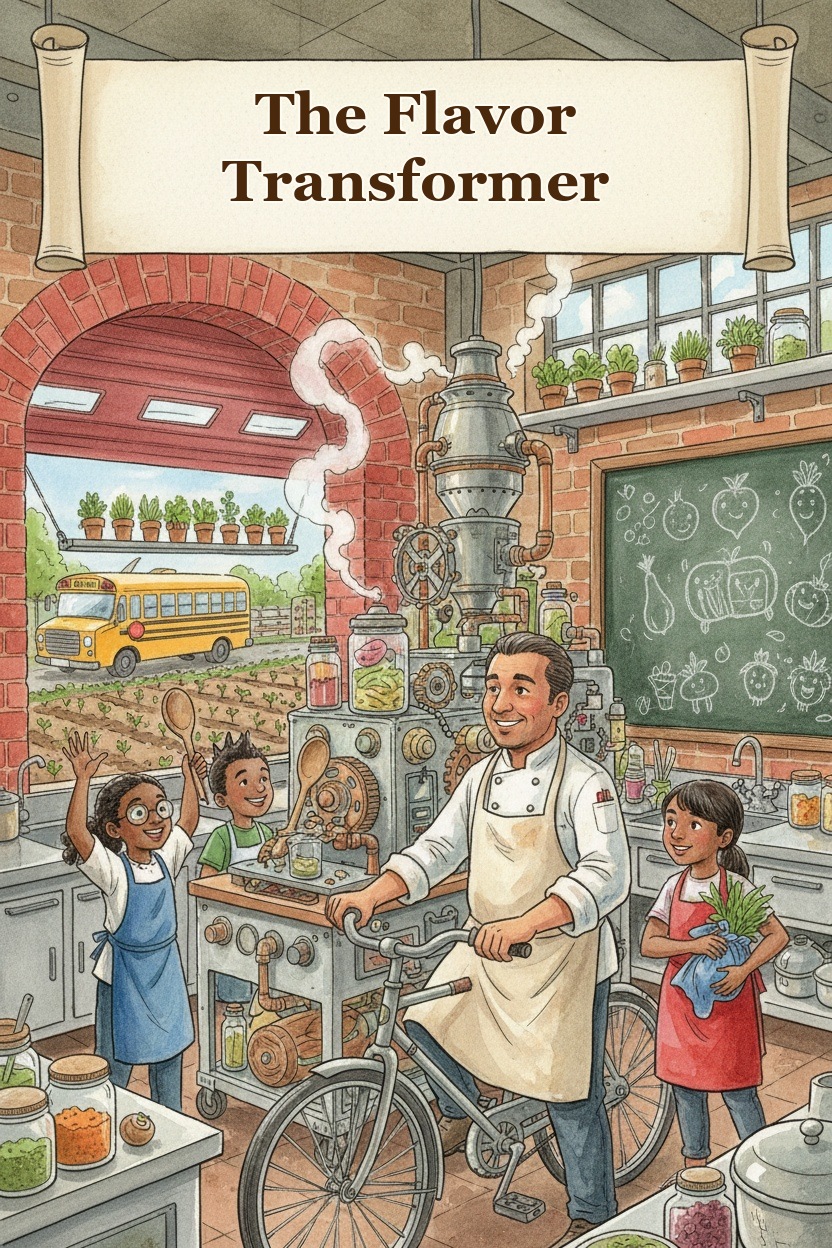
Book 20 in the Kitchen Lab Series
Section One: The Great Browning Mystery
The Kitchen Lab smelled like a bakery and a barbecue had decided to share a table. Tommy walked in, sniffed once, and said, "Something good is happening today."
"Something important is happening today," Chef Iggy corrected, adjusting his apron. "And because it is important, it will also be good."
On the great stainless steel range, six pans sat in a row. Beside each pan was a plate with a piece of food on it. The class gathered around, peering at the display.
Maya pointed at the first plate. "That's just a plain piece of bread."
"Correct," said Iggy. "And that's just a plain piece of tofu." He gestured down the line. "And that's just a plain piece of chicken. And that's just a plain piece of fish. And that's just a plain piece of bread again, but cut thicker."
"Six pieces of food that all have one thing in common," Iggy said. "None of them have been cooked yet."
Priya studied the pans. "They're all getting cooked in different ways?"
"Not different ways," Iggy said. "The same way. But at different temperatures, for different amounts of time. And by the end of this class, you will understand something that took human beings thousands of years to figure out."
"What's that?" asked Tommy, who had already picked up the piece of tofu and was examining it like it might hold secrets.
"Why browned food tastes better than unbrowned food."
Iggy turned to the chalkboard, where a cartoon was already drawn. It showed a little amino acid and a little sugar molecule holding hands and jumping into a frying pan together. Above them, hundreds of tiny stars exploded in all directions.
"This," said Iggy, tapping the cartoon, "is the story of the most important reaction in all of cooking. It has a name. It is called the Maillard reaction."
"Muh-yard," said Sam, testing the word.
"Maillard," Iggy repeated. "Named after a French scientist named Louis-Camille Maillard, who discovered it in 1912. And I am going to tell you the whole story, but first—"
The Spark Effect happened. Iggy's arm swept out in an enthusiastic gesture, and a wooden spoon flew off the counter behind him. It clattered to the floor.
Dev, who was keeping the prediction pool notebook this week, wrote down "wooden spoon" without looking up. No one had guessed wooden spoon.
"But first," Iggy continued, completely unbothered, "we are going to cook."
Section Two: The Temperature Experiment
Iggy assigned each student to a pan.
"Tommy, you get Pan Number One. Lowest heat. Your piece of bread will cook slowly, gently, at about one hundred degrees Celsius on its surface."
"Priya, Pan Number Two. A little hotter. Maya, Pan Number Three. Hotter still. Lucia, Pan Number Four. Sam, Pan Number Five."
"And Pan Number Six?" asked Dev, who had been assigned to it.
"Pan Number Six," said Iggy, "is the hottest pan in this kitchen. It has been preheating for twenty minutes. Its surface is over two hundred degrees Celsius."
Iggy lit the burners and the class watched as the six pans began to heat.
"While we wait," said Iggy, "I want you to notice something about these pans. They are absolutely dry. No oil. No butter. Nothing. We are about to observe what heat does to food all by itself."
The pans warmed. The class watched.
Tommy's bread began to toast very slowly. The edges turned pale gold after several minutes.
Priya's bread turned golden brown. Not dark, but golden. The color spread evenly across the surface.
Maya's bread browned faster, and the color went deeper—a rich amber brown.
Lucia's bread browned quickly and unevenly, with darker patches in some spots.
Sam's bread turned dark brown, almost mahogany, and began to smell strongly of toasted grain.
Dev's bread, in the hottest pan, turned dark brown almost immediately. Within seconds, it went darker. Then darker still. Soon, a wisp of smoke rose from the pan.
"Interesting," said Iggy. "Dev, what color is your bread now?"
"Um," said Dev, "it's kind of black. And it smells like... burning?"
"It is burning," Iggy said cheerfully. "That's what happens when you push the Maillard reaction past its limit. The same reaction that makes food delicious, taken too far, makes food bitter and burnt."
He turned off the burners. The class looked at their six pieces of bread, all now different shades of brown.
"Now," said Iggy, "I want you to taste them. In order. Starting with Tommy's."
Tommy broke a piece off his pale gold toast and chewed. "Tastes like bread. But toastier."
Priya tried hers. "This one tastes more... toasted? It's got a little bit of something in it. Like a nutty flavor."
Maya tried hers and her eyes widened. "Whoa. It's totally different. It's sweet and toasty and—there's so much going on."
The class worked through the next pieces. Each one was more complex than the last, with more layers of flavor, until they reached Dev's burnt piece.
"Careful with this one," Iggy warned.
Dev took a tiny bite and made a face. "That's just bitter and smoky and... no. That's not good."
Iggy nodded. "Perfect. You have just experienced the entire history of the Maillard reaction in six pieces of bread. But here's the thing about bread—it's mostly starch and sugar. To really understand what's happening, we need to add protein."
Section Three: The Chemistry of Delicious
Iggy replaced the bread with pieces of chicken, fish, and tofu. The class repeated the experiment.
"Well, I know what one of these is going to be like," said Tommy, gesturing at the tofu. "Tofu doesn't have any flavor."
"That is the single most incorrect thing you have said in this kitchen," said Iggy. "And you once said that salt was 'spicy water.'"
"I was seven."
"You were nine."
"I am learning!"
Iggy laughed and set the pans heating again. "Here is what a lot of people misunderstand about tofu. It doesn't have any flavor when it's raw. But it has something better than flavor. It has potential. And potential, in cooking, means one thing: amino acids."
"Maya, what can you tell us about amino acids?"
Maya brightened. "Amino acids are what proteins are made of. When you eat protein, your body breaks it down into amino acids and puts them back together. There are essential amino acids that our bodies can't make, so we have to get them from food."
"Correct," said Iggy. "And here's the thing you might not know. Amino acids are also what make food delicious. They are the building blocks of protein, yes, but they are also little flavor packets waiting to be opened."
He drew on the chalkboard again. "On your plate right now, you have pieces of chicken, fish, and tofu. They are all made of protein, which means they are all made of amino acids. And because they are animal or plant products, they also contain natural sugars. Just a little bit."
Priya raised her hand. "So the amino acids and the sugars... that's what the Maillard reaction combines?"
"Exactly," said Iggy. "When you heat food above about one hundred and forty degrees Celsius—" he wrote the number on the board, "—the amino acids and the sugars start reacting together. They join up and break apart and rejoin in different ways, over and over, creating hundreds of new flavor compounds."
"Hundreds?" Sam pulled out his notebook. "That seems like a lot."
"Hundreds," Iggy confirmed. "Some of them taste nutty. Some taste meaty. Some taste sweet. Some taste buttery. And when they all happen at once, on the surface of one piece of food, your tongue experiences something it can't get from any single ingredient. You experience complexity."
Iggy's voice got quieter, which the class knew meant he was about to say something important.
"This is why a piece of meat cooked in a pan tastes different from the same piece of meat boiled in water. Yes, yes, the water version is healthy and fine. But the pan version has a browned surface, and that browned surface contains all those flavor compounds. The boiled meat is like hearing one note played on a piano. The seared meat is like hearing a chord."
As he finished speaking, the pans were ready. The class seared their pieces of chicken, fish, and tofu, watching as the surfaces transformed from pale to golden to brown.
And when they tasted them—even the tofu, especially the tofu—there was a moment of silence.
Tommy was the first to speak. "That tofu tastes like... it tastes like it's been thinking about its life."
"That's the best description of Maillard I've ever heard," said Iggy.
Section Four: The Secret of the Sizzle
"Now," said Iggy, "I want to show you something even more interesting. Why don't we all try putting our pieces of food in water?"
"No!" said the class, almost in unison.
"Exactly right," said Iggy, grinning. "You've already learned it. But let me show you anyway."
He took a raw piece of chicken and dropped it into a pan of water. He set the pan over high heat. The water bubbled and boiled. The chicken cooked slowly, turning pale and white all the way through.
"It's cooking," said Maya. "It will be safe to eat."
"It is cooking," said Iggy. "But look at its surface. What color is it?"
"White," said Tommy. "It's white and sort of rubbery looking."
"Why?" asked Iggy.
The class thought.
Priya spoke up slowly. "The water... the water stops the surface from getting hot enough to brown?"
"Yes," said Iggy. "As long as there's water on the surface of food, the surface temperature can't get above one hundred degrees Celsius. Because the heat is going into evaporating the water instead of browning the food. The Maillard reaction doesn't even start until one hundred and forty degrees."
Dev nodded. "So if the surface is wet, it's stuck at one hundred. It has to get dry first."
"Exactly. That's why a piece of meat sizzles when you put it in a hot pan. Do you know what that sizzle is?"
"It's the water making a sound," said Lucia.
"More specifically," Iggy said, "it's the water on the surface of the meat boiling and escaping as steam. And here's the thing: if you put a piece of wet meat into a hot pan and you keep moving it around, the water keeps getting back to the surface and the surface temp stays low and you never get browning—"
"—patience," said Maya. "You have to pat the meat dry and then leave it alone."
"Pat it dry and leave it alone," Iggy repeated. "Every time I say anything, Maya tells me the part I forgot to say. Please keep doing that."
"So the sizzle is the sound of the pan drying the surface so the Maillard reaction can start," said Tommy. "It's like the popping of popcorn in the microwave, but for flavor."
"As always, Tommy has summed up the entire science in one weirdly perfect image."
Section Five: The Perfection
The class lined up at the stove. Each student was assigned a piece of protein to sear, and this time, the goal was perfection.
"You already know the science," said Iggy. "Now you need the skill."
"But there's one more thing you need to know about the Maillard reaction," he continued. "It doesn't just happen on the surface of meat. It happens anywhere you have amino acids and sugars and heat. It happens on the crust of bread. It happens on the surface of a roasted marshmallow. It happens when you toast nuts or seeds. Every time a food turns brown from the inside—not by added coloring, but by heat—the Maillard reaction is doing its work."
"Even caramel?" asked Sam.
"Caramel is different. Caramelization is what happens to sugar when the sugar gets hot all by itself. Maillard needs both sugar and amino acids. They're both browning, but they're different reactions. In a roasted marshmallow, you get both."
Priya was carefully setting her piece of fish into her pan. "Ammamma always puts a little bit of sugar in the tarka—the hot oil with mustard seeds. She says it makes the dal taste deeper."
"She's doing Maillard," said Iggy, "in the bottom of the pot. The sugar in the hot oil reacts with amino acids from the leftover dal from earlier. The tarka tastes more complex because of it."
Priya smiled. "I'm going to tell her she knew about a chemical reaction and didn't tell me."
"Grandmothers keep secrets from the young," said Iggy sagely. "It's part of the job."
At Dev's station, the tofu was perfectly browned. At Lucia's, the fish was golden. At Sam's, the chicken had a dark golden crust.
But Tommy was staring at his pan.
"What's wrong?" asked Iggy.
"I'm trying to decide," said Tommy. "Am I going to have the best sear or the most perfect sear?"
"What's the difference?"
"Best is brown and crispy with a good crust. Most perfect is..." Tommy looked at the piece of bread he had quietly placed in the pan. "Is bread. Back to my first experiment."
"Maya," said Iggy, "tell me the difference between one piece of bread seared at low heat and the same piece seared at high heat."
"Same reaction, more flavor compounds, and if you go too far it's bitter."
"And what does that mean for Tommy's bread?"
"It means high heat, but take it out before it burns."
Tommy watched his bread with total focus. The surface began to brown. The smell of toast filled the kitchen. At the exact moment it reached a deep, even amber, he flipped it.
When it was done, he held it up. It was perfect.
"I'm calling it," said Tommy, during the tasting, with a piece of chicken in his mouth and a piece of bread in his hand. "This. Is my favorite dish of the year. So far."
"What's the bread like?" asked Maya.
"Do you know how good this bread is? It's not just toast. It's toast that's thinking." Tommy swallowed. "Toast that's been thinking about its life."
Iggy looked at the class. "He's learned everything."
The Recipe
The class made a simple, perfect seared chicken breast, and Iggy wrote the steps on his recipe card as they worked.
PERFECTLY SEARED CHICKEN
Ingredients:
-
1 chicken breast (about 150 grams / 5 ounces)
-
A small drizzle of oil
-
A pinch of salt (and only a pinch — your grown-up might help you measure)
Equipment:
-
Paper towels
-
A frying pan big enough for the chicken
-
Tongs (with a grown-up nearby)
Steps:
-
Pat the chicken completely dry with a paper towel. In the Maillard reaction, "dry" is the whole secret.
-
Let the chicken sit on the counter for 10 minutes to stop being fridge-cold.
-
Ask a grown-up to heat the pan on high for 2 minutes. The pan must be so hot that a drop of water flicked in it dances immediately.
-
Drizzle oil into the pan and tilt so it covers the bottom.
-
Place the chicken in the pan. Resistance is normal. Now: DO NOT TOUCH IT. Leave it alone. Count to 30. You may count out loud.
-
Use tongs to flip the chicken. You should see a beautiful golden-brown crust. That crust is the Maillard reaction, and it is why your kitchen smells like a good restaurant.
-
Count to 30 again. Remove the chicken from the pan and let it rest for 5 minutes before cutting it. If you cut it before it rests, the juices run out and all your hard work pays a little less.
Chef Spark's Note: The brownest part of the chicken is where you will find the most flavor compounds — your taste buds' excitement grows with the crust. When you put this on a plate, look at it. You cooked a reaction that took Chemists and Chefs over a century to understand. You did it with a pan and some patience. That's the Kitchen Lab Cheat Code: patience + the Maillard reaction = delicious.
Iggy's Kitchen Lab Notes
"Today you learned about the Maillard reaction: the chemical dance that happens when amino acids and sugars meet heat and turn into hundreds of new flavors. You learned why dry beats wet (moisture keeps nothing below the 140°C starting line), why high heat matters (low heat is a lazy partner), and why patience is the most underrated ingredient in the kitchen. You also learned that a piece of plain bread, given attention and time, can behave like the fanciest dish in the world.
Here's your question to think about until next time:
If you sear a vegetable — a carrot, a cauliflower, a mushroom — what do you think happens to its flavor?
"Try it at home if you can. But understand this before you do: no matter what it tastes like, you will never eat a piece of toast the same way again. And that is a good thing." — Chef Iggy
End of Book 20: THE FLAVOR TRANSFORMER
Next: THE PEOPLE WHO FEED THE CITY — Book 21