Professor Plunks Impossible Lab
The Machine Museum
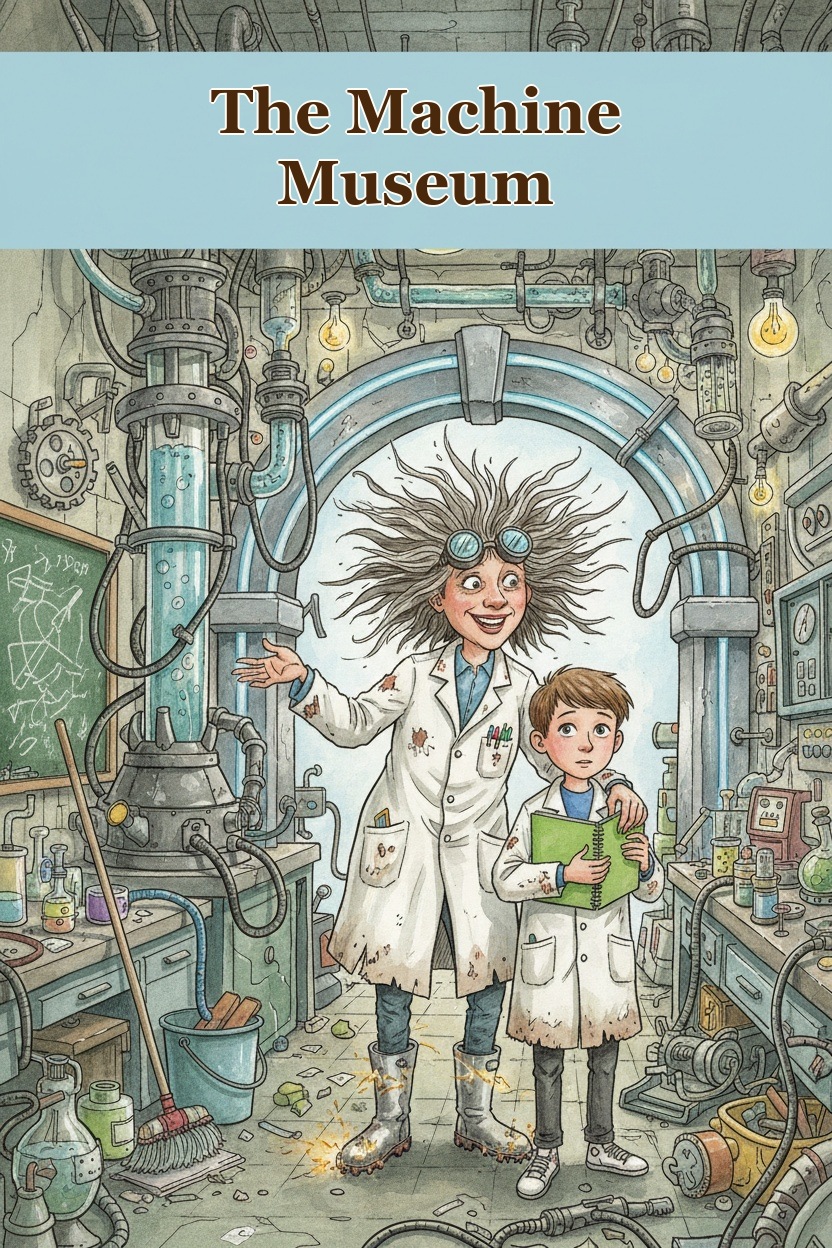
A Very Special Announcement
Otto was measuring the lab's temperature for his morning checklist when Professor Plunk burst through the door with a roll of red carpet under one arm and a megaphone in the other.
"ATTENTION, LABORATORY!" she shouted through the megaphone. "ATTENTION ALL SCIENTISTS, APPARATUS, AND INCIDENTAL DUST BUNNIES!"
Otto put down his thermometer. "Good morning, Professor. Why is there a red carpet?"
"Because today, my careful colleague, we are opening a MUSEUM!" Plunk unrolled the carpet across the lab floor with a dramatic flourish. "The MACHINE MUSEUM! A celebration of the six simple machines!"
Otto pulled out his lab notebook and found a fresh page. He wrote:
Today: Simple Machines Museum.
Prediction: Probably fine.
"Simple machines," Otto repeated, testing the words. "Like levers and pulleys?"
"EXACTLY!" Plunk was already dragging a large wooden wheel toward the center of the room. "Six of them! The lever, the pulley, the inclined plane, the wedge, the wheel, and the screw! Six beautiful devices that make work easier by changing the direction or size of a force!"
She stopped and struck a pose. "And today, Otto, we will demonstrate ALL SIX AT ONCE!"
Otto's pencil paused. "All six at once?"
"IN A COMPOUND SYSTEM!" Plunk's voice bounced off the ceiling. "Each machine connected to the next! A magnificent machine museum where every exhibit is connected to every other exhibit!"
Otto looked around the lab. He saw a long board balanced on a wooden block. A rope threaded through a wheel near the ceiling. A ramp leaning against the bookshelf. A wedge-shaped doorstop. A rolling cart. A spiral staircase that led to the roof.
He began to write:
Prediction update: Possibly not fine.
"Here's the plan!" Plunk announced, spreading a diagram across the workbench. Crumbs from this morning's toast scattered across the levers and pulleys she had drawn. "A weight sits here, on the lever. The lever pushes a cart up the inclined plane. The cart triggers the pulley, which lifts a gate. The gate releases a wedge, which pushes a wheel, which spins a screw, which—"
"Professor," Otto interrupted gently. "Have you tested any of these connections?"
Plunk looked at him with genuine surprise. "Otto. My friend. My meticulous colleague. Where would science be if we tested things before combining them?"
"Safer?" Otto suggested.
"PISH POSH!" Plunk boomed. "Science is about discovery! And we are about to discover something magnificent!"
She adjusted her goggles, which were on her forehead. "Now, let's build!"
The Machine Museum Opens
The Machine Museum took up the entire main floor of the lab.
Otto had to admit it looked impressive. Plunk had arranged the six machines in a rough circle, connected by ropes, ramps, and wooden tracks like a physics-themed board game.
The Lever: A long board resting on a triangular fulcrum. On one end sat a heavy copper weight labeled "THE LOAD" in Plunk's handwriting. On the other end hung a basket labeled "THE EFFORT."
"A lever multiplies your force!" Plunk explained, bouncing on her heels. "The farther the effort is from the fulcrum, the easier it is to lift the load!"
Otto wrote in his notebook:
Lever = board on a pivot. Push down far from fulcrum, load goes up. Mechanical advantage = distance effort/fingers from fulcrum divided by distance load is from fulcrum.
He paused. "So the mechanical advantage is how much the machine multiplies your force?"
"EXACTLY! Force output divided by force input!" Plunk beamed. "If you put in ten newtons of effort and get out fifty newtons of force, your mechanical advantage is five!"
She moved to the next exhibit. The Inclined Plane: A smooth wooden ramp leading from the floor to the top of a platform.
"Inclined plane!" Plunk announced. "You can lift something by going straight up—hard! Or you can push it up a ramp—easier! You use less force, but you travel a longer distance!"
"The wedge is next," Otto said, pointing to the doorstop-shaped wedge resting against a little cart.
"The wedge!" Plunk declared. "Two inclined planes back to back! You push it under something, and it splits the force sideways! Used for cutting, splitting, and—"
"Opening doors?" Otto suggested.
"Also that."
The Pulley: A rope threaded through a wheel mounted high on the wall. Plunk tugged it to demonstrate. The rope ran down to a hook that connected to the lever's effort basket.
"Pulley!" she said. "It changes the direction of your pull! Instead of lifting up, you pull down! And with more pulleys, you multiply your force even more!"
The Wheel and Axle: A large wooden wheel with a handle, connected to a smaller central rod. "The wheel and axle! You rotate the big wheel, and the small axle turns with more force but less speed!"
The Screw: Plunk pointed to a long metal spiral bolted to the platform. "And the screw! An inclined plane wrapped around a cylinder! It changes rotation into forward motion!"
Otto studied the entire setup. The weight on the lever connected to the cart on the inclined plane. The cart connected to the pulley rope. The pulley connected to the wedge. The wedge connected to the wheel. The wheel connected to the screw. And the screw pointed at—
"Professor," Otto said carefully. "The screw is pointing at the bookshelf."
"Yes!" Plunk confirmed. "The screw will rotate, push forward, and gently move the bookshelf aside to reveal our grand FINALE!"
"Your bookshelf weighs approximately four hundred pounds."
"Five hundred, with the encyclopedias," Plunk corrected cheerfully. She pulled a small chain that connected the lever to the counterweight. "Now! Stand back and observe the magnificent Machine Museum in action!"
Otto stepped behind the workbench. He opened his notebook to a fresh page and wrote:
Ready to observe compound machine system.
All components connected in series.
THIS IS EITHER VERY CLEVER OR A VERY BIG MISTAKE.
The Museum Opens
Plunk pressed a big red button.
The counterweight on the lever dropped. The lever's far end swung up, carrying the copper weight. The weight reached the top of its arc and tipped into the waiting cart on the inclined plane.
"Phase one!" Plunk cheered. "The lever is doing its job!"
The cart rolled down the ramp, gaining speed. It hit the bottom and slammed into the lever's effort basket, which swung downward and pulled the pulley rope.
The pulley rope yanked the wedge forward. The wedge slid under the cart and lifted it slightly. The lifted cart released a small ball, which rolled toward the wheel.
"My genius knows no bounds!" Plunk shouted.
Otto noticed something. "Professor, the wedge is supposed to push the wheel, not lift the cart."
Plunk squinted. "Hmm. The timing may be slightly—"
The ball hit the wheel. The wheel rotated, spinning the axle. The axle twisted a rope connected to the screw.
The screw began to turn. It advanced toward the bookshelf with a determined screech.
"Phase five!" Plunk clapped. "The screw is moving! Watch as it gently shifts the bookshelf!"
The screw reached the bookshelf and pushed.
Nothing happened.
PUSH.
Nothing.
PUSH CRANK SCREECH—
The bookshelf didn't move. But the screw pushed harder. And harder. And the bookshelf made a very ominous groaning sound.
"Professor," Otto said quietly, "I think the screw has too much mechanical advantage."
"Nonsense! The screw is doing exactly—"
The bookshelf toppled.
But it didn't fall toward the lab. It fell toward the inclined plane. And the inclined plane was connected to the pulley. And the pulley was connected to—
CRASH.
The bookshelf hit the inclined plane and slid down it like a sled. The encyclopedias flew in every direction. One hit the copper weight, which swung on its rope. The weight hit the lever, which flipped the cart.
The cart shot up the ramp.
The ramp collapsed under the bookshelf.
And the entire Machine Museum—all six simple machines, connected in perfect sequence—began a chain reaction that Otto could only describe as "the physics equivalent of a sneeze."
The lever launched the copper weight across the room. It smashed through the pulley rope. The rope wrapped around the wheel, which spun so fast it flung the wedge like a projectile. The wedge embedded itself in the wall. The screw kept turning, now unopposed, and drilled into the floor until it vanished completely.
Everything stopped.
Otto looked at the wreckage. The bookshelf lay on its side like a beached whale. Encyclopedias decorated every surface. The lever balanced on top of the cart, which sat on the collapsed ramp, which leaned against the pulley wheel.
Professor Plunk stood in the middle of it all, covered in encyclopedia dust and one who had fallen open to the letter "P."
There was a long, thoughtful silence.
"WELL!" Plunk announced, her goggles hanging from one ear. "That demonstrated mechanical advantage rather more vividly than I intended!"
Otto wrote in his notebook:
*What we learned:
-
Simple machines reduce effort individually.
-
Connected together in series, they multiply force—both useful force AND disastrous force.
-
The screw had enough mechanical advantage to move a bookshelf.
-
IT ALSO HAD ENOUGH TO DESTROY EVERYTHING ELSE.
-
THIS WAS NOT IN THE PLAN.*
The Cleanup and the Understanding
Gloriana arrived with a toolbox, a wheelbarrow, and a very large fishing net. She took one look at the fallen bookshelf, the embedded wedge, and the missing screw.
"Ladder," she said.
Otto pointed. "Over there."
Gloriana nodded and began her work. She did not look surprised. She never looked surprised.
Otto helped Plunk retrieve the copper weight from where it had landed—oddly, in the basket that was originally meant to hold it.
"The machine worked," Otto said slowly. "All six of them worked. They did exactly what they were supposed to do."
Plunk nodded, dusting off her lab coat. "They certainly did. The lever multiplied the force. The inclined plane redirected it. The wedge split it. The pulley redirected it. The wheel multiplied it. The screw converted it to forward motion."
"And together—"
"Together they multiplied all that force into one enormous push that knocked over a five-hundred-pound bookshelf." Plunk smiled. "Which is actually a wonderful demonstration of compound machines!"
Otto stared at her. "You're happy about this?"
"Otto!" Plunk put her hands on his shoulders. "Think about what we just proved! The mechanical advantage of each machine was small. The lever gave us maybe four times the force. The inclined plane maybe two. The wedge, the pulley, the wheel, the screw—each one gave a little more. But multiplied together?"
She spread her arms wide. "Tens of times more force than I put in! That's why compound machines are so powerful. And so dangerous."
Otto pulled out his notebook and read his notes aloud. "Mechanical advantage equals force output divided by force input. If you put in ten newtons and get out a hundred..."
"Then your mechanical advantage is ten!" Plunk completed. "Each machine multiplies the force a little more. The product of all six machines is the total mechanical advantage of the system."
Otto looked around the wreckage. "And the force output was...?"
Plunk pointed at the fallen bookshelf. "Approximately enough to move five hundred pounds of encyclopedia."
"So the lesson is that simple machines reduce effort by changing the direction or size of a force."
"Exactly!"
"And also that you should test components individually before combining them."
Plunk paused. Then she laughed—a big, warm laugh that made her goggles fall off entirely. "My careful colleague, you have just described the entire history of engineering in one sentence."
She reached down and picked up the fallen encyclopedia. It had opened to a diagram of a pulley system.
"You know what this means, Otto?"
"That we need a bigger bookshelf?"
"No!" Plunk's eyes sparkled. "It means we need to build a lift system with thirty-two pulleys to put the bookshelf back!" She tapped the diagram. "Think of the mechanical advantage!"
Otto opened his notebook to a fresh page. He wrote:
Proposed experiment: Lift System with 32 Pulleys.
Predicted outcome: Not going to end well.
Volunteering to take data anyway.
Before he could write more, Gloriana appeared beside him. She handed him a pencil, a measuring tape, and a very large helmet.
"For the data," she said.
Otto put on the helmet. "Thank you."
Gloriana nodded once and went back to untangling the rope.
The sun came through the window and caught the pulley wheel, making it glint like a tiny silver sun. Otto watched the light bounce across the wreckage of the Machine Museum, and he thought about everything the machines had done. Each one alone was simple. A board. A rope. A ramp. A doorstop. A wheel. A screw.
But together, they had turned a small push into a bookshelf-toppling force.
"And that," Plunk said, as if reading his mind, "is the wonder of machines. They take what you have—your small, human effort—and they make it bigger. Stronger. More."
Otto looked at the glinting pulley. "And sometimes messier?"
"Especially messier," Plunk agreed. "But that's how you learn."
Otto closed his notebook and tucked it under his arm. For the first time that day, he smiled.
"I think," he said, "the Machine Museum was a success."
Plunk's face lit up. "OF COURSE IT WAS! Now—help me clear the floor for the pulley lift system! We'll need at least fifty meters of rope!"
Otto looked at Gloriana. She was already carrying a coil of rope bigger than her own body.
"Fifty meters?" Otto repeated.
Plunk nodded enthusiastically. "At least! We have a bookshelf to lift and a physics principle to celebrate!"
Otto paused, pencil hovering over his notebook.
Update: When I said "success," I may have meant "educational."
Educational disaster is still a disaster.
But it's also still science.
Maybe that's the point.
He tucked the notebook into his pocket and followed Plunk toward the rope.
Gloriana watched them go. She reached into her tool belt and pulled out a single bandage.
"Just in case," she said to no one in particular, and followed them at her own steady pace.
THE END
Next: Book 29 — The Lever of Doom