Inside Out Academy
THE LONG WIRES
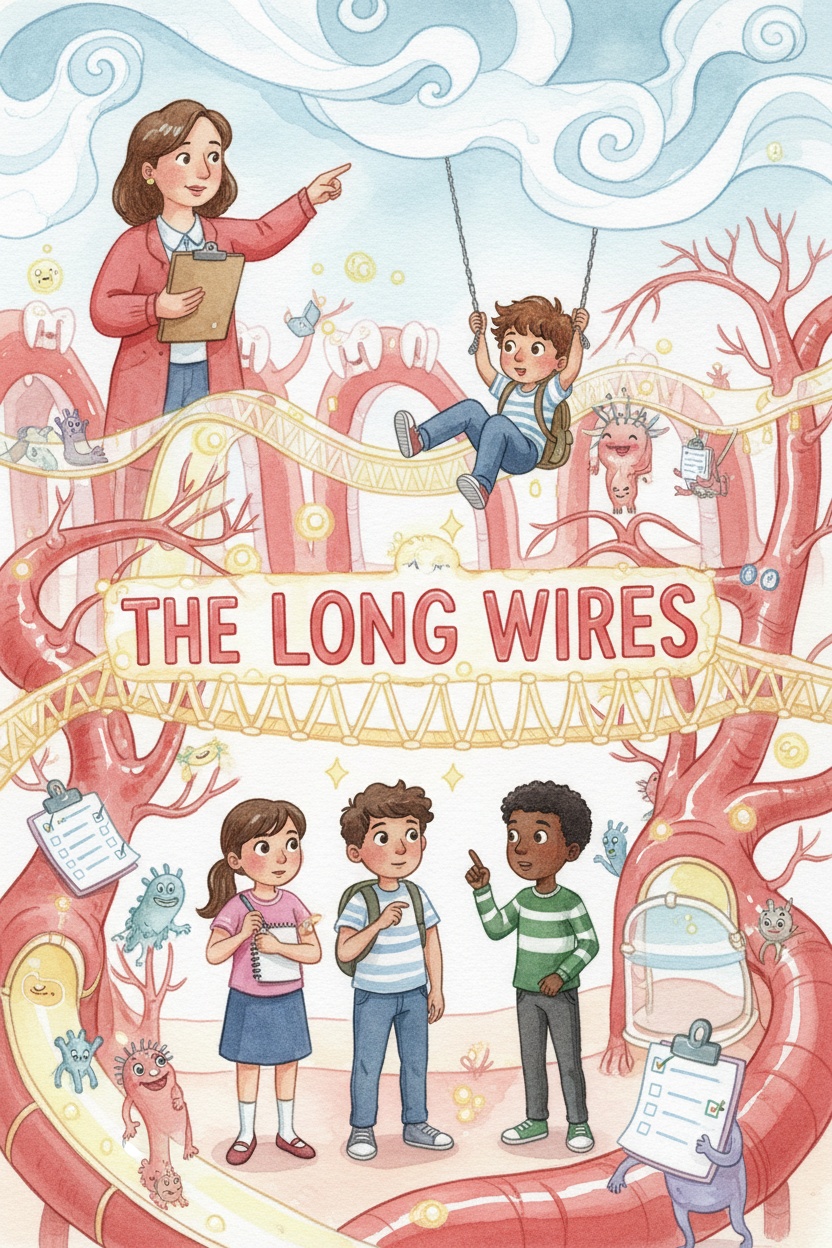
MS. VANCE'S CURRENT CHECKLIST STATUS:
-
Location: Spinal cord, thoracic region (T4-T6, approximately)
-
Day: 4 of the nervous system arc (Book 28 of the ongoing journey)
-
Students accounted for: 22 (Leo is present but has been standing very close to the edge of the nerve root for the past ten minutes)
-
New item added to checklist: "Find out why Leo keeps touching things that conduct electricity"
SECTION ONE: THE END OF THE HIGHWAY
The spinal cord was a highway. That was the only word for it, Leo thought, standing at the edge of it and looking down the long pale length of bundled nerve fibers. It ran like a massive white cable through the center of the vertebral column, and the class had spent the better part of a day traveling down it, marveling at the organized columns of nerve tracts, the branching roots that emerged between vertebrae like off-ramps.
But now they had reached the exit.
"The highway ends here," Sadie said, kneeling at the point where the spinal cord tapered. "Well, not ends exactly. It becomes the cauda equina—the horse's tail. All those nerve roots dangling down."
Leo leaned over the edge. "So this is where the wires come out."
"Wires," Marcus repeated. "He calls them wires."
"What would you call them?" Leo asked.
"Nerves. Peripheral nerves. They're part of the peripheral nervous system, which is—"
"The PNS," Sadie finished. "Everything outside the brain and spinal cord. The central nervous system is the command center. The peripheral nervous system is how it talks to the rest of the body."
Ms. Vance was already pulling out her map—the wrapper from Sadie's emergency energy bar, now covered in increasingly dense annotations. She studied it, then turned in a slow circle, orienting herself.
"We need to understand how the PNS works," she said. "Because we're going to need to navigate it to get out of Mr. Gomez eventually. But more importantly—" She paused, and her voice shifted into that particular tone that meant she was genuinely excited. "More importantly, this is the most extraordinary communication system ever built. Every thought Mr. Gomez has, every sensation he feels, every movement he makes—it all travels through these wires. Let's see how."
The class gathered around the nerve root that branched away from the spinal cord at their level. It was like standing at the mouth of a tunnel. The nerve was a bundle of individual fibers, each one a neuron's axon, wrapped in layers of connective tissue.
"The first thing we need to understand," Ms. Vance said, "is that there are two kinds of nerves leaving the spinal cord. Who can tell me what they are?"
Marcus raised his hand before she finished the question. "Motor nerves and sensory nerves. Motor nerves carry signals from the spinal cord out to muscles—telling them to move. Sensory nerves carry signals from the body back to the spinal cord—telling the brain what's happening."
"Exactly." Ms. Vance nodded. "And we're going to split up to explore both. Two teams. Team Motor—" She looked at Leo. "You're going to follow a motor nerve from here to a muscle. Team Sensory—" She looked at Fatima. "You're going to follow a sensory nerve from the skin back to here. We'll compare notes."
Leo was already moving toward the nerve root. "Which team do I want—"
"You're on Team Motor," Ms. Vance said. "Because Team Motor is going toward the muscle, and I want you far away from the skin. Last time you were near Mr. Gomez's skin, you tried to climb out through a pore."
"I just wanted to see if we could," Leo said.
"Team Sensory," Ms. Vance continued, "will need to be careful, because they'll be traveling against the direction of signal transmission. That's harder. Fatima, you're leading them."
Fatima nodded. She was already looking at the sensory nerve with the patient, focused expression that meant she was tracking every detail.
"Everyone check your buddy—"
"—and your equipment," the class chorused. It had become a call-and-response by now.
SECTION TWO: FOLLOWING THE MESSAGE
Leo had never been so happy. The motor nerve was enormous at their scale—a thick bundle of fibers, each one a single axon stretching from the spinal cord all the way to the muscle fibers it controlled. The class moved along the outside of the nerve, following its path as it branched away from the cord and threaded through the body's tissues.
"It's like following a river," he said, practically bouncing as he walked. "Except the river is made of nerves."
"The nerve is made of neurons," Marcus corrected. "And each neuron has the same basic parts. A cell body, which has the nucleus and all the machinery. Dendrites, which receive signals. And an axon—" He gestured at the long fiber they were walking alongside. "Which sends signals."
"This axon is the dendrite for the next neuron," Sadie added. "The signal jumps from the end of one neuron's axon to the dendrite of the next one, across a synapse."
Leo stopped. He had spotted something ahead—a bulge in the nerve fiber, like a knot in a rope. "What's that?"
Sadie moved closer, squinting. "That's the cell body. The neuron's headquarters."
Leo crouched. The cell body was a rounded swelling, and through its translucent membrane he could see the nucleus, the organelles, the machinery of a cell operating at full capacity. "It's not at the end."
"Right." Sadie nodded. "Sensory neurons have their cell bodies in clusters along the nerve—called ganglia. Motor neurons have their cell bodies in the spinal cord. But the key thing is—"
"The signal travels one way," Marcus finished. "Motor neurons send signals out to muscles. The signal starts in the spinal cord, travels down the axon, and reaches the muscle. All one direction."
Leo stood up. "So if we follow this nerve, we'll reach a muscle?"
"Eventually, yes. Depending on which branch we follow." Sadie consulted the map. "The nerve we're on innervates—connects to—the muscles of the arm and hand. If we follow it far enough, we'll reach actual muscle fibers."
They set off again. Ms. Vance's walkie-talkie crackled.
"Team Sensory to Team Motor," Fatima's voice came through, measured and calm. "We have reached the skin. We're at the sensory receptor now. Beginning our journey back toward the spinal cord."
"Roger," Ms. Vance responded. "Team Motor has—" She turned to Sadie. "How far do we have?"
"Maybe another few hundred yards," Sadie said. "At our scale. We're close."
They rounded a corner—and stopped.
The nerve fiber they had been following terminated in a spray of branches that spread out and attached to something the class had seen before: a muscle fiber. The striations of sarcomeres were visible, the same pattern they had studied in Book 7 and 8. But now they could see the junction—the place where nerve met muscle.
"The neuromuscular junction," Marcus whispered. "This is where the electrical signal becomes a chemical signal becomes a muscle contraction."
"Watch," Ms. Vance said. She raised the walkie-talkie. "Mr. Gomez, can you flex your right hand for us?"
A moment of silence. The class felt it before they saw it—a vibration in the muscle fiber, a tension building.
And then the signal came.
It moved down the axon toward them like a wave of light, a surge of electrical activity that made the nerve fiber glow for an instant. Leo watched, transfixed, as the signal reached the end of the axon, triggered a release of chemicals across the junction, and the muscle fiber responded—contracting with visible power.
The class felt the vibration through their feet. The muscle had moved. Mr. Gomez had flexed his hand.
"Whoa," Leo said. He was not capable of saying anything else for a moment.
"From thought to movement," Ms. Vance said softly. "From Mr. Gomez deciding to flex his hand, to the muscle actually contracting. In milliseconds."
Marcus was writing in his notebook. "The signal traveled down the axon to the neuromuscular junction, then released acetylcholine, which bound to receptors on the muscle fiber, which triggered the contraction."
Leo looked at the muscle, then at the nerve, then back at the muscle. "I want to see it again."
Twelve more times, Mr. Gomez flexed his hand. Twelve more times, the class stood at the neuromuscular junction and watched the signal arrive. It did not get old.
SECTION THREE: THE OTHER DIRECTION
Fatima was leading her team along the sensory nerve, and she had noticed something immediately.
It was the myelination that struck her first.
The sensory nerve was wrapped in segments of a fatty substance, like a series of beads threaded along the fiber. Between the segments, there were small gaps. It looked—she thought—like a string of sausages where the casing had been pinched.
"Myelin," she said to her team. "These are Schwann cells wrapped around the axon."
"The myelin makes the signal faster," one of the other students said. "It insulates the nerve."
"Not just insulates," Fatima corrected. She had picked this up from Sadie's briefing earlier. "It makes the signal jump. The electrical signal can't travel through the myelin, so it jumps from gap to gap. That's called saltatory conduction."
"Jumping conduction," another student said.
"Yes." Fatima nodded. "It's much faster than traveling down the whole axon uninterrupted."
They reached the beginning of their journey—the point where the sensory nerve terminated in the skin. Unlike the motor nerve's tidy neuromuscular junction, the sensory nerve ended in a receptor, a specialized structure buried in the layers of the dermis.
"This is a mechanoreceptor," Fatima said. "It responds to pressure and touch. When something presses on the skin, it deforms this receptor, which opens ion channels, which creates an electrical signal that travels toward the spinal cord."
"What kind of pressure?" asked one of the students.
Fatima considered. "We need to test it," she said. She raised the walkie-talkie. "Team Motor, this is Team Sensory. Mr. Gomez, could you touch something with your right hand? We're testing the sensory receptor."
A pause. Then the class felt it.
The pressure arrived at the receptor as a physical deformation. The membrane of the receptor cell stretched, ion channels opened, and a signal burst into existence—an electrical impulse that began to travel up the axon.
"Follow it," Fatima said, and the team began to run.
It was harder going in this direction. The signal moved through the axon faster than they could possibly travel, but the nerve carrying it pulsed with activity, marking the path. They followed the pulse, moving backward along the nerve, away from the skin and toward the spinal cord.
"Notice the difference," Fatima called back to her team. "The motor signal was one direction. The sensory signal is the opposite. We're following it from the receptor to the spinal cord, which tells us where the signal is going."
They passed through the same myelin segments they had observed on the way in, but now they could feel the signal jump from gap to gap, skipping along the nerve at remarkable speed. Fatima timed it, counting the intervals.
"The myelin multiples the speed by about ten," she said. "Without it, the signal would take maybe a tenth of a second to travel from the skin to the spinal cord. With it, it takes a hundredth."
"Is that a big difference?"
"The difference between pulling your hand away from a hot stove instantly and pulling it away a moment later," Fatima said. "When it comes to not getting burned, a hundredth of a second matters."
SECTION FOUR: COMPARING NOTES
The two teams met back at the spinal cord, slightly out of breath, full of observations.
"I'll go first," Leo announced. Which meant he would speak first, whether or not that had been decided. "The motor nerve was amazing. We watched the signal arrive at the muscle, and the muscle contracted. Every single time. Like clockwork."
"The sensory nerve was the opposite," Fatima said. "We started at the receptor and followed the signal back to the spinal cord. The same type of signal, traveling in the opposite direction."
"You're both describing the same system from different ends," Ms. Vance said. "Who noticed the structural differences?"
Marcus raised his hand. "The cell bodies are in different places. Motor neurons have their cell bodies in the spinal cord, and their axons go all the way to the muscle. Sensory neurons have their cell bodies in ganglia along the nerve, and they connect to the spinal cord at the dorsal root."
"And the myelin?"
"Both have myelin," Fatima said. "But I'm wondering—does the myelin work the same way for both?"
Sadie nodded. "Same mechanism. The signal jumps between nodes of Ranvier—the gaps between myelin segments. It's faster than continuous conduction. And the myelin also helps protect the axon."
Leo frowned. "So the signal is electrical?"
"Yes," Sadie said. "The neuron maintains a charge difference across its membrane—resting potential. When a signal comes, ion channels open, the charge reverses, and that reversal travels down the axon like a wave."
"We saw it glow," Leo said. "When the signal passed."
"That's the electrical activity," Ms. Vance confirmed. "You literally watched the signal travel."
"Twelve times," Leo said.
"Twelve times," Ms. Vance agreed. She looked at her checklist, marked something off, then looked up at the class. "One more thing to observe. Layer on top of layer—the signal travels electrically along the axon, then chemically across the synapse, then electrically again in the next neuron. That's how the nervous system transmits information. Electrical and chemical, working together."
Fatima was quiet for a moment. Then she said, "And every thought Mr. Gomez has, every feeling, every sensation—it's all this. Signals jumping along wires."
Nobody said anything for a moment.
"Which is extraordinary," Leo said finally. "Because I was thinking about sandwiches, and now I'm realizing my brain was sending signals about sandwiches."
The class dissolved into laughter. Even Fatima smiled.
MR. GOMEZ'S EXTERNAL LOG
They've been exploring my nerves all day. Fun fact: I didn't know I had nerves until twenty-three tiny students started treating them like highways. My right hand is tired from flexing it on command. When Team Sensory tested the touch receptor, it felt like a tiny pressure in my palm, delayed by a moment. Like a ghost patting me on the hand.
Dr. Chen from next door stopped by and asked why I keep holding my hand open and staring at it. I told her I was practicing being present with my body. She said "okay" and left.
The principal called again. I told him I was recovering from a medical procedure. He asked which one. I said "the kind where a class of fifth-graders lives in your circulatory system." He said "please advise." I advised him to stay calm. He said he would try.
My knee is doing that thing again. I'm assuming that's the class.
Tomorrow they want to test reflexes. I said fine. At this point, nothing surprises me.
END OF BOOK 28