The Logic League
Again and Again
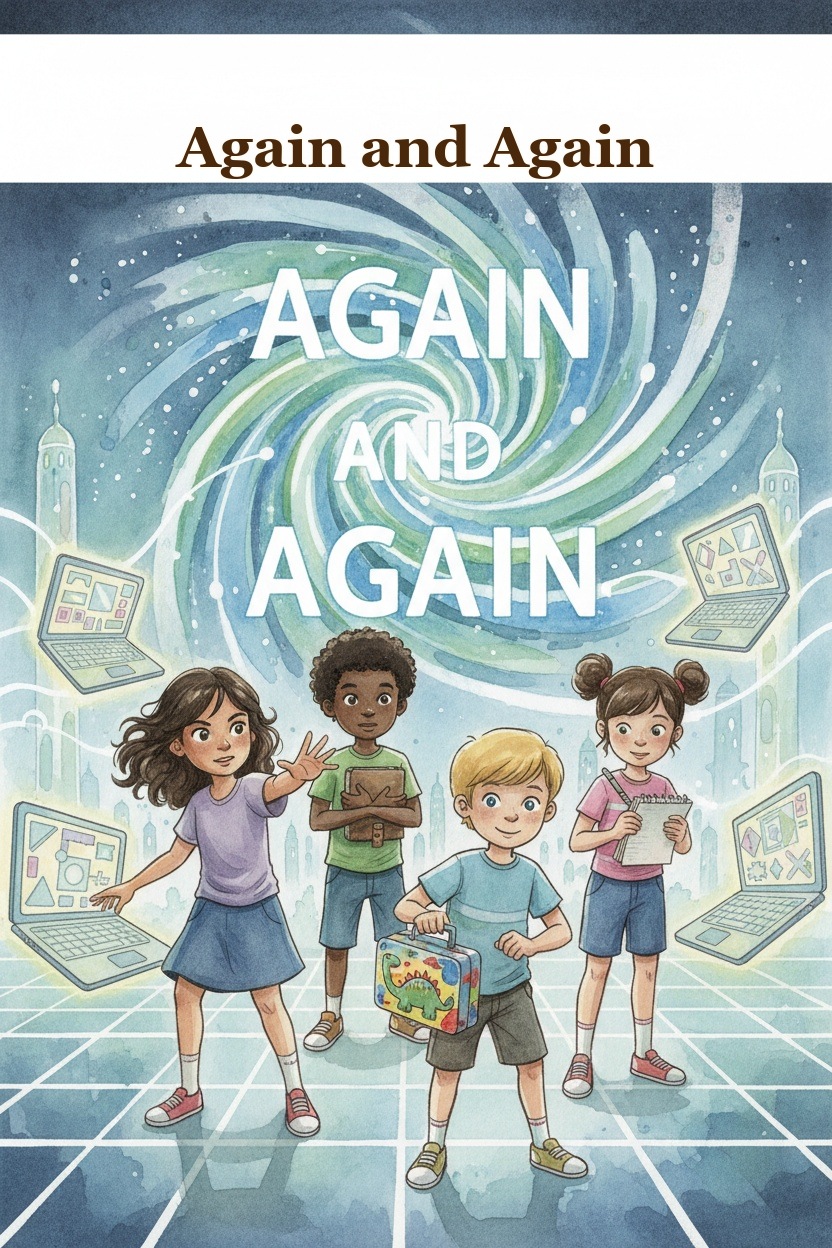
The Loop That Wouldn't Stop
The lost-and-found closet smelled like old sneakers and grape juice. Priya pushed past a bin of mittens and touched the laptop. It hummed, warm as always, and the screen lit up with green text.
"Ready?" she asked.
Kwame adjusted his backpack. Lily was checking something on the back of the laptop—a smudge, maybe. Sam bounced on their heels.
"Ready!"
The screen glowed brighter. The doorway opened. And the four of them stepped into the Grid.
They landed in a part of the Entry Zone they'd never seen before. The train station looked the same—glowing blue-white walls, numbered doors, golden lights—but something was wrong. The hall in front of them stretched forward, then curved back around. The same row of doors. The same flickering light. The same poster of a train that said WELCOME TO THE GRID.
"Wait," said Priya. "We just passed that poster."
They kept walking. The hall curved. The poster appeared again.
"We passed it again," said Kwame.
"How do you know?" asked Sam.
"Because the train in the poster has a bent wheel. It's the same train. We're going in circles."
The hall curved again. The poster appeared again. The same bent wheel.
Lily stopped walking. "We're stuck."
"I refuse to accept that," said Priya. She walked forward, faster this time. The hall curved. The poster appeared. She walked forward again. The poster appeared. She walked forward again.
The poster appeared.
Lily sat down on the floor. "You're turning into a loop," she said. "We all are."
The Same Thing, Again
Sam sat down next to Lily. "What's a loop?"
"It's when something repeats," said Kwame. "Like a song with a chorus. The chorus comes around again and again."
"But songs end," said Sam. "This hall doesn't end. It just keeps going."
Priya stopped pacing and came back to the others. "I counted. There are exactly fifteen doors between the poster and the corner. Every single time."
"Exactly the same?" asked Lily.
"Exactly. Same doors. Same order. Same colors. Same everything."
Lily was already up and moving. She walked to the first door in the row and examined it. "These doors are identical," she said. "Same height. Same handle. Same chip pattern on the wall next to them."
She walked to the second door. Then the third. At the fifth door she stopped.
"Wait," she said. "Door five has a different chip pattern than door four."
"That's not possible," said Priya. "I counted. They're all the same." She walked over and looked. Door four had a chip pattern that went two rows up and three across. Door five went three up and two across.
"They are different," said Priya. Her face did the thing it always did when she was wrong—a tiny flinch, like she'd been poked.
"So the hall isn't perfectly the same each time," said Lily. "Something changes."
What Changes?
The four of them stood in front of door four and door five, studying the chip patterns.
"Maybe last time through, door four had the three-up pattern," said Kwame. "This time it has the two-up pattern."
"So they swapped," said Sam. "The doors are moving?"
"Or the chips are changing," said Lily. She walked back to the poster—the one with the bent wheel—and looked at it carefully. Then she walked to the corner and counted doors backward.
"Door three has four chips in a square," she called. "Last time it had four chips in a square. Door seven has six chips in a row. Last time it had six chips in a row."
"But door four and door five changed," said Sam.
"Yes," said Lily. Her eyes were bright. "Door four and five changed. Nothing else changed. Just those two."
"Why would they change?" asked Kwame.
"Maybe they're the exit," said Priya. "Maybe the hall loops because we haven't noticed the right door changing." She walked to door four and pushed it open.
Behind it was another hall. The same golden lights. The same blue-white walls. The same poster with the bent wheel. The same row of fifteen doors.
"Of course," said Priya. She shut the door.
"Try door five," said Sam.
Priya opened door five.
Another hall. Same poster. Same doors.
She tried door four again. Same hall.
"That's not new, though," said Lily. "When we went through the main hall, door four led to the hall. Door five led to the hall. Now we're in a hall, and door four and door five should still change—"
"Unless the change has already happened," said Kwame. "Maybe the change happens once, and then the loop repeats. We're in a loop of a hallway that's the same each time, except for one change that already happened."
Priya was pacing again. "So we just need to go through the right door at the right time." She looked at door four. Then door five. Then back.
"Maybe there's a pattern to when they change," said Kwame. "Like in a story. The hero tries something three times, and the third time, it works."
"Or the first time it works, and then it stops working," said Sam.
Everyone looked at Sam.
"Like the doors," they said. "Maybe the first time we came through, the doors hadn't changed yet. The world was still loading."
Kwame laughed. "Sam, that's not a thing."
But Lily was nodding. "Sam's right, though. The chip patterns changed, and we don't know when. What if they change every time we go through the loop? What if door four and door five are counting?"
"Counting what?" asked Priya.
"Counting by changing," said Lily. "Each time the loop completes, the chips change. And when they reach a certain pattern, the loop stops."
"Doors can't count," said Priya.
"They can," said Lily. "They're made of the Grid. Everything in the Grid can count. It just does it by changing state."
Sam raised their hand. "But why do they need to count? Why can't they just decide to stop?"
The Error That Meant Something
"Because a loop needs something to be different each time," said Kwame slowly. "That's what Sam is asking. The doors changed—that's the different thing. But what are they changing toward?"
"I don't know," said Lily. She was on her knees, staring at door five's chip pattern. "Two up, three across. Door four is three up, two across. They're mirrors of each other."
"Mirrors," said Priya. She stopped pacing. "The whole hall is a mirror. The poster has a bent wheel. The doors are in the same order. The hall curves back around like a reflection."
"So door four and door five are the mirror point," said Kwame. "The place where it turns around."
Lily reached out and touched the chip pattern on door five. It clicked. The chips rearranged themselves—three up, two across.
Door four's chips rearranged too—two up, three across.
"They switched again," said Sam. "Now they're opposite."
"This is a very small difference," said Priya. "Why would the Grid make a loop that's almost but not exactly the same every time?"
"Because it's not a loop yet," said Lily. "It's a loop being built. The doors are the condition." She stood up and faced the others. "Every loop needs something to be different each time, or it runs forever. The doors are the difference. But if we don't figure out what they're counting toward, the loop will run forever."
As she spoke, the walls trembled. A red-bordered box flickered into existence in the air beside them:
ERROR: Loop has no exit
"Oh no," said Kwame.
"That's the worst one," said Priya. "That's the one that means forever."
"It doesn't mean forever," said Lily. "It means we haven't given the loop an exit yet. And a loop always needs an exit. We just have to build one."
"We can't build anything," said Priya. "We're in a hallway!"
Lily was already moving. She walked to the poster with the bent wheel and lifted it off the wall.
Behind it was a small box. The box had two buttons.
One button said REPEAT. The other said STOP.
"Of course," said Lily. "The loop needs something to be different each time. We gave it that. The doors changed. But it also needs a stop condition. The Grid doesn't decide when to stop—we tell it."
She reached out and pressed STOP.
The hallway flickered. The poster clicked back onto the wall. Door four and door five realigned their chips into matching patterns. And at the end of the hall, where the corridor had curved back around, a new doorway opened: a straight passage, a golden light, the way forward.
The red error message blinked once and disappeared.
Kwame's Journal
That night, back in the real world—the lost-and-found closet, the smell of old sneakers, the laptop closed and hums quiet—Kwame wrote in his journal:
"Today we learned that a loop is like a story that repeats until something changes. The hallway was the same every time, almost, but not quite. The doors kept swapping their patterns. At first we thought it was a mistake. It wasn't. The change was the point. A loop needs something to be different each time, or it just goes on and on forever. The difference is what gives it a reason to stop.
The Grid didn't want us stuck. It wanted us to see the change. Once we saw it, we could find the stop button. That's the secret: loops are powerful because they repeat, but they're useful because they end. A song that never ends isn't a song. It's noise. A loop that never ends isn't a loop. It's a trap. The trick is to know when to press STOP."
Priya read over his shoulder. "You made that sound almost poetic."
"Loops are poetic," said Kwame. "They're the universe's way of saying 'try again, but this time pay attention.'"
Sam yawned. "Can we go home now?"
"Already home," said Lily. She was looking at the laptop's screen. It flickered once—a single line of green text:
LOOP TERMINATED. WELL DONE.
Then it went dark.
The four of them sat in the lost-and-found closet, surrounded by mittens and sneakers, and for a moment the world felt very small and very safe.
"Same time next week?" asked Sam.
"Same time," said Priya. "If the laptop lets us."
"The laptop always lets us," said Kwame. "It's just waiting for us to be ready."
They filed out of the closet, one by one, and the door clicked shut behind them. Inside, the laptop glowed quietly in the dark, already waiting for the next time they were ready to learn something new.