Chef Sparks Kitchen Lab
THE MAGIC IN THE OVEN
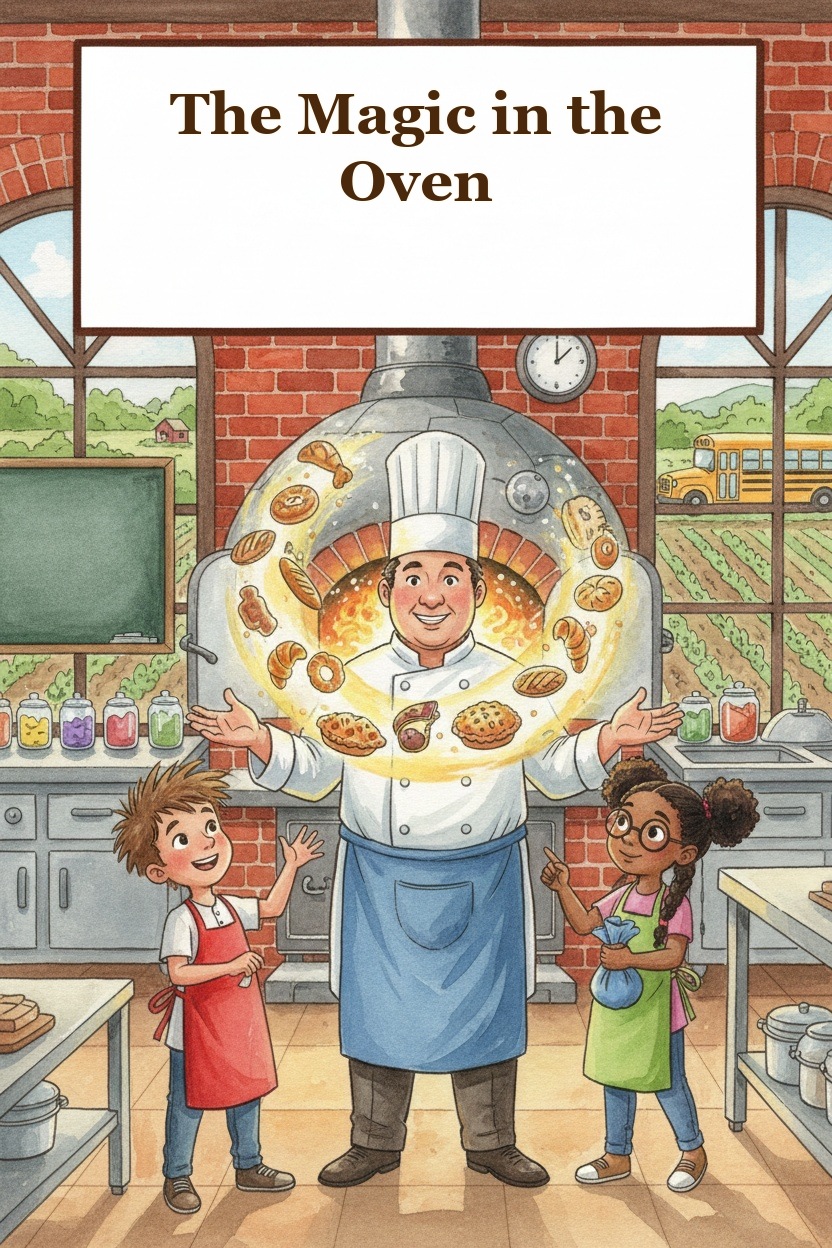
The Mysterious Oven
The Riverside Fire Station smelled like sugar before the students even opened the door.
Maya Okonkwo arrived first, as always, because she needed to check the kitchen. But today she stopped in the doorway and sniffed. "Something's already baking."
"That's impossible," said Tommy Reyes, pushing past her. "Class doesn't start for ten minutes."
But Maya was right. The great stainless steel range at the center of the converted fire station bay was warm, and on the counter beside it sat a single cake—round, golden, with a perfect crack across its top that showed pale yellow sponge beneath.
Priya Subramaniam came in behind them and immediately walked over to look at it. "It's a Victoria sponge," she said. "Ammamma makes these. She says the secret is patience."
"The secret," said Chef Ignacio "Iggy" Spark, emerging from the pantry with a bag of flour in each arm, "is chemistry."
The Spark Effect claimed its first victim of the day: a wooden spoon clattered off the counter and landed at Tommy's feet. Tommy picked it up and placed it in the bucket labeled SPARK EFFECT PREDICTION POOL—where nobody had ever predicted correctly, because predicting it was, as Iggy always said, epistemologically impossible.
"Chemistry?" Tommy asked.
"Chemistry," Iggy confirmed. "And not the kind where you mix two clear liquids and watch them turn purple. The kind where you mix flour, sugar, eggs, and butter, put them in a hot box, and they become something that didn't exist before."
He set down the flour and gestured dramatically at the cake. "Every time you bake, you are running a laboratory experiment. The oven is your equipment. The ingredients are your chemicals. And the cake?" He paused for effect. "The cake is your data."
Maya looked at the cake with new respect. "What did we learn from this data?"
"Ah," said Iggy. "That's what today is about."
The Ingredients That Argue
Iggy gathered the class around the prep table. On it sat seven small bowls, each containing a different ingredient.
"Let's start with a question," he said. "What is a cake, physically?"
"It's delicious," said Tommy immediately.
"True, but not chemically informative. Priya?"
Priya considered. "It's... a solid? But it's soft. It's like a foam that set."
"Excellent! A foam that set. Maya?"
Maya leaned in. "It's mostly air. When you cut it, you can see the holes. But the holes are held up by something."
"The holes are held up by something," Iggy repeated, delighted. "That's exactly right. And what holds up the holes?"
He picked up the bowl of flour. "This does. Flour contains two proteins—gliadin and glutenin. When you add water and mix, they join together to form gluten. Gluten is like a net made of protein. It catches the gas bubbles that form inside the cake and holds them up, the way a hammock catches you and holds your shape while you lie in it."
Tommy nodded slowly. "So flour makes the hammock."
"Flour makes the hammock. And what fills the hammock?"
Iggy picked up the bowl of eggs. "Eggs. Specifically, the yolks. Egg yolks contain fat and protein—some of the best fat and protein you can cook with. They trap air when you beat them. That air expands in the oven and becomes the holes in your cake."
He set down the eggs and picked up the sugar. "Sugar does three jobs. First, it makes things sweet, obviously. Second, it helps trap air when you cream it with butter—the sharp edges of the sugar crystals poke little pockets into the fat. And third, it holds onto water, which keeps your cake moist."
"Sugar is busy," said Maya.
"Sugar is very busy. And so is this." Iggy picked up the butter. "Fat is the tenderness ingredient. Gluten makes structure—that's a good thing, a strong thing. But if your cake has too much structure, it's tough. Fat gets in between the gluten strands and shortens them. That's why we call it shortening! Fat makes the cake tender, moist, and rich."
Priya raised her hand. "Why do you cream the butter and sugar together before you add anything else?"
"Ah!" Iggy's face lit up. "Because that's where the air comes from! When you beat cold-ish butter with sugar, you're forcing air into the mixture. Those little air pockets get coated with fat, and then they survive until the oven heat expands them. The cake rises because you trapped air before it ever went into the oven."
He pointed to the remaining bowls. "And then we have the leavening agents."
"Baking powder?" said Tommy.
"Baking powder," Iggy confirmed. "And baking soda. These are chemical air-makers. Baking soda is a base. When it meets an acid—like buttermilk or lemon juice or natural cocoa—it produces carbon dioxide gas. Baking powder has both the base and the acid built in, plus a little bit of cornstarch to keep them from reacting too early."
"So the baking powder makes bubbles," said Maya.
"The baking powder makes bubbles. Hundreds of millions of tiny bubbles. And the gluten hammock catches them, and the egg foam helps hold them, and the sugar keeps everything moist, and the fat keeps everything tender."
Iggy held up the last bowl. "And salt. Just a pinch. Salt doesn't taste salty in a cake—it does something better. It makes everything else taste more like itself. It brightens the sweetness, rounds out the flavors, and strengthens the gluten structure."
"That's seven ingredients," said Priya. "Seven ingredients doing seven different jobs."
"Working together," said Iggy. "And that's the thing about baking that's different from other cooking. When you're making soup, you can add a bit more water or throw in an extra carrot and it'll be fine. But baking is chemistry. The proportions are not negotiable. The reactions are not optional. If you change the amount of sugar, you change how much air gets trapped. If you change the amount of flour, you change how strong the gluten net is. If you leave out the salt, everything tastes flat."
He pointed at the cake. "That cake came out of the oven because every ingredient did its exact job in its exact amount. Baking is chemistry with delicious consequences."
The Wrong Batch
"Let's see what happens when the chemistry goes wrong," said Iggy.
He reached under the counter and produced a second cake. This one was flat, dense, and looked slightly sunken in the middle.
"This is my first attempt at today's demonstration," he said. "I made it last night, after the class went home."
"What went wrong?" asked Maya.
"I made the batter, and then I got distracted," said Iggy. "I was thinking about whether we could measure how many air pockets are in a cake, and I forgot to add the baking powder."
Tommy gasped. It was a dramatic gasp. "You forgot the chemical air-maker?"
"I forgot the chemical air-maker. And without it, no carbon dioxide gas. No bubbles. No rise. The gluten hammock had nothing to catch, so the whole structure just—collapsed into itself."
He cut into the cake. The knife went through without the resistance of a proper sponge, and the interior of the cake looked dense and heavy, like a slice of nutless fruitcake.
"This," said Iggy, "is what happens when the chemistry is incomplete. It's still edible. It's not poisonous. But it's not a Victoria sponge. It's a reminder that in baking, every ingredient has a job."
He set the failed cake aside. "Now, who wants to make a successful one?"
The Test
The class assembled around the prep tables. Iggy had set up stations with all the equipment they'd need: mixing bowls, whisks, measuring cups, and a recipe card clipped to each station.
"The recipe we're making," said Iggy, "is a classic Victoria sponge. It's named after Queen Victoria, who reportedly loved the cake—which means she loved chemistry and didn't know it."
He walked them through the ingredients, weighing each one carefully. "Here's the secret to baking: weigh, don't guess. A cup of flour can weigh different amounts depending on how it was packed. But a gram is a gram is a gram. In chemistry, we measure precisely, because the reaction depends on exact proportions."
Maya weighed out her flour and then paused. "How much sugar are we using?"
"The same weight as the flour. And the same weight of butter. And the same weight of eggs—in their shells."
"Equal weights?" Tommy looked confused. "That's it?"
"That's the classic formula. Equal parts flour, butter, sugar, and eggs. This cake has been made this way for over a hundred years because it works. The proportions give you exactly the right balance of structure, tenderness, moisture, and rise."
Priya cracked her eggs into a small bowl. "My Ammamma doesn't weigh things. She just knows by looking."
"That's because she's been making these cakes for sixty years," said Iggy. "She's internalized the chemistry. She knows what the batter is supposed to look like because she's seen it a thousand times. She doesn't need to weigh because her eyes and her hands are holding the recipe."
"At some point," said Iggy, "your hands can hold the recipe too. But today, we use the scale."
The class creamed their butter and sugar, beating until the mixture was pale and fluffy. Iggy walked around, watching each station. "More air," he said to Tommy. "I know you want to stop, but beat it more. You're making the air pockets that will become the cake's structure."
They added the eggs one at a time, folding gently, and then the flour—sifted, to add more air. The batter was smooth and thick, and when Iggy lifted his spatula, it dropped off in a slow, thick ribbon.
"That ribbon," he said, "is your dough telling you it's ready. The gluten has formed. The air is trapped. The chemistry is set. All that's left is to apply heat."
The cakes went into the oven—each station's batter divided into two tins, then placed on the middle rack. Iggy set the timer.
"Now we wait," he said. "And I want you to pay attention to what you can smell in about fifteen minutes."
"Caramelization?" said Priya.
"Part of it. And what else?"
"The heat is making the baking powder produce gas," said Maya. "The bubbles are expanding. The cake is rising."
"The cake is rising," Iggy confirmed. "The eggs are setting—the protein is denaturing, changing from liquid to solid. The gluten is stretching and then setting into structure. The sugar is caramelizing on the edges. The outside of the cake will get brown through the Maillard reaction—the same reaction that makes toast, and steak, and everything else delicious."
That's when the Spark Effect claimed its second victim: Iggy's timer clattered off the counter and skittered across the floor. Tommy caught it.
"Twenty minutes," he said. "That's not a prediction—that's a fact."
The Lesson in the Oven
When the timer went off, the cakes had risen perfectly. Each one was golden on top, with the characteristic slight crack across the center.
"They look like the store version," said Maya.
"They look better," said Tommy.
Iggy helped them turn the cakes out onto wire racks to cool. "The chemistry is still happening even now," he said. "Inside those cakes, the structure is setting. The moisture is evening out. If you cut them right now, they'd crumble—not because you did anything wrong, but because the chemical process isn't finished."
"So the oven isn't the only place where chemistry happens," said Priya.
"The oven starts the reaction. The cooling finishes it. Cooking isn't just one moment—it's a process."
While the cakes cooled, Iggy showed them how to assemble them: a layer of strawberry jam, a layer of vanilla buttercream, and then the second cake on top, dusted with sugar.
"This is the classic Victoria sponge," he said. "Jam in the middle. Buttercream in the middle. Nothing on top except a little snow of sugar."
"When can we eat it?" asked Tommy.
"We can eat it when it's cool," said Iggy. "Which is part of the lesson, too. Patience is an ingredient."
When they finally cut into the cakes, the sponge was light and springy. The slices held their shape. The crumb was soft and even.
Tommy took the first bite, chewed thoughtfully, and made the two-note sound. The Tommy hum. It meant success.
"This is better than the store," he said. "Because I know why it works."
"That's the whole point," said Iggy. "Understanding your food is an act of care. When you know what each ingredient does, you're not just following a recipe. You're witnessing a reaction. You're watching chemistry in action, and you're the one who made it happen."
He looked at the assembled sandwiches—the beautiful sponges, the jam, the buttercream. On the counter behind him, the failed cake sat untouched.
"If you want the magic," said Iggy, "you have to do the chemistry. The magic is the chemistry."
Kitchen Lab Notes
Dear Students,
Today we learned that baking is chemistry—and that's a good thing. Every ingredient has a job. The flour makes gluten, which gives structure. The eggs provide protein and fat. The sugar sweetens, holds moisture, and traps air. The fat makes things tender. The baking powder makes bubbles. And salt makes everything taste more like itself.
Try thinking about this the next time you eat bread, or a muffin, or a pancake. What ingredients went into it? What job did each one do? And what would happen if one of them were missing?
The question I'll leave you with: what other recipes are actually chemistry experiments wearing a delicious disguise?
— Chef Spark
Kitchen Lab Recipe: Classic Victoria Sponge
Ingredients:
-
200g (7oz) unsalted butter, softened
-
200g (7oz) caster sugar
-
4 large eggs
-
200g (7oz) self-rising flour
-
1 teaspoon baking powder
-
A pinch of salt
-
3 tablespoons strawberry jam
-
200ml (3⁄4 cup) heavy cream, whipped with 1 tablespoon powdered sugar (for buttercream—or use store-bought)
Equipment:
Two 20cm (8-inch) round cake tins, lightly greased and lined with parchment. Digital scale (Iggy insists).
Steps:
-
Preheat the oven to 180°C / 350°F.
-
In a large bowl, cream the butter and sugar until pale and fluffy. This takes about 5 minutes of beating—this is where the air gets trapped!
-
Add the eggs one at a time, beating well after each. If the mixture looks curdled, that's okay—it'll come back together when you add the flour.
-
Sift in the flour, baking powder, and salt. Fold gently with a spatula until just combined. Fold, don't stir—stirring bursts the air bubbles.
-
Divide the batter evenly between the two tins. Smooth the tops.
-
Bake for 20 minutes, until golden and the tops spring back when pressed gently (or a skewer inserted comes out clean).
-
Cool in the tins for 5 minutes, then turn out onto a wire rack to cool completely. Patience, remember.
-
When completely cool, spread jam on one cake, whipped cream on the other, and stack gently.
Iggy's Chef Note: Weigh your eggs in their shells. If they don't equal your other ingredients, adjust the flour and sugar to match the egg weight. This is the chemistry ratio at work. The cake doesn't care if your recipe is from a hundred years ago—it only cares about the proportions.