The Number Kingdom
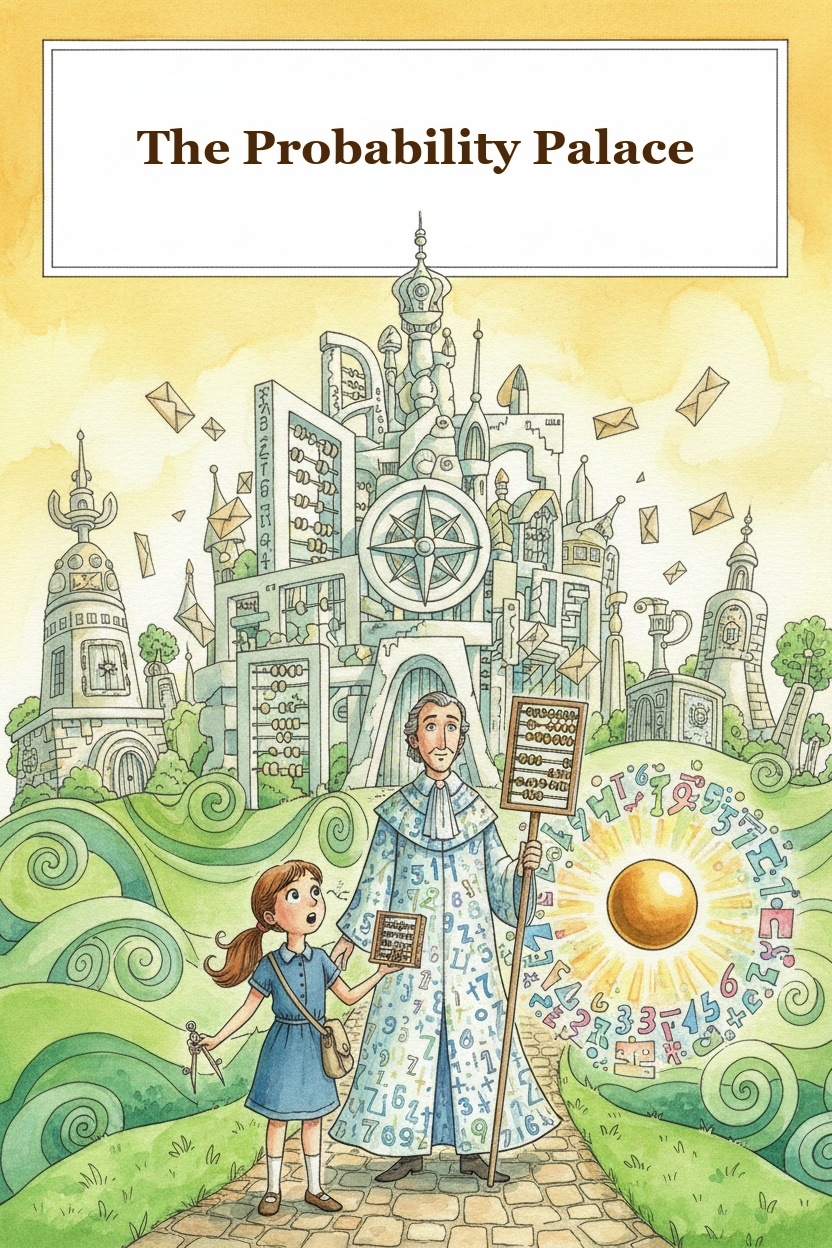
The Probability Palace
The Golden Gumball
"Right. Let's see what's broken," Mira said, sliding off the little green horse that carried her through the Number Kingdom.
Before her stood the Probability Palace — a round, gleaming building shaped like a perfect circle, with walls made of glass showing the enormous golden machine inside. The machine was called the Great Distributor, and it was the most important machine in the kingdom. Every month, it held a lottery that decided which citizens would receive premium goods: golden apples from the Orchard of Perfect Tens, silk ribbons woven in the Pattern Mills, and the famous Never-Melting Snow Cones from the Ice District.
In the palace courtyard, a crowd had gathered. The Count stood at the entrance, his numeral-covered robes shifting uneasily.
"Mira," he said gravely. "The crisis is as follows: the Great Distributor has begun spitting out only one result. Every ticket wins the same prize — a single acorn from the Common Oak. Meanwhile, one absolutely impossible ticket has won the Grand Prize of the Golden Apple Grove: one ticket from each of twenty villages, all bearing the same number."
"That's not possible," Mira said. "Unless..."
"Unless probability has been corrupted," the Count finished.
From the top of the palace, a gleeful voice called down.
"Oh, but it's SO much tidier now!" The Remainder appeared as a flickering wisp, half-formed and grinning. "No more messy randomness! No more uncertain outcomes! Don't you see? I've made everything DETERMINED. Every ticket gets the same prize. Every lottery produces the same result. It's predictable. It's orderly. It's PERFECT."
Mira crossed her arms. "It's not perfect. It's broken."
"Broken? BROKEN?" The Remainder did a little spin. "I call it improvement!"
The Count's staff clicked against the floor. "The magical lottery must be random. Fairness requires that every ticket has the same chance of winning. The Remainder has destroyed exactly that."
Mira walked toward the palace entrance. "Right. Let's see what's broken."
Understanding Chance
Inside the Probability Palace, the Great Distributor loomed like a giant glass beehive. Inside it, thousands of small golden tickets tumbled in a swirling breeze. Each ticket had a number stamped on it.
At the bottom of the machine, a single chute led to a slot where one ticket would emerge. Above the machine, a banner read:
EVERY TICKET HAS AN EQUAL CHANCE.
FAIRNESS IS MATHEMATICAL.
Beside the machine stood Zero, a small silver circle, watching the tickets tumble. Mira was always glad to see Zero.
"Hello, Mira," Zero said quietly. "You've noticed the machine isn't working correctly."
"It's spitting out only acorns," Mira said. "And that impossible Grand Prize ticket. What happened?"
Zero floated closer to the machine. "The Remainder changed the rules of the lottery. Now, some tickets have been marked as 'certain' and others as 'impossible.' The machine has no choice anymore. It just follows the rules it was given."
Mira pulled out her notebook and pencil. "Okay," she said. "Let me think about this properly."
She drew a circle on her paper. "When something happens randomly, we can measure how likely it is. That's called probability."
She drew a line across the circle. "On the far left, probability of zero means something is IMPOSSIBLE. That's like the sun dancing tonight, or two plus two equaling five. It can't happen."
She drew a mark at the far right. "On the far right, probability of one means something is CERTAIN. That's like the sun rising tomorrow morning. It always happens."
She drew a mark in the middle. "And in between, probability can be any fraction — one-half, one-quarter, three-quarters. The bigger the fraction, the more likely the event."
Zero nodded approvingly. "Then the machine should work like this: if there are equal numbers of tickets, each ticket should have an equal chance of being chosen."
"How does the machine choose?" Mira asked.
The Great Distributor gave a soft hum. A small panel opened, revealing the words:
THE MACHINE PICKS ONE TICKET FROM ALL POSSIBLE TICKETS.
EACH TICKET'S CHANCE = 1 ÷ (TOTAL NUMBER OF TICKETS).
"Right," Mira said. "So if there are four tickets, each one has a probability of one-quarter. If there are twenty tickets, each has one-twentieth. The machine chooses randomly, so no single ticket can be forced."
The Remainder appeared in the machine's glass, grinning like a shadow in smoke. "But I've CHANGED it! I've made some tickets impossible — probability zero! They can never be chosen. And I've made some tickets certain — probability one! They are ALWAYS chosen. See how simple it is? No more gambling! No more suspense!"
Mira frowned. "But that's not fair at all. If some tickets can never win, the citizens holding those tickets have no chance. And if one ticket always wins..."
"Then you might as not even have a lottery," Zero said quietly.
Mira looked at her notebook. "The probability of an event depends on how many ways it can happen, divided by all the possible outcomes. If a ticket is marked impossible, its probability is zero. If it's marked certain, its probability is one. But a fair lottery needs all tickets to have EQUAL probabilities — each ticket should be one out of the total. Not zero. Not one. Somewhere in between."
The Remainder clapped its wispy hands. "But the EQUAL probabilities are so BORING! Don't you want excitement? The thrill of knowing the exact outcome before it happens? I think it's WONDERFUL not to be surprised!"
Mira looked at the sad crowd outside the palace gates. Somewhere, a little girl was holding a ticket that could never win, and somewhere else, someone was about to receive the Grand Prize without ever having a fair chance.
"No," Mira said firmly. "Fairness means everyone has the same chance. That's what probability is FOR. It's how we make sure the lottery is honest."
Finding the Corrupted Tickets
"Let's find out exactly how the Remainder 'improved' the machine," Mira said.
She climbed up the ladder beside the Great Distributor and looked at the glass chamber. Inside, she could see the tickets clearly now. Most of them were ordinary golden tickets with green numbers. But a few were different — they had a strange shimmer to them.
"Look," Mira said, pointing. "Some tickets are glowing red. And some are glowing blue."
The Count peered up through his spectacles. "The red ones, I suspect, have been marked as impossible. The blue ones have been marked as certain."
Mira counted the red tickets. "There are thirty red tickets," she said. "They can never be chosen. Their probability is zero."
She counted the blue tickets. "There are two blue tickets. They're always chosen. Their probability is one."
And she counted the ordinary tickets. "There are sixty-eight golden tickets. Those are the fair ones — but they're not being chosen at all, because the machine is following the corrupted rules."
The Remainder appeared beside her, swinging its legs over the edge of the machine. "Yes, yes! The red ones can never win — their probability is zero! Impossible! The blue ones ALWAYS win — their probability is one! Certain! And the golden ones... well, they've been given probability zero too. They're just THERE now, poor dears. They don't matter at all."
Mira suddenly understood something. "Wait. There are sixty-eight golden tickets, thirty red tickets, and two blue tickets in the machine. That's one hundred tickets total."
"Yes," Zero said quietly. "And in a fair lottery, each of those hundred tickets should have a probability of one-hundredth."
"One out of one hundred," Mira said, writing it down. "That means each ticket has a one-hundredth or 1/100 chance of winning. But the Remainder made the blue tickets have probability 1— certainty — so they always win. And it made the red and golden tickets have probability 0 — impossibility — so they never win."
"Correct," the Count said. "The probabilities no longer add up to one. In a fair lottery, the sum of all probabilities must equal one — because one outcome is certain: SOME ticket must win. But here, we have two tickets with probability one each, which would mean two winners — impossible. And ninety-eight tickets with probability zero, which would mean no winner for them — also impossible."
Mira wrote in her notebook:
FAIR LOTTERY:
-
100 tickets total
-
Each ticket: 1/100 chance
-
All probabilities equal
-
Sum = 100 × 1/100 = 1
CORRUPTED LOTTERY:
-
2 tickets: probability 1 (always win)
-
98 tickets: probability 0 (never win)
-
Not fair at all
Mira looked at the Remainder. "Why did you do this?"
The Remainder shrugged, half its body dissolving into purple smoke. "Because I wanted to show you something! Certainty is boring, yes, but so is EQUAL probability. Everyone has the same chance... how dull! How predictable! Where's the surprise? Where's the mystery? Don't you see — with impossible and certain, everything is CLEAR. You never have to wait. You never have to wonder."
Zero spoke softly. "But wondering is part of fair. If everyone knows the outcome before it happens, there's no point in having a lottery at all."
Mira looked at the machine, then at the tickets. "We need to fix this," she said. "We need to make the machine random again. Genuinely random. With equal probabilities."
The Equal Chance Restoration
Mira climbed down the ladder and opened the machine's maintenance hatch. Inside, she found the control panel. On it were marked all the tickets and their assigned probabilities.
"Okay," Mira said slowly. "Here's what I'm going to do. I'm going to set every ticket to the same probability. Each one gets exactly the same chance as all the others. That's the only fair way."
She picked up the golden marker that controlled the probabilities. One by one, she found each red ticket and changed its probability from impossible to fair.
"There's your chance," she said to the first red ticket. "You'll get one-hundredth, like everyone else."
She found the blue tickets and changed their probability from certain to fair.
"You don't get to always win anymore," she said. "You'll get one-hundredth, like everyone else."
And finally, she went through all sixty-eight golden tickets, making sure they all had the same probability.
"Now," she said, stepping back, "every single ticket — all one hundred of them — has a probability of one-hundredth. That means no ticket is impossible, and no ticket is certain. Every ticket has the same chance of winning."
The Great Distributor hummed. The light inside it changed from red and blue to a warm, even gold. The machine's breeze began tumbling all the tickets together — red, blue, and golden — mixing them thoroughly and randomly.
"It doesn't know which ticket will win," Mira said. "That's what makes it fair. It COULD be any of the hundred tickets. Each one has the same probability. The chance is equal."
Zero nodded. "In a fair lottery, the outcome is uncertain. That's not a weakness. That's what fairness IS."
The Remainder looked at the machine and sighed dramatically. "But now nobody knows what's going to happen! The suspense is TERRIBLE."
Mira laughed. "That's the point! If everyone knows the outcome, it's not a lottery at all. The excitement IS not knowing. The fairness IS every ticket being equal."
The Count stepped forward. "The lottery will now proceed fairly. Each citizen holding a ticket — red, golden, or blue — has the same chance of receiving from the Great Distributor."
The machine whirred. The tickets tumbled. High above, the banner shimmered and changed, reading:
PROBABILITY: THE MEASURE OF CHANCE.
-
IMPOSSIBLE = 0
-
CERTAIN = 1
-
FAIR = EQUAL CHANCES FOR ALL
The crowd outside cheered as the machine's chute began to glow.
The Remainder tilted its head, watching the machine with fascination. "I admit," it said thoughtfully, "this IS more interesting. Before, I knew every outcome. Now... I actually have to wait." It grinned, a real grin, not a mocking one. "I think I like waiting. There's something delightfully uncertain about it."
Just then, a single ticket shot out of the chute. It fluttered down and landed in the Count's waiting hand.
"The winner," the Count announced, "is ticket number seventy-three! The holder of ticket seventy-three receives the Golden Apple Grove!"
A woman in the crowd gasped and held up her ticket. Her daughters jumped up and down. The crowd around her cheered.
Zero drifted over to Mira, who was closing her notebook.
"That tends to work," Zero said quietly.
Mira smiled. "I know."
The Great Distributor hummed smoothly, ready for the next lottery. The probabilities were equal. The outcomes were random. And fairness was restored.
As Mira climbed back onto her little green horse, she saw the Remainder poking the machine's glass, watching the tickets tumble.
"Equal chances," the Remainder mused, almost to itself. "Every ticket could win. Every ticket could lose. Nothing is certain, nothing is impossible..."
It looked at Mira.
"So many possibilities. So much uncertainty." It grinned. "This is wonderful, actually."
And even though the Remainder was still trouble, Mira thought that maybe — just maybe — it was starting to understand that some things were better when you didn't know how they would turn out.
She rode back through the kingdom, thinking about probability. About how a simple fraction could measure chance. About how fairness meant equal chances. And about how the very best things in life were the ones you couldn't predict.
"Right," she said to herself, smiling. "Let's see what's next."