Professor Plunks Impossible Lab
Very Very Small World
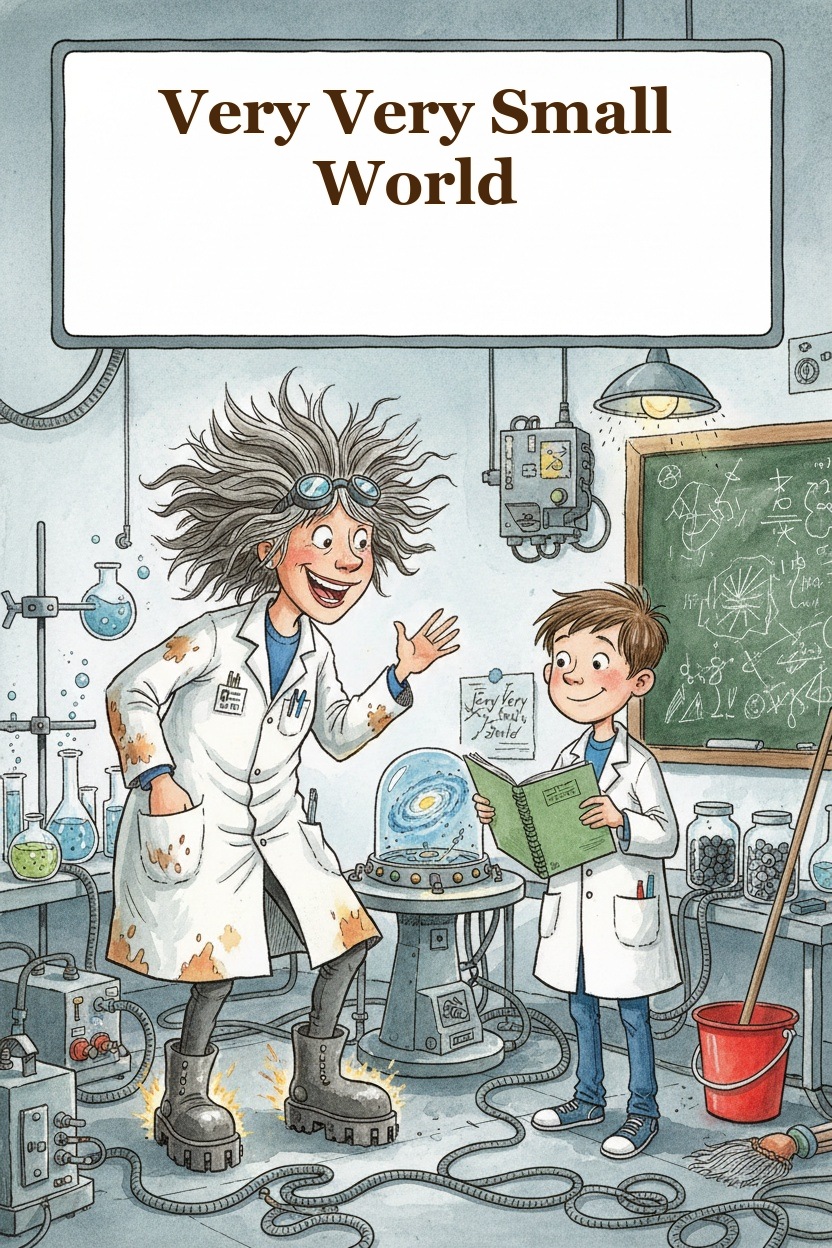
The Announcement
Professor Plunk burst through the lab door with a poster tube under one arm and a model of something round and lumpy under the other. Her safety goggles were on her forehead, which Otto had learned was either a good sign or an extremely bad sign.
"My careful colleague!" she announced. "Today, we explore the very, very small world inside the atom!"
Otto looked up from his notebook. "We did atoms last week, Professor. The holographic display rearranged my hair into electron shells."
"Inside the atom, Otto! Deeper! Smaller! We're going to see the nucleus!"
She unrolled a poster showing a tiny ball of circles with arrows pointing in every direction. Otto recognized it from his science books. It looked like a cluster of grapes that had been terribly offended.
"The nucleus," Plunk said, tapping the poster, "contains protons and neutrons. The protons have positive charge. And as we learned in Book 15, like charges repel each other."
"That's why magnets with the same poles push apart," Otto said, writing in his notebook.
"Exactly! So here's the puzzle. If you put a bunch of protons together in a nucleus, they should push each other apart. Yet they don't. They stay together. Does anyone know why?"
Otto thought about it. "Is it because the nucleus is too small to bother? Like when you have two magnets that are really small and they just... don't?"
Plunk's face lit up. "Otto, that's a beautiful guess, and it's absolutely wrong in a wonderful way! The forces between protons get stronger as they get closer, not weaker. By all logic, the nucleus should explode instantly. Every atom in the universe should fall apart!"
She paused dramatically.
"And yet you're standing there. And I'm standing here. And the universe hasn't fallen apart."
Otto looked at his hands as if checking they were still attached.
"So something else must be holding the nucleus together."
"YES!" Plunk shouted, making Otto jump. "And that something is the strong nuclear force! It's the strongest force in the universe! It's what holds everything together!"
She threw open her arms. "And today, Otto, we're going to build a scale model of a nucleus so we can see the strong force at work!"
The Model
The construction took most of the morning.
Otto's notebook entry from that period read:
9:15 AM: Professor Plunk says we are building a "one-billionth scale model" of a carbon nucleus. She says it will be "small enough for the workbench but big enough to see."
9:47 AM: The metal balls have arrived. There are six red ones (protons) and six blue ones (neutrons).
10:22 AM: I asked how the strong force will be demonstrated. Professor Plunk said "magnets, but stronger." This is not as reassuring as she seems to think.
10:58 AM: The machine that builds the machine is now building the model. I don't know why we needed a machine that builds a machine. Professor Plunk says it's "efficiency."
The machine that built the machine was called the Scale Model Apparatus, Mark Three. It had a lot of gears, a great deal of tubing, and a small sign that said "SET SCALE:__" with a dial.
The problem, Otto would later discover, was that the dial had been set to the wrong number.
"One billionth scale!" Plunk shouted, cranking the dial with both hands. "Six protons and six neutrons, each one about the size of a golf ball, held together by the strong nuclear force!"
She pressed a large green button.
The machine hummed.
The machine whirred.
The machine made a sound like a very large yawn.
And then it began to produce golf balls.
Plastic golf balls. Glass golf balls. Some that looked like they might be made of actual stone. They poured out of the machine in a long, rattling stream, filling baskets and buckets and eventually wheelbarrows.
"Hmm," said Plunk.
Otto looked at the growing mountain of balls. "Professor, how many golf balls are there supposed to be?"
"Twelve," Plunk said. "A dozen. Six red and six blue. The scale model of a carbon nucleus!"
Otto looked from the poster to the growing pile. There were already more than a dozen. Far more. "Professor, I think the dial might be wrong."
Plunk leaned in to look at the dial. Her eyes went wide. "One millionth of a billionth scale," she read. "That's... hmm."
She straightened up. "Well, the strong force will just have to keep up! Gloriana!"
Gloriana appeared in the doorway, her tool belt jingling. She looked at the mountain of golf balls, then at Plunk.
"Yes," she said.
"Can you bring the huge electromagnet from the Magnet Lab? The one that isn't actually a magnet anymore because of the Incident?"
Gloriana nodded once and left.
"The strong nuclear force," Plunk explained, "works like a super-strong magnet but much, much more powerful. It only acts over a tiny distance, but within that distance, it's the strongest thing in the universe!"
She grabbed two of the red balls and held them up. "These represent protons. They're positively charged, so they should repel each other..."
She pushed them toward each other. Otto saw her straining.
"But the strong force should overcome that repulsion! It should pull them together!"
The balls snapped together with a loud CLACK.
Otto leaned closer. "They're holding together?"
"Look at that! The strong force, Otto! See how it overcomes the electrical repulsion? The protons want to fly apart, but the strong force holds them together!"
Clack. Clack. Clack.
The machine kept producing balls. Gloriana returned with the world's largest electromagnet on a cart, and Plunk attached it to the mounting frame above the growing pile.
"Electricity makes the magnet strong!" she shouted over the machine's grinding. "And the strong force is even stronger! That's why nuclei are stable!"
The Neighbourhood Problem
By noon, the model had escaped the lab.
The Scale Model Apparatus, Mark Three, had produced approximately one million golf balls. They had filled the lab, then the corridor, then the staircase, and were now, Otto realized with horror, flowing out the front door of the Plunk Institute of Physics and Related Mishaps and across the street.
"Professor," he said, his voice very calm, "I think the scale model is bigger than the neighbourhood."
Plunk looked up from the electromagnet, which was now the size of a small car. "Nonsense, Otto! It's just — oh. Look at that."
Gloriana looked out the window. Across the street, a small crowd had gathered to watch golf balls pour out of the building like a very weird river.
"Council," she said.
"Right," said Plunk. "The notice."
Otto found her three minutes later in her office, writing a letter on official lab letterhead.
To the City Council Planning Department:
I regret to inform you that our scale model of a carbon nucleus is somewhat larger than anticipated. The strong nuclear force demonstration is currently occupying most of Maple Street and all of the park. Please advise on parking arrangements for the additional protons.
Yours in physics,
Professor E. Plunk
"Will that help?" Otto asked.
"Probably not," she said cheerfully, signing her name with a flourish. "But politeness is important! You know, Otto, says a lot about the strong force that even a million golf balls are easier to manage than a single nucleus without it."
"How do you mean?"
She held up two of the balls. "Watch." She pushed them together, and they snapped into place. "Strong force: holding protons together. This is the same force that keeps your atoms from falling apart right now. Every proton in every atom in your body stays put because of this force."
Otto looked at his hands again. "Even though all the protons in my body want to push each other apart?"
"Every single one. The electromagnetic force says 'go away' and the strong force says 'stay here' — and the strong force wins. It always wins. That's why matter doesn't just... dissolve."
She paused, and her voice became softer. "The strong nuclear force is the reason anything exists at all, Otto. No strong force, no atoms. No atoms, no you. No me. No park. No golf balls."
She looked out the window at the park, which was now completely covered in golf balls.
"Also no golf balls to get stuck in trees. Which we now have."
The Decay
The electromagnet had been running for exactly forty-seven minutes when the first golf ball fell out of the sky.
Otto looked up from his notebook, where he had been sketching the scene. "Professor, the magnet is — "
"The repulsion!" Plunk shouted, pointing. "Watch! The protons near the edge of the nucleus are getting pushed away by the protons in the middle! This is the electromagnetic force fighting back!"
Not one ball fell.
A hundred balls fell.
No, more than a hundred. They rained down from the sky like a very strange hailstorm, bouncing off the street and the roof and the crowd of schoolchildren who had come to watch and were now running away laughing.
"Radioactivity!" Plunk exclaimed, racing outside. "This is exactly how radioactive decay works!"
Otto ran after her. "The golf balls are radioactive?"
"No, but they're demonstrating the same idea! When a nucleus has too many protons, the strong force can't hold them all together properly. The nucleus is unstable. So it gets rid of some pieces — it decays — until it reaches a stable arrangement!"
A clump of red balls burst free from the main pile, rolling down the street.
"That's an alpha particle!" Plunk shouted. "Two protons and two neutrons leaving the nucleus together!"
Otto scribbled in his notebook while running: ALPHA PARTICLE. LEAVES THE NUCLEUS. VERY FAST.
"And when a nucleus has too many neutrons relative to protons, that's also unstable! It decays in a different way, turning a neutron into a proton and releasing energy!"
"What happens when it's stable?" Otto asked.
The machine ground to a halt. The last golf ball, a blue one, rolled out and settled against the pile.
Plunk pointed at the gigantic heap. "That, Otto, is a stable nucleus. Carbon-12. Six protons and six neutrons, all held together by the strong force. It will stay like that forever — until we clean it up."
Gloriana stepped out of the building with a broom, a dustpan, and a very large net.
"Recycling bin," she said. "Needs the ice cream."
Plunk blinked. "I'm sorry?"
"Machine makes ice cream," Gloriana said. "Scale's off."
Otto looked at the machine, then at the million golf balls, then at Gloriana, who was holding the largest net he had ever seen.
"The Scale Model Apparatus was also supposed to make snacks?" he asked.
"Mark Three," Plunk said, beaming. "Multipurpose!"
The Wonder
It took the rest of the day to return the golf balls to the machine, which did indeed convert them into ice cream. One million ice cream cones, to be exact. The neighbourhood had a very large party.
Otto sat on the lab's front steps, eating his ice cream and writing in his notebook.
2:47 PM: The strong nuclear force holds the nucleus together. It is the strongest force in the universe. It works like a super-magnet but much, much more powerful.
3:30 PM: The electromagnetic force pushes protons apart. The strong force pushes them together. Most of the time, the strong force wins.
4:15 PM: When a nucleus is unstable, it decays. This is radioactivity. It happens until the nucleus reaches a stable shape.
5:00 PM: The scale model was one million times too big. Professor Plunk says this is "good data."
He paused, then added:
The strong force is why anything exists. Without it, every atom in the universe would fall apart. The universe would just be loose pieces floating around. There would be no tables. No ice cream. No anything.
THIS WAS NOT IN THE PLAN.
He looked up at the sky, which was turning pink and orange in the evening light. Somewhere up there, in every star, the strong force was holding nuclei together, making light and heat and new elements.
And here, in his own hand, the strong force was holding his atoms together.
"Quite a thought, isn't it?" Plunk said, sitting down beside him with her own ice cream cone.
Otto nodded. "Every atom in me is held together by the strongest force in the universe."
"Every atom in everything. The strongest force in the universe, and it works on a scale so small you can't even see it."
Plunk licked her ice cream. "You know what I love about physics, Otto? The smallest things we study turn out to be the ones holding up the whole world. We spent all day with a million golf balls, and the real nucleus — the one we were modeling — is so small you'd need a powerful microscope to see it. And yet it's what keeps absolutely everything from falling apart."
Otto was quiet for a moment. "So being small doesn't mean being unimportant."
"Exactly. The smallest things matter the most. Every atom in your body is a tiny, complete world, perfect and stable, doing its job so you can do yours."
They sat in the evening light, watching the neighbourhood children play in the last few golf balls that hadn't been turned into ice cream yet.
"Is that why you study physics, Professor?" Otto asked.
Plunk smiled. "It's why I study everything, Otto. Because underneath it all, there's something beautiful holding the world together."
She stood up, dusted off her lab coat, and pushed her goggles up.
"Well! That demonstrated nuclear forces rather more vividly than I intended."
Gloriana appeared beside them, holding two more ice cream cones.
"Chocolate," she said. "For later."
She handed them over, nodded once, and walked back inside.