Professor Plunks Impossible Lab
The Momentum Monster
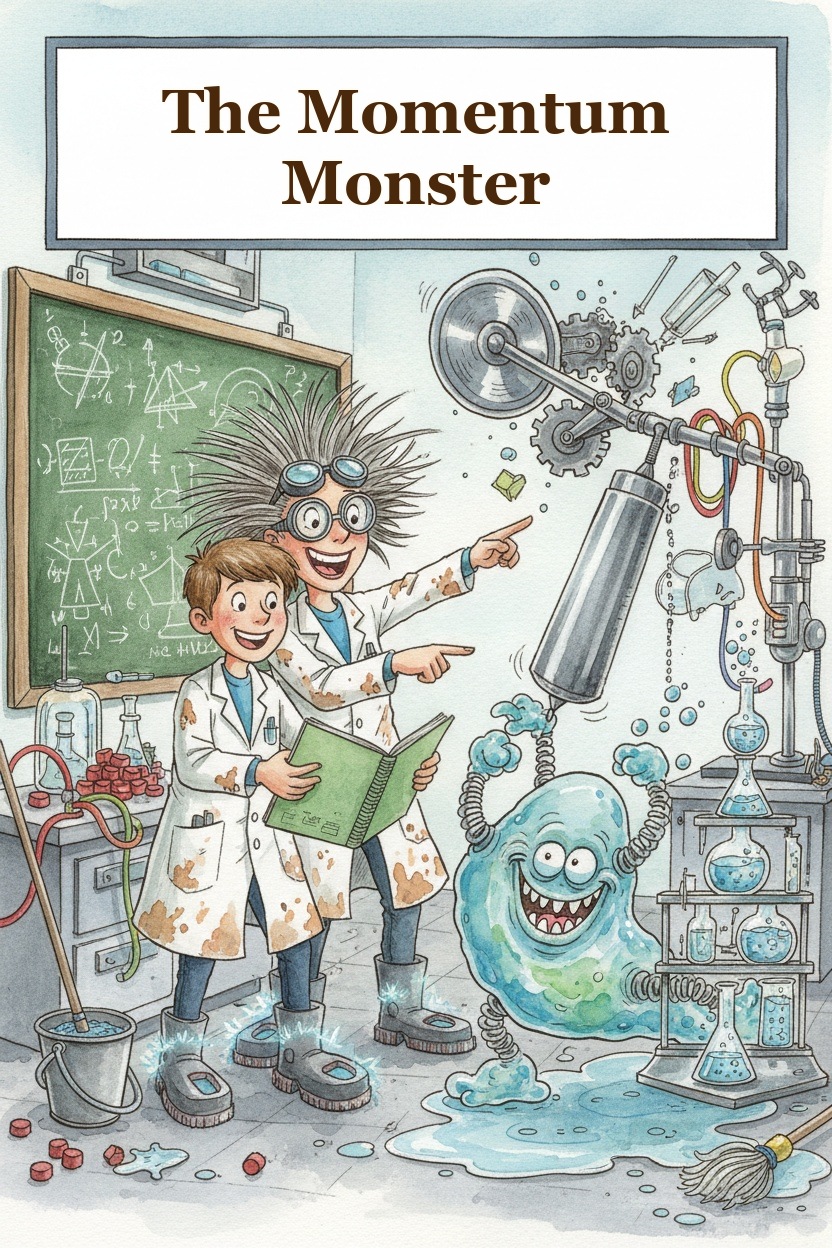
Section 1: The Problem with Perfect Plans
Otto Finch arrived at the lab on Tuesday morning to find Professor Plunk standing on the workbench, arms spread wide, addressing a collection of balls, bowling pins, and what appeared to be a very large watermelon.
"Otto! My careful colleague! Perfect timing!" Professor Plunk's voice bounced off the walls. "Today, we conquer momentum!"
Otto opened his green lab notebook and uncapped his favourite pen. "Conquer it, Professor?"
"We shall demonstrate it! Display it! Make it visible!" Plunk leaped off the bench and landed with a thump that sent a small rubber ball rolling across the floor. "Momentum, Otto, is the hidden power in everything that moves. Every rolling ball, every speeding bicycle, every runaway lunch trolley has momentum!"
Otto wrote: Momentum = something that makes things keep going.
"Now," Plunk continued, pulling a chalkboard to centre stage, "the equation is beautifully simple. Momentum equals mass times velocity. P equals M times V!"
She wrote it in huge letters: p = mv
"Mass is how much stuff something has," she explained, patting the bowling ball. "Velocity is how fast it's going and in which direction. Multiply them together, and you get momentum!"
Otto nodded, writing carefully. Mass × Velocity = Momentum.
"Here's the clever part," Plunk said, her goggles sliding down her nose. "If you double the mass, you double the momentum. If you double the speed, you double the momentum. But if the mass is big AND the speed is fast—" She paused dramatically. "Well, then you have a Momentum Monster on your hands!"
Otto looked at the collection of objects. There was a tennis ball, a bowling ball, a bicycle wheel, and the watermelon.
"What's the watermelon for?" he asked.
"Safety," said Plunk.
Otto blinked. "Safety?"
"Target practice!" Plunk beamed.
Section 2: The Demonstration Begins
The lab's longest hallway had been cleared. At one end, Plunk had set up a ramp. At the other end, she'd placed the watermelon on a little pedestal.
"We need to see momentum in action," Plunk announced. "So we shall roll objects down the ramp and observe how much they move the watermelon!"
Otto looked at the watermelon. He looked at the bowling ball. He wrote in his notebook: The watermelon seems nervous.
Actually, he wrote: The watermelon appears to be at risk.
"First!" Plunk held up the tennis ball. "A light object at a gentle speed. Otto, please record the mass estimation."
Otto wrote: Tennis ball: approximately 57 grams. Speed: slow. Momentum: small.
Plunk placed the tennis ball at the top of the ramp and let it go. It rolled down, bouncing slightly, and tapped the watermelon. The watermelon wobbled.
"Excellent!" Plunk declared. "Now, same tennis ball, but with more speed!"
She placed the ball higher on the ramp. Otto noticed there was a second, steeper ramp leaning against the wall.
"Er, Professor, are you going to use that one?"
Plunk looked at the steep ramp. "Oh no, that's for later. This is a controlled experiment!"
She released the tennis ball from the higher point. It shot down the ramp, crossed the floor, and struck the watermelon with a satisfying thock. The watermelon rolled halfway off its pedestal and wobbled back.
Otto wrote: Double speed = roughly double the effect. As predicted.
"Now!" Plunk picked up the bowling ball. "Same idea, but with MASS! This ball weighs seven kilograms. We shall roll it gently and see what happens."
Otto checked his notebook. Bowling ball mass = 7 kg. Tennis ball mass = 0.057 kg. Bowling ball is about 123 times heavier.
"Professor, um, 123 times heavier—"
"Momentum monster, remember?" Plunk grinned. "That's the point!"
She set the bowling ball at the very top of the gentle ramp and released it with a careful push.
The ball rolled down the ramp with a deep rumble. It crossed the floor with the patient determination of something that knows it can't be stopped. It struck the watermelon.
The watermelon left its pedestal entirely.
The watermelon flew across the hallway.
The watermelon hit the far wall with a wet, spectacular SPLAT.
Otto stared. Plunk stared. The watermelon was no longer a watermelon. It was a watermelon-shaped impression on the wall.
"FASCINATING!" Plunk shouted, pulling out her measuring tape. "Did you see that? One hundred and twenty-three times the mass, and the effect was—"
"Catastrophic?" Otto offered.
"Excellent data!" She scribbled something on the chalkboard. "Now then. Let's try the bowling ball with MORE velocity!"
Otto looked at the smeared remains of the watermelon on the wall. He looked at the steep ramp leaning against the wall. He looked at his notebook.
"Professor, maybe we should use a smaller target next time?"
"Nonsense, Otto! Gloriana has more watermelons!"
Gloriana appeared in the doorway, a fresh watermelon under each arm. She looked at the splatter on the wall, then at Otto, then at Plunk.
"Second shelf," she said, pointing to the supplies closet. "Three more."
And she walked away as if this were perfectly normal.
Otto wrote in his notebook: Momentum demonstration proceeding as expected. The watermelon is not.
Section 3: The Parking Lot Problem
The bowling ball hit the steep ramp's top, and despite Otto's protests, Plunk gave it a mighty push.
The ball sailed down the ramp like it had somewhere to be.
It crossed the hallway in a blur.
It struck the second watermelon.
The watermelon exploded with even more dramatic results, and the bowling ball kept going—through the lab door, across the hallway, down the stairs, and out the building's front door. The door banged open, and the ball bounced across the pavement and rolled to a stop in the parking lot.
Plunk watched the entire journey with enormous satisfaction. "Now THAT, Otto, was momentum!"
Otto's notebook read: Momentum = mass × velocity. Larger mass + larger velocity = MUCH larger chaos.
"But here's the question," Plunk said thoughtfully. "How do we stop something with that much momentum? What stops the monster?"
She tapped the chalkboard. "Force! To stop something, you need to apply force in the opposite direction. The more momentum something has, the more force it takes to stop it!"
Otto smiled. "So we just need enough force to stop the bowling ball?"
"Precisely!" Plunk's eyes lit up. "And to prove it, let's go outside and do a controlled experiment!"
The parking lot behind the lab had been recently cleared, which Otto suspected was not an accident. Gloriana had handled it. "Told her so," she'd said, holding a wrench.
Plunk emerged from the lab pulling a wagon loaded with objects. There was a medicine ball, a bicycle, a skateboard, and the third watermelon, which Otto was starting to feel personally attached to.
"Here's the plan!" Plunk announced to the empty parking lot. "I will roll the medicine ball across the lot. You, Otto, will attempt to stop it using only this—" She held out a traffic cone.
Otto took the cone. "With this?"
"Think of it as a controlled application of force through a very small area!"
Otto looked at the medicine ball. It was heavy—very heavy. Gloriana had carried it like it weighed nothing, but Otto had tried to lift it and his arms had complained for an hour.
"Professor, what if I roll the lighter ball and YOU stop it with the cone?"
"Excellent question!" Plunk beamed. "But no."
She placed the medicine ball on a small ramp attached to her wagon. "Now, the ball will roll at a moderate speed. When it reaches you, apply your force. Ready?"
Otto gripped the cone. "Ready?"
"GO!"
Plunk released the medicine ball. It rolled across the asphalt with a low, ominous sound—the sound of mass committed to a journey.
Otto planted his feet. He held the cone out like a sword. The ball approached.
It struck the cone.
Otto struck the pavement.
The ball continued rolling, exiting the parking lot, bouncing over the kerb, and crossing the road before settling against a hedge.
Otto lay on the ground, staring at the sky. He looked at the cone, which was now flat.
"ANY QUESTIONS?" Plunk shouted, running over.
Otto sat up slowly. "Yes. Why is the medicine ball still moving?"
"EXCELLENT QUESTION!" Plunk helped him to his feet. "Because it has a lot of momentum! Mass thirty kilograms times velocity about two meters per second equals SIXTY kilograms-meters per second! That's a momentum monster, Otto, and you simply don't have the force to stop it!"
Otto dusted himself off. He wrote in his notebook: The cone is not enough force. I am not enough force. I think I understand momentum now.
Section 4: The Collision That Wasn't Planned
"Now," Plunk announced, "we approach the most important concept of all: conservation of momentum!"
Otto looked up from his notebook. "Conservation?"
"Total momentum is ALWAYS conserved!" Plunk declared. "In any collision, the total momentum before equals the total momentum after!"
She drew a diagram on the pavement with chalk. "Imagine two objects collide. Before they collide, object one has momentum, and object two might be at rest. After they collide, momentum is shared between them. But the TOTAL never changes!"
Otto considered this. "So if I roll the medicine ball into a stationary object—"
"It will transfer some momentum to that object! The ball slows down, the object speeds up, and the total momentum is exactly the same!"
"Can you show me?"
"Of course! It's the most beautiful demonstration in physics!" Plunk pointed at the bicycle lying on its side. "I'll roll this wheel to show you, and you roll the tennis ball into it—"
But Otto was already distracted. He noticed the third watermelon sitting by the lab door. He noticed that the wheels on Plunk's demonstration wagon were looking a bit wobbly. He noticed that the wagon was angled slightly down the gentle slope toward the parking lot's far end, where the road led back toward the city.
"Professor," Otto said carefully, "your wagon has a load on it."
"I know!" Plunk beamed. "That's the experiment!"
"No, I mean—"
The wagon's wobbly wheel chose that exact moment to give up.
The wagon began to roll.
Slowly at first, then picking up speed, the wagon rolled across the parking lot with all its contents: the medicine ball, the bicycle, the skateboard, and the watermelon.
"That's not the experiment!" Plunk shouted, running after it.
Otto ran too. "What do we do?"
"MOMENTUM!" Plunk yelled, sprinting. "We need to apply a force in the opposite direction! A very large force!"
The wagon gained speed, bouncing over the curb and into the street.
"Gloriana!" Otto shouted at the lab building.
A window opened on the third floor. Gloriana leaned out.
"Mop or net?" she called.
"MOMENTUM!" Otto shouted.
Gloriana studied the situation for a moment. "Parking lot!" she said, disappearing back inside.
"Otto! The ramp!" Plunk pointed to a small loading ramp by the back door, used for deliveries.
Otto grabbed one end. Plunk grabbed the other. Together they swung it in front of the runaway wagon.
The wagon hit the ramp.
The wagon launched.
For a beautiful moment, everything in the wagon—medicine ball, bicycle, skateboard, watermelon—sailed through the air in perfect formation, a glorious demonstration of momentum, projectile motion, and the laws of physics combining in harmony.
Then everything landed in the street.
The medicine ball rolled left. The bicycle rolled right. The skateboard spun in circles. The watermelon did not roll at all, as it had already been sacrificed to science in the lab.
And then, from behind them, a second wagon appeared—this one pushed by Gloriana, rolling directly toward the first wagon, which had stopped against a lamppost.
"Gloriana! NO!" Plunk shouted.
But it was too late.
The wagons collided.
The impact was magnificent. Gloriana's wagon, empty and light, bounced off the heavier first wagon. But the medicine ball, having rolled back toward the collision site, hit the second wagon and knocked it sideways into the first wagon again.
Otto watched, notebook in hand, completely still.
"Professor," he said quietly, "I think I understand conservation of momentum now."
Plunk stood in the middle of the street, surrounded by wagons, balls, and bikes. Her lab coat was splattered with watermelon remnants. Her goggles had fallen down onto her nose. Her hair was pointing in forty different directions.
"Otto," she said, "that was a momentum demonstration AND a conservation demonstration AND a catastrophe."
"Which one were you trying to do?" Otto asked.
"All of them, apparently!" Plunk laughed, and Otto couldn't help but laugh too.
Gloriana walked past them, towing both wagons. She looked at the chaos, then at Otto's notebook, then at Plunk.
"Net wasn't big enough," she said.
Section 5: The Beautiful Truth
Back in the lab, Otto was writing in his notebook while Plunk chalked equations on the board.
"Momentum equals mass times velocity," Otto read out loud. "So heavy and fast is much harder to stop than light and slow."
"Exactly!" Plunk drew a diagram of the wagon collision. "And when the wagons collided, the momentum didn't disappear. It just transferred! The first wagon had a lot of momentum. When it hit the lamppost, some went into the lamppost, and some went into the medicine ball, and the medicine ball took that momentum and gave it to Gloriana's wagon, and—"
"It's like a story," Otto said softly. "Where the energy has a journey."
Plunk paused. She smiled. "That's exactly what it is, Otto. Momentum doesn't vanish. It gets passed along, like a baton in a relay race. The total moment before equals the total moment after. Always."
Otto looked at the diagram on the board. The equation was simple, but the dance was everywhere. Balls bouncing, cars crashing, planets orbiting, comets growing tails—all standing on the shoulders of p = mv.
He wrote his final notebook entry for the day:
Momentum = mass × velocity.
Heavier things are harder to stop.
Faster things are harder to stop.
Both things together = literally unstoppable.
When things collide, momentum is conserved.
The total never changes—it just moves around.
Then, in smaller letters:
The parking lot will need a new lamppost. I will note this in next week's budget.
And at the bottom, in his carefulest handwriting:
THIS WAS NOT IN THE PLAN. BUT THE PHYSICS WAS BEAUTIFUL ANYWAY.
Gloriana walked past carrying two bent traffic cones and what appeared to be a fragment of the watermelon.
"Need new ones," she noted flatly, and continued on.
Otto looked out the window at the parking lot, where the lamppost was leaning at a forty-five-degree angle, and where the medicine ball had come to rest, finally stopped at last—not by force, not by a cone, but by giving its momentum to everything it touched along the way.
"Professor?"
"Yes, my careful colleague?"
"A thing in motion stays in motion until something stops it. And the something that stops it just takes the motion with it."
Plunk turned from the chalkboard, and her smile was the warmest Otto had ever seen. "That's exactly right, Otto. The motion never truly ends. It just keeps going somewhere new."
The lamppost creaked in the wind.
The medicine ball sat perfectly still.
And somewhere, far away, a physics lesson rolled quietly on.