The Number Kingdom
The Estimation Estate
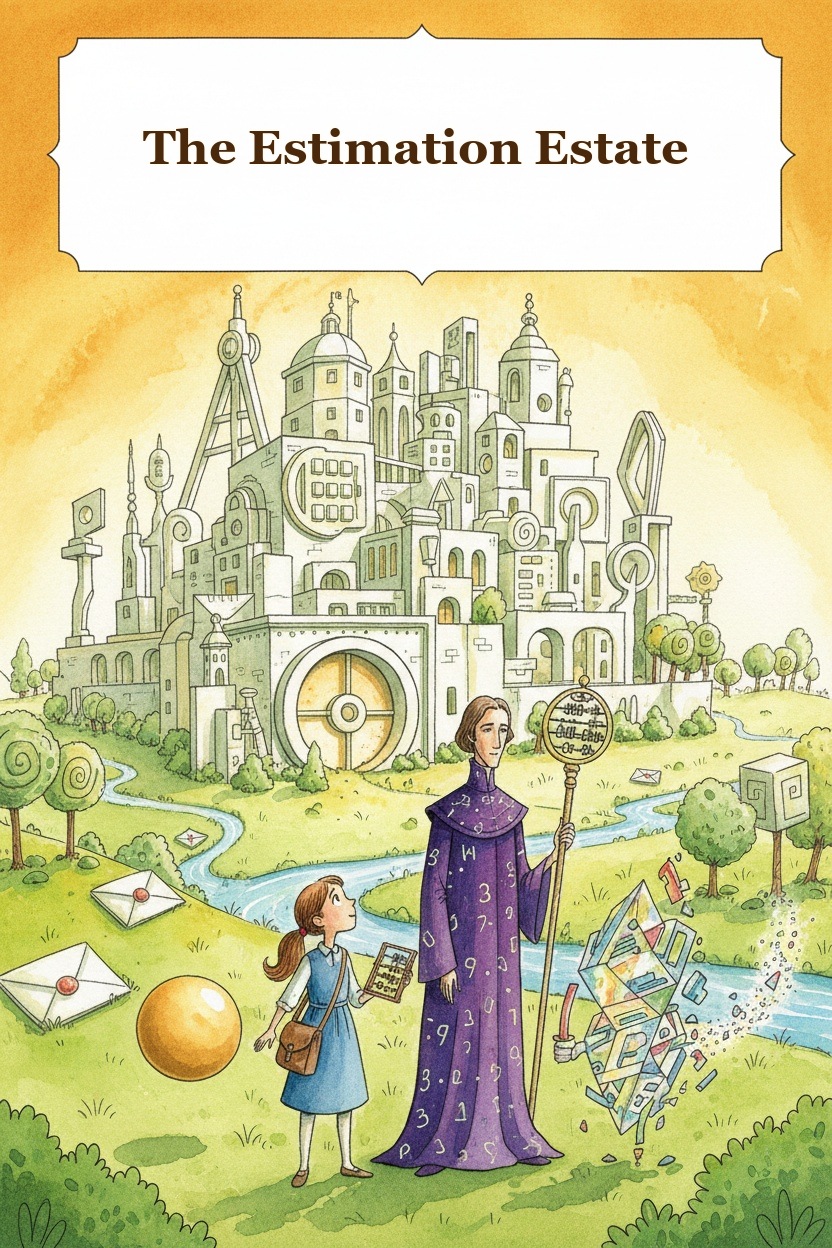
The Summons to the Estate
"Right. Let's see what's broken," Mira said, arriving at the gates of the Estimation Estate with her satchel bouncing against her hip.
The Estate sprawled before her — a vast network of fields, orchards, mills, and storehouses that fed the entire Number Kingdom. Farmers moved through the rows with baskets, tallying harvests. Carts rolled along the gravel paths, heavy with grain. Bridge keepers checked the weight of every load.
But something was very, very wrong.
Everywhere Mira looked, people were stopped dead. A farmer stood frozen beside a half-filled basket, muttering numbers to himself. A cart driver sat with his reins loose, his head in his hands. A woman at the well was counting water drops one by one.
The Count appeared at her side, his robes shifting with numerals. "The crisis is as follows," he said gravely. "The Remainder has decreed that no work may continue until every measurement on the Estate is exact to the final digit. The harvest will not be gathered, the grain will not be transported, and the water will not be distributed until absolute precision is achieved."
"That sounds reasonable," Mira said, confused. "Isn't precision good?"
"Precision is excellent," the Count said. "But there is a difference between precision and paralysis."
As if on cue, a familiar voice rang out from above. The Remainder sat on the estate gate, swinging its legs and grinning. Today it looked like a wispy figure made of loose change and leftover scraps of paper.
"Exactness for everyone!" it crowed. "I've decreed it! No more sloppy approximations! Every apple counted to the core! Every grain of wheat measured to the speck! Every drop of rain in the well — numbered and named!"
"That could take forever," Mira said.
"Exactly!" The Remainder clapped its hands. "That's the point! Haven't you noticed how messy this place is? They say 'about a basketful' and 'roughly a mile' and 'close to noon.' It's DISGUSTING. I'm making everything precise."
It vanished with a pop, leaving behind a puff of dust that settled across the estate like a challenge.
The Weigh Station
Mira walked to the nearest weigh station, where a guard named Tam was trying to weigh a cart of apples. The apples were piled high, rolling slightly, impossible to count exactly.
"I can't measure this," Tam said miserably. "The Remainder changed the scales. Now they demand the exact weight to the hundredth of a pound before the gate will open. But the apples keep shifting! Every time I get a reading, one rolls off and the whole number changes."
Mira pulled out her pencil and paper. "Let's think about this. What do you actually need to know?"
"I need to know if my cart is under the bridge's weight limit," Tam said. "If the apples weigh more than one ton, the bridge won't hold."
"One ton is two thousand pounds, right?" Mira asked.
Tam nodded.
"So do you need to know the exact weight of every apple?" Mira asked. "Or do you need to know whether you're near that limit?"
Tam squinted at her. "I need to know if I'm safe to cross."
Mira looked at the cart. The apples filled it to the brim — maybe sixty or seventy bushels. "Well, the empty cart weighs about four hundred pounds. And each bushel of apples weighs around forty pounds. So if there are about sixty bushels..."
She scribbled on her paper:
40 × 6 = 240
40 × 60 = 2,400
"Wait, that's already over the limit," she said. "Let me check. Sixty bushels times forty pounds is 2,400 pounds. Plus the cart."
Tam's face went pale. "So I can't cross?"
"Not with sixty bushels," Mira said. "But let me check my estimate. I rounded each bushel to forty pounds. Some bushels might be a little lighter. Let's see if a smaller load would work."
She looked at Tam's load more carefully. "How many bushels did you pick?"
"I was going to count them, but the Remainder said counting one by one would take too long and I should weigh them exactly instead," Tam said.
"Counting takes less time than exact weighing," Mira said. "And because we know approximately what each bushel weighs, we can estimate the total fast." She began counting. "One, two, three..."
It took her two minutes. "Forty-five bushels."
She did the math: 45 × 40 = 1,800 pounds. Plus the 400-pound cart: 2,200 pounds. Still over.
"Take off five bushels," she said. "Then you'd have forty bushels — about 1,600 pounds of apples, plus 400 for the cart, equals about 2,000 pounds. That's right at the limit. Maybe take off eight to be safe."
Tam pulled off eight bushels, leaving thirty-seven. Mira estimated: 37 × 40 = 1,480 pounds, plus 400 equals about 1,880. Under the limit with room to spare.
"The bridge will hold," she said. "You don't need to know the exact weight of every apple. You need to know you're safely under the limit."
Tam drove through. The gate opened easily.
But from somewhere across the fields, Mira heard a mischievous laugh. The Remainder was watching.
The Orchard Problem
Mira walked through the orchards, where the fruit pickers were in despair. The trees were loaded with apples, pears, and plums, and the harvest was rotting on the branches while the pickers tried to satisfy the Remainder's demand for exact counts.
"Each tree has a different number of apples," a picker named Ola said. "I can't tell you the exact total until I've counted every single one, and by then they'll be spoiled!"
Mira looked at the orchard. There were rows and rows of trees — more than she could count quickly. But she didn't need to count them all.
"How many rows are there?" she asked.
"Twenty," Ola said.
"How many trees in each row?"
"About thirty. Some have twenty-eight, some have thirty-two."
"And how many apples does each tree usually produce?"
"Depends on the tree," Ola said. "Small ones maybe fifty. Big ones more like a hundred. But most are somewhere in between — around seventy-five."
Mira pulled out her paper again. "So if I multiply twenty rows by thirty trees, that's about six hundred trees. And each tree has about seventy-five apples. Six hundred groups of seventy-five..."
She wrote:
600 × 75 = 6 × 75 × 100
6 × 75 = 450
450 × 100 = 45,000
"About forty-five thousand apples," she said. "Is that close enough?"
Ola stared at her. "Close enough for what?"
"For planning," Mira said. "How many baskets do you need? If each basket holds a hundred apples, you need about four hundred and fifty baskets. Do you have that many?"
Ola nodded slowly. "We have five hundred."
"Then you have enough — using our estimate, you have some to spare. But if you'd counted exactly and found forty-eight thousand apples, you'd still have enough with five hundred baskets. And if the crop was small, say forty thousand, you'd still have enough. The estimate tells you what you need to know."
Ola began directing the pickers to fill the baskets. The work moved fast now.
Mira smiled. But she knew the Remainder wasn't finished.
The Remainder's Argument
The Remainder appeared beside the well, where water was being hauled up in buckets. It wore a look of mock offense.
"Estimates!" it said, pretending to be shocked. "You want to govern this estate with guesses? I thought you loved math, little Mira. I thought you believed in truth."
"Estimation isn't guessing," Mira said. "A guess is 'I think this might be heavy.' An estimate is 'I know this cart weighs about four hundred pounds, and each bushel weighs about forty, so forty-five bushels makes about 2,200 pounds total.' It's using what you know to make a good, useful approximation."
"But it's not exact!" the Remainder said. "What if a bushel weighs forty-one pounds? Then your estimate is wrong!"
"Maybe," Mira said. "But the question is whether it's wrong enough to matter. For the bridge, I needed to know if the cart was under 2,000 pounds. My estimate was 2,200 — clearly over. Even if my estimate was off by a hundred pounds, the cart was still over the limit. The estimate told me what I needed to know."
"But what about the harvest?" the Remainder pressed. "If you estimate forty-five thousand apples and it's actually forty-five thousand three hundred and seventy-two, then your estimate is wrong!"
Mira thought about this. "It's not exactly right," she agreed. "But the pickers needed to know whether five hundred baskets would be enough. An exact count would take days. By then, the fruit would rot. The estimate was good enough to make the right decision."
"So you admit your mathematics is imperfect!" the Remainder said triumphantly.
Mira was quiet for a moment. She thought about what the Remainder had said. It wasn't entirely wrong — which, she had learned, was the most interesting kind of thing the Remainder said.
"Estimates aren't perfect," Mira said. "They're not supposed to be. They're supposed to be useful." She looked at the Remainder. "You insisted on exactness everywhere. But exactness takes time — so much time that the work would never get done. In that time, the apples would rot, the grain would spoil, the well would go dry. An exact answer that comes too late is less valuable than an estimate that comes in time."
The Remainder flickered, its form shifting. "But... exactness is truth."
"Exactness is one kind of truth," Mira said. "But there's another kind. If I say 'it's about a mile to the village,' that's not a guess. It's a rounded answer. I know the distance is somewhere between half a mile and a mile and a half. For someone planning to walk it, 'about a mile' is enough information."
She drew a number line in the dirt.
"Look," she said. "The village is maybe 5,280 feet away. But if I tell you to bring water for the walk, do you need to know it's 5,280 feet? Or is 'about a mile' enough?"
The Remainder stared at the number line.
"What if it's 5,300 feet?" it asked.
"Rounding to the nearest thousand, that's about 5,000 feet," Mira said. "Rounding to the nearest hundred, it's 5,300. Rounding to the nearest ten, it's exactly 5,300. We choose how to round based on what we need."
"The Remainder tilted its head. "So you're saying precision is... optional?"
"Precision is a tool," Mira said. "Sometimes you need it — when you're engineering a bridge or mixing medicine. But sometimes a good estimate is better. The skill is knowing which one you need."
The Reconciliation
Zero appeared — small, silver-white, perfectly round — standing at the center of the number line Mira had drawn.
"I notice no one has considered zero," Zero said quietly. "When you estimate to the nearest thousand, the smaller places are effectively zero. When you say 'about a mile' instead of '5,280 feet,' the difference is less than 300 feet — which, compared to the total, is closer to zero than it is to anything else."
Mira looked at Zero. "So estimation is about finding what doesn't matter — and letting it go?"
"Precisely," Zero said. "A good estimate knows what to ignore. The places that don't change your decision — the ones, the tens, even sometimes the hundreds — those are the zeros of the problem. They're real, but they don't change the outcome."
The Remainder puffed up. "But I like the ones and tens! I LIKE the little numbers! They're the leftovers! The remainders!"
"Some numbers deserve attention," Mira said. "Some don't. Knowing the difference is part of the skill." She thought about the Remainder's words. "And you're right that the little numbers exist. They're real. But like a tiny remainder in a division problem, sometimes they're not the point. The point is the answer — and the answer is 'about' something."
The Remainder was quiet. It looked at the line, then at the busy estate — pickers filling baskets, carts rolling toward the bridge, water flowing from the well.
"If I disappear," it said slowly, "will everything become neat? Will all the numbers be exact?"
"No," Mira said. "The estate will always have approximations. Some measurements will be uncertain. Some numbers will be rounded. That's honest. That's how the world works."
The Remainder brightened. "So my chaos remains! Hidden in the estimates!"
"Your chaos is part of the mathematics," Mira said. "Every estimate has a range. Every rounded number has a quiet crowd of smaller digits hiding behind it. They're there. We just choose not to count them when they don't matter."
The Remainder looked almost pleased. It flickered once, twice, and then collapsed into a small pile of dust that blew away across the fields.
Zero watched it go. "You know it will return."
"I know," Mira said. "It always does. But for now, the estate is working."
The Count appeared, formal as ever. "The Estate is functioning. Your solution was... pragmatic. I had not considered that there are situations where precision produces less truth, not more."
"Estimation is a skill," Mira said. "It's knowing what's worth counting."
The Count nodded slowly, the numerals on his robes rearranging themselves. "Yes," he said. "That tends to be the way."
But Mira noticed that Zero had already vanished — and after thinking about it, she supposed some things simply didn't need to be exact.