Chef Sparks Kitchen Lab
WHAT IS FOOD
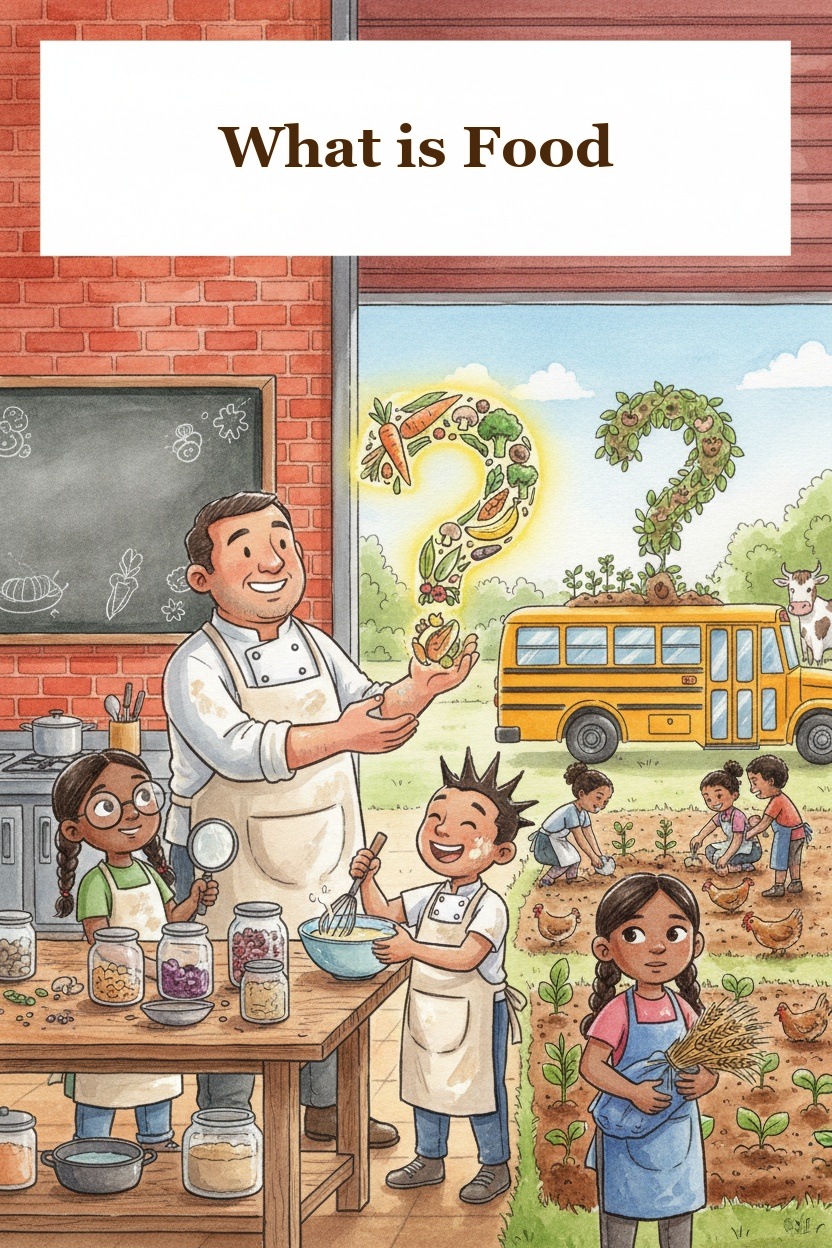
Chapter One: The First Day
The old fire station on Riverside Street had not seen a fire engine in eleven years. No sirens. No hoses. No Dalmatians.
But on this particular Saturday morning, something was happening. The big red doors were rolled up, and the morning light poured into the enormous kitchen that had once been an engine bay. Steam rose from a pot on the great stainless steel range. The smell of something warm and slightly sweet drifted out onto the sidewalk.
Maya Okonkwo was the first to arrive. She always arrived first, because she needed to check the kitchen. She walked slowly around the horseshoe of prep tables, examining the counters, reading the labels on the jars that were already laid out. Peanut oil — she noted it, mentally filed it, knew it would be nowhere near her station. Sesame seeds — she spotted the jar and made a note to ask Chef Spark to move it to the far counter, which she would do, politely and carefully, because she had practiced the way to say it.
"You're early," said a voice from above.
Maya looked up. Chef Ignacio "Iggy" Spark was sliding down the fireman's pole from his apartment above the kitchen. He landed with a soft thump and brushed off his apron. His apron said: Cooking is Chemistry You Can Eat.
"I'm always early," Maya said.
"Good," said Iggy. "That means you noticed the sesame seeds before anyone else did. You checked the labels on the oil. You know exactly what's in this kitchen, and that means you know exactly what you're working with. That's the most important skill a cook can have."
Maya felt something warm in her chest. She decided to leave the sesame seeds where they were, because they were at the far end, and she would simply not go near that counter.
The door banged open and Tommy Reyes burst in. His hair was sticking up in three directions, and he was already talking.
"My aunt said I'm not allowed to eat before I get here because Chef Spark always feeds us and my mom said I should save room and also I brought my own spoon in case someone else's spoon is slow what are we making?"
"Good morning, Tommy," said Iggy. "We're making a vinaigrette."
Tommy stopped. "A what?"
"Sit down," said Iggy. "The others are coming."
Priya Subramaniam arrived next, carrying a small container. She held it out to Iggy like an offering. "My Ammamma sent this. She said you would know what to do with it."
Iggy opened the container and sniffed. His eyes widened. "Coconut oil. From her own pressing?"
"She says the real thing tastes different from the store kind."
Iggy closed his eyes and took a deeper sniff. "She's right," he said. "It does. Tell her I'll use it carefully." He paused. "Priya, you're not going to cry today, are you? We haven't even started cooking yet."
"No," Priya said, wiping her eye. "I'm just happy."
The rest of the students filtered in — Dev, who immediately started measuring the angles of the prep tables; Lucia, who opened her sketchbook and began drawing the light coming through the big doors; Sam, who took out a small notebook labeled "FOOD RATINGS" and licked the tip of a pencil. Iggy looked around the kitchen at the horseshoe of students, all watching him, all waiting.
"Today," he said, "is the first day of the rest of your taste buds' lives. We're going to answer a question that sounds too simple to be a question at all."
He picked up a piece of chalk from the tray below the giant chalkboard wall.
"What is food?"
Chapter Two: What Is Food?
The students looked at each other.
"Things you eat," said Tommy.
Iggy wrote it on the board: THINGS YOU EAT.
"That's right," he said. "But it's not the whole answer, because lots of things you eat aren't really food, and some things that are food you'd never think to eat. Seaweed. Lichen. Yeast. What about those?"
"Food is what keeps you alive," said Maya. "It's what your body needs to work."
Iggy wrote: WHAT KEEPS YOU ALIVE.
"Also right," he said. "But here's the question underneath the question: why does food keep you alive? What does your body actually do with it?"
"Calories," said Sam.
"Calories!" Iggy practically bounced. "Yes! Energy! That's the first thing your body does with food. It burns it for fuel. Everything you do — running, thinking, breathing, beating your heart, growing your fingernails — everything uses energy. And where does that energy come from?"
He tapped the board. "Food. The food that you eat today becomes the energy that you use to climb the stairs tomorrow. That's not a metaphor. That's chemistry. Your body is an engine, and food is its fuel."
He drew a cartoon on the chalkboard — a little stick figure with a fire in its belly. "But energy is only one thing food does." He drew arrows branching off the stick figure. "Food also builds you. The protein in your beans and eggs and milk — that protein breaks apart into building blocks called amino acids, and your body puts those blocks back together to make new cells. Your hair, your skin, your muscles — they're literally made from the food you ate last week. You are, quite literally, what you eat." He paused. "Which means I am, at this moment, approximately forty percent rice and eleven percent very good cheese."
Lucia laughed and sketched a little Iggy made of rice and cheese.
"And the third thing," Iggy said, holding up three fingers. "Food gives you information."
Tommy squinted. "Information? Food doesn't tell me anything."
"Doesn't it?" Iggy walked to the counter and picked up a lemon. "When you bite into a lemon, your tongue sends a message to your brain: sour. That's information. Your body uses that information to decide whether to eat it again — and to make you pucker so you think hard about what you're eating. When the tomatoes get ripe and turn red, that color is information that tells you they're ready. The nutrients in your food — the vitamins and minerals — they're not building blocks or fuel, exactly. They're signals. They tell your body how to do its job."
He put the lemon down. "So food is three things at once: energy, building material, and information."
"How do we remember that?" asked Dev. "I'm going to remember it."
Iggy tapped his chin. "Here's how: food is what you eat, but it's also what you become, and it's also what you build with, and it's also the message your body gets about how to work. When my grandmother told me 'you are what you eat,' she was being literal. The actual molecules from the food on your plate end up in your actual body."
"Then I'm a taco," Tommy said happily. "I'm the most delicious person in my family."
"You're certainly the most honest," Iggy said.
Chapter Three: The Vinaigrette
"Now," Iggy said, "we're going to make the simplest food in the world. You can make this in two minutes. Three ingredients. But when you understand this, you understand the first secret of how food works."
He laid out the ingredients: a small glass bowl, a whisk, a jar of mustard, a bottle of vinegar, and a bottle of olive oil.
"This is a vinaigrette. It's a dressing. You put it on salad, but it's not just a dressing — it's a science experiment you can eat. Does anyone know what my favorite thing about vinegar and oil is?"
"They're both delicious," said Tommy.
"They are," Iggy agreed. "But here's the thing: they don't mix."
He poured the vinegar into the bowl. Then he poured the oil on top. The oil floated on the vinegar in two separate layers.
"See that? Oil and water don't mix. Vinegar is mostly water, and oil is, well, oil. They're like two people who have nothing to say to each other. Shake them up, and what happens?"
He put a lid on the jar and shook it. The mixture turned cloudy. Then, slowly, the oil rose to the top again.
"They break up again," said Maya.
"They always do," Iggy said. "Because oil and water are fundamentally different. They're different in how they're made, they're different in what they weigh, and they're different in how they behave. But there's a way to make them stay mixed. Watch."
He added a small spoonful of mustard to the vinegar and whisked it. Then, slowly, in a thin stream, he poured the oil while whisking. The mixture turned creamy. It thickened. It turned into something that looked like a pale golden sauce.
"That's called an emulsion," Iggy said. "And the mustard is the unsung hero — it acts as a kind of peacemaker between the oil and the water. We call that an emulsifier. It holds onto both at once, so they can't separate. This is a temporary emulsion — it will hold for a few hours, and then the oil and vinegar will go back to being themselves. That's okay. Just shake it again."
He dipped a spoon and taste — very carefully, because it was hot, even though it wasn't hot — no, it was just right. He handed tastes around.
Tommy took his taste and made a sound. A specific, two-note sound. The sound was so clear, so full of approval, that the other students knew immediately: this was a good sound.
"The Tommy hum," Maya said. "It's official now."
"What's in the mustard?" asked Priya. "Why does it work?"
"The mustard is actually more complicated than just one thing," Iggy said. "It's a seed. It contains oils of its own. It has a little bit of a substance called lecithin, which is a natural emulsifier. And it gives the dressing a little bite, which is delicious." He paused. "But the mustard isn't just one thing — it's a whole system, and it's doing chemistry. The vinegar and the oil each have a different kind of chemistry, and the mustard helps them find a way to work together."
"So making a dressing is like making two people be friends," Priya said. "The mustard is the friend who introduces them."
"Yes," said Iggy. "The mustard is a good friend with a lot of chemistry knowledge."
Sam was writing in his notebook. "That's a ten," he said. "That's a ten out of ten."
Your body does with food what the vinaigrette cannot do with oil and water: it takes the fuel, the building blocks, and the information, and it makes them into something new. It takes your lunch and turns it into your afternoon. It takes your dinner and turns it into your muscles. It takes the rice you ate and makes you more yourself.
"You," Iggy said, "are the best recipe in the world. You're the one dish that you'll spend your whole life making over and over. And the better you understand what goes into you, the better you'll get at making yourself into the person you want to be."
Maya was thinking. "So when I pack my lunch," she said, "and I check the ingredients because of my allergies, I'm not just making sure I don't eat something dangerous. I'm making sure I'm feeding my body what it needs."
"That's right," said Iggy. "You're the chef of your own body. And a chef who cares about their ingredients is going to cook the best meal. That's what we're going to learn in this class: how to be chefs of our own bodies. How to understand what food is, what it does, and how to use it to make something wonderful."
—
Chapter Four: The Spark Effect
It happened in the moment of quiet that always fell after a good lesson — when the students were still holding their tastes of the vinaigrette, still thinking, still chewing.
Iggy turned, with that characteristic sweep of his arm, the one he always used when he was about to make a point. "And that, my friends, is the beginning of—"
The pepper grinder was on the edge of the counter. It had been there all day, waiting, unassuming. It had been — some students would later calculate — exactly 3.7 centimeters from the edge. It was not a precarious position. It was a pepper grinder that had been used almost an hour ago and set down with no particular attention to its location.
Iggy's arm swept. The pepper grinder tipped, fell, and clattered to the floor with a sound that made everyone jump.
Iggy did not look at it. He did not acknowledge it. He continued the sentence as if nothing had happened: "—the beginning of everything. You have learned that food is energy, building material, and information. You have learned that oil and water don't mix, but that sometimes you can help them. And you have learned that a good salad dressing is about chemistry, not just about taste."
"That's the Spark Effect," Tommy whispered to Maya. "That's the fourth one this month."
"I counted," Lucia said. "I'm tallying it. Pepper grinder, counter two, 10:47 AM." She was already drawing it in her sketchbook.
Priya was smiling. "In Ammamma's kitchen, the same thing happens with the salt pot. There's a little ring of salt on the floor that's been there for thirty years because she always knocks it off the counter when she says 'and now we eat.' She says it's how you know the recipe is working."
Iggy heard her. He turned, and his face did something complicated and soft. "Priya," he said. "There might be something to that."
"Let's eat," said Tommy.
—
Chapter Five: The Recipe
The recipe card was on the fridge, and every student took a copy as they left. It said:
THE KITCHEN LAB VINAIGRETTE
-
1 tablespoon wine vinegar (or lemon juice)
-
1 teaspoon Dijon mustard
-
3 tablespoons olive oil
-
Salt and pepper to taste
Steps:
-
Put the vinegar and mustard in a small bowl.
-
Whisk them together until they're completely combined.
-
Add the olive oil while you whisk, a little bit at a time, slowly.
-
Taste. Add salt and pepper. Taste again.
-
Put it on something wonderful.
Chef's note from Iggy: This is the first recipe you ever make as a chef — not because it's the easiest, though it is, but because it teaches you the most important skill: making two things that don't want to work together find a way to work together. That's what cooking is, and also what friendship is, and also what being a person is.
Maya took her copy and read it twice. Then she folded it carefully and put it in her pocket. The recipe was safe. She would make it at home, and she would not eat it with anything that had sesame seeds in it. She would make her own version. She would figure out the version that was safe for her body. That was what being a chef of your own body meant.
Priya took her copy and read it to herself, then read it again, then realized she had memorized it on the first read. She tucked it into her pocket and thought about how she would tell Ammamma about the mustard being a peacemaker, and how she would ask if they could make the vinaigrette together, and how the vinegar and oil separating and coming back together was like the ocean and the moon — things that are always trying to go their separate ways, and yet always find their way back.
Tommy took his copy and read it once, out loud, very fast, and then ate the extra piece of bread that had been dipped in the last of the vinaigrette, and then licked his fingers, and then made the Tommy hum again.
The old fire station on Riverside Street fell quiet. The kitchen was warm. The jars were capped. The tables were washed.
On the chalkboard, in Iggy's handwriting, were the words:
FOOD = ENERGY + BUILDING + INFORMATION
And underneath it, in smaller letters:
And you are the best recipe in the world.
Iggy stood in the empty kitchen and looked at the chalkboard. He could hear the last of the students' voices fading down the street — Tommy's laughter, Maya's careful goodbye, Priya singing something softly in another language.
He picked up the pepper grinder from the floor.
He put it back on the counter.
Then he moved it to the center of the counter, far from the edge, where it would not fall.
Probably.
Iggy's Kitchen Lab Notes
Dear Students,
Today you learned that food is not just what you eat — it's what you're becoming. Every bite you take is doing something in your body: giving it energy, building it up, sending it information. You are a recipe. You are always being cooked. And you get to be the chef.
Here's the question I want you to think about until next time:
If food is information — what is your food telling your body?
Think about it at dinner tonight. And then, if you like, think about the vinaigrette, and how the oil and the water found a way to be friends.
Actually, that math is hard. Let me redo it: if you think about the vinaigrette, remember the mustard. Remember what it did.
Until next time — keep cooking.
Chef Spark
THE END
Coming in Book 2: THE FUEL — Carbohydrates. Iggy makes a timeline on the chalkboard, and the class makes risotto slowly, learning that the same rice that stores energy for a plant also stores energy for you — it's a tiny, delicious battery.