Inside Out Academy
ALL FIVE ROADS
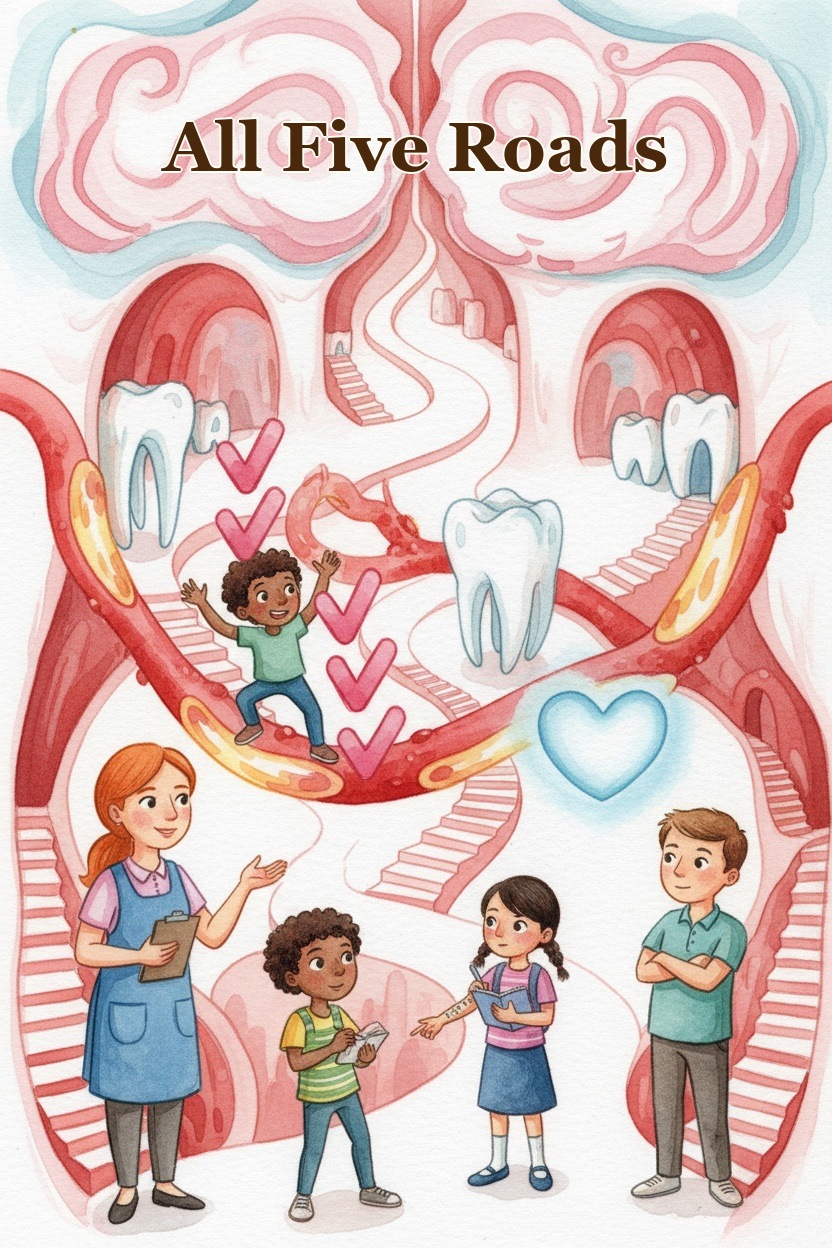
Current Checklist Status:
-
Location: The optic nerve junction, right eye (observation post)
-
Day: 23 of the Journey
-
Class: All 22 students + Ms. Vance ✓
-
Leo's Status: Currently being removed from a tear duct (again)
-
Mr. Gomez's Note: "My eye is watering. Also, I think I sneezed someone."
Part One: The Meeting at the Crossroads
The class had gathered in what Marcus was calling "The Grand Junction" — the place where all the sensory roads from Mr. Gomez's right eye, left ear, nose, tongue, and skin seemed to meet before racing off to the brain. It looked like the world's most complicated train station, with bundles of nerve fibers crossing and weaving and diving into the depths of the nervous system.
"Okay," Ms. Vance said, pulling out her ever-growing checklist and flipping to a fresh page. "We have completed our study of the nervous system's highways. Now we need to understand the entrances."
Sadie was already nodding. "The sensory systems. The data collection. The—"
"The roads in," Fatima finished quietly.
"Exactly," Ms. Vance said. "Every single thing Mr. Gomez knows about the world comes through these pathways. Light, sound, pressure, chemicals. And every one of those signals travels along nerve fibers to the brain, where something extraordinary happens."
Leo appeared from somewhere behind a fold of tissue, slightly damp and very excited. "I found a road that goes to his nose! It's amazing — there are these little hairs and everything."
"Leo, you were supposed to be—"
"There were smells, Ms. Vance. I smelled the cafeteria. From inside his nose. That's insane."
Marcus was already pulling out his notebook. "Okay, so the five senses. Sight, hearing, smell, taste, touch. Everyone knows that. But what's the actual science?"
"I love that you asked," Ms. Vance said, and she had that voice — the one that meant she'd been waiting all day to talk about this. "Because here's the thing: each sense has its own type of receptor. Specialized cells that detect specific kinds of information from the world outside."
She gestured to the nerve bundles around them. "These are the roads. But each road starts at a different kind of detector. In the eye, you have photoreceptors that respond to light. In the ear, mechanoreceptors that respond to vibrations. In the skin, receptors that respond to pressure and temperature. In the nose and tongue, chemoreceptors that respond to molecules."
Sadie raised her hand. "Okay, so technically, the receptors are transducers. They convert one form of energy into another — light into nerve signals, sound into nerve signals, chemical into nerve signals."
"Precisely, Sadie."
Leo frowned. "So the brain just gets... signals? Like, it doesn't actually see anything?"
Ms. Vance smiled. "That, Leo Okafor, is the most important question anyone has asked all day. Let me show you something."
Part Two: The Trail and the Map
Ms. Vance led the class to a small alcove where they could observe a sensory nerve fiber in action. It was like watching a tiny telegraph line — pulses of electrical activity zipping along the axon toward the brain.
"Here's what the brain receives," Ms. Vance said. "Just these. Electrical impulses. Nothing else. No images, no sounds, no smells. Just patterns of firing."
"That can't be right," Marcus said. "Mr. Gomez sees things. Like, actual things. With colors and shapes."
"Does he?" Ms. Vance asked. "Or does his brain construct those colors and shapes from the patterns of impulses it receives?"
Everyone went quiet.
Fatima spoke first. "So the world isn't what we see. The world is what our brains decide to show us."
"Exactly, Fatima. The eyes detect light. The brain creates vision. The ears detect vibrations. The brain creates sound. The receptors are just sensors — the brain is the interpreter. And everything you experience is a construction, built from raw data."
Leo's eyes went wide. "So when I see a pizza, my brain is making up the pizza?"
"It's making sense of the data. The pizza is real — the light reflecting off it is real. But the image you see? That's a neural construction. The color, the shape, the way you recognize it as pizza — that's all your brain's work."
Marcus looked slightly disturbed. "So what's actually real?"
Ms. Vance's smile softened. "The data. The light. The sound waves. The chemicals. Those are real. Everything else — the world you experience — is your brain's best guess at what the data means."
A voice crackled through Ms. Vance's walkie-talkie. It was Mr. Gomez. "Uh, Ms. Vance? I can hear you talking in my head. Or, well, in my eye. It's very strange. My eye feels like it's having a conversation."
"That's us, Mr. Gomez. We're at the optic nerve junction."
"Ah. Would that be why I keep blinking?"
"Very possibly."
"Should I blink more? Less? I'm not sure of the protocol here."
"How about you just blink normally and we'll observe."
"Will do. Also, I'm having a cup of tea. Just so you know. There's a cake situation happening at the school — the cafeteria lady's birthday — and I've been asked to supervise it. So I'm drinking tea and supervising cake."
Ms. Vance looked at the class. "Does anyone else find it remarkable that a man can carry twenty-three miniature people inside his body and still be responsible enough to supervise cake?"
"I find it adorable," Sadie said.
"Agreed. Now — let's talk about how the brain handles all this incoming information."
Part Three: The Problem of Everything at Once
The class had gathered around a particularly fascinating sight: a neuron that was receiving signals from multiple sources at once. It looked like a tree with hundreds of branches, each one carrying a different message.
"Here's the problem," Ms. Vance said. "Mr. Gomez's body is constantly collecting information. Light, sound, pressure, temperature, chemical signals from everything he eats and breathes. Millions of signals every second. If you had to pay attention to all of them, you'd never be able to function."
"So the brain ignores most of it?" Leo asked.
"The brain prioritizes. It selects. And it adapts."
Sadie perked up. "Sensory adaptation!"
"Exactly, Sadie. Tell them about it."
Sadie took a breath. "Okay, so sensory adaptation is when your receptors stop sending signals about a constant stimulus. Like when you walk into a room that smells like fish, and after a few minutes you don't notice it anymore. Your smell receptors aren't sending as many signals, because the information isn't new or important. It's not dangerous. So the brain stops paying attention."
"That's brilliant," Marcus said. "The brain is saving its resources for information that actually matters."
"Precisely," Ms. Vance said. "Your receptors are built to detect changes, not constants. If something doesn't change, it becomes background noise. The brain is designed to notice what's new, what's different, what might require action."
Leo jumped up. "So if Mr. Gomez sits in a chair for an hour, he stops feeling the chair?"
"Actually, no," Sadie said. "That's the interesting part. Pressure receptors adapt, but not completely. And there are some things that never fully adapt — like pain. You never adapt to pain, because pain is always important."
"That's why we can't ignore a headache," Fatima said quietly. "Even if we want to."
"Exactly, Fatima."
Ms. Vance pulled out her map — the one Fatima had been drawing since Book 2, now covered with annotations and routes and tiny illustrations of everything they'd seen. She spread it out on a relatively flat surface.
"Here's what I want us to do," Ms. Vance said. "I want us to map all five sensory roads. Where they start, what they detect, how they travel. And then we're going to vote on which ones we visit up close in the next few books."
"A vote!" Leo was already vibrating with excitement. "I vote for all of them. Can we do all of them?"
"We can't do all five at once, Leo. We'll do them one at a time, and we'll spend real time in each one. So we need to choose wisely."
Marcus had his notebook out. "Let's lay out the options. Option one: the eye. Photoreceptors, rods and cones, the whole visual system. Option two: the ear. Mechanoreceptors, the ossicles, the cochlea. Option three: the nose. Chemoreceptors, olfactory epithelium—"
"And smells," Leo interrupted. "Actual smells. I'm telling you, the cafeteria smell was incredible."
"—option four: the tongue. Taste buds, gustatory receptors, the different taste qualities. And option five: the skin. Touch, pressure, temperature, pain."
"The skin is everywhere," Fatima said. "It's not one road. It's thousands of roads, all over the body."
"That's true," Ms. Vance said. "The skin is actually the largest sensory organ. And its receptors are distributed everywhere — you can feel touch on every part of your body. But the other senses are more concentrated."
Leo was bouncing on his heels. "So which one wins? I say the eye. The eye is the best. The eye is—"
"The eye is the most complex," Sadie said. "But the ear is underrated. It also controls balance, which is amazing. And the cochlea has these hair cells that are insanely delicate—"
"The nose is the most direct," Marcus said. "Olfactory signals go almost straight to the brain. They don't even go through the thalamus like other senses do. Smell is connected directly to memory and emotion."
"That's true," Ms. Vance said. "Which is why certain smells can instantly bring back a memory. The olfactory system has a direct line to the brain's emotional and memory centers."
Fatima said nothing. She was studying the map, tracing the routes with her finger.
"What about taste?" Leo asked. "The tongue is pretty cool."
"Taste is fascinating," Ms. Vance said. "But it's actually the weakest of the senses in some ways. A huge part of what we think of as taste is actually smell. That's why food tastes bland when you have a stuffy nose."
"So we should go to the nose and the tongue together," Marcus said. "To see how they work as a team."
"That's a possibility. And the touch system is the most fundamental — it's the first sense to develop and the last to leave. Touch is essential to how we understand the world."
Sadie raised her hand. "I want to offer a perspective."
"Go ahead."
"Technically, we're inside Mr. Gomez. We can't actually see through his eyes or hear through his ears in the same way he does. But we can observe the structures. We can see how the receptors work. And we can do that for any of the five."
"But the experience will be different," Ms. Vance said. "The eye is a camera we can observe from the inside. The ear is a drum and a hammer. The nose is a chemical detector. The tongue is a taste garden. The skin is an outer wall with a million sensors."
Fatima spoke. "We vote."
Ms. Vance looked at her. "You're right. We vote. But first, let's understand the full picture. Let me walk you through all five roads more completely."
Part Four: The Maps and the Vote
Ms. Vance stood and gestured for everyone to gather closer.
"Sense one: sight. The road starts at the retina, in the back of the eye. Photoreceptors — rods for light and dark, cones for color — detect photons, which are particles of light. The signal travels through the optic nerve to the brain. This is the only sense where the receptors are actually part of the brain."
"The retina is brain tissue," Sadie added. "It's like the brain stuck out a window to see."
Everyone laughed, but it was true.
"Sense two: hearing. The road starts in the inner ear, in the cochlea, where sound vibrations cause tiny hair cells to bend. That bending creates electrical signals that travel through the auditory nerve to the brain. The ear is also home to the vestibular system — the balance sensors — but that's a different pathway."
"Three bones in the middle ear," Marcus said. "The malleus, the incus, and the stapes. The smallest bones in the body."
"Sense three: smell. The road starts in the olfactory epithelium, high up in the nasal cavity. Chemoreceptors detect odor molecules — and there are hundreds of different types of receptors, which combine to detect thousands of different smells. The signal travels through the olfactory nerve, and as Marcus mentioned, it goes almost directly to the brain's memory and emotion centers."
"The cafeteria," Leo whispered reverently. "I smelled it."
"Sense four: taste. The road starts at the taste buds, which are clustered on the tongue and also in other parts of the mouth. Each taste bud contains cells that detect one of the basic taste qualities: sweet, sour, salty, bitter, and umami — which is savory. The signal travels through cranial nerves to the brain. And as I said, taste and smell work together."
"Umami," Marcus wrote in his notebook. "From the Japanese for 'delicious.'"
"Sense five: touch. The road starts everywhere — in the skin, all over the body. There are multiple types of receptors: mechanoreceptors for pressure and vibration, thermoreceptors for temperature, nociceptors for pain. Each one sends signals through the spinal cord to the brain. And touch is the only sense that's spread across the entire body."
Ms. Vance closed her notebook. "Now. The vote. Which sense do we explore first up close?"
"Eye!" Leo shouted.
"Ear!" Sadie countered.
"Tongue!" Marcus said.
"Nose!" someone else called.
"Skin!" came another voice.
The room erupted into a friendly chaos of voting. Ms. Vance let it go on for exactly fifteen seconds before raising her hand.
"All right. Count your votes. But before you cast them, I want you to think about something."
The class quieted.
"The next books will be our sensory exploration," Ms. Vance said. "But the real gift isn't just understanding the organs. It's understanding that every experience you've ever had — every sight, every sound, every taste, every touch — was built by a brain doing extraordinary work. Your brain doesn't just receive the world. It creates it, moment by moment."
Fatima spoke. "That's why we call it perception."
"Yes, Fatima. The receptors detect. The brain perceives. There's a difference."
Leo was quiet for a long moment. When he spoke, his voice was softer than usual. "So when I see my mom's face... my brain is making that?"
"The light reflecting off her face is real. The pattern of signals traveling to your brain is real. But the image you see, the recognition, the feeling of seeing your mom — that's your brain's creation. Every time you see her, your brain paints a picture from the data."
"That's actually really cool," Leo said.
"It's the coolest thing in the body," Ms. Vance said. "And now, let's vote for real."
The votes were cast.
The winner was the eye — by a margin of two votes.
"The camera that never stops," Marcus said, writing it in his notebook. "Book 31. The eye."
Leo cheered. Sadie nodded, already planning. Fatima looked at the map, tracing the optic nerve's path from the retina to the brain.
"There's one thing I want to research first," Fatima said.
"Research?" Marcus asked. "This isn't homework. We're inside a man."
"I know." Fatima smiled — a rare, small smile. "But I want to understand the blind spot before we go."
"The blind spot?" Sadie asked.
"The spot where the optic nerve exits the retina. There are no photoreceptors there. Every human has a blind spot in each eye."
"Wait — so Mr. Gomez can't see everything?"
"His brain fills in the gap," Fatima said. "It creates what it expects to be there. That's perception."
Ms. Vance looked at Fatima with genuine pride. "You've been paying attention."
"Always," Fatima said.
Part Five: The View from Outside
Later that night, after the class had set up their base camp at the optic nerve junction and most of the students were asleep, Mr. Gomez's voice came through the walkie-talkie.
"Ms. Vance?"
"I'm here, Mr. Gomez."
"I've been thinking about what your class was discussing today. About perception. How my brain builds the world for me."
"Yes?"
There was a pause. "I've been trying to notice it. The way I see things. The way sounds make feelings, how a smell can take me right back to my grandmother's kitchen." Another pause. "It's kind of incredible, isn't it?"
"Mr. Gomez, I've been teaching science for twelve years, and I still think that's the most remarkable fact about being alive."
"I was just sitting here and I realized... my brain is doing all of this right now. While I'm drinking tea. While I'm thinking about the day. It's just... building my world."
"Yes, Mr. Gomez. That's exactly what it's doing."
A long pause. "I think I've been taking it for granted."
"Most of us do."
"Is that something your students could know? That the world is always being made? That they're always creating it?"
Ms. Vance looked at the sleeping class. Leo was sprawled across a nerve bundle, mouth open. Sadie was curled up with her emergency kit as a pillow. Marcus was muttering about photoreceptors in his sleep.
"Yes, Mr. Gomez. I think they know."
"Good. That's good." Another pause. "Also, I have a headache. Is that you?"
"No, Mr. Gomez. That's the principal. He's been sending emails."
"Ah. I knew it was something."
The walkie-talkie clicked off, and Ms. Vance sat for a moment in the warm, pulsing darkness, surrounded by the quiet work of a body that was, even now, building a world for Mr. Gomez to live in.
She didn't need to tell anyone else. She just smiled, and began planning tomorrow's lesson.
Mr. Gomez's External Log — Day 23
Today was strange, and I say that as a man who has had a classroom of miniature people inside me for three weeks.
My eye watered for about an hour. My nose kept twitching — I think someone was looking at my smell receptors. And at 3:00 PM, I had a brief, inexplicable sensation of being very aware of my own existence.
I called my mother afterward. Told her I loved her. She asked if I was dying. I said no, just learning about perception.
She said: "Son, you've always been a little odd."
She's not wrong.
The cafeteria lady's birthday was today. I supervised the cake. Nobody said anything about my blinking, which I appreciate.
Knee's doing fine. Heart's steady. Brain is... well, it's building my world, apparently. I'm going to try to pay more attention.
— Mr. Gomez