Professor Plunks Impossible Lab
Up Down and Very Fast
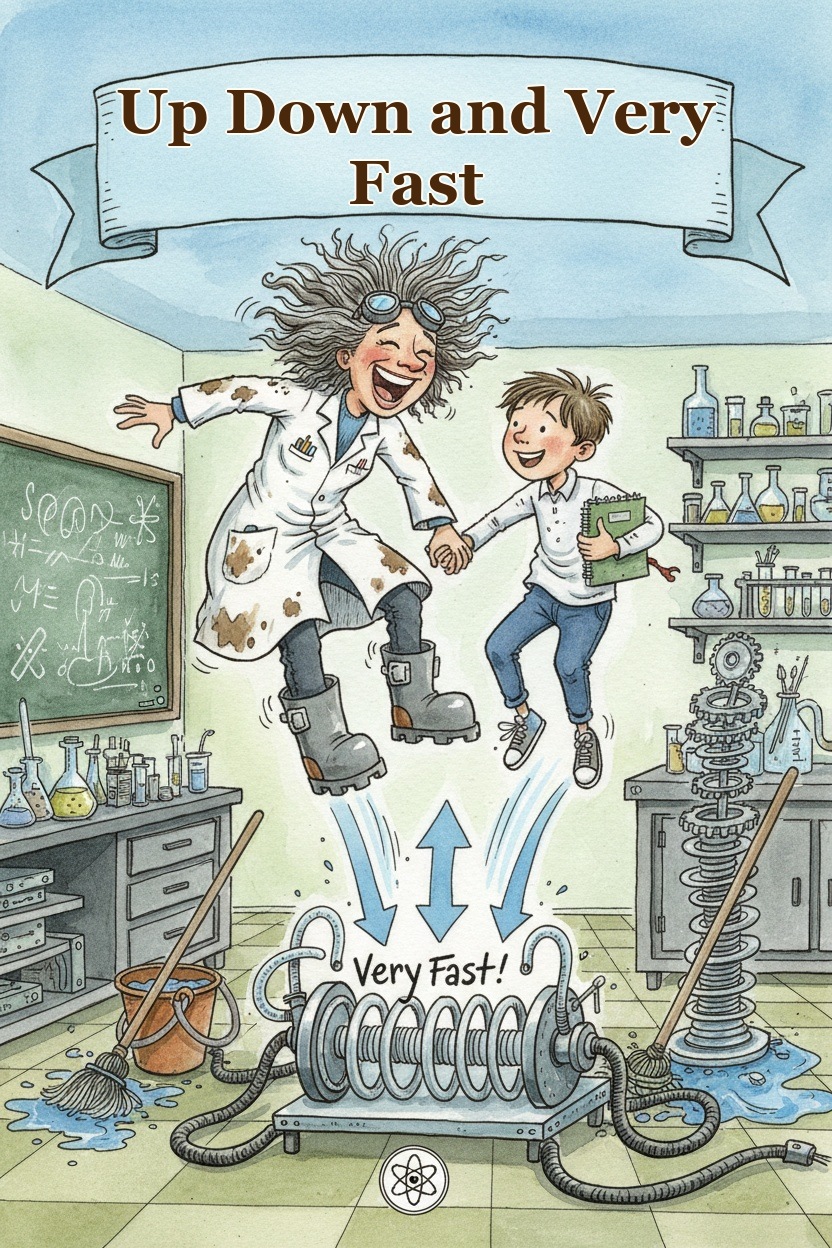
The Announcement
Professor Plunk burst through the lab door with a roll of blueprints under one arm and a length of gleaming steel track over her shoulder. Her goggles were on her forehead. Her hair was doing something that Otto privately believed should have been impossible without a fan.
"Otto! My careful colleague! I have it!"
Otto looked up from his notebook, where he was documenting yesterday's energy store experiment. Specifically, the part where the spring-loaded launch device had redecorated the lab's ceiling with their lunch.
"Have what?" he asked.
"The greatest demonstration of gravitational potential energy ever attempted within a residential building!" Professor Plunk unrolled the blueprints across the workbench, pinning them down with a coffee mug, a wrench, and a half-eaten biscuit. "Behold! The Gravitational Demonstration Apparatus, Mark One!"
Otto peered at the blueprints. It appeared to be a roller coaster. A very large roller coaster. Winding through what looked like the entire lab.
"Professor," he said carefully, "is that track going through the chemistry storage room?"
"Only briefly! Around the curve, you see. Now, observe!" She traced the track with her finger. "We start here, at the highest point. The cart sits at the top, full of gravitational potential energy. Then—" She swept her hand dramatically down the first drop. "It falls! And as it falls, that potential energy converts to kinetic energy—energy of motion! The higher the starting point, the more potential energy, the faster the cart goes at the bottom!"
Otto nodded. He'd learned this in his physics books. It made sense. At the top, the cart had stored energy from being lifted up. As it descended, that stored energy became speed.
"And then?" he asked.
"The track levels out, the cart coasts along the flat section, and arrives gently at the designated stopping station." Professor Plunk tapped a small square on the blueprint labeled STATION: WHERE OTTO WILL STAND WITH THE STOPPING NET.
Otto looked at the stopping net. It was small. The size of a bedsheet.
"That's the station, Professor? At the bottom of the first drop?"
"Precisely!"
"And how fast will the cart be going when it reaches the station?"
Professor Plunk consulted her calculations. "Oh, approximately... let's see... given the height of the drop... accounting for friction on the track..." She brightened. "Quite fast! But the net will catch it beautifully!"
Otto took out his pencil and wrote in his notebook:
Experiment: Gravitational Demonstration Apparatus, Mark One
Purpose: Demonstrate conversion of potential to kinetic energy
Prediction: Cart will stop at the station as intended
Concern: The net looks very small
The Build
The track construction took three days. Gloriana assisted with the welding while Otto documented every step. The coaster started at the top of the lab's tallest bookshelf—which Professor Plunk had cleared of books, stacking them precariously in the hallway—and plunged down in a dramatic swoop that passed through the chemistry storage room, curved around the central workbench, and ended at the small station with the net.
Every piece was secured. Every joint was tested. Professor Plunk checked the track three times, humming enthusiastically.
"You see, Otto, the beauty of this experiment," she said, tightening a bolt, "is that it demonstrates conservation of energy. The cart at the top has potential energy—stored because of its height. As it falls, that energy transforms into kinetic energy—motion. At every point along the track, the total energy stays the same, minus a tiny bit lost to friction and air resistance."
Otto wrote this down. Then he asked the question that had been bothering him.
"Professor, what happens to the kinetic energy when the cart arrives at the bottom?"
"Ah! Excellent question! The cart's kinetic energy must go somewhere. The net will stop it, converting the kinetic energy to… well, to the net's energy. And also a bit of heat from the stopping friction."
"Will the net hold?"
Professor Plunk looked at the net. It was bed-sheet sized. The cart was a repurposed shopping trolley with a seat attached.
"Of course it will hold! I've calculated the stopping distance precisely!"
Otto wrote:
Physics principle: Potential energy (from height) converts to kinetic energy (motion) as objects fall. Higher start = more speed at bottom. Energy is conserved (minus friction).
Prediction check: The net is one sheet. The cart is a shopping trolley. I am nervous.
The Test Run
The day of the demonstration arrived with excellent weather. By "excellent weather," Otto meant: no rain, no wind, and no obvious reason to postpone. Professor Plunk was positively vibrating with excitement.
"Prepare the cart, Otto! We'll place this bowling ball in the seat as our test passenger. Then we send it down!"
Otto placed the bowling ball in the cart. It looked comfortable. He wished he could say the same for himself.
"What height are we starting from?" he asked.
"The top of the bookshelf—over four meters above the station!"
Otto did some quick calculations. A bowling ball dropped from four meters would be moving quite fast. A shopping trolley rolling down a track from four meters would build significant speed, especially with such a smooth track.
"And the net—"
"Ready!" Professor Plunk pulled the net's corners, stretching it across the station area. "As I said, my careful colleague, the cart will arrive moving quickly, but the net will catch it and bring it to a gentle stop!"
Otto looked at the track. Then at the net. Then at the cart with the bowling ball.
"Professor, I think we should test with a smaller weight first. Just to be safe."
"Nonsense! The physics is sound! Potential energy at the top converts to kinetic energy at the bottom. The cart will slow as it hits the net, and stop safely! Begin the launch!"
Otto looked at the release mechanism. It was a lever. A very simple lever.
Physics principle: Levers multiply force.
Current job: Pull the lever.
He pulled it.
The cart rolled forward. It moved slowly at first, cresting the top of the first hill before beginning its descent down the track.
And then it went very, very fast.
Otto watched as the cart plummeted, the bowling ball riding along, and realized that four meters of height creates an enormous amount of kinetic energy when there's very little friction to slow you down. The cart shot through the chemistry storage room, rattling the shelves. It curved around the workbench, the bowling ball wobbling dangerously. It reached the station—
And hit the net.
The net caught the cart. The cart stopped.
For approximately one second.
Then the net—the bed-sheet-sized, officially-calculated stopping net—stretched, gave way at one corner, and the cart burst through with the bowling ball bouncing cheerfully behind it.
"Ah," said Professor Plunk.
The cart continued down the track, which extended beyond the station in a long curve. Otto watched in growing horror as the cart ascended a gentle rise, wobbled at the top, and then—
The track didn't end. It curved around and connected back to the main circuit.
"Professor," Otto said, "why does the track connect back to the beginning?"
"I may have created a continuous loop! For demonstration purposes! Multiple runs!"
"The cart is still moving!"
"Indeed it is! You see, Otto, without enough friction to remove the cart's kinetic energy, the energy carried it through the station and continued along the track. The energy didn't disappear—it kept the cart moving!"
The cart raced around the circuit again. The bowling ball now had a look of excitement that Otto found deeply concerning.
"The cart is completing a second lap!"
"Remarkable! It lost some energy to friction, so it's moving slightly slower than the first pass. Observe how it doesn't climb quite as high on that second hill!"
Otto observed. The cart did indeed climb slightly less high. It was also still going very fast.
"Professor, how will we stop it?"
"Let the energy dissipate! Each lap, friction and air resistance steal a little more kinetic energy. Eventually, the cart will slow enough to stop!"
Otto did the math. Each lap, the cart lost maybe ten percent of its speed. Starting from the initial drop speed, it would take approximately—
"THAT'S GOING TO BE TWENTY LAPS!"
"No, no, I think you're overestimating. Perhaps fifteen."
The cart zoomed past again, the bowling ball raising what looked suspiciously like a tiny bowling ball arm in a wave.
The Extra Loop and the Explanation
By lap six, Otto had moved to behind the workbench. By lap eight, Gloriana had entered with a very large fishing net and a bucket of sand.
"Here," she said, handing Otto the bucket.
"What am I supposed to—"
The cart shot past. The bowling ball was definitely having fun now.
"Sand," Gloriana said. "In front of the wheels. Slow it down."
Of course! Friction! Otto grabbed a handful of sand and scattered it across the track ahead of the cart's path.
The cart hit the sand and slowed, wheels dragging, for a moment. Then it passed.
"It's still going!"
Gloriana nodded. She took the bucket, walked to the lowest point of the track—just before the next climb—and dumped the entire contents in a thick layer.
The cart hit the sand and stopped. The bowling ball continued forward, however, sailing out of the cart and across the lab to land with a soft thunk in the chemistry storage room's sink.
Silence.
Otto looked at the stationary cart. Then at the bowling ball in the sink. Then at Gloriana.
"Thank you."
Gloriana nodded. "Told her so."
Professor Plunk emerged from behind the net, which was now hanging limply from one corner. Her expression was bright. Her goggles had fallen off. Her hair had somehow gotten bigger.
"Well!" she announced, dusting sand off her lab coat. "That demonstrated the conversion of potential energy to kinetic energy rather more vividly than I intended!"
Otto opened his notebook to a fresh page.
Observations: Cart started with potential energy from height. As it dropped, energy converted to kinetic energy—speed. Higher starting point = more speed at bottom. Cart was going fast enough to break through the stop net and complete additional laps because its kinetic energy didn't disappear at the station—it carried the cart forward until friction stole it away.
Additional observations: Bowling ball enjoyed the ride.
"Professor," Otto said, closing his notebook, "why exactly did the cart keep going?"
"Excellent question!" Professor Plunk pointed at the track. "At the top, the cart had gravitational potential energy from being lifted to that height. When I released the lever, gravity pulled the cart downward, converting that stored energy into kinetic energy—motion. The lower the cart went, the faster it traveled, because more potential energy had become kinetic energy!"
"The bowling ball was really moving at the bottom."
"Exactly! The cart was fastest at the lowest point, because that's where all the potential energy had converted to kinetic. Then, as the cart climbed the next hill, the kinetic energy converted back to potential energy—the cart slowed as it rose, using its motion to regain height. But your friction sand removed some of that energy, so the cart couldn't climb high enough to continue."
Otto nodded, writing:
Energy is conserved—it changes form but doesn't disappear. Friction steals some energy as heat, which is why nothing runs forever.
"So," he said slowly, "the cart would have kept going around forever if there was no friction?"
"Well, not forever—air resistance would eventually slow it. But certainly for many, many laps! The energy from that four-meter drop was much more than my stopping net could remove all at once. I miscalculated the net's capacity, but the physics was perfect!"
Otto looked at the cart, now sitting quietly in a pile of sand. He looked at the bowling ball, still in the sink. He looked at Professor Plunk, beaming with pride.
The Wonder Moment
Later, after Gloriana had cleaned up the sand and Professor Plunk had declared the experiment a complete success, Otto stood at the bottom of the track's first drop. He looked up at the top of the bookshelf where the cart had started.
"Its work," he said quietly.
"Yes." Professor Plunk stood beside him. "The cart had all that stored energy just from being lifted. I didn't add any energy to make it move—gravity did all the work."
"It's like the cart was holding onto the height, waiting to release it."
"Exactly. Every object up high has that stored energy, my careful colleague. The water in a glass. A book on a shelf. A person at the top of a slide. It's all waiting there—potential energy, ready to become motion when gravity gets the chance."
Otto thought about this. He thought about how the cart had coasted through the station because it had too much energy to stop gracefully. He thought about how each lap had been slightly slower, the energy gradually leaving the system as heat and sound.
"Professor Plunk," he said, "that cart at the top of the track—it could do that forever, couldn't it? If we lifted it back up again?"
"Every time we lift it, we add energy. And when we let it fall, that energy comes back out as motion. It just keeps changing form, never truly disappearing."
Otto wrote the last line of his notebook entry:
Energy doesn't vanish. It just keeps changing—from height to speed, from speed to heat. The cart is slower now because it gave its energy to the world. And if we want, we can give it more.
He looked up at the tower of bookshelves, at the gleaming track plunging down, at his friend standing beside him with wild hair and a sandwich in her pocket.
"Can we try it again tomorrow?" he asked. "With a better net?"
Professor Plunk grinned. "My dear colleague, I thought you'd never ask!"
Gloriana appeared from the storage room, holding the bowling ball. She looked at Otto, then at Plunk, then at the cart.
"Better net," she said. "I'll bring one."
And Otto, for the very first time, wrote down:
What will go wrong this time? I'm excited to find out.
THIS WAS NOT IN THE PLAN.
BUT I'M GLAD IT HAPPENED.