Professor Plunks Impossible Lab
The Inertia Incident
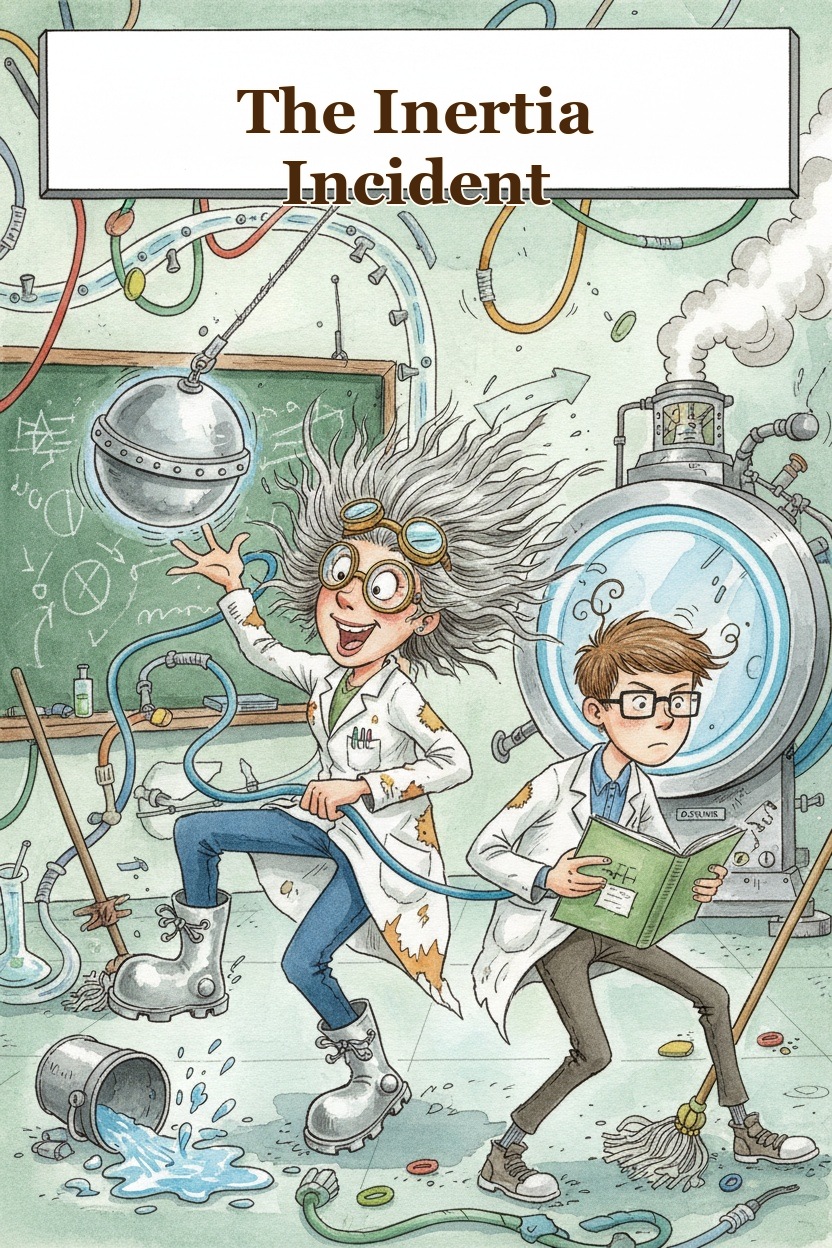
- The Perfect Demonstration
"Otto! My careful colleague! Prepare yourself for the most elegant demonstration in the history of physics!"
Professor Plunk burst through the lab door carrying a tablecloth, a stack of plates, three glasses, and what appeared to be an entire chocolate cake balanced precariously on her forearm. Her safety goggles were, as always, on her forehead.
Otto looked up from his notebook. "Professor, is that—"
"The Tablecloth Inertia Demonstration Apparatus! I call it TIDA, Mark One!" Plunk swept a pile of gears off the central workbench and laid the tablecloth across it. "Today, Otto, we prove one of the most beautiful laws in all of science: objects resist changes to their motion. This is inertia!"
Otto opened his notebook to a fresh page. He wrote carefully:
Experiment: Tablecloth Pull Demonstration
Goal: To show that objects stay still unless a force moves them
Prediction: Something will go wrong
"Now then," Plunk continued, arranging the plates, glasses, and cake in a neat row down the center of the tablecloth. "I shall grip the cloth firmly and pull it sharply forward. The objects—due to their inertia—should remain exactly where they are. The cloth slides out from beneath them. They do not move. They barely even wobble!"
Otto studied the setup. The plates were stacked dangerously high. The glasses were filled to the brim with juice. The cake was enormous.
"Professor, does the cake need to be part of the demonstration?"
"The cake is for after the demonstration! But it also demonstrates the principle beautifully! Mass has inertia, Otto. The cake has mass. Therefore the cake has inertia!"
Otto considered this logic. It was technically correct.
"Ready?" Plunk gripped the cloth with both hands. "Three... two... one... PULL!"
The cloth whipped out from beneath the setting. The plates stayed. The glasses stayed. The cake stayed.
They didn't even wobble.
Otto blinked. "It worked."
"WELL, OF COURSE IT WORKED!" Plunk was practically vibrating with excitement. "That's the beautiful thing about inertia, Otto! It doesn't need to be coaxed! It doesn't need to be persuaded! It simply IS! The objects resist changes to their motion—and their motion was to remain still!"
Otto wrote in his notebook:
Result 1: PERFECT. Everything stayed. This is suspicious.
- The Second Pull
"Let's do it again!" Plunk cried, already rearranging the tablecloth.
"Professor, perhaps we should stop while—"
"While what? While we're winning?" Plunk set up the plates and glasses again. "Otto, one demonstration is interesting. Two demonstrations are a pattern. Three demonstrations are a scientific certainty! We need to show that this works every time!"
Otto watched her add extra plates to the stack. "Why are you adding more plates?"
"To make the demonstration more impressive! You see, Otto, inertia depends on mass. More mass means more inertia. More inertia means the objects resist motion even more strongly!"
"Then shouldn't the heavier plates make it work better?"
"Exactly! Let's prove it!"
Gloriana appeared in the doorway. She looked at the tablecloth, the plates, the juice glasses, and the cake. She looked at Otto.
"Put the cake down," she said.
Otto looked at the cake. It was sitting directly next to the demonstration zone. "Maybe we should move the cake first."
"Nonsense!" Plunk waved her hand. "The cake performed perfectly last time! It's on our side! Ready? PULL!"
The cloth moved faster this time. Plunk put her whole body into it.
The plates stayed. The glasses stayed.
The cake... shifted.
Just slightly. Just a tiny slide. The bottom layer of frosting moved an inch to the left.
Otto watched it happen. He wrote:
Result 2: Cake moved. I told her about the cake.
"See!" Plunk was triumphant. "The heavier plates didn't move at all! Their greater mass gives them greater inertia! But"—she looked at the cake thoughtfully—"that was a gentle pull. Let's give the next one more power!"
"Professor, the cake shifted. That means the demonstration almost—"
"Almost nothing! We need a proper test! Real science requires enthusiasm!" Plunk rolled up her sleeves. "This time, I'm going to give it everything I've got!"
Gloriana appeared again. She handed Otto a dishtowel.
"For what?" Otto asked.
"Later," she said, and left.
- The Third Pull, and the Fourth
Plunk placed her feet wide apart. She took a deep breath. She gripped the tablecloth with both hands.
"Otto! Record this! The moment when science triumphs absolutely!"
"Professor, maybe you should—"
"PULL!"
The tablecloth left Plunk's hands like a shot. The plates didn't just stay—they seemed to hold their positions with defiant stillness. The glasses curved slightly toward the pull, then settled back.
The cake, however, was no longer on the tablecloth.
Nor was it on the table.
Otto watched in what felt like slow motion as the cake launched off the table, flew in a perfect arc across the lab, and landed—with considerable force—on the bench where Gloriana had been about to set her coffee cup.
Gloriana looked at the cake. Looked at Otto. Looked at the coffee cup in her hand.
"Told you about the cake," she said.
"FASCINATING!" Plunk was scribbling notes on the wall. "You see what just happened, Otto? The cake had inertia—it was at rest, resisting movement. But when I pulled the cloth with sufficient force, the cake's inertia wasn't enough to keep it completely still! The force of the pull transferred through the friction between cloth and cake, and..."
Otto read her scribbled notes over her shoulder. "The cake's inertia kept it in place relative to the table, but the cloth's sudden acceleration created a force that overcame the cake's static friction..."
"AND THE CAKE FLEW!" Plunk finished joyfully. "Because force, mass, and acceleration all interact! Newton's First Law: an object at rest stays at rest unless acted upon by an external force! The cloth pulling was the external force!"
"But Professor," Otto said carefully, "the plates worked perfectly. Only the cake moved. Should we stop and study why?"
"Stop?" Plunk looked genuinely offended. "Otto, we've only just begun! The cake moved because it's tall—it has a higher center of mass! The plates are low and wide, so they stay put. We need a taller test subject!"
She grabbed a tall vase from the shelf. "Let's see how inertia handles THIS!"
Otto looked at Gloriana. Gloriana looked at Otto.
"The juice is still good," she said.
Otto took the dishtowel.
- The Demonstration That Kept Going
The vase did not just fly. The vase attempted to follow the tablecloth into Plunk's hands. It made it halfway across the table before gravity reminded it that it was not, in fact, an airplane.
The vase shattered against the chalkboard with a spectacular crash that Otto was fairly certain they would still be hearing tomorrow.
"WAIT!" Plunk held up a hand. "That wasn't a failure! That was a SUCCESS! I successfully demonstrated that inertia causes objects to continue in their current state of motion—and the vase's current state was 'being yanked forward by friction'!"
"Professor," Otto said, "the vase is in pieces."
"The vase is in multiple pieces! Which proves that the force was significant! Which proves the inertia wasn't enough to hold it together! Otto, this is revolution! This is science!"
Otto wrote in his notebook:
Result 3: Vase no longer a vase. Plunk says this is fine.
Result 4 prediction: I am hiding under the table.
Plunk was already setting up the next round. No tablecloth this time—she'd decided the tablecloth was too gentle. She was wrapping the table in wax paper.
"If we reduce friction between the objects and the surface, the inertia will be even more visible! They won't just resist moving—they'll stay perfectly still while the surface moves beneath them!"
Otto was under the table. He had decided this was the safest place to observe.
"Ready, Otto? You're recording this, right?"
Otto held up his notebook with one shaking hand. "Recording."
"THREE! TWO! ONE! PULL!"
The wax paper came off the table in one clean sweep. Everything on it—the plates, the glasses, the forks, Otto's favorite pen that he'd left out earlier—stayed exactly in place.
Everything stayed.
Except the table itself.
The table, having been dragged forward by Plunk's enthusiastic pulling, continued moving forward with all the inertia it had gained. It slid three feet, hit the chalkboard, and knocked the erasers onto the floor.
Plunk stared at the displaced table. She stared at the intact plates. She stared at the wax paper in her hands.
Her face lit up.
"OTTO! DO YOU SEE?!"
Otto, from under the table, saw quite a lot. "The table kept moving!"
"Because the table was in motion and its inertia kept it in motion! Newton's First Law again! An object in motion stays in motion unless acted upon by an external force! The chalkboard was the external force!"
She was beaming. The lab was a wreck. There was cake on the bench, glass on the chalkboard, and the table had somehow rotated forty-five degrees.
"And do you know what this means, Otto?"
"That we should stop?"
"It means we've demonstrated inertia twice! Once with objects at rest staying put, and once with an object in motion keeping moving! We've shown both sides of Newton's First Law!"
Gloriana appeared with a mop. "Also the juice," she said, and pointed at the floor where the juice glasses—which had stayed on the table—had now tipped over during the slide.
Otto climbed out from under the table. He was covered in chalk dust. His notebook page had a juice stain in the corner.
- The Lurch and the Lesson
But Otto was thinking. There was something niggling at him.
"Professor," he said, "you mentioned that inertia is why you lurch forward when a car stops suddenly."
"EXACTLY! When the car stops, your body keeps wanting to move forward! Your inertia continues your motion! You lurch forward because your body resists the change in speed!"
"So... it's not just objects on tables. It's people too."
"EVERYTHING, Otto! EVERYTHING has inertia! Your body has mass, and that mass resists changes in motion!"
Otto looked around the lab. At the cake on the bench. At the broken vase. At the rotated table. At Gloriana, who was collecting glass fragments without a word.
"Professor, if everything has inertia... and more mass means more inertia..."
"Yes, Otto?"
Otto turned to look at the enormous, heavy, ancient bookcase that sat against the far wall. Plunk had barely brushed against it during the last pull.
"Does that bookcase have a lot of inertia?"
"A TON of it! We measured it once. Well, we estimated it. Well, the bookcase estimated it."
"Oh." Otto walked over to the bookcase and pushed gently. Nothing happened. He pushed harder. The bookcase didn't budge.
"See! Perfectly still!" Plunk was beside him now. "It has so much inertia that it resists even being pushed!"
Otto pushed again, harder. The bookcase shifted a millimeter.
"That's the resistance!" Plunk clapped her hands. "You're feeling inertia RIGHT NOW!"
Otto pushed once more, with all his weight. The bookcase creaked but didn't move.
"It's heavy," he said.
"It's heavy because it has mass! And mass gives inertia! The more mass, the more it resists being moved!" Plunk grabbed Otto's shoulder. "And THAT, my careful colleague, is what Newton's First Law is all about!"
Otto wrote in his notebook:
Newton's First Law: Objects resist changes to their motion.
At rest = stay at rest unless forced to move.
In motion = keep moving unless forced to stop.
More mass = more resistance to change.
THIS IS WHY PEOPLE LURCH IN CARS.
Final result: The demonstration worked. The lab is messier. The cake is ruined.
But... I understand now. Inertia is everywhere. It's why plates stay still. It's why jumps don't make you fly off the planet. It's why you hold the railing when the bus stops.
THIS WAS NOT IN THE PLAN.
But the plan was missing something.
Otto looked up from his notebook. Plunk was standing in the middle of the lab, arms spread wide, surveying the glorious mess. Cake on the bench. Glass dust on the floor. A table at a forty-five-degree angle. Wax paper hanging from the chalkboard.
And in the middle of it all, on the floor, perfectly untouched: the plate of cookies Gloriana had brought in earlier and set down just before the demonstration began.
"Professor," Otto said quietly. "Look."
Plunk followed his gaze. The cookies were unharmed.
"The plate has inertia," she whispered. "It stayed perfectly still."
"And the cookies," Otto said.
"The cookies have inertia too! They're at rest! They resisted the entire chaos around them!"
Plunk walked over and knelt beside the cookies. She picked up the plate with something like reverence.
"Inertia kept them safe," she said softly. "It watched over them."
Otto sat down on the floor next to her. "Inertia is like the universe's way of keeping things calm."
"YES!" Plunk's eyes lit up. "Until something forces change! And then—"
"Then everything flies around," Otto finished. "Or falls off tables."
"Or lurches forward in cars." Plunk nodded seriously. "But you know what, Otto? Even when things fly around? Even when vases break and cake becomes a projectile?"
She held out a cookie.
"Next time we put the cookies somewhere safer," Otto said.
They ate their cookies in the middle of the ruined lab, and Otto wrote one more line in his notebook:
Tomorrow, I'm going to study inertia by walking very carefully.
Gloriana appeared beside them with a dustpan and a box.
"For the vase," she said.
"Excellent!" Plunk stood up. "Because I was thinking, Otto—what if we tried the tablecloth pull with the cookies as the demonstration objects? We can make a hundred of them and test how inertia changes with different arrangements..."
Otto took another cookie. He'd learned something today, and it wasn't just about physics.
Sometimes, the second attempt made things messier.
And stopping after success was a valid scientific strategy.
But that was a lesson for a different day.