Inside Out Academy
WHAT BLOOD IS
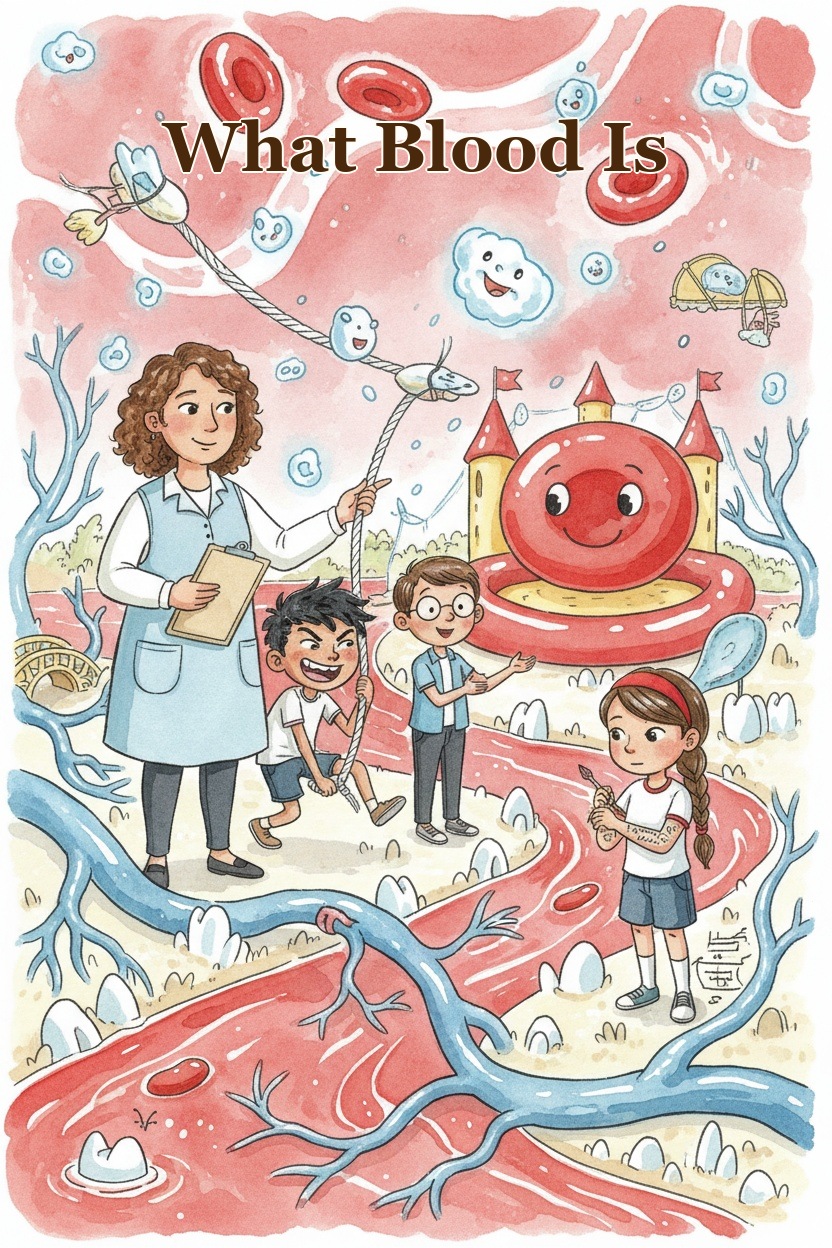
MS. VANCE'S CURRENT CHECKLIST
Location: Base camp beside a capillary, near the left index finger
Date: Thursday, June 5th (Day 6 inside Mr. Gomez)
Students accounted for: 22 out of 22 (Leo is being watched more closely)
✓ Find a stable location for base camp
✓ Establish what blood is made of
✓ Keep Leo away from anything that moves quickly
✗ DO NOT let Leo ride a red blood cell
PART ONE: THE RIVER AT OUR FEET
The class had set up camp on a solid, stable surface—which, inside Mr. Gomez, was not easy to find.
"Everyone stay still," Ms. Vance said, holding up her hand. "We are currently standing on something that is moving."
"Slightly," Sadie added, crouching down to examine the ground beneath them. "Very slightly. Like standing on a very slow escalator."
"The capillary wall," Marcus announced, writing in his notebook. "That's what this is. A blood vessel so small that red blood cells travel through it single file."
Leo was already on his hands and knees, pressing his face against the surface. "It's warm!"
"Blood is approximately 98.6 degrees Fahrenheit," Sadie said. "So yes, Leo. It's warm."
Through the translucent wall of the capillary, the class could see the most extraordinary parade. Things were moving—lots of things. A constant stream of objects, flowing past like traffic on a busy highway.
Leo pressed closer. "What IS all that?"
Ms. Vance smiled. "That, class, is blood. And we're about to find out exactly what it's made of."
PART TWO: THE DISK-SHAPED PASSENGERS
"Sadie," Ms. Vance said, "you've been waiting for this moment since we got here. Tell us what we're seeing."
Sadie took a deep breath. This was her moment. "Okay, so technically, the first thing you notice is the red blood cells. They're the most numerous—about five million of them in a single drop of blood."
The class watched as one floated past. It was disk-shaped, like a tiny donut that had been flattened and then bent slightly in the middle. It moved through the capillary with a strange, graceful flexibility, bending and squeezing as it navigated the narrow passage.
"It's flexible," Fatima observed quietly. "It squished through a spot smaller than itself."
"Exactly right," Ms. Vance said. "Red blood cells have to be flexible because they travel through capillaries smaller than their own diameter. They fold up, squeeze through, then spring back into shape on the other side."
"How do they know where to go?" Leo asked.
"They don't," Sadie said. "They just float. They follow the flow. The blood is always moving, always circulating—from the heart, through arteries, into capillaries like this one, then through veins and back to the heart again."
"Like a subway system," Marcus said.
"Like a subway system where every single passenger is a delivery driver," Sadie corrected. "Because look—here's the important part."
Another red blood cell floated past, and this one was close enough that the class could see something on its surface. A reddish tint. A glow.
"That's hemoglobin," Sadie said. "It's a protein inside the red blood cell. And it's what makes blood red."
"Why red?" Leo asked.
"Because hemoglobin contains iron," Sadie explained, "and when iron bonds with oxygen, it turns red. That's why blood is red. It's full of iron, and it's carrying oxygen to every cell in Mr. Gomez's body."
Mr. Gomez's voice crackled over the walkie-talkie. "I feel a slight tickle in my left index finger."
"That's us," Ms. Vance said. "We're fine. Keep your hand still."
"Will do," Mr. Gomez said. "Also, that explanation about the hemoglobin? I didn't know I was so interesting."
"You're incredibly interesting, Mr. Gomez," Ms. Vance said. "Now, who wants to see a white blood cell?"
PART THREE: THE PATROLS AND THE PLATELETS
The white blood cell appeared from nowhere.
One moment, the capillary was empty. The next, a much larger cell was rolling along the vessel wall, moving purposefully, scanning.
"Whoa," Leo breathed. "That one's BIG."
"White blood cells are larger than red blood cells," Sadie said. "But there are far fewer of them—about one white blood cell for every six hundred red blood cells. They're the body's security force."
The white blood cell paused. It seemed to be examining something on the capillary wall—some tiny irregularity that the class couldn't even see.
"Is it looking at us?" Marcus asked nervously.
"No," Sadie said. "We're on the outside of the capillary. It's on the inside. But yes, it's definitely looking at something."
The white blood cell extended a pseudopod—a temporary arm of its own body—and touched the spot on the wall. Then, apparently satisfied that it was nothing, it moved on.
"White blood cells are always patrolling," Sadie explained. "They move through the bloodstream looking for signs of infection or damage. If they find something dangerous—a bacterium, a virus, some kind of invader—they hunt it down and destroy it."
"Destroy it?" Leo's eyes went wide.
"Eat it, actually," Sadie said. "Some of them physically engulf the invader and digest it."
"That's amazing," Fatima said softly. "It's like the body is always on guard."
"It is," Ms. Vance said. "Every moment of every day, Mr. Gomez's white blood cells are patrolling his body, making sure nothing harmful gets through. You're looking at one of the most sophisticated defense systems in the natural world."
The walkie-talkie crackled again. "Does that mean you're all safe in there?" Mr. Gomez asked.
"For now," Ms. Vance said. "As long as we stay on the outside of the capillary and don't trigger an immune response."
"And now," Sadie said, "look. Platelets."
The platelets were tiny—much smaller than the red blood cells floating past. They moved in clusters, sticking together, pausing in small groups along the vessel wall.
"There's a small tear in the capillary," Sadie observed. "Nothing serious, just some wear and tear from normal use. But the platelets are already gathering there."
The class watched as platelets collected at the spot, layering on top of each other, forming a tiny plug.
"They're like little workers," Marcus said. "Rushing to patch up a leak."
"Exactly," Sadie said. "Platelets are your body's emergency repair crew. If you get a cut, platelets gather at the wound and clump together to stop the bleeding. They also release chemicals that help the blood clot."
"So red blood cells carry oxygen," Leo said, counting on his fingers. "White blood cells fight off invaders. Platelets patch things up. What's the other one?"
"Plasma," Sadie said. And she pointed to the space between all these things—the medium they were all floating in.
Everything moved through plasma.
PART FOUR: THE MEDIUM AND THE MESSAGE
"Plasma is the liquid part of blood," Sadie explained. "It's about 92% water, and it carries everything—the red blood cells, the white blood cells, the platelets, and also dissolved nutrients, hormones, waste products, proteins... everything."
"It's the river," Fatima said. "Everything else is traveling in the river."
"Precisely," Ms. Vance said. "Plasma is the medium that allows blood to move everything from one place to another. Oxygen goes in the red blood cells. Nutrients ride in the plasma. Hormones float along like messages in bottles. Even the waste products—carbon dioxide, urea—are carried away by plasma."
"So blood is a delivery system," Marcus said. "Red blood cells deliver oxygen. Plasma delivers nutrients and messages. White blood cells deliver protection."
"And platelets deliver repairs," Sadie added. "And together, they're blood."
"And blood," Ms. Vance said, "is the reason every other system in Mr. Gomez's body can function. Without blood, there's no oxygen delivery, no waste removal, no immune defense, no way to get hormones where they need to go. Blood is the river that makes everything else possible."
The class was quiet for a moment.
"Blood is really important," Leo said, with genuine surprise. "Like, really important."
"About five liters of it," Sadie said. "That's how much Mr. Gomez has flowing through his body right now."
"Five liters?" Marcus looked down at his own tiny body. "That's... that's a lot of river."
The walkie-talkie crackled.
"So I'm a river now," Mr. Gomez's voice said. "I've been called many things, but never a river."
"You're a very good river, Mr. Gomez," Ms. Vance said.
"Thank you, Ms. Vance. Also, I've made sandwiches for everyone for lunch. They're on my desk."
PART FIVE: THE QUESTION
The class was examining the capillary wall, looking at the plasma flowing past, when Leo asked the question.
"