The Capy Series
The Toymaker’s Second Note
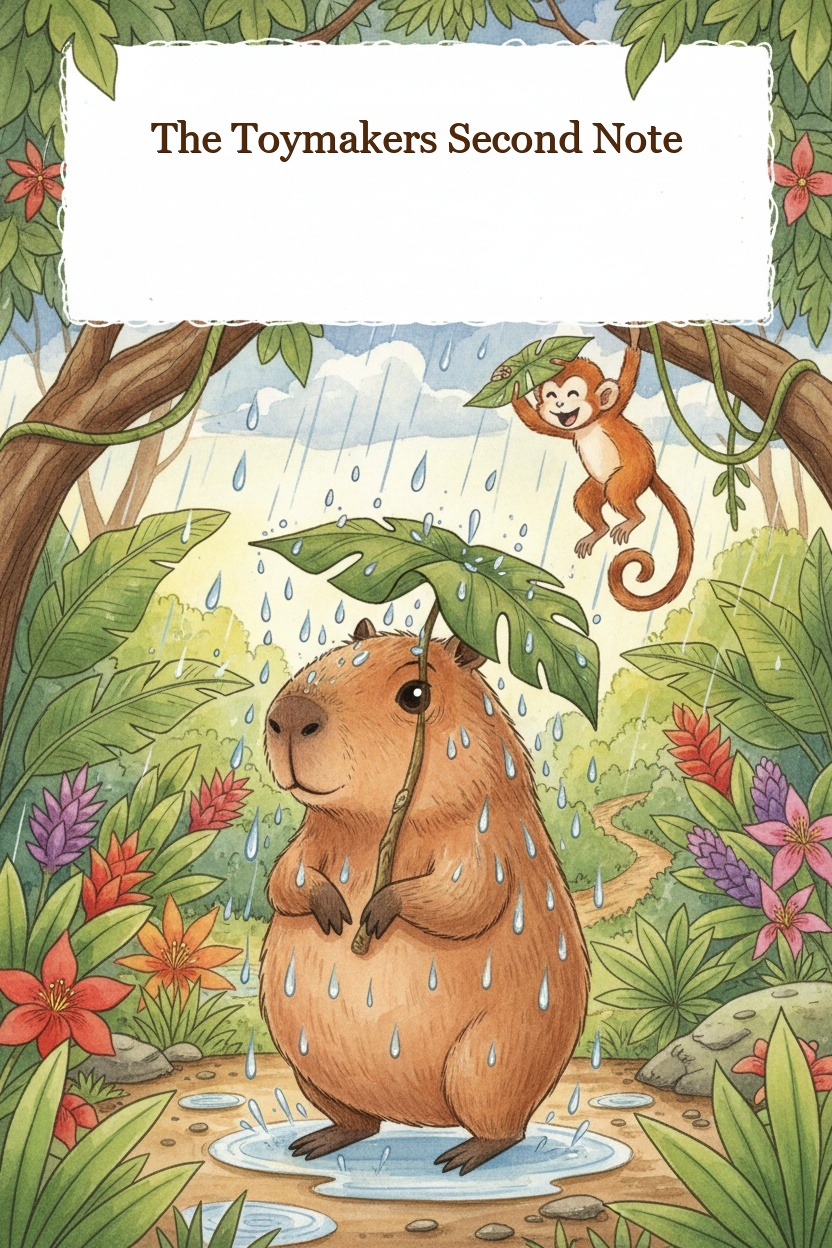
The rain was falling in sheets, which in the Amazon meant the whole world smelled like wet leaves and crushed flowers. Caper the capybara stood at the edge of their camp, his big brown nose twitching. Water dripped from his whiskers, and his fur was a soggy, lumpy mess.
“It’s just water, Caper!” chirped Squeaky the squirrel monkey, hanging upside down from a branch above. He was holding a tiny umbrella made from a large leaf, but it was doing very little to help. “Think of it as a shower! A big, free, jungle shower!”
“I don’t like showers,” grumbled a voice from a dark, coiled pile of scales by the tree roots. Hisss the anaconda lifted his massive head, his tongue flicking out to taste the air. “I like it wet, but not this wet. This is the kind of wet that gets into your bones.”
Flora the quetzal bird, perched primly under a broad fern, ruffled her magnificent, shimmering rainbow tail feathers. “The rain is ruining my iridescence. I look positively dull.” She preened a single feather, then sighed. “Dull, I tell you.”
Caper ignored them all. His ears were pricked forward, listening. Above the drumming of the rain, he heard something else. A strange, tinkling, clanking sound. It was coming from the riverbank.
“Do you hear that?” he asked.
Squeaky stopped swinging. He tilted his head, his big dark eyes blinking. “Hear what? All I hear is the endless, monotonous… wait. Yes! It sounds like a hundred tiny bells having a fight with a tin can!” He zoomed down, grabbing a vine and swinging toward the river.
Caper trotted after him, his short legs splashing through puddles. Hisss slithered behind, muttering about his joints. Flora flew overhead, her long tail trailing like a rainbow ribbon, grumbling about the damp air ruining her feathers’ shine.
At the riverbank, a mess of branches, leaves, and mud had been pushed together into a small dam. Stuck in the middle was a glass jar. The lid was sealed, but inside, they could see a rolled-up piece of paper. The clanking sound was the jar being shaken by the current as it bumped against the sticks.
Squeaky, of course, was the first to reach it. He was a blur of golden fur, grabbing the jar and popping the lid with a satisfying plink! “Treasure! I found treasure! It’s mine! All mine!” He unrolled the sopping-wet paper.
“Careful, Squeaky!” Caper said, wading up to his belly in the cool water. “It’s falling apart!”
But Squeaky was not being careful. He was being Squeaky. The paper tore in his paws. A piece, maybe a third of it, fell into the river.
“Ooops,” he said.
Flora let out a squawk of horror. “My feathers are not just for decoration, you know! My eyes are important! And I saw that! That was a piece of a map! A treasure map!” She dove down and, with her sharp beak, managed to snag the soggy piece of paper just before it floated away. She landed awkwardly, flapping her wings to keep her balance, but the paper was in her beak.
Hisss had been watching quietly. He sighed, a long, deep sound like air leaving a balloon. “Is it a map to a nest of juicy frogs? I am hungry.”
Caper gently took the two pieces of paper from Flora and Squeaky. He laid them flat on a dry-ish rock. The rain had soaked them, but they were still readable. One piece was covered in scratches that looked like… writing. Messy, cramped writing. The other piece had a simple drawing of what looked like a glowing, beating heart.
The writing was smudged, but they could make out some words:
…found the old inventor’s diary. He was a strange one, that Toymaker. Everyone said he was a villain, that his machines would swallow the sun. But his notes say different. He wrote: ‘The Emerald Heart is a machine. Not one of gears and metal, but one of life. I have broken it. I will make it sing again.’
Caper read it out loud, his voice slow and careful.
Silence fell over the group. Even Squeaky stopped bouncing.
“The Emerald Heart?” Flora whispered, her feathers shimmering in the dim light. “That’s just a legend. A myth about the beating core of the forest.”
“A machine?” Caper said, frowning, thinking. “But the Emerlad Heart is the forest itself. It’s living. It’s the trees, the rivers, the animals. How can that be a machine?”
“Who’s the Toymaker?” Squeaky asked, hopping from one foot to the other. “Is he the one who made the floating islands? I’ve always wanted to see a floating island. I bet they have the best swinging vines.”
Hisss the anaconda spoke, his voice a low rumble. “My grandmother told me stories of the Toymaker. She said he was a dreamer with magical hands. She said he tried to capture the sun in a golden cage to power his city, but the cage broke, and the city fell apart, and the pieces floated into the sky.”
“And he broke the Emerald Heart trying to do it,” Caper said, his heart sinking. “So everyone thought he was a villain. An evil genius who wanted to steal the sun.”
But the note said something different. It said the Toymaker was trying to fix it. It said he loved the forest.
Caper looked at the little drawing of the heart. “If he was a dreamer, and he broke the Heart… then the legends are wrong. His plan wasn’t to destroy. It was to create. To connect everything. To make the forest sing. And someone twisted his story.”
“Wait!” Squeaky suddenly shrieked, making everyone jump. “There’s more! On the back of my piece! Look!”
He flipped over the soggy piece he had dropped in the river. On the back, printed in faded blue ink, was a series of symbols and a short sentence:
The pond of the smiling frogs. Follow the three plums.
“A clue!” Flora cried. “To where he hid his next note! Or his machine! We have to go!”
Caper felt a shiver that wasn’t from the cold rain. He was a cautious capybara. He liked routine and naps. This felt big, and scary, and important. “The Toymaker wasn’t the villain, but he still broke the forest. Someone stole his plan and twisted it. But who? And why?”
“Who cares!” Squeaky was already packing his tiny bag with bits of string and a spare seed. “There’s a mystery to solve! An adventure! Let’s go to the Pond of the Smiling Frogs!”
Hisss grumbled, “It’s raining. I’ll be thirsty, but I will not enjoy it.”
Flora fluffed her feathers. “The best jewels require a proper setting. A little adventure will just make my tail look more brilliant.”
So, with the rain starting to ease, they set off. Caper led the way, his nose to the ground, following a path only he could smell. They walked for an hour, through dripping ferns and under arching roots, until they came to a small, clear pond. Large, lily pads floated on the surface.
And on the lily pads were frogs.
But they weren’t just any frogs. They were tiny, golden-yellow frogs with big, unblinking eyes. Their mouths curved up in a permanent, serene smile. They basked on the lily pads, not moving.
The Pond of the Smiling Frogs.
“Now what?” Squeaky whispered. “Do we ask them for directions?”
“They’re not going to talk, Squeaky,” Caper said, feeling a little silly for even saying it.
But as he watched, one of the frogs opened its mouth. It wasn’t a croak. It was a single, clear, ringing note. Like a tiny bell. It sang for a few seconds, then stopped. Then another frog did the same. Then another. Their little voices rose and fell, creating a gentle, tinkling chorus.
“They’re singing,” Caper breathed.
And as they sang, the water of the pond began to shimmer. In the centre, three plums floated to the surface. They were perfect, purple, and glowing with a soft inner light. Three plums.
Squeaky’s eyes went wide. “Three plums! Like the clue! The three plums are here!”
But Caper’s mind was racing. The Toymaker called the heart a machine. The Heart was the song of the forest. The frogs were singing their part. And the plums were floating.
“The Heart isn’t a machine of metal,” Caper said slowly. “It’s a machine of music. The Toymaker was trying to build a music box! A giant one! The whole forest is the music box, and the Heart is the little cylinder that makes it play. When he tried to harness the sun, he cracked the cylinder, and the music stopped.”
He looked at the floating plums. “But he built this. He made the forest so that it could heal itself. The pond produces the plums. The plums are the seeds. They’re part of the Heart’s song.”
“So, do we eat them?” Squeaky asked, reaching out.
Caper gently stopped him. “No. We plant them. The note said, ‘I will make it sing again.’ To make it sing, we have to give it a seed. A new seed for a new song.”
Flora looked at the plums, their glow reflecting in her brilliant eyes. “The Toymaker wasn’t a villain. He was a gardener. A musician. He came back to try and plant the seeds to fix his mistake, but someone stole his plan before he could finish.”
Caper nodded. “And that someone twisted the story, trying to make people think the Heart was a prize to be captured, not a song to be shared. Waiting for the plums to ripen and be forgotten. But we found them.”
Carefully, Caper waded into the pond. The frogs didn’t jump away. They just watched him, humming their little notes. He reached into the cool water and gently took the three glowing plums. They felt warm in his paws.
He didn’t know what to do with them. He didn’t have a plan. But he saw a patch of muddy, rich earth at the edge of the pond. With his nose, he dug three small holes. One by one, he pushed the warm plums into the cool soil and covered them up.
As soon as the last seed was buried, the ground began to tremble gently. The frogs’ chorus grew louder, turning from a melody into a big, joyful song. The earth pulsed.
And from the small patch of mud, three tiny, emerald-green sprouts pushed their way up into the air.
The rain had stopped. The sun broke through the clouds. And for a moment, Caper felt the whole forest take a deep breath. It wasn’t the new Heart, not yet. But it was a start. The Toymaker’s second note had been a confession, a key, and a promise. And they had followed it.
Flora landed beside Caper and nuzzled a sprout with her beak. “You did it, Caper. You made it sing again. A little bit.”
“We did it,” Caper corrected him, feeling warm all over. “He made the seeds. The frogs made the music. We just had to listen to the story and know that a villain isn’t always a villain. Sometimes, a machine is just a broken song waiting to be played again.”