The Number Kingdom
The Everything Crisis
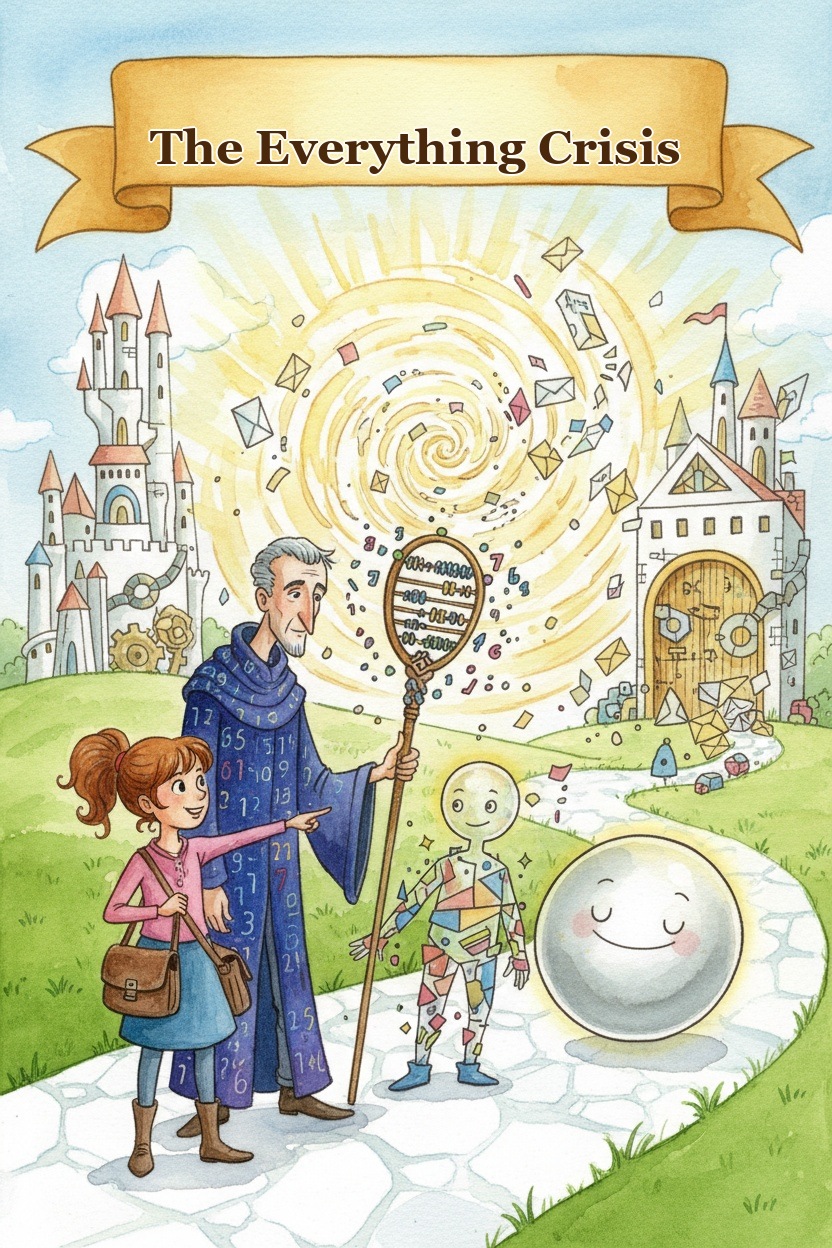
The Day Everything Broke
Mira arrived at the Number Kingdom's great plaza to find chaos. But not ordinary chaos—this was organized chaos, the kind that looked accidental but wasn't.
The counting fountains were spitting numbers in the wrong order: 7, 5, 9, 3, 8. The fraction bridges over the canal were sagging with mismatched denominators. The geometric buildings had begun tilting at strange angles. Market prices had become algebraic expressions no one could solve. And the great clock tower was striking hours that didn't exist.
"Right. Let's see what's broken," Mira said.
The Count appeared, his numeral-covered robes flickering between different values. "Everything," he said, with the particular weight of someone who had never said that word before. "The Remainder has—"
"Everything is broken?" Zero materialized beside Mira, perfectly round, perfectly calm.
"The counting sequences," the Count continued. "The fractions. The geometry. The algebra. The statistics. The clock. All at once. Every law of mathematics is failing simultaneously."
A gleeful voice echoed across the plaza. "Isn't it wonderful?"
The Remainder perched on the fountain's edge, looking like a child assembled from leftover pieces of other things—a third of a smile, half a wave, a remainder of something that hadn't divided evenly.
"I thought," it said, "if breaking one thing at a time was interesting, breaking everything at once would be BEAUTIFUL. And it is! Look at the mess! The glorious, glorious mess!"
Mira looked. The mess was, indeed, impressive. But she wasn't admiring it. She was seeing patterns.
"Wait," she said. "The counting fountains are breaking in a specific way."
The Pattern in the Chaos
Mira pulled out her paper and pencil. The Count and Zero watched as she began sketching.
"The fountains," she said, writing numbers quickly. "7, 5, 9, 3, 8. That's not random. Seven minus two is five. Five plus four is nine. Nine minus six is three."
"Subtracting two, adding four, subtracting six," the Count said. "An alternating pattern with increasing differences."
"Right. So the next term should be three plus eight, which is eleven." Mira looked up. "But the fountain is trying to produce twelve."
She studied her paper, then crossed out her first note. "No, wait. That's not it either. Let me look at it differently."
The Remainder leaned in, genuinely interested. "Oh, this is my favorite part. When you get confused. It's almost as good as the breaking!"
Mira ignored it. "If the pattern is subtract 2, add 4, subtract 6, add 8, then the sequence goes 7, 5, 9, 3, 11. But the fountain produced an 8 in the fifth position. So the fountain isn't following the rule I think it's following."
She tried again, writing smaller. "What if the pattern is built on pairs? Seven plus five equals twelve. Nine plus three equals twelve. So the pairs should sum to twelve. The next pair should be eight plus four."
"Ah!" the Remainder clapped its half-formed hands. "Very good! The pairs DO sum to twelve. But that's not the end of it, is it?"
Mira's eyes widened. "The fractions! The bridge supports are labeled with fractions that should each equal something specific. 2/3, 4/6, 6/9. Those are all equivalent fractions—they all equal two-thirds. But they've been scrambled to 2/3, 4/5, 6/9."
The Count nodded gravely. "The bridges are collapsing because the support ratios are wrong."
"And the geometric buildings," Mira continued, now seeing it. "Their angles should sum to specific values. A triangle's angles sum to 180 degrees. But these triangles have angles of 60, 90, and 45 degrees—which sums to 195. That's not a triangle at all!"
The Remainder clapped again. "You're seeing everything! The algebraic expressions in the market that don't balance, the statistical records that don't match the data, the clock that's running on the wrong numbers—"
"It's all connected," Mira said slowly. "The pairs summing to twelve. The equivalent fractions. The angles that should sum to 180. The equations that should balance. The probability that should sum to 1. It's all about things fitting together."
She looked at her paper, covered in patterns. "But I can't fix it all at once. Every law is broken in a different way. I need to understand how they all relate."
Zero's Empty Set
Mira sat down in the middle of the plaza, surrounded by her papers. She had tried six different approaches. She had corrected herself four times. She had crossed out almost as much as she'd written.
"All the math is connected," she said. "Addition and subtraction are opposites. Multiplication and division are opposites. Fractions and decimals are the same things written differently. And it all connects—counting connects to addition connects to multiplication connects to division connects to fractions connects to algebra."
"But every connection is broken," the Count said. "Every law fails at once."
Mira felt something she hadn't felt in forty books: genuine hopelessness. "I can't fix everything. Every time I fix one thing, another breaks. It's like trying to hold water in a sieve."
The Remainder appeared beside her, suddenly almost gentle. "What is left over?" it asked. "When you try to divide evenly, what remains?"
"The remainder," Mira said. "You."
"Yes. And what remains when you count? What's left over at the end of every sequence? What do you have left when you've solved everything you can?"
"Infinity," Mira said slowly. "There's always more."
"AND WHAT DO YOU HAVE LEFT WHEN YOU'VE GIVEN EVERYTHING?" the Remainder said, its form flickering with excitement.
Zero stepped forward. It had been quiet, as always, but now it spoke.
"Zero," Zero said.
Everyone looked at it.
"Zero," Zero repeated. "The empty set. Nothing left over. When the remainder is zero, the division is complete. When the unknown in an equation is balanced, both sides equal the same thing. When probability sums to one, it becomes certainty. And zero—" Zero paused, its form taking on a quiet significance. "Zero is what makes all of it work."
Mira blinked. "Zero is the additive identity. When you add zero to anything, it stays the same. But if everything is being changed—"
"Then I am the only thing that doesn't change," Zero said. "Zero is the one value that is the same everywhere. Zero degrees. The origin at (0,0). The probability of something impossible. Zero is the point where everything meets."
The Remainder's eyes widened. "Oh. OH. You mean—"
"Start from zero," Zero said. "Everything else is relative to that."
Mira grabbed her paper. "The pairs sum to twelve. Twelve minus seven is five. Twelve minus nine is three. Twelve minus eight is four. And twelve minus twelve is—"
"Zero," said Zero.
Mira was writing furiously now. "Every broken thing is broken because it's missing its connection to zero. The fractions that should be equivalent—2/3 minus 2/3 is zero. The angles that should sum to 180—180 minus 180 is zero. Equations that should balance—both sides equal, so their difference is zero."
She looked up. "If I can find what makes each thing zero, I can fix it. The counting sequence should produce pairs that sum to twelve—so the difference between each pair and twelve must be zero. The fractions should be equivalent—so their difference must be zero. The equations should balance—so their sides must be equal."
The Count's robes had stopped flickering. "She's right. Zero is the common ground. All mathematics is fundamentally about achieving zero—balance, equality, completion."
"Not completion," Mira said, and even she was surprised by her own words. "Not exactly. Zero is the starting point. The place where you begin. The thing that makes everything else measurable."
She stood up. "I need to fix the counting first. If the pairs sum to twelve, then the missing numbers are: seven needs five, nine needs three, eight needs four."
The Everything Restored
Mira moved through the kingdom, and as she went, she described what she was doing so the others could follow.
"The counting fountains: the pattern is pairs summing to twelve, so I'll restore the sequence to 7, 5, 9, 3, 8, 4, 12, 0."
She wrote the numbers, and as she did, the fountains began to flow correctly again.
"The fraction bridges: the supports need equivalent fractions. 2/3 equals 4/6 equals 6/9. The difference between each pair is zero. Restoring the equivalent fractions means their differences are zero."
The bridges stabilized.
"The geometric buildings: the triangle angles must sum to 180. 60 plus 60 plus 60 is 180. So I'll change the 90 to 60 and the 45 to 60. Their sum minus 180 equals zero."
The buildings straightened.
"The algebraic expressions: each equation must balance. X plus 3 equals 8, so X equals 5. Both sides equal 8, so their difference is zero."
The market prices became solvable.
"The statistical records: the average must match the data. If the numbers are 2, 4, 6, 8, their mean is 5. The difference between each data point and 5—when you add them all up—equals zero."
The records aligned.
"The clock: the hours must make a complete cycle. Twelve hours plus twelve hours equals twenty-four hours. The difference between the clock's time and the correct time must be zero."
The clock struck the correct hour.
And then, for the first time in what felt like a very long time, the kingdom was still.
The Count looked around. "Everything is... restored."
The Remainder stood at the edge of the plaza, looking uncharacteristically thoughtful.
"I broke everything," it said. "And you fixed everything. But did you notice?"
"Notice what?" Mira asked.
"The remainders," the Remainder said. "In every single fix, there was a moment where something didn't fit. Where you had to try something wrong first. Where you had to cross out and start again. Where a number didn't divide evenly, or an unknown stayed unknown, or an answer wasn't obvious."
Mira was quiet.
"Mathematics isn't about things being perfect," the Remainder said. "It's about things being understood. You understood me, Mira. After forty books, you finally understood."
"Understood what?" Mira asked, though she felt something settling in her chest, like a piece she hadn't known was missing.
The Remainder smiled—a real smile, not its usual gleeful grin. "I'm not a failure of mathematics. I'm the part that keeps it going. If everything divided evenly, there'd be nothing left to solve. If everything balanced perfectly, there'd be no questions. The remainder IS the question. And the question is always: what's next?"
Mira looked at the kingdom—at the restored fountains and bridges and buildings, at the balanced equations and correct records and accurate clock.
"At the end of Book 1," she said slowly, "I knew how to count. At the end of Book 40, I know that counting never really ends. There's always one more. Always something left over."
"Yes," the Remainder said. "That's it. That's exactly it."
It began to fade, but it left one last thought: "I'll be back, Mir-ah. Not to break things. To ask questions. And you'll answer them. OR YOU'LL TRY. And that will be even better."
The Remainder vanished, leaving a faint trail of leftover numbers in the air—fractions that would never simplify, square roots that would never be whole, probabilities that would never quite reach certainty.
Zero appeared beside Mira. "It's gone," it said.
"It'll be back," Mira said. "And that's okay."
"Are you afraid?" Zero asked.
Mira considered the question carefully—the way she had considered every mathematical problem across forty books.
"Afraid of what I don't know?" she said. "No. Not anymore. Not knowing something isn't a failure. It's a question. And the best mathematical question is always the next one."
Zero nodded quietly. "Yes. That tends to work."
The Count stepped forward. "You have restored the kingdom, Mira. Not by knowing everything, but by understanding how everything connects. The counting leads to addition. The addition leads to multiplication. The multiplication leads to division. The division leads to fractions. The fractions lead to decimals and percentages. The patterns lead to algebra. The data leads to statistics. The unknown leads to—"
"The question," Mira finished. "Everything leads to the question."
She looked at her paper, covered in crossed-out mistakes and corrected paths and genuine mathematical thinking. It was a mess. It was beautiful.
"What happens now?" she asked.
"Now," the Count said, and for the first time in forty books, Mira heard something almost like warmth in his formal voice, "you ask the next question."
Mira smiled. She picked up her pencil and turned to a blank page.
"Right," she said. "Let's see what's next."