Chef Sparks Kitchen Lab
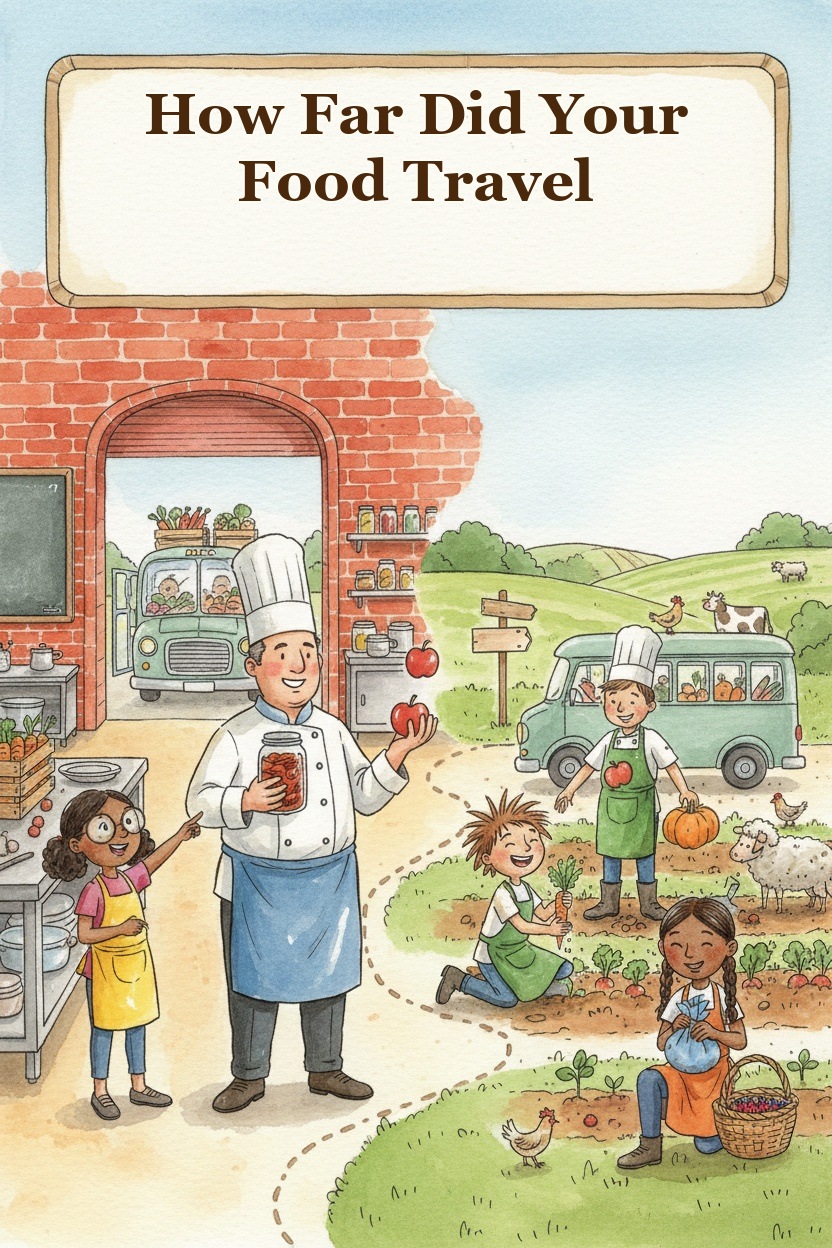
HOW FAR DID YOUR FOOD TRAVEL
The Map on the Chalkboard
The Kitchen Lab smelled like lemons and fresh basil when the class arrived on Tuesday afternoon. The big garage doors were open, letting in the warm autumn air, and the students could see the garden in the courtyard—the last tomatoes hanging on their vines, the basil bushes still lush and green.
Priya stopped at the door. "Chef Iggy, why is the chalkboard covered in paper?"
Iggy turned from the stove, his apron already dusted with flour. "Ah! The mystery of the covered chalkboard! Today, we are going to find out where our food comes from. And I mean exactly where."
He pulled the paper down with a flourish. Behind it was a huge map of the world, pinned to the chalkboard. The continents were drawn in blue and green chalk, with little red dots scattered across them.
"A map!" Tommy exclaimed. "Are we going on a field trip?"
"In a way," Iggy said. "We're going on the most important field trip there is—we're going to follow the trail of every single ingredient in this kitchen."
Maya walked closer, studying the map. Her eyes found a cluster of red dots near the top. "What are all these marks?"
Iggy beamed. "That's what we're about to find out. Today, we're going to learn about food miles."
Dev raised his hand. "Is that like when your food gets tired from walking so far?"
"Ha! Not exactly," Iggy laughed. "Food miles are the distance food travels from where it's grown to where it's eaten. And I want you to help me figure out how far our food has traveled to get to our kitchen."
He gestured to the huge prep table, which was covered in ingredients. There were apples, onions, potatoes, flour, sugar, rice, bananas, chocolate, lemons, and a big bunch of spinach.
"Every single ingredient has a story," Iggy said. "And every story starts somewhere. Let's see if we can figure out where."
The Lemon from Far Away
Iggy picked up a lemon and held it in the light. "Let's start with this. Where do lemons come from?"
"They grow on trees!" said Lucia.
"Right! But where in the world?" Iggy asked.
The class looked at each other. Priya thought for a moment. "Ammamma says the best lemons come from India. She always talks about the lemon trees there."
"That's true!" Iggy said. "But this particular lemon—" He turned it over and squinted at the sticker on its skin. "This one says it's from Spain."
He walked to the map and put a pushpin in Spain. "From a region called Murcia, to be exact. That's about 4,500 miles from our kitchen."
The class let out a collective "Ooooh."
Tommy looked at the lemon with new respect. "That lemon had a passport!"
"It did!" Iggy laughed. "It traveled across the Atlantic Ocean, through ports, onto trucks, into warehouses, and then to our door. And that's just the final journey. Before that, it was grown on a farm, watered, picked by people, washed, sorted, packed, and loaded. Every mile it traveled used fuel. Every mile put carbon dioxide into the air."
"Carbon dioxide is bad for the planet?" Sam asked.
"Too much of it is," Iggy said. "You've heard about climate change, right? When we burn fossil fuels—gasoline and diesel and jet fuel—to move food around, we add greenhouse gases to the atmosphere. So the farther food travels, the more fuel it takes, and the more it adds to the problem."
Maya held up a bag of spinach. "What about this? Where's this from?"
Iggy checked the label. "That's from about two hundred miles away—a farm just across the state line. It probably traveled by truck, which uses less fuel than a plane or a boat for the same amount of food."
"So the spinach has fewer food miles than the lemon," Priya said. "That means it's better for the environment, right?"
The class started nodding, but Iggy held up a hand. "Hold on. It's not that simple. Let me show you something."
He walked to the chalkboard and, with a dramatic swoop of his arm, knocked a spoon off the counter. It clattered loudly and rolled across the floor.
Tommy grinned. "That's the fifth spoon this month, Chef!"
"I have no idea what you're talking about," Iggy said, picking it up. "Now, focus. I want to tell you about a tomato."
The Tomato's Secret
Iggy picked up a beautiful red tomato from the counter and held it up. "This tomato came from a greenhouse right here in our city. It traveled about ten miles to get here. Ten food miles! That's almost nothing."
He placed the tomato on the table and picked up another one. "And this tomato came from Spain. It traveled about 4,500 miles."
Tommy frowned. "So the first tomato is better for the planet, right?"
"Here's where it gets interesting," Iggy said. He put both tomatoes side by side. "The first tomato was grown in a greenhouse. In October. Back home, it's getting cold, right?"
The class nodded. Outside, the maple trees were turning orange and gold.
"To grow a tomato in October in our climate, the greenhouse has to stay warm," Iggy said. "That takes energy to heat it. And energy means burning fuel, which means carbon emissions. We have to add those emissions to the ten-mile tomato's total."
He turned to the Spanish tomato. "But this tomato? It grew outside, in the sunshine, in Spain's warm climate. That's how Spanish tomatoes are grown in the fall—naturally, without greenhouses. It traveled a long way by boat or truck, which uses fuel too. But the energy used to grow it was mostly just... sunshine."
Dev's eyes lit up. "Oh! So the Spanish tomato might use less total energy than the local one?"
"Exactly!" Iggy clapped his hands. "When you count all the energy—not just the transportation, but the growing, the heating, the storing, everything—food miles are only part of the story."
Priya was nodding slowly. "So a tomato grown far away in a warm place can be better for the planet than a tomato grown close by in a cold place?"
"If the local tomato had to be grown in a heated greenhouse, absolutely," Iggy said. "That's called the carbon footprint of food—the total amount of greenhouse gases produced to get it from farm to plate. Food miles are part of that footprint, but so is the way food is grown, stored, and processed."
Maya looked at the local tomato thoughtfully. "So the best tomato is the one that's in season where it's grown?"
"Yes!" Iggy pointed at her. "Maya's got it. When we eat seasonally—when we eat what's naturally growing in our area right now—we get food that's fresh, delicious, and less energy-intensive. In summer and fall, our local tomatoes are amazing because they grew outside, in natural sunshine, completely free of extra energy use."
"But in winter—" Lucia began.
"In winter, eating a local tomato means someone had to heat a greenhouse or use special lights to grow it," Iggy said. "And that can use a lot more energy than shipping a tomato from a place where it naturally grows at that time of year."
The class was quiet, thinking about this. Tommy broke the silence. "So... we're not going to eat tomatoes today?"
Iggy laughed. "We're absolutely going to eat tomatoes! But I'm going to show you which ones are the best choice for right now."
The Map Takes Shape
The class spent the next half hour checking every ingredient in the kitchen. Each time they found where something came from, Iggy marked it on the map with a pin.
The apples? From Washington State. The onions? A hundred miles away. The chocolate? From West Africa, via a factory in Pennsylvania. The rice? From Thailand. The bananas? Ecuador. The olive oil? Italy. The potatoes? From right here in the same state.
By the end, the map was covered in pins connected by a web of lines. Iggy stepped back and smiled. "There it is. The journey of our food."
"It looks like a spiderweb," Lucia said.
"It looks like the whole world," Priya said quietly.
Iggy nodded. "Food connects us to the whole world. Right now, in this kitchen, we have ingredients from six different countries and four different continents. And that's a good thing—most of the time."
"How is it a good thing?" Sam asked. "I thought we were supposed to eat local food?"
Iggy spread his hands. "Eating local is great when it makes sense. It supports farmers in your community, builds relationships, and often means fresher food. But here's the thing: none of us can grow everything we need. Our climate doesn't grow coffee or chocolate or cinnamon. If we only ate local food, we'd never taste a banana or a warm bowl of rice."
Maya looked at the map. "So there's a balance?"
"Exactly. The world's food system is complicated," Iggy said. "Some foods absolutely should be eaten in season—tomatoes, strawberries, asparagus. But other foods—rice, coffee, spices, chocolate—simply can't grow in our climate, and importing them is the only way to have them at all."
"So we should think about where our food comes from, but not feel bad about all of it?" Tommy asked.
Iggy's face lit up. "That's the most important lesson of today. The goal isn't to never eat food from far away. The goal is to understand the choices we make. When we understand food miles and carbon footprints, we can make better choices. We can eat strawberries in June when they're local and amazing. We can eat tomatoes in summer and fall from the garden. And when winter comes, we can enjoy oranges from Florida and know that we're eating food that grew easily and naturally in that warmer place."
He picked up his famous pan and gave it a little shake. "And you know what? We can also cook a meal that celebrates the whole world."
The Global Feast
The dish Iggy made that day was something he called "A World on a Plate."
The class divided into groups. One group sautéed the Washington apples with cinnamon. Another group steamed the local potatoes. A third made a grain bowl with Thai rice and a simple dressing made from the Italian olive oil and a squeeze of the Spanish lemon.
Maya checked every label carefully. "No nuts, no sesame, no shellfish," she announced. "We're good."
Priya chopped the local spinach and mixed it with the rice. "This spinach didn't travel far at all," she said. "It came from the farm near our school."
"But we're putting it with rice from Thailand and dressing with lemon from Spain," Dev said. "So the dish has food miles from all over the world."
"It's like we're having a dinner party with the whole globe," Tommy said, taking a big bite. "And everyone brought something delicious."
Iggy tasted the finished bowl and made the Tommy hum—the two-note sound that meant success. "Every ingredient has a story," he said. "When you know the story, you understand the food better. And when you understand the food better, you can make choices that are good for you and good for the planet."
Maya looked at the map, then at her bowl. "So food miles are like a question, not an answer."
Iggy's eyebrows rose. "That's beautiful, Maya. Food miles are a question: 'Where did this come from? How did it get here? What did it take to produce it?' The answer helps us make better choices."
"Like choosing the Spanish tomato in winter instead of the greenhouse one?" Lucia asked.
"Exactly. And choosing, when we can, to eat what's in season, close to home. And being thankful for the treats that come from far away—like chocolate, which absolutely has a huge carbon footprint, but which also supports farming communities in West Africa. For some foods, the right answer isn't 'never eat it.' It's 'sometimes, with awareness, honoring the journey it took.'"
Iggy set down his spoon and looked at the map. "Food connects us to people we'll never meet—farmers, truckers, sailors, port workers, shopkeepers. Every bite is a chain of human effort reaching across the world. Understanding that doesn't make food less delicious. It makes it more delicious."
Tommy took another bite and nodded. "It's better when you know the story," he said with his mouth full. "It's like the food has a flavor of all the places it visited."
Priya smiled. "Ammamma says the best food is made with love. I think she meant that the food is full of the love of everyone who helped make it."
Iggy raised his glass. "To the world, and everything it grows."
Everyone raised their glasses. And the tomato on the counter—the one that had started it all—sat glowing in the afternoon light, wearing its seashell, rich with the story of the sea it had crossed.
Kitchen Lab Notes
From the desk of Chef Iggy Spark
Dear Students,
Today we learned that food has a biography. Every ingredient has been somewhere, met someone, traveled a journey before it reached your plate. Food miles are one part of that story—but only one part. A local tomato grown in a heated greenhouse in winter can use more energy than a tomato shipped from Spain. The most important thing you can do is ask the question: Where does this food come from, and what did it take to produce it? When you know the answer, you can choose with your eyes open. Eat local when it makes sense. Eat seasonal whenever you can. And when you eat something from far away, savor it—it traveled a long way to meet you.
Your question to think about: What food in your home has traveled the farthest to reach your table? How did it get there? What do you think its journey was like?
Recipe Card
A World on a Plate Bowl
Serves 4 hungry students (or 2 very hungry Chefs)
Ingredients:
-
1 cup rice (basmati or any variety)
-
1 tablespoon olive oil
-
1 apple, diced small
-
1 teaspoon cinnamon
-
2 cups fresh spinach, chopped
-
Juice of 1 lemon
-
Salt and pepper to taste
-
Optional: 1/2 cup cooked chickpeas or beans for extra protein
Steps:
-
Cook the rice according to package directions. (Ask a grown-up for help with the stove.)
-
While the rice cooks, warm the olive oil in a small pan over medium heat. Add the diced apple and cinnamon and sauté for 3–4 minutes, until soft and fragrant.
-
When the rice is done, fluff it with a fork. Stir in the spinach and allow it to wilt slightly from the warmth of the rice.
-
Squeeze the lemon juice over the top. Add salt and pepper to taste.
-
Top with the cinnamon apples and any other vegetables or beans you like.
-
Eat it slowly and think about all the places your food traveled.
Chef's Note: This is a no-recipe recipe! Use whatever vegetables, grains, and dressings you have. The meal is about the thinking, not the exact ingredients. Every time you make it, you can learn about your food's journey.