The Number Kingdom
The Multiplication Introduction
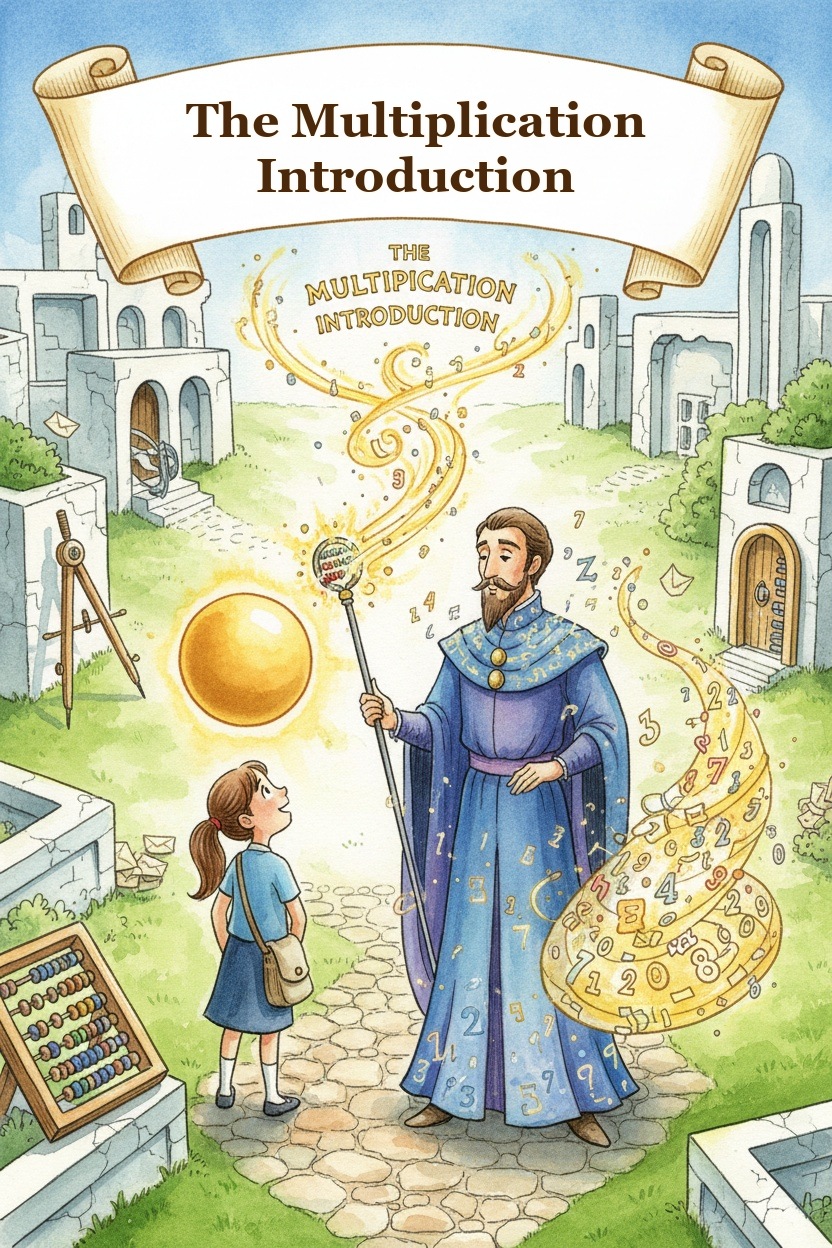
The Festival Problem
The Number Kingdom was buzzing. The Great Harvest Festival was only five days away, and every market stall, every bakery, and every orchard was working at full speed. The festival meant feasting, and feasting meant food—lots of it.
Mira found the Count in the Grand Food Hall, staring at a long table covered with empty baskets.
"Right," she said, slinging her satchel over her shoulder. "Let's see what's broken."
The Count turned to her, his numeral-covered robes shifting slowly. "Nothing is broken, Mira. That is precisely the problem. Nothing is broken, and yet nothing is working."
Mira looked at the empty baskets. "I don't understand."
"The festival requires one hundred and twenty apple tarts," the Count said grimly. "The bakers can make four tarts per tray. At this rate, they will finish just in time for next year's festival."
A small, silver-white circle rolled gently across the floor and came to rest beside Mira's foot.
"The tarts are being counted one at a time," Zero said quietly. "Watch."
Mira followed Zero's gaze to the corner, where a frazzled baker was hunched over a tray of glowing, golden tarts. She was counting them very carefully.
"One apple tart, two apple tarts, three apple tarts, four apple tarts..."
She set the tray aside and reached for the next one.
"One apple tart, two apple tarts, three apple tarts, four apple tarts..."
The Count gestured at the rows of baskets. "Thirty trays remain. Each tray contains four tarts. She has been counting this way all morning."
The baker finished her fourth tray and started on the fifth, her voice growing tired.
"One apple tart, two apple tarts, three apple tarts..."
Mira watched, feeling the slowness of it in her bones. This was going to take forever.
Too Slow
Mira sat down beside the baker. "Excuse me," she said. "Is there a faster way to count these?"
The baker looked up, grateful for the interruption. "I only know one way," she admitted. "I count every tart on every tray. Four per tray. Thirty trays. Four plus four plus four..."
She trailed off, looking at the remaining trays with despair.
Mira pulled out her notebook and pencil. "Okay," she said. "Let's think about this."
She drew thirty little circles in a row. "Thirty trays. Each tray has four tarts. So that's thirty groups of four."
"But counting them all is taking too long," the baker said. "I've been counting for hours, and I'm only on tray five. The festival opens in five days!"
Mira stared at her drawing. Thirty groups of four. She started writing out the addition: 4 + 4 + 4 + 4 + 4...
After writing twenty-three plus signs, she stopped. This was too slow even on paper.
The Remainder appeared then, as it always did when things were becoming too slow and too frustrating. It materialized in a swirl of unfinished numbers, half-formed and gleeful.
"Four plus four plus four," it sang, dancing around the baskets. "Oh, what fun! But what if one tray only had THREE tarts? Then what? Hmm? How would your counting work THEN?"
Mira ignored it. She was looking at her notebook, at the long list of fours, and something was beginning to form in her mind.
"Groups of four," she said slowly. "Thirty groups of four. That's not really thirty different things. It's the same thing—four—happening thirty times."
The baker blinked. "What do you mean?"
Mira drew a simple picture: 30 boxes, with the number 4 in each one.
"Look. Each box is a tray. Each tray has four tarts. If I add them all up, I'm just doing the same addition over and over. Four, thirty times."
She counted the boxes. "But counting thirty groups one at a time is like... like walking one step at a time across the whole kingdom, when there's a road that goes straight there."
The Remainder stopped dancing. It looked, for the first time, interested.
"A road?" it said. "What road?"
Mira didn't know yet. But she knew there had to be one.
The Faster Way
Mira found Zero in the palace gardens, sitting perfectly still in the center of a flower bed shaped like a number line.
"Zero," she said, "is there a way to add the same number many times without adding it one at a time?"
Zero considered this. "What do you think?"
Mira sat down in the grass. "Well... when I count, I'm making equal groups. Thirty groups of four." She wrote in her notebook: 4 + 4 + 4 + 4 + 4 + 4 + 4 + 4 + 4 + 4 + 4 + 4 + 4 + 4 + 4 + 4 + 4 + 4 + 4 + 4 + 4 + 4 + 4 + 4 + 4 + 4 + 4 + 4 + 4 + 4
"Thirty fours," she said. "That's a lot of writing."
Zero didn't say anything. It just waited.
Mira looked at her long line of fours. "There has to be a shorter way to say 'thirty groups of four.' A way that means the same thing."
The Count appeared at the garden gate, his staff tapping the path. "There is," he said. "It is called multiplication."
Mira looked up. "Multiplication?"
The Count nodded gravely. "When you add the same number many times, you are multiplying. The symbol is ×. Thirty groups of four is written like this."
He traced a symbol in the air with his staff. It glowed golden and hung there:
30 × 4
"Thirty times four," the Count said. "It means exactly what you wrote: thirty groups of four. But it is shorter. And because it is shorter, it can be calculated faster."
Mira stared at the glowing symbols. "Thirty times four," she repeated. "Thirty groups of four. They're the same thing."
"Precisely," the Count said. "Multiplication is repeated addition. When you have equal groups, you can multiply instead of adding over and over."
The Remainder popped up from behind a hedge. "But what if the groups AREN'T equal?" it asked. "What if one tray has four tarts and the next has three and the next has five? What THEN?"
Mira thought about this. "Then multiplication doesn't work," she admitted. "Multiplication is only for equal groups. If every tray has exactly four tarts, I can multiply. If they don't, I have to add each one separately."
The Remainder looked almost disappointed. "Hmm. You're right. That's annoyingly correct."
Zero spoke quietly. "Mira, try one. What is three groups of four?"
Mira wrote: 3 × 4 = ?
She pictured three trays, each with four tarts. "Three groups of four. Four plus four plus four. That's twelve." She wrote: 3 × 4 = 12
"Three times four equals twelve," she said. "Three groups of four. Twelve tarts."
The Count nodded, something like approval flickering in his ancient eyes. "And what about four groups of three?"
Mira frowned. "Four groups of three? That would be three plus three plus three plus three. Also twelve." She wrote: 4 × 3 = 12
She looked at the two equations:
3 × 4 = 12
4 × 3 = 12
"Wait," she said. "They're the same?"
The Count's staff tapped once. "When you multiply, the order does not matter. Three groups of four and four groups of three both make twelve. We call this the commutative property of multiplication."
The Remainder rolled its eyes. "Boring. Everything the same, same, same. What if there were SIXTEEN left over? What if the tarts didn't fit into trays at all?"
Mira smiled. "Then we'd have a different problem," she said. "But right now, we have equal groups. And equal groups can be multiplied."
The Great Scaling Up
Back in the Grand Food Hall, Mira stood before the exhausted baker.
"Thirty trays of four tarts," Mira said. "Thirty groups of four. Thirty times four."
She picked up a piece of chalk and wrote on the flat stone counter:
30 × 4 = ?
"I know how to figure this out," she said. "Four groups of thirty is the same as thirty groups of four. Because order doesn't matter in multiplication."
She drew thirty circles in a row. "But I still don't want to add thirty fours. Let me count in groups instead."
She circled ten circles at a time. "Ten groups of four is forty. So thirty groups of four is three times forty." She wrote:
10 × 4 = 40
30 × 4 = 120
"One hundred twenty tarts!" she said. "Thirty trays of four tarts is one hundred twenty tarts. Exactly what the festival needs!"
The baker stared at the chalk marks. "That took you... a minute. It would have taken me hours."
Mira looked at her long addition problem, then at the short multiplication problem. "Multiplication is faster because it's the same as repeated addition, but organized. You don't have to count every single tart. You just count the groups and the number in each group."
The baker smiled for the first time all day. "Groups and numbers in each group. That's all it is?"
"That's all it is," Mira said. "Now, how many other foods need scaling up?"
The baker pulled out a long list. "The market needs twenty crates of apples, six per crate. The bakery needs forty loaves, five per oven. The kitchens need sixteen pots of soup, eight per pot..."
Mira grabbed her chalk.
20 × 6 = ?
"Twenty groups of six," she said. "Or six groups of twenty. Six times twenty is one hundred twenty. Easy."
40 × 5 = ?
"Forty groups of five. Five groups of forty. Five times forty is two hundred."
16 × 8 = ?
Mira paused. This one was trickier. "Sixteen groups of eight. I could break it into smaller groups. Ten groups of eight is eighty. Six groups of eight is forty-eight. Add them together... one hundred twenty-eight."
The baker's eyes went wide. "You just did that in your head!"
"Multiplication is just organized addition," Mira said. "When you understand the groups, everything gets faster."
The Festival Feast
Five days later, the Great Harvest Festival opened on schedule.
The tables groaned under the weight of one hundred twenty apple tarts. The market stalls were stacked with apples. The bakery's ovens had produced two hundred loaves, and the kitchens were serving one hundred twenty-eight pots of soup—with time to spare.
The Count stood at the head of the festival, his staff gleaming. "The food production has been successfully scaled up," he announced. "Thanks to the application of multiplication, what would have taken weeks was accomplished in days."
Mira stood beside him, eating an apple tart. It was excellent.
The Remainder appeared in a puff of crumbs. "Well, well," it said. "You found a shortcut. But here's something interesting about your shortcut, little human. What about a tray with ZERO tarts? What then?"
Mira frowned. "Zero tarts in a group? That doesn't make sense for baking."
"Ah, but it makes SENSE in mathematics," the Remainder said, grinning. "What is five groups of zero? What is zero groups of five? Hmm? What happens to your perfect multiplication then?"
The Remainder dissolved into a shimmer of unfinished numbers, leaving its question hanging in the air.
Zero rolled up beside Mira and sat very still for a moment.
"Multiplying by zero," Zero said quietly, "gives you zero. Always. No matter how many groups you have."
Mira thought about this. "So five groups of zero is... zero? And zero groups of five is also zero?"
"Every time," Zero said. "Multiply anything by zero, and the result is zero. It's one of my favorite properties."
The Count looked down at Zero with something approaching respect. "That is, in fact, correct. Multiplication by zero always produces zero."
Zero said nothing. It simply sat there, perfectly calm, taking up no space at all.
"Yes," Zero said after a moment. "That tends to work."
Mira looked at her notebook, at all the equations she'd written.
3 × 4 = 12
4 × 3 = 12
30 × 4 = 120
5 × 0 = 0
"Multiplication is repeated addition," she said. "Equal groups. The order doesn't matter. And zero makes everything zero."
She closed her notebook. "That's not a shortcut," she said. "That's a whole new way of thinking."
The Count bowed his head. "The festival is saved, Mira. The tarts are baked. The kingdom is fed. And you have discovered one of the most powerful tools mathematics offers."
Mira took another tart. "I should get back to counting," she said.
"Haven't you finished?" the baker asked.
"Not counting tarts," Mira said, grinning. "Counting all the other things I want to try multiplying."