The Logic League
Talking to the Grid
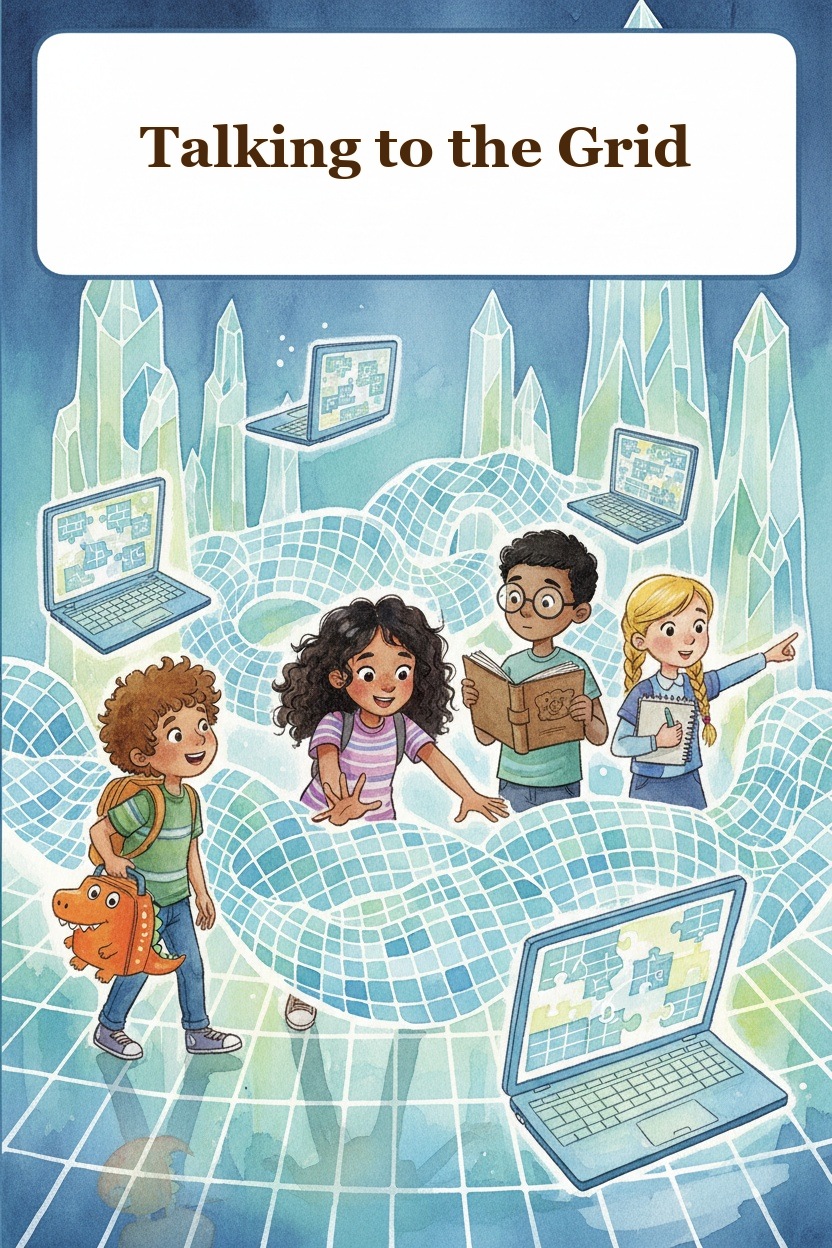
Chapter One: The New Thing in the Entry Zone
The four friends had been in the Grid enough times now that they'd started to feel like experts. Priya could spot patterns in the glowing blue-white architecture before anyone else. Kwame knew the Entry Zone's train station layout by heart. Lily had fixed three error messages that weren't even theirs. And Sam—well, Sam always found the thing nobody else noticed.
Today, Sam found the new thing.
"Um, what's that?" they asked, pointing to a tall, slim column in the middle of the main hall. It hadn't been there yesterday.
The column was made of polished silver material that caught the golden light of the Entry Zone. At about Sam's head height, there was a small rectangular screen. Below it was a slot, like a mouth waiting to be fed.
"It's a terminal," Priya said, walking up to it with her hands on her hips. "You know, like a computer you talk to."
"You don't talk to computers," Lily said, tilting her head at it. "You give them input."
"Exactly," said Priya. "And they give you output."
Kwame pulled out his journal. He'd been recording every Grid discovery in story form since Book 1, and this one was already finding its way into a sentence. "Input goes in, output comes out," he muttered, writing. "Like... asking a question and getting an answer."
"Or like putting money in a vending machine and getting a snack," Sam offered.
Everyone turned to look at Sam.
"What? I'm hungry."
Chapter Two: The Unhelpful Helpful Screen
The screen blinked to life as the kids approached. Text appeared in neat block letters:
WELCOME TO THE GRID TERMINAL.
PLEASE PROVIDE INPUT.
"See?" Priya said. "It wants us to tell it something."
"What should we tell it?" Sam asked.
"I don't know. Anything." Priya stepped forward. "Hello?"
The screen paused for a moment, then displayed:
ERROR: INPUT NOT RECOGNIZED. PLEASE TRY AGAIN.
"See, Priya," Lily said, "you have to give it useful input. 'Hello' doesn't tell it anything."
"You're not the boss of my input," Priya muttered.
Kwame was examining the terminal more closely. "There's a slot here. Like something goes in."
"What goes in?" Sam asked.
"My guess? Information." Kwame tapped his chin. "In stories, terminals give you things when you ask correctly. The key is knowing what the terminal can understand."
Lily stepped forward, squinting at the screen. "There's writing at the bottom. Tiny. 'This terminal responds to requests containing two parts: a noun and a question about that noun.'"
"Two parts," Priya repeated. "A noun and a question about it."
"So we could ask," Sam thought out loud, "what is a door?"
Lily typed carefully into the small panel below the screen:
DOOR: WHAT IS IT?
The terminal hummed. The kids leaned in. The screen displayed:
A DOOR IS AN OBJECT THAT BLOCKS OR ALLOWS PASSAGE.
OUTPUT COMPLETE.
"Whoa," Sam breathed.
"It worked," Kwame said, scribbling in his journal. "We gave it input—the noun and the question—and it gave us output—the answer."
"It's like a conversation," Priya said, the gears in her brain turning. "But you have to speak its language."
"That's what input and output means," Lily said. "The input is what you put in. The output is what comes out."
Chapter Three: The Door That Needed Questions
Behind the terminal, a door slid open that definitely hadn't been there before.
"No way," Sam said. "We opened a door by asking a question?"
"Not by asking a question," Priya corrected. "By giving the terminal good input. The output was the door opening."
They stepped through into a small round room. It was empty except for another terminal, identical to the first, and a large sealed archway on the far wall.
WELCOME TO THE QUESTION ROOM.
PROVIDE THREE INPUTS TO UNLOCK THE ARCHWAY.
"This is a test," Kwame said. "We have to figure out what inputs it wants."
"Three inputs," Priya mused. "But what about?"
The screen flickered and added:
THE ROOM CONTAINS ONE HIDDEN OBJECT.
ASK THREE QUESTIONS TO IDENTIFY IT.
EACH QUESTION MUST BE ABOUT A DIFFERENT PROPERTY.
"Properties," Lily said. "Like color. Or size. Or what material it's made of."
"So we need to ask three questions about three different properties," Priya said, "and use the outputs to figure out what the thing is."
"But we can't see anything," Sam pointed out, looking around the empty room.
"Look closer," Lily said.
They looked. And there, tucked in the corner behind a small shimmer—a Grid quirk that meant something was there but not quite visible—sat a small object about the size of their hand.
"One input gets one answer," Kwame said. "We only get three. How do we figure out what it is with only three questions?"
Chapter Four: Sam's Big Question
"I'm going to ask what color it is," Priya announced, walking to the terminal.
"Wait," Sam said.
Priya stopped. "Wait what?"
"If we ask the wrong questions," Sam said slowly, "we'll get output, but it won't help. Do we want to know what color it is first? Or what it is first?"
Priya blinked. "That's... actually a good point. Asking what color it is only helps if we already know what colors things can be."
"The terminal knows what the object is," Lily said. "It's just answering our questions."
"Right," Sam said. "So what if we ask a question that gives us more information than just one thing? Like... what's the category of this thing?"
"Categories?" Kwame said, thinking hard. "Like, 'is it a tool' or 'is it food'?"
"That's a yes or no question," Priya said. "Those are efficient."
Lily was already at the terminal. "Let's try."
IS THIS OBJECT USED FOR WRITING?
The screen hummed:
YES.
"It's something used for writing," Kwame said, writing it down. "That narrows it down."
Priya stepped up. Next question.
WHAT COLOR IS IT?
RED.
"Something red that's used for writing," Sam said. "A red pen! A red pencil!"
"One more question," Lily said. "We need to know what kind of writing thing it is. So let's ask about its shape."
IS IT LONG AND THIN?
YES.
"A red, long, thin thing used for writing," Priya said. "That's a red pencil."
The terminal displayed:
CORRECT. THE OBJECT IS A RED PENCIL.
UNLOCKING ARCHWAY.
The archway shimmered and slid open.
Chapter Five: The Best Gift
As they walked through, they found themselves back in the main hall of the Entry Zone. The red pencil was sitting on a small pedestal.
"Uh," Sam said. "It's ours now?"
"I think so," Priya said, picking it up. It was a perfectly ordinary red pencil with no markings on it.
"There was the first terminal," Kwame said, thinking. "We put in a noun and a question, and we got a door. Then we put in three questions and got a pencil and an archway. The terminal is a way to exchange information."
"Input and output," Lily said. "You give it the right input, and it gives you the output you need."
Kwame opened his journal and read aloud:
"The Grid is like a friend who only speaks in questions and answers. If you ask well—if your input is clear and useful—you get good answers. But if you ask badly, you get nothing. Actually, that's not true. If you ask badly, you get an error message. The Grid always answers. It just answers with what you deserve.
Input is what you give. Output is what you get. And the best programs—like the best friends—are the ones you can give different things to and get different, useful things back."
"I think that's the whole lesson," Sam said. "The terminal wasn't a machine. It was a conversation partner."
"A conversation partner that needed very specific questions," Priya added.
"Most good conversation partners do," Kwame said.
They walked back toward the glowing laptop that always waited for them at the edge of the Entry Zone. The red pencil in Priya's hand was warm.
"I'm going to ask it a question next time," Sam said. "A really good one."
"Like what?" Lily asked.
"I'm going to ask it how to get home," Sam said quietly.
The others went quiet. Then Priya put her hand on Sam's shoulder.
"That's the right question," she said. "And now we know how to ask it."
THE END
Next: Book 10 — Error 404: Why?