The Logic League
Biggest to Smallest
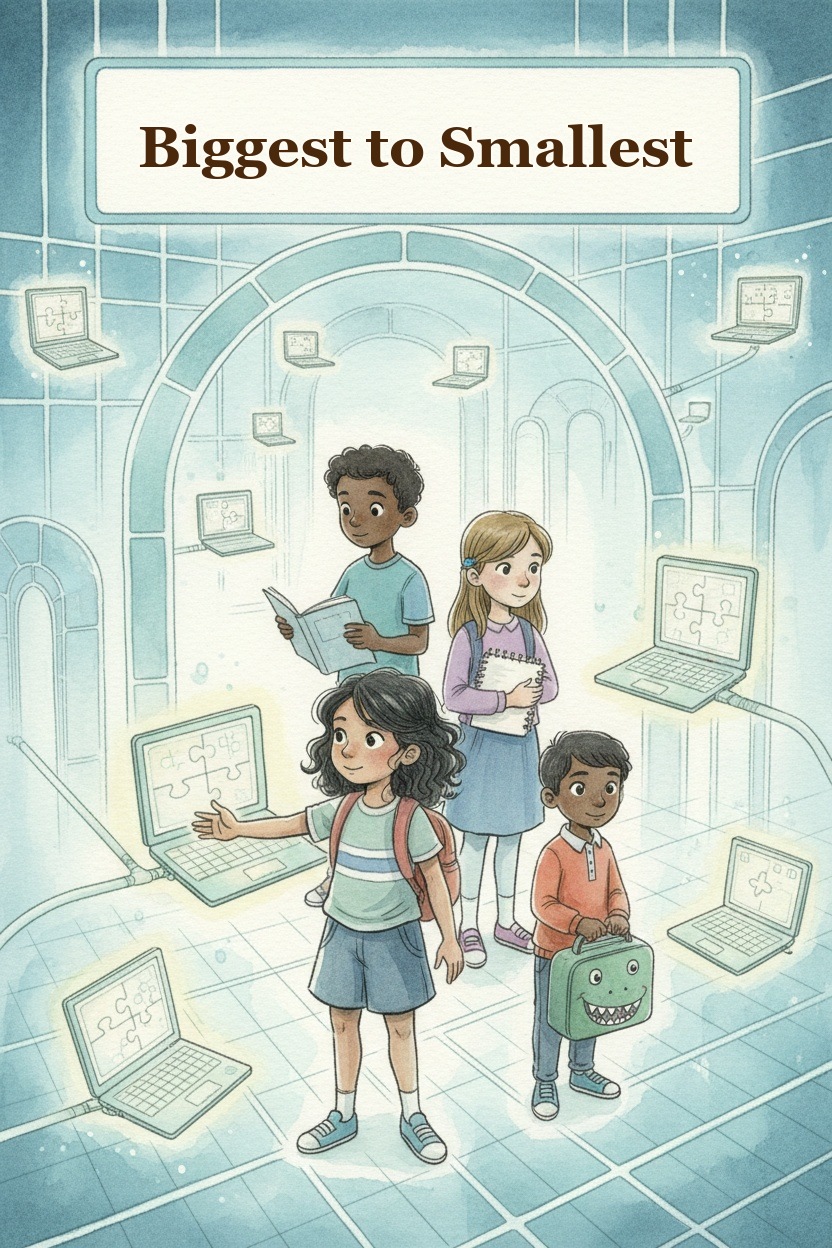
The Unsorted Archive
The lost-and-found closet smelled like old sneakers and rainy recesses. Priya pushed past a bin of mittens, and there it was—the laptop, glowing softly on a shelf where it definitely hadn't been yesterday.
"Who keeps moving it?" Kwame asked.
"Does it matter?" Lily was already opening it. The screen flickered, green text cascading, and then the doorway unfolded like a paper crane made of light.
They stepped through into the Loop Lands. But this wasn't the spiraling green-teal architecture they'd learned to navigate. This was a vast warehouse, stretching in every direction, filled with shelves that reached into darkness. And everywhere—everywhere—were cards. Thousands of them. Millions. Floating in stacks, piled on shelves, drifting through the air like confetti made of numbers.
"This is new," Sam said.
A sign hung overhead, flickering like an old fluorescent light:
THE ARCHIVE OF EVERYTHING RETRIEVABLE
ALL ITEMS STORED. NOTHING LOST. NOTHING FOUND.
Below the sign, a terminal blinked. Priya walked toward it, already scanning the room for patterns. There was one—she could see it. The cards weren't random. Each one had a number, large and clear:
7, 2, 9, 4, 1, 8, 6, 3, 5
But the piles were chaos. A stack with a 9 on top sat next to a stack with a 3. A floating card with 1 drifted past a shelf labeled "5."
"Look," Kwame said, pointing to a small desk at the far end of the warehouse. A single card sat on it, face up:
42
Underneath it, a note:
THE ARCHIVE REQUIRES ORDER. THE ITEM YOU NEED IS BURIED. SORT TO FIND. FIND TO LEAVE.
"Sort," Lily read. "Sort what? All of these?"
The terminal flickered to life:
ERROR: Archive retrieval failed. Item exists. Location unknown. Recommend: sort the collection.
"Recommend?" Sam said. "Is the Grid being polite?"
"Recommend is a command disguised as advice," Priya said. She was already pacing. "Okay. We need to find something in this mess, but we can't find it until it's sorted. So we sort."
"Sort how?" Kwame asked. "There must be a million cards."
"Not a million," Lily said, squinting. "Look—they're arranged in groups. Stacks by value, maybe, but disordered within each stack. And the stacks themselves are in the wrong order."
"Then we fix it," Priya said. "Put the stacks in order, biggest to smallest. Easy."
She reached for the nearest stack—7, 2, 9, 4, 1. She began rearranging. 9, 7, 4, 2, 1. Done. That took her maybe ten seconds.
She moved to the next stack. 6, 3, 8, 5, 2. Rearranged: 8, 6, 5, 3, 2. Done.
After three more stacks, she stopped. The warehouse hadn't gotten smaller. If anything, it seemed larger now. She'd sorted maybe fifty cards. There were thousands.
"This is going to take forever," she said.
"Maybe there's a faster way," Sam said.
Everyone turned. Sam was holding a single card from a nearby pile. It had a 14 on it. "Like, what if we don't sort the whole thing? What if we just find the biggest one, and then the next biggest, and just pick them out one at a time?"
Priya opened her mouth. Closed it.
"That's... actually not wrong," she said slowly. "To sort by biggest first, you could find the biggest card, set it aside. Then find the biggest remaining card, set it aside. Keep going."
"Does that work?" Kwame asked.
"It works," Lily said, nodding. "It's just... slow. For each card you pick, you have to look through everything left. The first pick takes a million looks. The second takes 999,999. It gets faster, but..."
"But the total is huge," Priya finished.
"Everything's huge if the number's big enough," Sam said. "But at least it works."
A new voice—or something like a voice—came from the terminal:
ERROR: Sorting incomplete. Multiple valid approaches exist. Please select a method and proceed.
"Select a method," Kwame muttered. "Like we're choosing a story to tell."
The Human Sort
Lily was staring at the cards with her most focused expression—the one that meant she was seeing the structure underneath the mess.
"We need to test this," she said. "Not on the whole archive. On a small set. We need to experience the sorting."
"How?" Sam asked.
Lily grabbed a stack of ten cards, still unsorted. She handed one to each person: two each. Then she looked around, grabbed a handful more, and dealt them out until each of them held a small handful of cards.
"Okay," she said. "We're going to sort ourselves."
"Sort ourselves?" Priya looked horrified.
"Into a line," Lily said patiently. "Biggest to smallest, smallest to biggest—doesn't matter which, pick one. You hold your cards. We arrange ourselves so that when we read our cards in order, they're sorted."
"Ooh," Sam said. "Like we're the cards."
"Exactly," Lily said. "Now—quick way. Everyone, look at your cards. What's the smallest one you have?"
There was a rustle of paper. Priya had a 3 and a 7. Kwame had a 9 and a 2. Lily had a 5 and a 8. Sam had a 1, a 4, and a 6.
"The 1," Sam said.
"Okay," Lily said. "You're at the front of the line. Now—from your remaining cards, what's the smallest?"
"The 2," Kwame said.
Kwame stood next to Sam.
"Next?"
"The 3," Priya said, stepping next to Kwame.
They went on—4, 5, 6, 7, 8, 9—until they stood in a neat line, sorted from smallest to largest.
"That was fast," Sam said. "Because we looked at our own cards first. We each found our smallest without checking everyone else's whole hand."
"Exactly," Lily said. "That's not the slow way. The slow way is what Priya was doing—take the smallest card in the whole pile, then the next smallest, checking everything every time. This way, we broke it into small pieces."
"Selection sort," Priya said. "What you just did—picking the smallest from a group, then the next smallest—that's selection sort. And what I was doing before is also selection sort, but slower, because I didn't pre-divide."
"Pre-dividing helps," Kwame said. "Because the search is smaller."
"But wait," Sam said. "What if we don't pick at all? What if we just swap?"
Priya blinked. "Swap?"
"Like—you two," Sam pointed at Priya and Kwame. "You're standing next to each other. If the person on the left has a bigger number than the person on the right, swap. Then move down. Keep doing passes through the line until everything's in order."
"Bubble sort," Lily said, and her eyes lit up. "That's bubble sort."
"Let's try it," Sam said.
They rearranged themselves randomly. Then Sam called out: "Priya's 7, Kwame's 2—swap!"
They swapped.
"Kwame's 2, Lily's 5—no swap. Lily's 5, my 9—swap!"
The line rippled. Sam moved past Lily. Things shifted.
"Again!" Sam said, and they did it again—another pass, more swaps, more shifting. And again.
By the fourth pass, the line was sorted, and everyone was laughing.
"That took more passes," Priya said, catching her breath. "But it was easy. No thinking—just compare neighbors, swap if wrong, repeat."
"Trade-off," Kwame said. "More work, less thought. The first way—I thought more about what I had, but the line formed faster."
"Different approaches," Lily said. "Different costs."
The terminal flickered:
ERROR: Method selection incomplete. All valid approaches are valid. Efficiency is the difference.
The Grid Sorts
"So we need to sort the whole archive," Priya said. "But we can't do it ourselves. We need the Grid to do it."
"How?" Sam asked.
Lily pointed at the terminal. "We tell it how. We give it the method."
"We can't write code," Kwame said. "We don't know any language."
"We don't need a language," Lily said. "We need to show it. Sort us once, the right way, and show the Grid what we did."
"The Grid learns from example," Priya said slowly. "That's what the Loop Lands taught us—patterns are instructions if you perform them correctly."
They arranged themselves again, starting from a random line. Then, step by step, they performed selection sort—finding the smallest, then the next smallest, forming the line in order.
As they moved, the warehouse moved with them. Cards lifted from shelves, swirling in spirals. Numbers reorganized. Stacks merged and divided.
"Look!" Sam pointed.
The piles were sorting themselves. Not all at once—but in chunks. Each stack resolved into order. Then the stacks themselves ordered, biggest to smallest, left to right across the warehouse floor.
It was beautiful. Like watching a million leaves arrange themselves into a perfect path.
"The Grid is using our method," Kwame whispered. "It saw us sort, and now it's sorting the same way."
"Because we showed it," Lily said. "Not by telling. By doing."
A sound—a chime, clear and final. The last cards settled into place.
The warehouse was transformed. Every stack ordered. Every number where it belonged.
And there, in the exact center of the floor, on a pedestal that hadn't been there before, sat a single card:
42
"The item," Sam said. "The one we needed."
Kwame picked it up. It was warm, and the number seemed to glow faintly.
"What is it?" Priya asked.
"It's a key," Kwame said. "The second Grid Key."
"Sorting found it," Sam said. "We couldn't find it until everything was in order. But once it was sorted, it was just... there. Right where it should be."
"Putting things in order makes finding things possible," Lily said. "That's what sorting is. It's the difference between searching forever and knowing exactly where to look."
The terminal displayed one final message:
ERROR: All sorted. Nothing lost. Item found. Proceed to next.
"Technically accurate," Lily said. "And technically useless."
"Technically," Priya said, grinning, "we just sorted an entire archive."
The Journal Entry
Later—back through the glowing doorway, back in the lost-and-found closet, the laptop warm but quiet—Kwame wrote in his journal:
Today we sorted things. Not just cards—ourselves. We stood in lines and moved when the numbers said to move. We learned that sorting is a story you tell the world about where things belong.
The slow way: pick the smallest from everything. It works, but you look at everything a thousand times.
The middle way: break into hands, find your own smallest, then compare. Faster, because everyone works at once.
The bubbly way: swap neighbors when they're wrong. Repeat until nothing swaps. It's more passes, but it's lazy thinking—just compare, swap, move on.
Every way works. Every way costs something different. The trick is choosing which cost you can pay.
Underneath it all, sorting is just this: deciding what comes before what, and making the world follow your decision. The Grid doesn't care how you sort. It only cares that you do.
Biggest to smallest. Smallest to biggest. It doesn't matter—as long as you're consistent, and you finish what you start.
We finished.
We found the key.
And somewhere, in a warehouse made of light, a million cards are in order because we took the time to put them there.
He closed the journal. Priya was already at the closet door, peeking out at the empty hallway.
"Same time tomorrow?" she asked.
"Same time tomorrow," Lily said.
Sam was still holding the card from the archive—the 42. It had come back with them, small and solid and real.
"I like sorting," Sam said. "It's the only time everything makes sense."
Kwame laughed. "The only time? Or the first time?"
"The first time," Sam agreed. "The first time in a long time."
They slipped out of the closet, into the quiet school, carrying the second key and the knowledge of a thousand cards in perfect order.