Just Like Me
Pretending to Be Fine
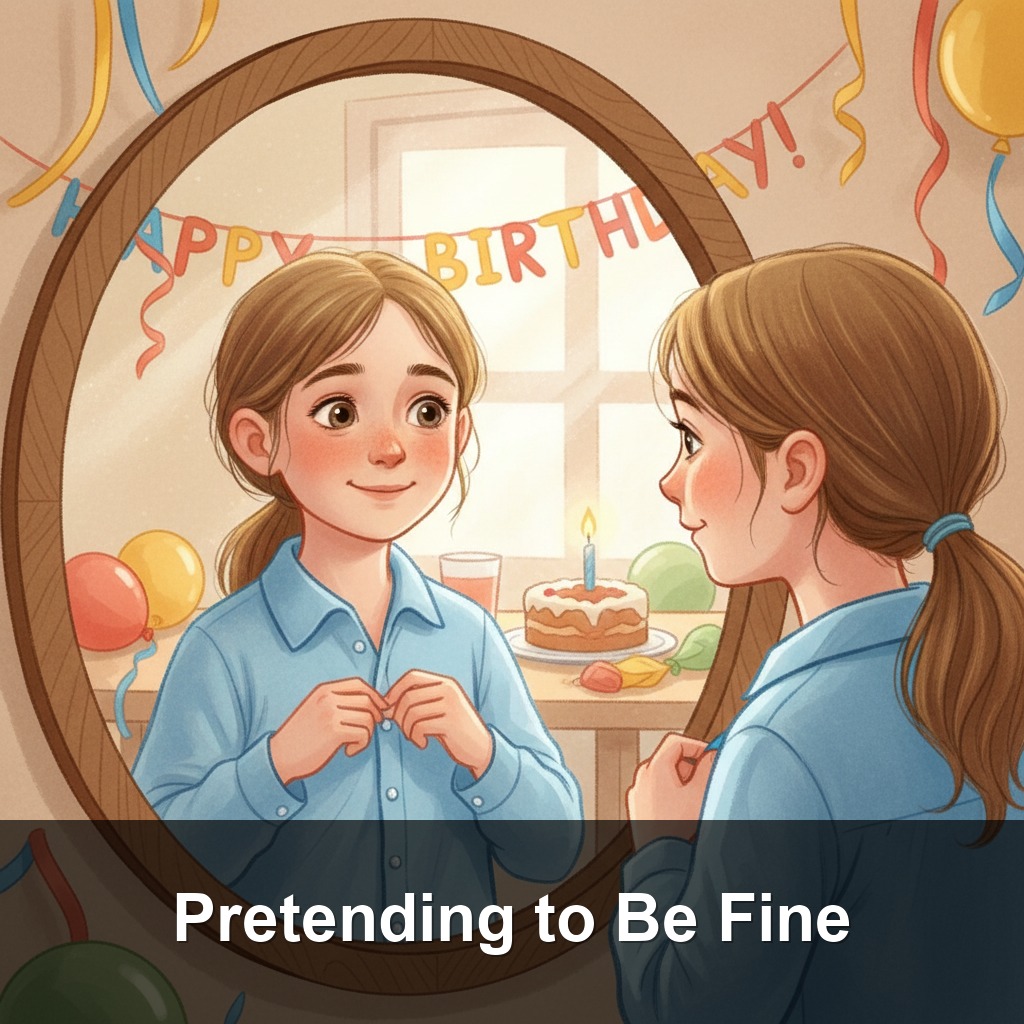
Sam woke up on Saturday morning and looked at the calendar. The red circle around today's date said: COUSIN LEO'S BIRTHDAY PARTY.
Sam's tummy did a little flip.
Not a bad flip. Not a good flip. A middle flip.
"I'm going to wear the soft blue shirt," Sam told Mama at breakfast. "The one with no tags."
"That sounds like a good choice," Mama said.
"And I'll practice my smile," Sam said. Sam practiced the smile right there at the table. It felt like a mask. But Mama didn't say anything about masks. She just nodded.
At the party, there were balloons. Red ones. Blue ones. Yellow ones. They made a crinkly sound when they bumped the ceiling. Sam counted them. Seventeen. Then they moved, so Sam counted them again. Eighteen. Then they moved again.
Sam's brain wanted to count them over and over until they stopped moving. But the balloons never stopped. So Sam stopped counting and started smiling instead.
"Happy birthday, Leo!" Sam said. The words came out bouncy and bright. That was good. That was how words were supposed to sound at parties.
Aunt Rachel came over. "Sam! You've gotten so tall! How's school?"
"School is good," Sam said. Sam's real answer was about the weather unit and the cloud chart and how cirrus clouds meant fair weather and how Sam had drawn fifteen different cloud formations in the margin of the worksheet. But that wasn't a party answer. So Sam said, "It's nice."
Aunt Rachel smiled. Sam smiled back.
The smile was getting heavy.
At the snack table, there were chips. Loud chips. Crunchy chips. Someone was chewing with their mouth open. The chewing sound was very loud. It sounded like footsteps in a hallway. Like tiny boots marching inside someone's head.
Sam wanted to cover ears. But covering ears at a party was not a party thing.
So Sam put hands in pockets instead. Sam squeezed fingers inside pockets. Squeeze. Release. Squeeze. Release. That was a secret thing Sam could do. Nobody could see it. It was like wearing a invisible fidget.
"Isn't this fun?" said Uncle Marcus.
"Yes!" said Sam. The word came out high and quick. Sam's voice sounded like somebody else's voice. A party voice. A voice that loved chips and balloons and small talk.
Sam put another chip in mouth. The chip was too salty. Sam wanted water. But asking for water meant explaining. And explaining meant more talking. And talking was getting tired.
Sam ate the chip anyway.
Someone turned on music. Loud music. The kind with a beat that shook the floor. The floor shook through Sam's shoes. Up through legs. Into tummy. The music was inside Sam's body now. It vibrated in teeth. It buzzed in bones.
"Come dance!" said Cousin Mia, grabbing Sam's hand.
Sam's hand went stiff. Sam's feet did not want to go. But Mia was pulling. And everyone was watching. And there was a face that Sam could make — a happy face, a fun face, a I-love-dancing face — and Sam put that face on.
Sam danced.
The music was too loud. The lights were too bright. The feet were too stompy. But Sam kept smiling. Sam kept dancing. Sam's face was a mask. The mask said: I am fine. I am having fun. I am just like everyone here.
Inside, Sam was counting. Counting the seconds. Counting the beats. Counting the tiles on the floor. One, two, three, four, five, six, seven, eight—
The cake came out. Everyone sang. The candles flickered. Leo blew them out. Everyone cheered.
The cheering was like a wave. A wall of sound. It hit Sam's ears like a hundred hands clapping at once. Sam's face wanted to crumple. Sam's hands wanted to cover Sam's ears. Sam's body wanted to run to the quiet car and sit with the door closed and just breathe.
But Sam didn't.
Sam clapped too. Sam cheered too. Sam made the mask smile so hard that the mask hurt.
When Mama said it was time to go, Sam said goodbye to everyone. Sam's voice was very bright. "Thank you for having me! Happy birthday, Leo! I had a wonderful time!"
All true words. All mask words.
The car door closed.
The quiet came in like a big soft blanket.
Sam didn't talk on the way home. Sam just sat. The mask was melting. It was sliding off Sam's face in pieces. Underneath, Sam's real face was very tired. Sam's real face didn't want to smile. Sam's real face didn't want to talk. Sam's real face wanted to be in the quiet room with the door closed and the lights low and no sound except the hum of nothing.
At home, Sam walked to the bedroom. Sam closed the door. Sam lay on the floor. The floor was cool. The floor was flat. The floor didn't ask questions.
Sam lay there for a long time.
Mama knocked softly. "Sam? Can I come in?"
Sam didn't answer. Mama waited.
Sam said, "I need a minute."
Mama said, "Take two minutes. Take twenty."
Sam lay on the floor. Sam was a big piece of laundry that had been wrung out too hard. All the water gone. All the energy gone. All the fakeness gone.
Finally, Sam said, "Come in."
Mama came in. Mama sat on the floor next to Sam. Mama didn't talk. Mama just sat. That was the best thing about Mama.
"I pretended all day," Sam whispered. "I smiled and I talked and I danced and I was fine. I was so fine. I was the finest I've ever been."
Mama nodded. "That sounds exhausting."
"It was," Sam said. "I'm not fine now. I'm the opposite of fine. I'm... wrung out."
"Wrung out," Mama repeated. "Like a towel."
"Like a towel that has been pretending to be a piece of paper," Sam said. "All flat and smooth and fine. But underneath, I was a towel all along. And now I'm wet and tired and I don't want to be a paper anymore."
Mama was quiet for a minute. Then Mama said, "I saw you at the party. You were wearing the paper face."
"You did?"
"I did. I noticed when you went quiet after the cake. And when you put your hands in your pockets during the music."
"You saw that?"
"I see everything about you, Sam. I always have. I was proud of you for making it through. But I was also sad, because I knew the paper face was hard to wear."
Sam felt something loosen in chest. A knot. A tight knot that had been pulled all day.
"I don't want to wear the paper face tomorrow," Sam said.
"Then you don't have to," Mama said. "We can stay home. We can do nothing. We can be towels together."
Sam laughed. It wasn't a party laugh. It was a real laugh. It came from Sam's real face.
"I like you better when you're a towel," Mama said.
Sam rolled onto side. The floor was still cool. The room was still quiet. The mask was gone.
"Me too," Sam said.
That night, Sam and Mama made a list. Not a paper list. A real list. A for-real-life list.
When I don't want to wear the paper face:
-
I can say "I need a minute" even at parties.
-
I can cover my ears. People will understand.
-
I can sit in the quiet car by myself.
-
I can say "I had enough" and that's okay.
-
I can be a towel.
"Being a towel is allowed," Mama said. "Being a towel is always allowed."
Sam nodded. Sam was a towel. A warm, soft, crumpled-up towel. A real towel. A Sam towel.
And that was exactly right.
Author's Note for Parents and Readers:
Masking — pretending to be "fine" when you're not — is something many autistic children do, often without anyone realizing how hard it is. It takes enormous energy to perform neurotypical behavior for hours, and the crash afterward is real. This book is about that experience, and about giving children permission to take off the mask in safe spaces. If your child relates to Sam, know that the exhaustion is real, and that "just being a towel" is a valid way to recover.