Inside Out Academy
THE CAMERA THAT NEVER STOPS
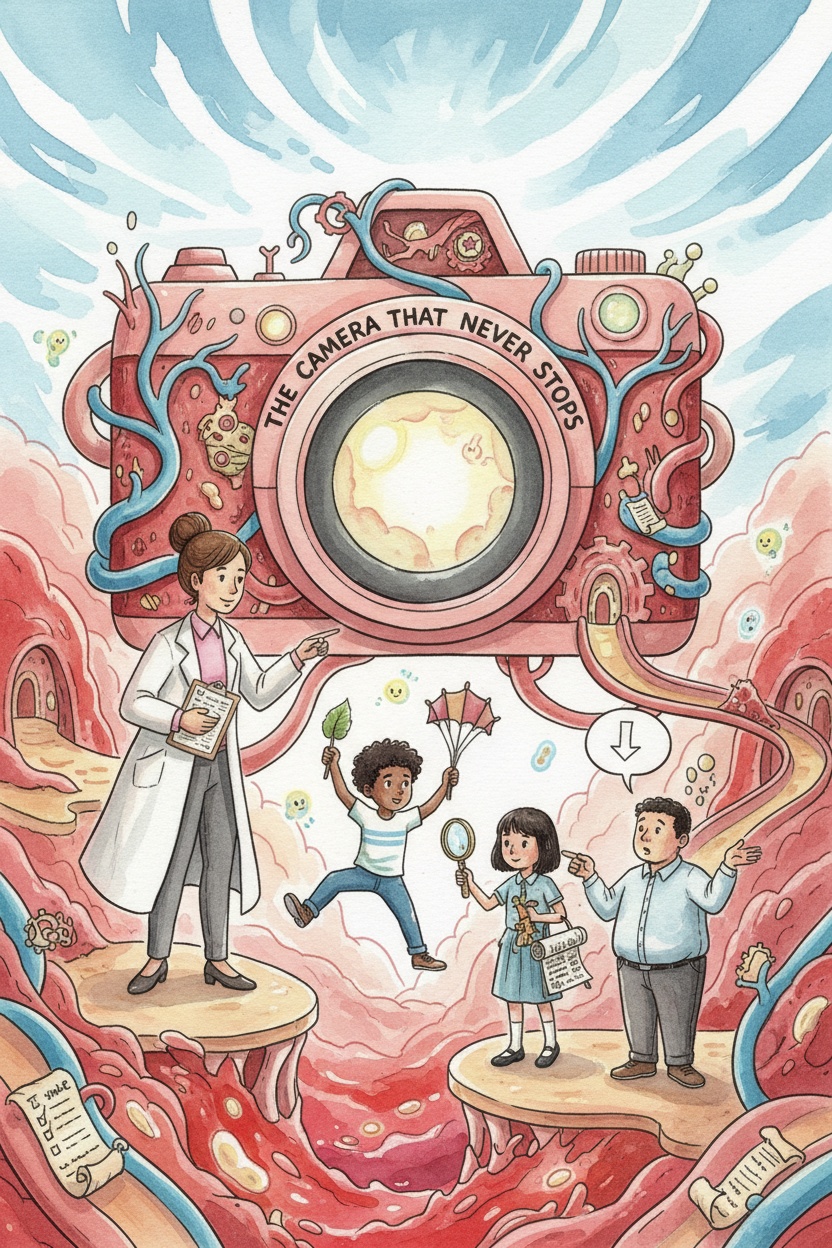
MS. VANCE'S CURRENT CHECKLIST:
-
Location: Approaching the right eye via the optic nerve corridor
-
Students accounted for: All 22 (Leo is currently being detained at the front of the group)
-
Weather inside Mr. Gomez: Warm, dim, slightly damp
-
Today's objective: Understand the eye, the camera that never stops
PART ONE: THE ROAD TO THE EYE
"Okay, so technically," Sadie said, walking backward so she could face the group, "the eye is the only part of the brain that you can actually see from outside the skull. It's not really an organ floating in the head. It's a piece of the brain that grew outward during development."
"Which means," Marcus said, "the eye is basically a brain with a window."
"That's not wrong," Sadie admitted.
The class was traveling along the optic nerve — a thick cable of about a million nerve fibers that connected each eye to the brain. The path had been surprisingly easy to follow. The nerve fibers were bundled together like a highway, all running in the same direction, all carrying the same message: I saw something. I saw something. I saw something.
"Mr. Gomez," Ms. Vance said into the walkie-talkie, "we're approaching the back of your right eye. Can you blink a few times?"
From outside, Mr. Gomez's voice crackled back: "Blinking now. One. Two. Three."
Inside the optic nerve, the class felt a gentle pressure ripple through the surrounding tissue as the eyelids swept across the front of the eyeball like windshield wipers.
"Fascinating," Fatima said quietly. "The whole structure flexes."
"Wait until you see the eyeball itself," Ms. Vance said. "It's about the size of a ping-pong ball, and at our scale, it's going to be enormous. Like walking into a cathedral made of jelly."
Leo, who had been held back at the front of the group, wiggled free. "Jelly? Did you say jelly?"
"I said 'made of jelly,' not 'made of edible jelly.' Do not eat anything you find in the eye, Leo."
"I wasn't going to—"
"You were absolutely going to."
The optic nerve ended at the back of the eye, and the class emerged into a space so strange that everyone stopped talking at once.
They were standing on the rim of what looked like a pale pink disc — the optic disk, where the million nerve fibers of the optic nerve fanned out and attached to the inside surface of the eyeball. Beyond the disk, the eye opened up into an enormous chamber. It was filled with a clear, gelatinous substance that caught the beam of the class's lamp and scattered it in a thousand directions.
"The vitreous humor," Ms. Vance said, her voice dropping into that special tone she used when she was genuinely excited about a biological structure. "The vitreous body. It fills the entire space between the lens and the retina. It's what keeps the eyeball from collapsing in on itself. It's mostly water, but it's structured — it has a framework of collagen fibers that hold it together."
"It's like walking inside a snow globe," Sadie said.
"Except instead of snow, it's light," Fatima said. "The vitreous humor is transparent. It lets light pass through from the front of the eye all the way to the back, where the retina is."
Ms. Vance nodded. "Exactly. The eye is a camera. And the vitreous humor is the empty space inside the camera — the part that lets light travel from the lens to the film. Except in this case, the film is alive."
Leo was already wading into the vitreous humor, which was gelatinous enough to support his weight but clear enough that he didn't disappear. "It's like walking through Jell-O!"
"Do not—" Ms. Vance began.
"I'm not eating it! I'm just standing in it!"
"That's acceptable. Stay within sight of the group."
PART TWO: THE LIVING SCREEN
The class made their way through the vitreous humor toward the back wall of the eye — the retina. As they approached, the structure resolved out of the gelatinous dimness: a thin, translucent layer of tissue covering the inside of the eyeball like wallpaper.
But this wallpaper was alive.
At their scale, the retina was not a smooth surface. It was a dense array of cells, each one packed tightly against its neighbors, each one bristling with tiny projections that reached into the vitreous humor. It looked like a field of sea anemones, swaying gently in a current — except the current was light.
"The photoreceptors," Ms. Vance said. "The cells that detect light. There are about 120 million of them in each eye."
"120 million?" Marcus pulled out his notebook. "How do you even count that?"
"You don't. You estimate. The retina has roughly 120 million rod cells and about 6 million cone cells."
Leo pushed past the group to get a closer look. "Which ones are which?"
"See those cells that are long and thin, like little cylinders?" Ms. Vance pointed. "Those are rods. They're incredibly sensitive to light. They can detect a single photon. They're what let you see in dim light, but they don't see color at all. Everything they see is in shades of gray."
"And those ones that look like... little cones?" Fatima asked.
"Exactly. Cone cells. They need brighter light to activate, but they detect color. There are three types of cones — one that responds to red wavelengths, one to green, one to blue. Your brain takes the signals from all three and mixes them together to create every color you can see."
"Like a TV screen," Marcus said. "Red, green, and blue pixels."
"Exactly like a TV screen. Your brain is constantly mixing the signals from those three types of cones to produce the entire color spectrum."
Leo had climbed onto a structure that looked like a small hill in the middle of the retina. "What's this?"
"That's the fovea," Ms. Vance said. "The most important part of your vision and you're standing on it, Leo."
He jumped off immediately. "Is it important important?"
"The fovea is a tiny pit in the center of the retina — about one and a half millimeters across. It's packed almost entirely with cone cells, packed so densely that there are no rods there at all. When you look directly at something, the light from that thing lands exactly on your fovea. That's where your vision is sharpest — where you see color and detail."
"So when I'm reading a book," Sadie said, "the words are landing on my fovea."
"Every word. And the rest of your vision — the peripheral parts — are mostly rods. That's why you can see movement in the corner of your eye even in dim light, but you can't see color there. Your peripheral vision is in black and white."
"Wait," Marcus said, frowning. "You're telling me that the center of my vision is sharp and colorful, but the edges are fuzzy and black and white?"
"More or less. Your brain fills in the rest. It makes you think you're seeing the whole world in sharp color, when actually you're only seeing a tiny spot of sharp color at the very center. The rest of your visual field is sort of... suggested."
For a moment, nobody said anything.
"My whole life is a lie," Marcus said.
"It's not a lie," Ms. Vance said. "It's an incredibly efficient visual system. You don't need to process every pixel of your entire visual field. You only need to process the small part you're looking at. The brain is always moving your eyes to point your fovea at whatever is most important."
As if to demonstrate, the walkie-talkie crackled. Mr. Gomez's voice came through: "I'm looking at a bird outside the window. A blue jay."
"Everyone look at the retina," Ms. Vance said quickly. "Watch what happens."
The class turned back to the retina. On the fovea, the cone cells were firing — the class could see the signals rippling through the tissue as the blue light from the bird outside struck the cones and triggered a cascade of electrical activity.
"Blue light is hitting the blue-sensitive cones," Sadie said, watching the pattern. "Now the green ones are firing a little bit too — because blue jays are blue, but they're also sort of blue-gray, and the gray part is stimulating the green cones slightly..."
"The brain is mixing the signals," Fatima said. "It's not just detecting blue. It's comparing the levels of blue and green and red, and using the ratios to create the exact color."
"Precisely," Ms. Vance said. "Color vision isn't about detecting colors. It's about comparing signals. The retina doesn't see blue. It detects that the blue cones are firing strongly, the green cones are firing moderately, and the red cones are barely firing. The brain takes those three numbers and produces 'blue.'"
"So color is just a pattern of signals," Marcus said. "It's like a code. Three numbers, and the brain translates them into a color."
"Exactly. Red-green-blue. Three numbers. Every color you've ever seen is just a combination of those three."
PART THREE: THE PLACE WHERE THE WIRES LEAVE
After the demonstration, the class spent some time exploring the retina. They found the rod cells in the periphery, arranged in dense clusters. They found the cone cells in the fovea, packed so tightly that it was hard to see where one ended and another began. They traced the path of light through the retina — how it passed through several layers of nerve cells before reaching the photoreceptors at the very back.
"That seems inefficient," Leo said. "Why doesn't the retina just put the photoreceptors on the surface? Why make the light travel through all these other cells first?"
"This is one of the great design flaws of the human eye," Ms. Vance said. "The retina is wired backward. The photoreceptors are at the back, and the nerve fibers that carry their signals to the brain run across the surface. Light has to pass through all of those nerve fibers before it reaches the photoreceptors."
"So the eye is... poorly designed?"
"It's a legacy of evolution. The eye developed this way, and it works well enough that there was never any evolutionary pressure to fix it. But it means there's a place where the nerve fibers all gather together to leave the eye and become the optic nerve. And because all the nerve fibers are leaving through that one spot, there are no photoreceptors there at all."
Ms. Vance pointed to the optic disk — the pale pink spot where the class had entered the eye.
"There," she said. "That's the blind spot."
Leo frowned. "But I don't have a blind spot. I can see everything."
"You do have a blind spot. Everyone does. And you don't notice it for two reasons."
"Reason one," Sadie said, holding up one finger. "The blind spot in your left eye is not the same as the blind spot in your right eye. Your two eyes overlap their visual fields, so the blind spots don't line up. Each eye fills in what the other eye is missing."
"Reason two," Marcus said, holding up two fingers. "Your brain fills in the gap. The brain doesn't like having a hole in your visual field, so it just... invents what it thinks should be there, based on the surrounding information."
"So I'm not seeing what's actually there?" Leo asked.
"You're seeing what your brain believes is probably there," Ms. Vance said. "Most of the time, that's exactly what's there. But sometimes your brain gets it wrong."
"We can prove it," Fatima said.
Everyone turned to look at her. She was standing at the edge of the optic disk, looking back at the group with an expression that Ms. Vance had come to recognize: Fatima had an idea, and it was probably a good one.
"How?" Ms. Vance asked.
"We need Mr. Gomez to look at something with the right pattern on it. Something that would be easy for his brain to fill in incorrectly."
PART FOUR: THE GAME WITH THE MISSING HOLE
The class explained the plan to Mr. Gomez over the walkie-talkie. It took a few minutes, because Leo kept interrupting.
"So you want me to draw a dot and a circle on a piece of paper and stare at it?" Mr. Gomez asked.
"With your right eye closed," Ms. Vance said. "And you need to put the paper at a specific distance. We'll guide you."
Mr. Gomez, who had long since accepted that his Tuesday involved directing his own eyeballs at drawings based on instructions from inside his skull, retrieved a piece of paper and a pen. The class heard him moving around, and then his voice came back:
"Okay. I put a circle on the left side and a cross on the right side. What now?"
"Close your right eye," Ms. Vance said. "Hold the paper at arm's length. Look at the cross with your left eye."
"Okay."
"Everyone, watch the optic disk," Ms. Vance said to the class.
They arranged themselves around the optic disk, peering back into the eye. The disk itself was a pale, featureless area — just nerve fibers, no photoreceptors. Light that landed on that spot would not be detected. It would simply vanish.
"Now," Ms. Vance said into the walkie-talkie, "slowly bring the paper closer to your face. Keep your left eye on the cross."
The class watched the retina. They saw the cone cells in the fovea firing steadily, tracking the cross that Mr. Gomez was looking at. The signal was strong and clear.
"Am I supposed to just—oh," Mr. Gomez said. "Oh. The circle disappeared."
"Try moving the paper away again," Ms. Vance said.
"Now it's back."
"Faster. Move it back and forth."
The class watched the pattern of signals from the retina. When the image of the circle landed on the optic disk, the signal simply stopped — the fovea kept firing, the surrounding retina kept firing, but the exact spot where the image of the circle should have been was silent.
"Mr. Gomez," Leo said into the walkie-talkie. "When the circle disappears, what do you see instead?"
"Nothing," Mr. Gomez said. "I just don't see it. It's not like there's a black spot. The paper is just... paper. There's no circle there."
"His brain is filling in the blank," Fatima said. "It's taking the white paper around the blind spot and extending it across the gap. It's not showing him 'there should be a circle but there isn't.' It's showing him 'there is no circle there at all.'"
"Your brain is actively editing your vision," Sadie said. "Right now, in real time, it's removing things that don't match what it expects to see."
"Wait," Marcus said slowly. "If his brain can remove a circle because it thinks there shouldn't be one... what else does it remove?"
The class fell silent. The question hung in the air, too big and strange to answer quickly.
"Okay," Mr. Gomez said from outside. "My brain is making me hallucinate a uniform piece of paper. That's... something."
"Your brain makes you hallucinate everything," Ms. Vance said. "But it's a hallucination that helps you survive. The brain isn't showing you the world as it is. It's showing you the world as it needs to be — a model of reality, updated in real time, based on the signals from your eyes."
"So what we see isn't real?" Leo asked.
"It's real enough," Ms. Vance said. "The signals from your eyes are real. The world is real. But the picture in your head — the image you experience — is your brain's best guess. And your brain is very, very good at guessing."
Mr. Gomez's voice crackled through. "I'm going to look at the circle again. Just for fun."
"Do it," Leo said.
The class watched as the round dot vanished from the retina's signal and the brain smoothly, seamlessly, completely edited it out of Mr. Gomez's conscious experience.
"Okay, that's still creepy," Mr. Gomez said.
"It's our glorious malfunctioning camera," Marcus said, and he wrote it down in his notebook.
PART FIVE: THE CAMERA THAT NEVER STOPS
It was time to leave the eye. The class made their way back to the optic disk, carefully crossing the field of photoreceptors. Even as they walked, the retina continued to fire — Mr. Gomez was blinking, and each blink sent a brief surge of dark signal through the tissue, then a bright surge as the light returned.
"The eye never stops," Fatima said, pausing at the edge of the optic disk to look back. "Even when it's not seeing anything, it's still sending signals. The photoreceptors fire. The retina processes. The optic nerve carries the message."
"It's a camera that never stops," Leo said. "Even when you close your eyes, it's still recording."
"It's not recording," Sadie corrected. "It's processing. The eye doesn't store images. It sends them instantly to the brain. The storage happens in the memory, not in the eye."
"But the camera part," Leo insisted. "The camera that never stops. That's still true."
Ms. Vance consulted her checklist. "Everyone accounted for? All twenty-two students? Plus one teacher? Yes. Good."
"Mr. Gomez," she said into the walkie-talkie, "we're leaving the eye and heading back along the optic nerve."
"How did it go?" Mr. Gomez asked.
"Everyone learned why you can make a circle disappear," Ms. Vance said.
"Oh, in a good way?"
"In the best way," Leo said, and Ms. Vance smiled. "In the best way."
MR. GOMEZ'S EXTERNAL LOG, DAY 31:
Today I learned that my brain edits my vision in real time. I made a circle disappear by looking at a cross. The class seemed very excited about this. I have decided not to think too hard about what else my brain might be editing.
Felt a faint tickling in my right eye around 2 PM. It was probably the class leaving. I blinked carefully.
Dinner was salmon with rice. The principal called again. I told her I was having a medical issue. She asked what kind. I said "vision-related." This is technically true.
My knee is fine today. The blue jay came back to the window. I looked at it for a long time, thinking about how my retina was turning the bird into signals, and my brain was turning the signals into a bird. Same trick from both directions.
The class is the best thing that ever happened to me, and I hope they find the exit before the end of the year. But I'm going to miss them when they go.
— Mr. Gomez