Chef Sparks Kitchen Lab
THE PLANET ON YOUR PLATE
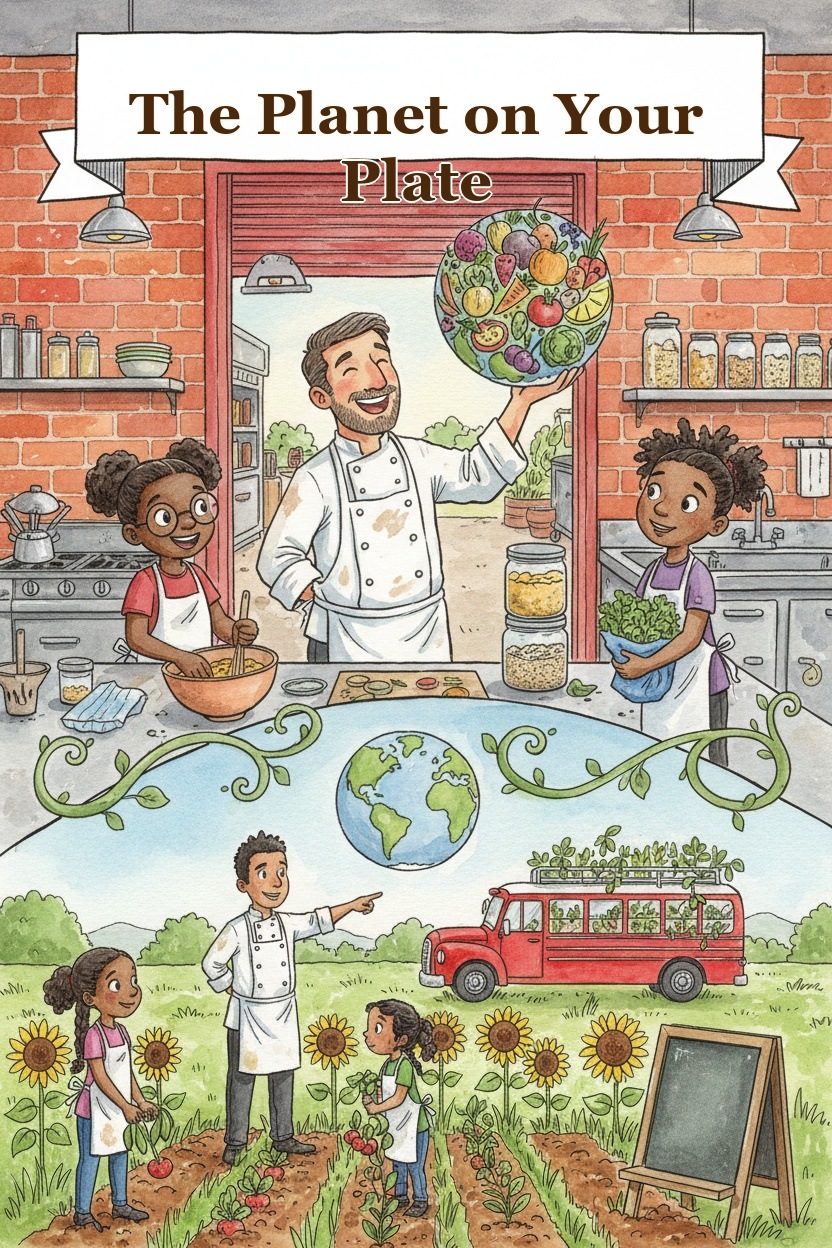
The Big Question
The Riverside Fire Station kitchen smelled like lemons and warm sugar. Chef Iggy Spark stood at the front of the class, holding up a single, perfect lemon.
"Here's a question," he said, "and I want you to think before you answer. What does this lemon have to do with the planet?"
Dev raised his hand. "It grows on a tree?"
"Correct," said Iggy. "But I mean bigger than the tree. What does this lemon have to do with the whole planet?"
Lucia squinted. "It came from somewhere. Like, far away?"
"Farther than you think." Iggy rolled the lemon along the counter. "This lemon grew on a farm in Spain. A truck carried it to a port. A ship carried it across the ocean. Another truck carried it to the market. And then it came here, to our kitchen. Every step of that journey used energy. And energy — depending on how it's made — can send greenhouse gases into the air."
Tommy frowned. "Greenhouse gases? Like, from cars?"
"Yes," said Iggy. "And also from food. Growing food, moving food, even the way we cook food — everything leaves a mark. We call that mark a carbon footprint."
Priya raised her hand slowly. "Chef Spark, are we going to calculate our own footprints?"
Iggy grinned. "You read my mind."
The Chart on the Chalkboard
Iggy turned to the chalkboard, where he had drawn three columns. Each column had a title:
LAND USE | WATER USE | GREENHOUSE GASES
"Here's what I want you to understand," he said, tapping the board with his chalk. "Different foods take different amounts of resources to produce. And these three things — land, water, and greenhouse gas emissions — are how we measure what a food costs the planet."
He drew a picture of a cow. "Take beef," he said. "A cow needs to eat grass for a long time before it's ready to become food. That grass needs land and water. The cow releases methane — a powerful greenhouse gas — as part of its digestion. So beef has a big footprint."
He drew a picture of a lentil. "Now take a lentil. It grows in a field. It uses water. But it doesn't release methane. It doesn't need years of food before it's ready. Its footprint is much smaller."
Maya nodded. "So meat is worse for the planet than vegetables?"
"Generally, yes," said Iggy. "But here's where it gets interesting, because it's not that simple. That's why I want you all to tell me what you ate for dinner last night."
The class went quiet. Sam raised his hand. "Do we have to say everything?"
"Everything you remember," said Iggy. "That's the fun part."
Sam spoke first. "Last night we had pizza from the place on Main Street. Pepperoni, extra cheese."
Iggy wrote PIZZA on the board. Then he drew lines connecting it to the three columns. "The cheese comes from dairy. The pepperoni comes from pork. The wheat for the crust comes from a farm. The pizza place had to run an oven, and maybe a delivery car."
Dev went next. "We had tofu stir-fry with rice and broccoli."
"Excellent," said Iggy. "Tofu comes from soybeans. They're grown on farms too, but they need less land and water than animals, and they don't produce methane."
Lucia was next. "My family made spaghetti with meatballs."
Priya looked thoughtful. "Ammamma made her dal soup with rice and vegetables."
Maya's turn came. "My mom made a list of foods I can eat," she said carefully. "So last night I had a prepackaged snack bar, and some crackers with hummus, and fruit."
Iggy nodded, writing everything down. "Good, good. And Tommy — what about you?"
Tommy's face lit up. "My grandma made a huge pot of beans with a little bit of chorizo crumbled on top for flavor. My whole family ate it with rice and tortillas."
Iggy's chalk stopped moving. He turned around slowly.
"That is fascinating," he said. "That's exactly what I was hoping someone would say."
The Surprising Results
Iggy walked to the chalkboard and drew a big circle. "Okay," he said. "I'm going to do something now that took me a long time to learn. I'm going to add up all your dinners and compare them."
He made a chart:
| Student | Dinner | Carbon Footprint |
|---------|--------|------------------|
| Sam | Pizza with pepperoni and extra cheese | Medium-large |
| Dev | Tofu stir-fry with rice and broccoli | Small |
| Lucia | Spaghetti with meatballs | Medium |
| Priya | Dal soup with rice and vegetables | Small |
| Maya | Snack bar, crackers, hummus, fruit | Medium |
| Tommy | Beans with chorizo and rice | Small |
The class studied the chart in silence.
Sam's face scrunched up. "Wait. Tommy had meat — chorizo — but his footprint is small?"
"Smaller than mine," Maya said quietly. "I didn't have any meat at all. How is that possible?"
Iggy took a breath. "This is the part I want you to really think about," he said. "Because sustainability isn't simple. It would be easy if it were. If eating no meat made you perfect, and eating meat made you bad, then the whole system would be simple to understand."
He pointed at Tommy's row. "Tommy's family had beans as the main dish. Beans have a tiny footprint — they're a plant food that even puts nitrogen back into the soil. They had rice, which also has a small footprint. And the chorizo?" He drew a circle around it. "A small amount, used as flavoring. Tommy's grandma didn't serve a big hunk of meat to every person. She crumbled a little bit on top so everyone got the flavor without the footprint."
He turned to Maya's row. "Maya, your snack bar and crackers came in packages. Making packaging uses resources, and so does transporting it. And some packaged foods have palm oil or other ingredients that come from places where forests have been cleared to grow them. You didn't eat any meat — but your food still cost the planet something."
Maya looked at her own row. "So... it's not just about meat?"
"Exactly," Iggy said. "It's about all of it. Where food comes from, how it's grown, how it's processed, how it's transported, how much is wasted."
Priya raised her hand. "My dal is the same as Dev's tofu stir-fry — both small. But we use different ingredients. What makes them both sustainable?"
"Great question," Iggy said. "Lentils and soybeans are both plants. They both need less land and water than animals. They both produce almost no greenhouse gases directly. And they're both sources of protein — which is why people all over the world have built their diets around them for thousands of years."
Tommy was staring at his row. "So my grandma's dinner was... sustainable? She didn't even know what that word means."
"She knew exactly what it meant," Iggy said. "She knew that beans are filling and cheap and good for you. She knew that a little meat goes a long way. She knew that feeding a family well didn't mean feeding them a big piece of meat every night. She might not call it sustainable eating. But that's what it is."
The Bigger Picture
The Spark Effect struck. Iggy's chalk flew from his hand and clattered across the counter, knocking over a small jar of smoked paprika. The students didn't even flinch. Priya made a note in her book.
Iggy picked up the jar and continued as if nothing had happened. "Now," he said, "I want you to think about the biggest picture of all. Because here's the thing about carbon footprints: they're not just about what you eat. They're about everything."
He turned to the chalkboard and drew a row of boxes.
"When your family drives to school, that's a footprint. When you leave a light on, that's a footprint. When a grocery store wastes food that ends up in a landfill, that's a footprint. Food is important — but it's one part of a much larger picture."
Dev raised his hand. "So... does what I eat even matter that much?"
"It matters," Iggy said. "It matters a lot. Because you eat three times a day, every day. That's over a thousand meals a year. Small changes, made over and over again, add up to something big."
Sam looked at the chart. "So should I stop eating pizza?"
"Absolutely not," Iggy said firmly. "Pizza is delicious, and my kitchen lab has rules against banning delicious things. But here's what I want you to think about: would the pizza be less delicious with a little less cheese? Could you get mushrooms on it instead of pepperoni sometimes? Could a slice of fruit be dessert instead of a packaged cookie?"
Lucia was writing in her notebook. "Choosing foods with smaller footprints, when you can."
"Exactly," Iggy said. "When you can. Because here's the other part I want you to understand: not everyone can make different choices. Some foods are cheaper than others. Some foods are easier to find. Some families don't have time to cook from scratch. Maya's food allergies mean she has to buy certain things, even if they come in packaging, because her options are limited."
Maya looked up, surprised.
"The goal isn't to be perfect," Iggy said. "The goal is to understand. When you understand what your food costs the planet, you can make choices that feel right to you. And then you do what you can. That's all any of us can do."
The Recipe: Beans with Chorizo and Rice
"Since nothing could possibly be more delicious than the meal Tommy described," Iggy said, "we're going to make a version of it. Tommy's grandma's beans, adapted for our kitchen lab. Bean soup with a small amount of chorizo."
Tommy grinned so wide his eyes almost disappeared.
The class got to work. Priya rinsed the beans — small brown ones that Iggy had soaked overnight. Dev and Lucia chopped onions and garlic. Maya carefully checked the chorizo wrapper to make sure it contained none of her allergens (it didn't, but she checked anyway, because she always checked).
Tommy stood at the stove with Iggy, learning how to cook the chorizo slowly so it released its smoky, spicy oil into the pot. The kitchen filled with a smell that made Sam's stomach growl audibly.
"A small amount of chorizo," Iggy said, "goes a long way. The fat carries flavor. A little crumbled on top tastes almost as good as a lot. And that, my friends, is sustainability by taste."
The beans simmered for a long time. The class watched the bubbles, and Iggy explained how the beans were slowly softening, how their skins split and their creamy centers dissolved into the broth.
When everything was ready, Iggy ladled the beans over rice in small bowls. He added a sprinkle of crumbled chorizo to each one — not a handful, just enough to color the top.
Tommy took the first bite. He chewed. Then he hummed — the two-note sound that every student recognized as the Tommy Hum of success.
"This tastes like my grandma's," he said. "And I didn't need to have it practically swimming in meat either. The flavor is just... there."
"The flavor is where you can find it," Iggy said, "if you know what you're looking for."
What We Learned
That night, Iggy wrote in his Kitchen Lab Notes:
"Today we learned that every bite of food has a price — not just the money you pay for it, but the land, water, and energy it takes to produce it. Some foods have a bigger footprint than others. But sustainability isn't simple, and anyone who tells you it is is probably selling you something. It's not about eating perfectly. It's about understanding what you're eating, and then making the choices that feel right to you, in your family, with your situation. Every meal is a chance to feed yourself and the world at the same time."
At the bottom, he added a question:
"What's one food you eat a lot of? Where does it come from, and how do you think it got to your plate?"
RECIPE CARD
Beans with Chorizo and Rice
(Tommy's Grandma's Dinner, Adapted for Young Cooks)
Ingredients:
-
1 cup dry brown beans (soaked overnight, or 2 cans of cooked beans)
-
1 small onion, chopped
-
2 cloves garlic, minced
-
1 tablespoon olive oil
-
4 ounces chorizo (about half a sausage)
-
1 teaspoon ground cumin
-
1 teaspoon smoked paprika
-
4 cups water or vegetable broth
-
2 cups cooked rice
-
Salt to taste
Steps:
-
If using dry soaked beans and an adult helper: combine beans and water in a large pot. Bring to a boil, then reduce heat and simmer until beans are soft (about 1 hour).
-
In a separate pan, heat the olive oil over medium heat. Add chorizo and cook until it's crispy and has released its red oil. Remove chorizo with a slotted spoon and set aside.
-
Add onion and garlic to the same pan. Cook until soft and golden.
-
Add the cooked beans with their liquid (or canned beans with water/broth), cumin, and paprika. Add more liquid if needed. Simmer for 10 minutes.
-
Serve beans over rice with the crumbled chorizo sprinkled on top.
Chef's Note: Don't skip the chorizo — but don't add more, either. A small amount of strong flavor is called 'balance,' and balance is what makes food taste just right.