Chef Sparks Kitchen Lab
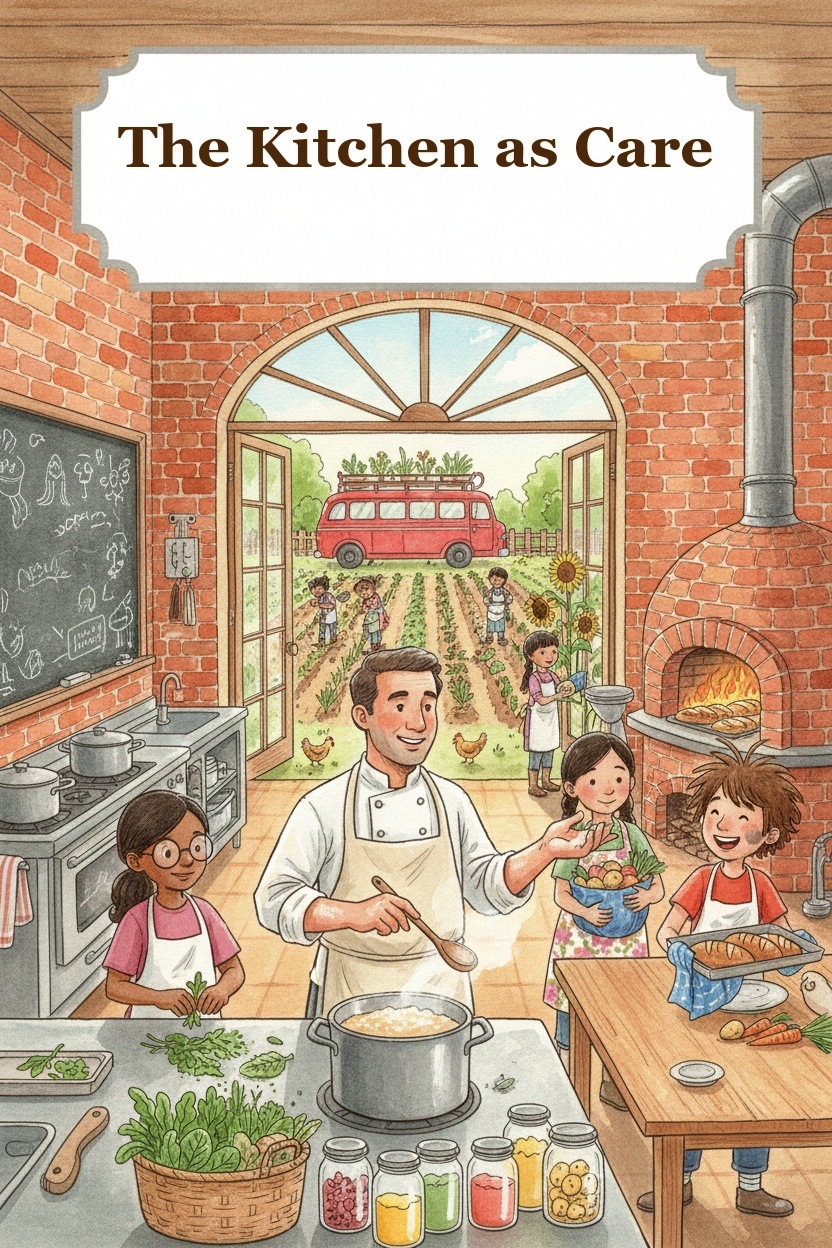
THE KITCHEN AS CARE
The Question
The Riverside Fire Station kitchen smelled like lemons and possibility. Chef Iggy Spark stood at the front of the room with his hands clasped behind his back, which the students knew meant he was about to ask them something important.
"Today," he said, "we are not going to cook."
The class gasped. Tommy's jaw actually dropped. "Not cook? Chef, are you feeling okay?"
"I'm feeling wonderful," Iggy said. "Because today we are going to plan a meal. And planning is where cooking begins."
Priya tilted her head. "Ammamma never plans. She just... knows."
"Your Ammamma has been cooking for sixty years," Iggy said gently. "She has planned so many meals in her head that the planning has become invisible. But it's there. Every time she chooses rice over bread, every time she decides to make dal before the vegetables because dal takes longer—that's planning. Today, we're going to make that thinking visible."
He turned to the chalkboard and drew a large circle with a question mark in the middle.
"Here's the question: If you could cook a meal for anyone—anyone in the world—who would it be, and what would you feed them?"
The room went quiet.
"For my mom," Tommy said immediately. "She works double shifts and always eats standing up. I'd make her sit down."
"For my Ammamma," Priya said. "She's always feeding us. Someone should feed her."
Maya was quiet for a moment. "My aunt," she said finally. "She's the one who taught me to read food labels. She checks everything before I eat it. I'd want to cook for her without her having to worry."
Iggy nodded slowly. "Those are beautiful answers. But here's the twist. Today, you're not cooking for someone you love." He paused. "You're cooking for someone who cares for you—but you don't really know them."
He let that sink in.
"Someone in this neighborhood has been watching you arrive at this kitchen every single week for three years. Someone who waves as you walk by, who knows your faces, who has never once been invited inside. Who might that be?"
Lucia's hand shot up. "The newsstand lady! Outside the fire station! She's always there when we arrive!"
"Mrs. Albright," Iggy said. "She opens that newsstand at six every morning, rain or shine, and she has watched three years of students walk past her window to come learn how to cook."
"And Mr. and Mrs. Gomez," Dev added. "They're the janitors at my school. They clean our classrooms after we leave, and they're always nice to everyone, and I don't think anyone has ever cooked for them."
Iggy's eyes lit up. "So we have our guests. Two tables. Two meals. One question remains: What do we feed them?"
The Plan
The chalkboard filled with ideas. Tommy suggested pizza. Priya suggested a feast with fifteen dishes. Sam suggested something fancy "to impress them."
Iggy wrote everything down without judgment, then he drew a line under it all.
"Now," he said, "let me ask you something. Are we cooking to impress, or are we cooking to nourish?"
"What's the difference?" Tommy asked.
"Impress is about you," Iggy said. "It's about showing someone how skilled you are. Nourish is about them. It's about asking: What does this person need? What will make them feel seen, warm, cared for?"
Maya raised her hand. "Mrs. Albright sits all day. She must get cold in that little booth in winter. Something warm would be good."
"Mr. and Mrs. Gomez clean all day," Dev said. "They're on their feet for hours. They need something that gives them energy but also feels like a treat."
Priya smiled. "Something you can eat with a spoon. Something that says 'you don't have to do anything but sit and eat.'"
Iggy nodded slowly. "There's a word for this kind of food," he said. "In Japan, they call it o-motenashi—wholehearted hospitality. In India, the word is atithi devo bhava—the guest is God. In Mexico, there's a saying: mi casa es su casa—my house is your house. Every culture has a tradition of feeding people as an act of care. It's one of the oldest human things there is."
He turned to the board and began writing.
"So we need two meals. Both warm. Both comforting. Both built around what our guests need, not what we want to show off. Let's think about what we know about them."
"We know Mrs. Albright has been selling newspapers for thirty years," Lucia said. "My mom says she remembers buying candy from her when she was a kid."
"We know Mr. Gomez fixes the broken chair in our classroom even though it's not his job," Sam added. "And Mrs. Gomez always says hello to us in the hall."
Iggy drew two columns on the board. "What do these people need?"
"To feel appreciated," Maya said quietly. "To know someone noticed them."
"And what does that look like on a plate?" Iggy asked.
The class thought hard.
Priya spoke first. "It looks like food that takes time. Food that says 'we spent hours thinking about you.' Not fancy food. Just... careful food."
"Like soup," Tommy said. "When my grandma makes soup for someone who's sad, she doesn't make it fancy. She makes it slow. She lets it simmer all day. You can taste the waiting in it."
Iggy smiled. "Tommy just told us something important. There is a taste to care, and it comes from time. When you cook something slowly, you're not just cooking food—you're cooking patience into it."
By the end of the hour, the plan was written on the board:
For Mrs. Albright: Chicken and rice soup, soft and warm, with extra vegetables and a squeeze of lemon at the end. Something she can eat with one hand while she watches her shop.
For Mr. and Mrs. Gomez: A baked pasta with cheese and a simple tomato sauce, with garlic bread and a green salad. Something hearty that says "you've worked hard, now rest."
"Both meals take time," Iggy said. "Both use simple ingredients. Neither one is trying to impress anyone with technique. They're trying to say something. What?"
"Thank you," the class said together.
"And what's the science behind that?" Iggy asked.
They all looked at him blankly.
"The science of caring," he said. "When food simmers for hours, the proteins break down into amino acids, the starches release sugars, and the flavors meld together. You can't rush that chemistry. You can't fake it. The same way you can't fake paying attention to someone."
He knocked a spoon off the counter without noticing. Maya silently added it to her mental prediction tally.
The Cooking
On Saturday morning, the kitchen filled with the smell of onions softening in olive oil. Iggy had divided the class into two teams.
Team One—Maya, Tommy, and Lucia—worked on baked pasta. Maya grated cheese with careful precision while Tommy chopped basil and Lucia assembled the layers.
"The sauce has been simmering for three hours," Iggy said, lifting the lid. "What do you notice?"
Tommy leaned in. "It's darker than when we started. And it smells sweeter."
"That's the Maillard reaction," Iggy said. "Remember Book 15? The amino acids and sugars are browning slowly, creating hundreds of new flavor compounds. You can't get this flavor in thirty minutes. It literally takes chemistry time."
Team Two—Priya, Dev, and Sam—made the chicken and rice soup. They had started the broth the night before with a whole chicken, onions, carrots, celery, and a bay leaf.
"It smells like home," Priya said. "Ammamma makes something like this when someone is sick."
"Exactly right," Iggy said. "This is the food we make when we want to say 'I want you to feel better.' Every culture has a version of it. The Jewish tradition calls it 'Jewish penicillin.' In Vietnamese cooking, it's phở. In the Caribbean, it's a hearty pepperpot. The dish changes, but the message is the same: you matter, and I want to feed you."
"Chef," Sam said carefully, "I have a question. Is this soup... enough? It's so simple. Should we be doing something more impressive?"
Iggy set down his ladle. "Sam, let me tell you something. The most impressive meal I ever made was at my first restaurant. Seven courses. Sixteen plates. I was trying so hard to show everyone how good I was that I never once asked if they were enjoying it."
He sat down on a stool and looked at the class.
"The least impressive meal I ever made was for my grandmother when she was sick. It was just rice and eggs and a little soy sauce. She couldn't eat much. But I made it the way she taught me, the way she liked it, and she ate every bite."
His voice got soft.
"She told me it was the best meal she'd ever had. And I knew it wasn't—not technically. But it was the most careful. That's what she tasted."
The kitchen was quiet for a moment.
"So yes," Iggy said, standing up. "This soup is enough. It's more than enough. Because it's not about what's on the plate. It's about who the plate is for."
The Serving
At noon, Mrs. Albright arrived first, led in by Lucia and Dev. She was smaller than she looked in her booth, wrapped in a knitted cardigan that had seen many winters.
"I have watched you children," she said, "for three years. Every Saturday, you come skipping down the street with your backpacks. And I always wondered—what are you learning in there?"
"Today," Maya said, "we're learning about you."
They seated her at a small table with a bowl of soup, the steam rising in gentle curls. She picked up her spoon, stirred it once, and then—to everyone's surprise—she put down the spoon and pressed her hands around the bowl, letting the warmth sink into her fingers.
"It's warm," she whispered. "My hands are always cold. You made it warm."
She took a bite. Then another. Then she closed her eyes.
"I've been eating lunch at my booth for thirty years," she said. "Sandwiches. Mostly standing up. I'd forgotten what it feels like to sit down and eat something made for you."
The Gomezes arrived next, brought in by Sam and Tommy. Mr. Gomez was tall and quiet, and Mrs. Gomez was short and beaming.
"Tommy told us you're the best tamale maker in the neighborhood," Mrs. Gomez said to him. "Is that true?"
"My aunt is," Tommy said. "But I'm learning."
They sat down to plates of baked pasta, golden and bubbling, with garlic bread and a bright green salad. The pasta came out imperfectly—the layers weren't even, and one corner was slightly over-browned—but no one seemed to notice.
Mr. Gomez twirled pasta around his fork. He took a bite. Then he took another bite, faster.
"We clean a school," he said quietly. "Every night, we clean the rooms where children have spent the day learning. We see the crayon marks and the paper scraps and the fingerprints on the windows. We know you were there. We just never knew you were thinking about us."
Mrs. Gomez reached across the table and squeezed his hand. "You thought about us," she repeated. "You made us food."
The meal went on. It was not fancy. The soup had the chicken pieces in it—Maya's careful fingers had removed all the bones, but the carrots were cut in slightly uneven circles. The salad had too much dressing on one side and not enough on the other. The lemon at the end of the soup was a little overdried.
And it was perfect.
The Lesson
After their guests left, Iggy gathered the class around the big prep table. The dishes were stacked, the pots soaking, and the kitchen smelled like a good day.
"How do you feel?" he asked.
"Tired," Tommy admitted. "But a good tired."
"Did you notice anything?" Iggy asked. "About the meal, about yourselves?"
Priya spoke slowly. "I noticed that I cared more about whether they liked it than whether it was perfect."
"Because it was for them," Iggy said. "When you cook to impress, you're watching for reactions. When you cook to nourish, you're watching to see if they're okay. Did you see Mrs. Albright's hands on the bowl?"
Everyone nodded.
"Has anyone ever touched your food that way?" Iggy asked. "Like they were holding something precious?"
Maya raised her hand hesitantly. "I think that's what my aunt does when I make her tea. She holds the mug with both hands. I never understood why until just now."
"Because tea made for you is a different thing than tea you make yourself," Iggy said. "Someone else's care is in it. You can taste that. Or rather—you can feel it. That's not a science I can explain with molecules."
He paused, then looked at the chalkboard, still covered in their plans.
"In many cultures, hospitality is the highest virtue. In the Middle East, guests are treated with such generosity that there's a saying: 'When a guest arrives, the host's prayers are answered.' In the Mediterranean, they say you eat twice—once with your mouth, once with your heart."
He picked up a piece of chalk.
"The word 'companion' comes from Latin: cum, meaning 'with,' and panis, meaning 'bread.' A companion is someone you share bread with. That's what we did today. We made our guests companions, even for one meal."
Sam raised his hand. "But Chef—we didn't do anything special. It was just soup and pasta."
"Just soup and pasta," Iggy repeated. "Just the two most universal comfort foods on Earth. Just the things every culture makes when they want to say 'I care about you.' Just the chemistry of slow cooking and the wisdom of simple ingredients and the oldest tradition there is: feeding someone."
He set down the chalk and smiled.
"You want to know the secret to caring for someone with food? It's not technique. It's not skill. It's paying attention. It's asking 'what do you need?' and then making it. That's it. That's the whole recipe."
Maya looked at him. "Is that why you teach us? Because you care?"
Iggy was quiet for a long moment. Then he said, "Do you know why I wanted to teach this class? Because a restaurant kitchen taught me how to cook. But this kitchen taught me—is teaching me—what cooking is for."
He spread his hands wide.
"Cooking is how we say 'I see you.' 'You matter.' 'I want you to be warm and fed and okay.' It's not about the food. It's never been about the food. It's about the person sitting across the table."
Tommy looked at the empty chairs where their guests had sat. "Do you think they felt it? The care part?"
"I think," Iggy said, "they felt something they haven't felt in a long time. Someone thinking about them. Someone paying attention to their hands, their cold hands, their tired feet, their long days. That's the gift you gave them today. The food was just the messenger."
The Spark Effect knocked a wooden spoon off the counter. Tommy didn't even add it to his tally.
He was too busy thinking about what his next meal for his mother would be.
Kitchen Lab Notes
Dear Students,
Today we learned that cooking is never just about cooking. It's about noticing people—what they need, what comforts them, what says "I see you" in a language they can taste. The chemistry was real: the Maillard reaction in the sauce, the collagen breaking down in the broth, the starch thickening the soup. But the chemistry was in service of something older and simpler: the human act of feeding each other.
Here's your question to think about until next time: Who in your life does something for you that you've never thanked properly? And what would you make them if you could?
—Chef Spark
Recipe: Chicken and Rice Soup (The Soup of Care)
Ingredients:
-
1 whole chicken (about 4 pounds)
-
1 large onion, quartered
-
3 carrots, peeled and cut into large chunks
-
3 celery stalks, cut into large chunks
-
2 bay leaves
-
1 teaspoon black peppercorns
-
1 cup white rice
-
1 lemon, cut into wedges
-
Salt to taste
Steps:
-
Place the chicken in a large pot and cover with cold water. Add the onion, carrots, celery, bay leaves, and peppercorns.
-
Bring to a boil, then reduce to a gentle simmer. Cook for 1½ hours, skimming foam from the surface.
-
Remove the chicken to a cutting board. When cool, pull the meat off the bones and shred it.
-
Strain the broth, discarding the vegetables. Return broth to the pot.
-
Add the rice and shredded chicken. Simmer until the rice is tender, about 18 minutes.
-
Season with salt. Serve with a squeeze of lemon.
Chef Spark's Note: The soup is better the next day. That's not magic—it's chemistry. The flavors keep mingling overnight, the starch keeps releasing, and the patience becomes part of the taste. Cooking for someone is the only way to give them time itself.