Lighthouse Cats
The Wrong Island
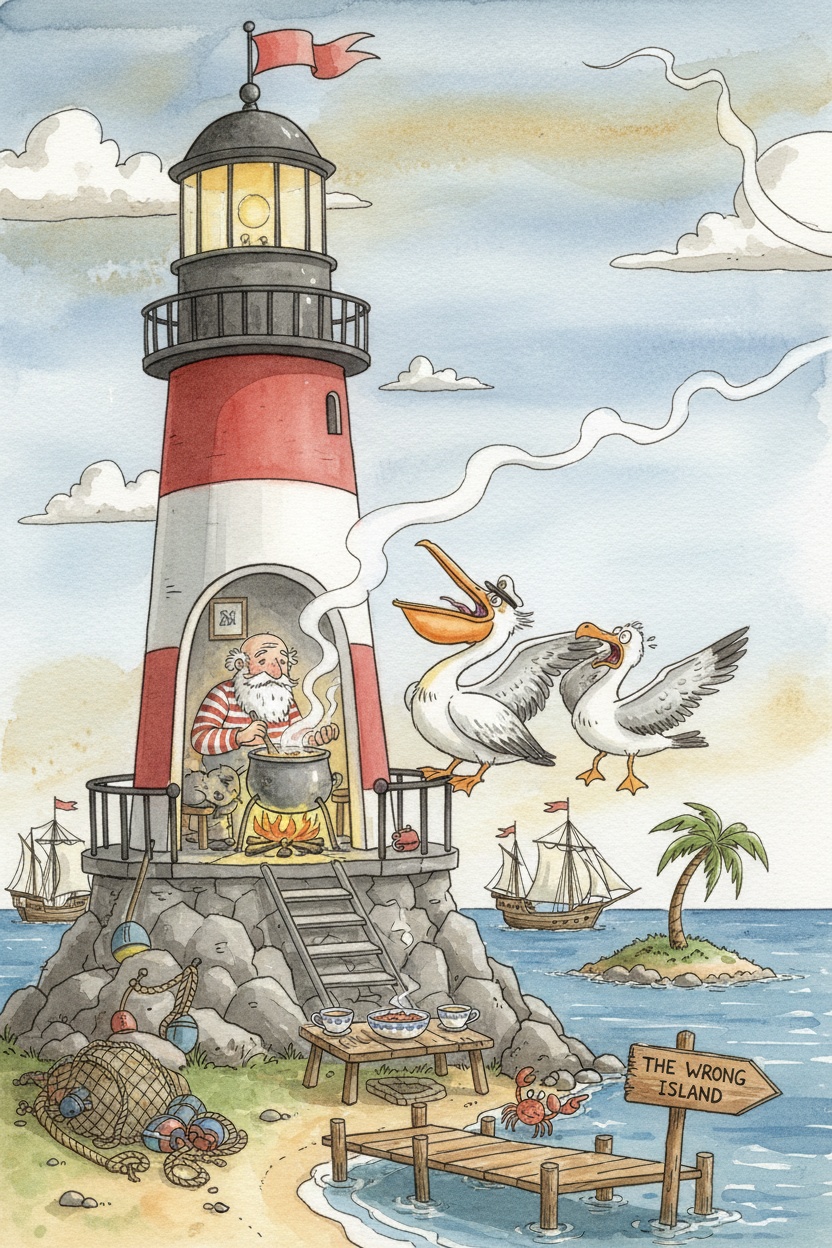
The morning began with the fog, as it so often did at Pelican Point.
Captain Whiskers was in her window, watching the grey sea breathe. The light from the lighthouse swept across the water in long, slow blinks. The foghorn boomed.
Then Morris arrived.
“WHISKERS!” he screamed, skidding onto the windowsill. “WHISKERS, THERE’S A SHIP! IT’S COMING IN FAST! IT’S COMING IN FAST AND IT’S GOING TO CRASH AND IT’S GOING TO SINK AND IT’S GOING TO BE THE WORST THING THAT HAS EVER HAPPENED AT THIS LIGHTHOUSE!”
Whiskers blinked. The ship was coming in slow. It was not going to crash.
“Morris,” she said. “What sort of ship?”
Morris squawked. “A round one! A floating one! A— a— hold on.”
He squinted.
“It’s a very small ship, Whiskers. With a very small crew. They’re waving. They’re waving a lot.”
Whiskers stood up, stretched, and stepped onto the windowsill. She looked down at the sea.
The ship was a walnut shell with a paper sail. It bobbed gently in the swell, drifting toward the harbour as if it had all the time in the world.
The crew were field mice. Six of them. They wore tiny sailor hats and looked extremely relieved to see the lighthouse.
Penny the Pelican swooped down and landed beside Whiskers with a thump. “Captain! I saw them!” she said. “They need help! I can tell! I’m first mate, I can always tell!”
“What do they need?” Whiskers asked.
Penny looked at the mice. The mice looked at their charts. One of them, a small grey mouse with a very important clipboard, called up in a tiny voice.
“Hello! Excuse me! We’re looking for Cheese Cay!”
Whiskers tilted her head.
“This is not Cheese Cay,” she said.
The small mouse looked at his clipboard. He frowned. He looked again. He passed the clipboard to the mouse next to him.
“Are you sure?” the small mouse called.
Whiskers did not answer that. She simply sat down and began to groom her paw.
Morris gasped. “THEY’RE LOST! THEY’RE COMPLETELY LOST! THEY’LL NEVER GET HOME! THEY’LL BE LOST FOREVER!”
“Morris,” said Whiskers.
“YES?”
“You are very loud.”
Morris lowered his wings. “Oh. Sorry.”
Whiskers looked at the ship again. The mice were now all crowding around the clipboard, muttering and pointing. One mouse was turning the chart upside down. Another was shaking his head. The smallest mouse looked like he might cry.
Captain Whiskers descended the lighthouse stairs.
By the time she reached the dock, the walnut shell had bumped gently against it. The six mice scrambled onto the wood, dragging their charts and their little rope and a very small compass that was now pointing at the horizon in a way it certainly should not have been.
The small grey mouse stepped forward. He looked up at Whiskers with enormous eyes.
“We were following the stars,” he said. “And the currents. And the map. All of it. We did everything right.”
“Except one thing,” said Whiskers.
The mouse looked at his clipboard. “What?”
Whiskers sat down. She was very calm. She did not sigh. She did not roll her eyes.
“You forgot the wind,” she said.
The mice all looked at each other.
“The wind?” said the small grey mouse.
Whiskers reached out a paw and tapped the chart. The mice gathered around.
“The wind blew you off course,” she said. “You navigated perfectly. But the sea does not always follow charts. The sea does not ask permission.”
The smallest mouse sniffled. “So we’re lost.”
“You are not lost,” said Whiskers. She flicked the chart with her claw, turning it the right way around. “You are simply elsewhere. Now— let me show you where Cheese Cay is.”
She traced a line on the chart with one claw. The mice watched, utterly silent.
“You are here,” she said. “Which is not where you meant to be. But look.”
She tapped the line she had drawn.
“A little east. A little north. And you arrive.”
The small grey mouse stared at the line. Then he looked up at Whiskers.
“We were very far off,” he said.
“You were,” said Whiskers.
“And you fixed it.”
“I showed you how to fix it,” she said. “You did the sailing. You will do the sailing home.”
The mice looked at each other. The smallest mouse stopped sniffling.
The small grey mouse raised his clipboard.
“We have a gift,” he said. “For the lighthouse that wasn’t Cheese Cay but was very kind anyway.”
He reached into the ship and pulled out a tiny square of cheese. It was the size of a button, bright yellow, and it smelled magnificent.
Whiskers looked at it.
She did not say anything.
Then she lowered her head and took the cheese very gently in her teeth. She carried it to the lighthouse wall, where other small gifts waited: a duck’s ribbon, a frog’s fishing cork, a piece of whale-song written on driftwood.
She placed the cheese beside them.
When she turned around, the mice were back in their boat, adjusting their sails. The small grey mouse waved.
“Thank you, Captain!” he called.
Whiskers nodded.
“A little east,” she said. “A little north.”
The walnut shell sailed out of the harbour, the paper sail small and white against the grey sea.
Morris landed beside Whiskers. “That was amazing! You fixed their charts! You saved them! You’re a hero!”
“I corrected their course,” said Whiskers.
“That’s the same thing!”
“It is not,” said Whiskers.
She walked back up the lighthouse stairs. From the kitchen, the smell of chowder drifted out.
Angus was sitting in his rocking chair. He opened one eye.
“Funny,” he said. “Thought I heard tiny voices.”
Whiskers blinked at him neutrally.
“The wind,” she said.
Angus nodded, and closed his eye again.
Whiskers went to her window. Below, the sea had cleared. The walnut shell, already far away, was sailing steady.
Every ship gets home, she thought.
Even the ones that start somewhere else.
The End