Professor Plunks Impossible Lab
The Temperature Catastrophe
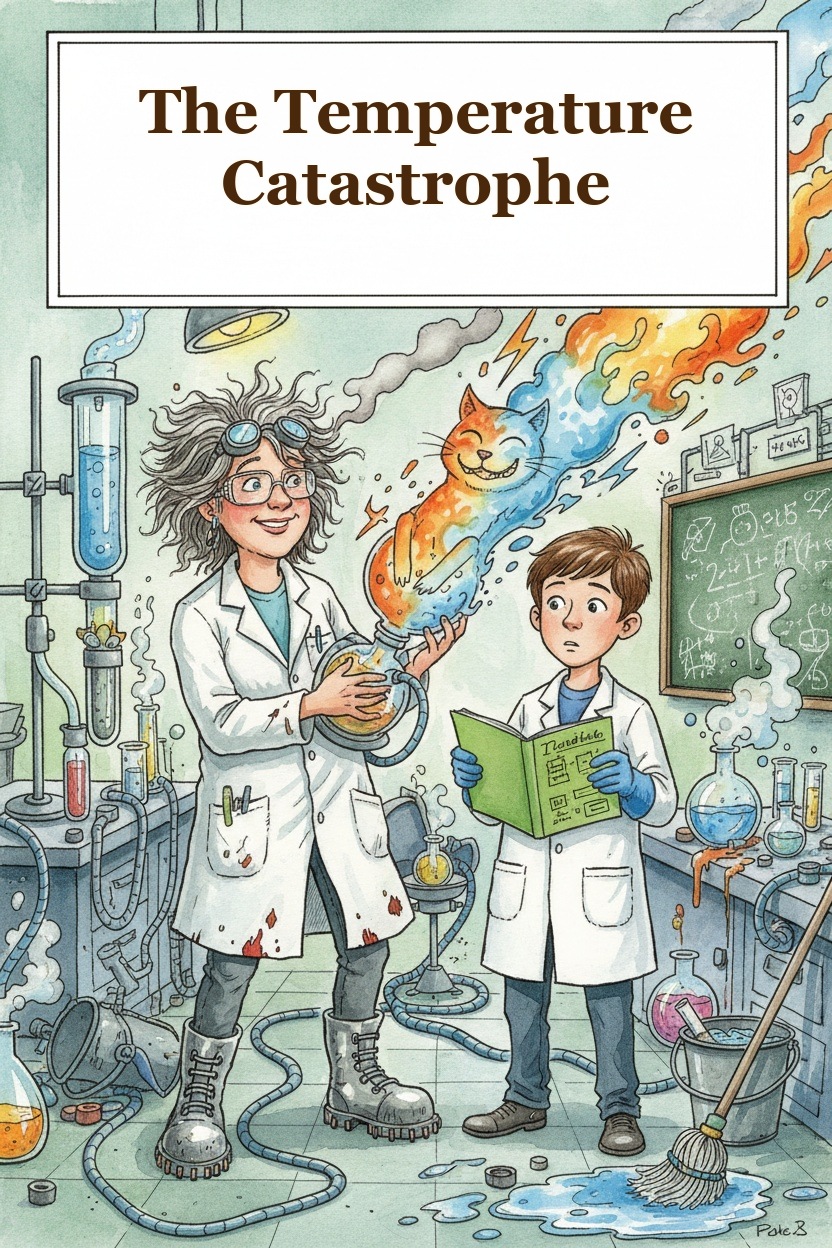
Section 1: The Machine That Was Going to Be Perfect
"Otto! My careful colleague! Today we make the cold hot and the hot cold!"
Professor Plunk burst through the lab door with a metal box under each arm and her safety goggles bouncing on her forehead like an excited third eye. Her lab coat billowed behind her even though there was no wind indoors.
Otto looked up from his lab notebook. He had been carefully drawing a diagram of Tuesday's lunch tray incident, which had been educational in ways Otto had not planned to learn.
"Cold hot and hot cold?" he repeated. "Professor, I think that might be—"
"Impossible? Nonsense? Complete and utter scientific foolishness?" Plunk beamed. "That's what they said about the indoor kite! And the grape-powered clock! And—"
"The emergency exit that opened inward instead of outward," Otto said, checking his notebook.
"The PRINCIPLE was sound!" Plunk declared. "The exit was simply... enthusiastic."
She set the metal boxes on the workbench so hard that a pencil rolled off and landed in a beaker. Otto retrieved it. It was slightly steaming.
"What ARE those?" Otto asked.
Professor Plunk placed her hands on her hips. "I'm glad you asked, Otto! I call it the Thermal Exchange Demonstration Apparatus! Mark One!"
Otto wrote in his notebook: Mark One. This does not fill me with confidence.
"You see," Plunk continued, pulling a tangled nest of copper tubing and colorful wires from the larger box, "temperature is all about particle energy. Everything around us—this table, you, me, the suspicious sandwich under that beaker—is made of particles that are constantly wiggling and jiggling and moving around."
Otto inspected the suspicious sandwich. The suspicious sandwich appeared to be moving.
"The particles in hot things wiggle FAST," Plunk said, making her hands vibrate at high speed. "The particles in cold things wiggle SLOW." She slowed her hands to a crawl. "Temperature is just a measurement of how fast the average particle is wiggling!"
Otto nodded and wrote: Particles in hot things move fast. Particles in cold things move slow. Temperature = average wiggle speed.
"That's simple enough," he said.
"Of course it is! Now watch THIS!" Plunk held up the second metal box. "This is my special thermal exchange unit! It takes heat from one place and pushes it to another! We'll put our ice cream on one side AND our hot chocolate on the other, and BOTH will stay perfectly temperatured forever!"
Otto blinked. "Do we have ice cream?"
"WE DO!"
"Do we have hot chocolate?"
"WE HAVE THREE MUGS!"
"Whose?"
Plunk waved a hand dismissively. "Gloriana won't mind. Probably. Possibly. She might not even notice."
Otto looked around the lab. Somewhere in the back, he heard the very soft, very patient sound of a mop being wrung. Gloriana was already in the building. That could mean anything.
"Now," Plunk said, "we just connect these tubes, plug in this exchanger, and—"
"Professor?"
"Yes, Otto?"
"What does 'overloaded' mean?"
Plunk looked at him, blinking owlishly. "Funny word to bring up! Whatever do you mean?"
Otto pointed at the thermal exchange unit. Written clearly on the side, under a sticker of a sun holding a snowflake, were the words: FOR SMALL DEMONSTRATIONS ONLY.
"Ha!" Plunk laughed. "That's just legal language! This unit can handle THIRTY TIMES the stated capacity! I checked—"
"You checked?"
"I estimated," Plunk corrected. "I estimated magnificently. Now, pass me the ice cream!"
Section 2: Half Cold and Half Not
The machine was enormous. Otto wasn't sure why this surprised him, because Professor Plunk's machines were always enormous, but this one seemed particularly enormous. It took up half the workbench, which meant Otto's lunch tray had been moved to a stool, which meant the stool was wobbling dangerously, which meant Otto was standing guard over the cheese sandwich he had carefully brought from home.
The thermal exchange unit stood in the center of the machine, surrounded by coils of copper tubing. On one side of the unit, Plunk had placed a bowl of ice cream—vanilla, Otto's favorite. On the other side, she had placed three mugs of hot chocolate.
"Watch closely, Otto!" Plunk said, flicking a large red switch. "The machine will absorb heat from the hot chocolate, which will make the chocolate COLD—"
Wait," Otto said. "If the chocolate gets cold, we won't want to drink it."
"RIGHT! Exactly! It will get cold, and the heat it loses will travel through this piping here," Plunk traced a thick red rubber tube with her finger, "and go to the OTHER side, where it will warm up the ice cream and keep it soft and creamy! And then the ice cream's heat will travel BACK through the other pipe and—"
"Keep the chocolate warm?"
"YES! Brilliant! You see, Otto, heat flows from hot things to cold things. Always! Without exception! Heat is the great traveler—it moves from where it's toasty to where it's chilly until everything reaches the SAME temperature."
Otto wrote: Heat moves hot → cold. Never cold → hot. Natural flow.
"Once both the chocolate AND the ice cream reach the same perfectly balanced middle temperature," Plunk continued, "the machine maintains them there forever! The cold stays cold! The hot stays hot! Equilibrium everywhere!"
"Equilibrium," Otto repeated. "That means... everything the same temperature?"
"Exactly!"
Otto considered this. "But if everything becomes the same temperature, won't the ice cream melt and the chocolate get cold?"
Plunk's smile flickered for just a fraction of a second. "That's what I'm preventing with the machine!"
"By moving heat in two directions at once?"
"IN TWO DIRECTIONS AT ONCE!" Plunk slammed the red switch with the flat of her hand.
The machine hummed. The coils of copper tubing began to vibrate. The hum got louder. And louder. And—
The machine made a sound like a teakettle falling down a flight of stairs.
"That's not right," Otto said.
"Fine tuning!" Plunk shouted over the rising whine. "The thermal exchange unit is just working up to full power!"
The ice cream bowl began to rattle on its side of the bench. The hot chocolate mugs began to rattle on their side. The entire workbench started shaking, which made the stool shake, which made Otto's sandwich wobble dangerously.
"The SMALL DEMONSTRATIONS ONLY label," Otto said, "seems like it might have been accurate."
"Accuracy is flexible!" Plunk replied. "Physics is flexible! Everything is—OH!"
There was a POP. Then there was a FWOOSH. Then there was a CRACKLE. And then—
The temperature did something.
Otto couldn't describe it any other way. The temperature itself, everywhere in the lab, at the same moment, had a thought. He could see it in Professor Plunk's face, which had frozen in a very unusual expression: her mouth was forming the word "PERFECT" but her eyes were forming the word "OH N—"
The machine exploded into two streams of air.
One stream was BITINGLY COLD. Otto felt it physically press against his skin, and his breath came out in a cloud.
The other stream was BAKINGLY HOT. The air rippled and shimmered, and Otto felt his ears complain in a way he hadn't known ears could complain.
And then—the lab split.
Section 3: The Great Divide
The left side of the lab—the side with the ice cream, the plumbing corner, and the window that had been stuck since 2019—was covered in frost. The pipes wore thick coats of ice. The window had grown a beautiful fractal pattern of snowflakes. The mop bucket had frozen solid in a single dramatic moment, its mop pinned into the ice at an angle that suggested it had been trying to escape.
The right side of the lab—the side with the hot chocolate, the sandwich, and the equipment shelf—was shimmering with heat. The air rippled. A rubber hose had softened and slumped over like a tired noodle. The cheese sandwich had become... Otto didn't want to look at what the cheese sandwich had become.
Between them, running straight down the middle of the room, a line divided the frost from the shimmer. The line was so sharp Otto could have drawn a ruler along it. On the left, Gloriana's famous tool cart was a perfect icy decoration. On the right, the same tool cart's wheels were beginning to bead like they were sweating.
"That," Otto said slowly, "should not be possible."
Professor Plunk was standing directly on the line. Her left lab coat sleeve was frosty and stiff. Her right lab coat sleeve was curling gently in the heat. She looked down at herself with a scientist's deep consideration.
"Fascinating," she said.
"The lab is half frozen and half melted," Otto said. "The left wall is icy! The right wall is sagging!"
"An excellent observation! The ice is very thorough, isn't it? Look—even the dust particles have frozen mid-air!"
Otto had never seen frozen dust before. He didn't want to see frozen dust now. He wanted to see a lab that was one single temperature, preferably a comfortable one. He pulled out his notebook.
Dear Future Otto, he wrote. If you are reading this, you are probably warm. Enjoy it. The left half of the lab just froze solid and the right half just turned into an oven. The physics concept under study is temperature. The physics concept under attack is my sense of safety.
"Professor," Otto said, "how can your left coat be freezing and your right coat be burning?"
"Because, Otto," Plunk said triumphantly, "heat is flowing in both directions at once! The heat from the right side is being pulled toward the left side, and the cold from the left side—"
"Cold isn't a thing," Otto said automatically. "Cold is just less heat. You said so in Book 2."
"I DID say so! And it's TRUE! Cold is just the ABSENCE of heat! So what's happening is..." Plunk paused, and her face lit up. "The machine tore the heat out of the left side and shoved it into the right side! But it OVERDID it! It made the left side so heat-less that everything froze, and the right side so heat-full that everything melted!"
Otto looked at the frozen pipes and the sagging shelf. "So the machine pulled heat from the cold side and pushed it to the hot side?"
"YES!"
"That's backwards," Otto said. "Heat flows from hot to cold. Not cold to hot."
"UNDER NORMAL CIRCUMSTANCES YES! But my thermal exchange unit does the opposite! It actively pumps heat! It's like... like a fridge!" Plunk jogged to the hot side of the lab, slipped on a particularly melted patch of floor, jogged more carefully, and pointed at a small refrigerator in the corner. "A fridge pulls heat from the INSIDE and pushes it OUT. It doesn't make the inside cold—it makes the inside have LESS heat! The cold is just what's left behind!"
Otto thought about this. Inside his head, the pieces began to click together like the gears of a very safe, very predictable machine.
"Temperature measures the average kinetic energy of particles," he said slowly. "That's the wiggle. Hot particles have lots of kinetic energy, so they have high temperature. Cold particles have less."
"Yes!"
"And heat flows naturally from areas with high temperature to areas with low temperature. It always flows toward the slow-wigglers."
"ALWAYS!"
"So..." Otto gestured at the frozen half and the melting half. "Your machine forced the heat from the already-cold side and gave it to the already-hot side. It made the difference BIGGER instead of smaller."
Plunk clapped her hands. "Otto, you're a genius!"
"I don't think I am," Otto said. "I think I'm a person whose sandwich is currently liquefying on a stool that is slowly tipping over."
Section 4: Materials and Their Secrets
The lab was still half frozen and half melting. Professor Plunk showed no signs of concern. She was, in fact, pointing at various objects and exclaiming things like "LOOK AT THE COPPER!" and "OH, THE WOOD IS STILL PERFECTLY WARM!"
Otto was trying to rescue the hot chocolate. All three mugs were steaming so aggressively that the steam was forming a small personal cloud. He carefully lifted one—then dropped it immediately.
"OW!"
"Ah," Plunk said, appearing beside him with a towel. "That's because the MUG heated up too! That's heat CONDUCTION! The hot chocolate's particle energy transferred to the mug's particles, and the mug's particles transferred to your hand!"
Otto looked at his red palm. "You could have warned me."
"Where would be the learning in that?"
Otto wrote: Materials transfer heat at different rates. Metal conducts fast. Wood... he hesitated, walked over to the shelf, and touched the wooden shelf edge. It was warm, but not in a burn-y way. ...wood conducts slow. Gloriana's mop bucket: frozen, because it was on the cold side. Do not touch metal with wet hands. Ever.
"The point," Plunk said, "is that different materials hold heat differently! Some materials, like copper, absorb and release heat quickly. That's why the copper tubing froze ITSELF almost instantly on the left side—it gave away its heat faster than any other material!"
From the left side of the lab, there was a POP. Otto turned to see a frozen pipe cracking open.
"And other materials," Plunk continued, "like wood and plastic, hold on to their heat more stubbornly! They heat up slowly and cool down slowly. They have high specific heat!"
"Specific heat?" Otto said.
"The amount of energy it takes to warm up one gram of material by one degree! Water has a very HIGH specific heat—it holds on to its heat beautifully! It takes forever to warm up and forever to cool down!" Plunk looked at the frozen pipes on the left, which were beginning to make cracking sounds. "Ice has a HIGH specific heat too. That's why it takes so long to melt! You have to keep adding energy to change it from solid ice into liquid water."
Otto looked at the ice cream. The ice cream on the cold side had frozen into a perfect, pale yellow cube. It was, Otto had to admit, extremely sturdy. "So the same energy that raised the temperature of something by one degree can..."
"...it takes MORE energy to warm up water than almost anything else!" Plunk beamed. "One calorie raises one gram of water by one degree! But it takes EIGHTY calories just to melt one gram of ice into water, without changing the temperature AT ALL!"
The explanation was followed by a satisfying CRACK from the left side of the lab. The frozen window—the one that had been stuck since 2019—shattered in a beautiful spray of ice.
"AND the frozen window was stuck because it was FROZEN, and now it's BROKEN," Otto said, "and I think we should probably shut off the machine."
"Oh, the machine is already off," Plunk announced.
Otto spun around. The machine had, indeed, turned itself off. It was also on fire. A small, controlled fire that was burning, somehow, in the middle of a patch of frost.
"Ah," Plunk said. "A fire on the cold side. That tells me something very important!"
"What?" Otto asked desperately.
"Warmth can still exist near cold! The fire is locally hot, so it raises the temperature of its immediate surroundings, but the intense cold of the frost elsewhere means the heat is already being drawn away in all directions. It's a wonderful natural demonstration of—"
"REACHING EQUILIBRIUM," Otto finished. "You mean it's all going to eventually... balance?"
The smoke from the fire began to drift horizontally, pulled toward the frozen pipes like a moth toward a flame. Within seconds, the fire had been reduced to a small, sad pile of ash strewn across the glittering frost.
"Exactly! Heat flows from hot to cold until everything is the same temperature. Here, watch!" Plunk grabbed one of the still-steaming mugs of hot chocolate and set it on the floor on the COLD side. Otto watched as the mug's temperature visibly dropped. The steam stopped. The frost nearest the mug began to retreat, melting in a small circle, but the mug itself quickly turned lukewarm.
"It got cold," Otto said.
"Not cold!" Plunk corrected. "LESS HOT! It gave away its heat to the colder air around it! The air particles were wiggling slowly, and the mug's particles were wiggling fast, so they shared! They bumped into each other and passed the energy along until everyone was wiggling at the same speed!"
Otto watched the mug stop steaming entirely. "It got cold."
"IT REACHED THE SAME TEMPERATURE AS THE AIR ON THAT SIDE! And look at the ice cream!"
Otto looked. The frozen ice cream cube—which had been, a few minutes ago, a solid yellow brick of dairy frozen solid by the over-worked thermal exchange unit—had begun to develop a thin layer of cream on the outside. The air in the lab was, gradually, beginning to return to a normal, breathable temperature, and the ice cream was slowly, painstakingly, melting.
"Because heat is flowing FROM the warm air INTO the ice cream," Otto said. "The warm air particles wiggling fast bump into the ice cream particles wiggling slow, and they share their energy. The air cools down, and the ice cream warms up. They're reaching equilibrium."
Section 5: The Warmest Cold and the Coldest Warmth
"EVERYTHING!" Plunk shouted, standing triumphantly in the middle of the lab, one sleeve still frozen and the other still smoking. "Everything is trying to be the same temperature! The universe wants equilibrium! The sun heats the earth, the earth heats the air, the air heats the ocean, and they all share and share until—"
"Until everything is the same temperature and nothing ever changes again," Otto said.
Plunk lowered her arms. "Well, no. Because the sun keeps pumping energy in, and the earth keeps radiating energy out, so they're in a constant dance. But yes—if there were no energy coming in from anywhere, everything would eventually reach the same temperature. It's called THERMAL EQUILIBRIUM."
Otto stood next to his frozen-then-melting cheese sandwich and his lukewarm hot chocolate, and made a decision. He wrote in his notebook:
LESSON LEARNED:
- Temperature = average wiggle speed of particles.
Hot particles wiggle fast.
Cold particles wiggle slow.
Please never force your particles to wiggle in ways they don't want to.
- Heat flows from hot to cold.
ALWAYS.
In every situation.
Until everything is the same temperature.
The universe is one big sharing game, and everyone is forced to participate.
- Different materials hold heat differently.
Water hangs onto heat like it's its favorite blanket.
Metal throws heat away like yesterday's socks.
Wood is in between.
He paused, then added: The mug was hot. I should have waited. I have learned a second physics lesson today.
"Otto!" Plunk said, appearing at his shoulder. "You've written 'THIS WAS NOT IN THE PLAN' and then drawn a thermometer. That seems very organized."
"It's what I do," Otto said. He looked at the lab. The frost on the left side was beginning to turn to puddles. The melted rubber hose on the right side was beginning to stiffen back into its normal shape. The only thing that had remained continuously, exactly, at room temperature throughout the entire disaster was Gloriana's tool cart.
"You know," Otto said slowly, "this was kind of amazing."
Plunk raised an eyebrow. "The disaster?"
"The LEARNING." Otto gestured at the lab. "We had freezing and melting happening AT THE SAME TIME. We had heat flowing in two directions at once—forced one way by the machine, natural the other way by physics. We had materials behaving differently, and water proving again that it's the most stubborn thing in the universe."
"The most stubborn thing in the universe," Plunk said, "is actually the unwillingness of anything to stop sharing heat. Look."
She pointed, and Otto looked. On the left side of the lab, the last of the frost was retreating from a copper pipe. The pipe was warming up, and even as he watched, the frozen moisture turned to liquid, then to droplets, then to steam as the pipe's temperature climbed past the boiling point—it was, after all, still connected to the hot side.
The droplet hung for a single, perfect moment, suspended at the edge of the pipe, before tipping over and splashing into the newly forming puddle.
"You see?" Plunk said softly. "That water was ice two minutes ago. Now it's liquid. Then it'll be vapor—steam rising into the air, carrying its energy away, sharing it with the atmosphere, becoming part of the great dance of heat. There is no moment in the universe where heat is not being shared."
Otto thought about this. He thought about his frozen fingers, now warming. His scorched hand, now cooling. The mug, now room temperature. The sandwich, which was, unfortunately, no longer any temperature Otto was willing to talk about.
"I think," Otto said, "that heat sharing is something the whole universe does. All the time. And we just got to watch."
"WE DID!" Plunk beamed. "We watched the most fundamental thing in thermodynamics happen in dramatic, frozen, melted, explosive glory!"
She struck a pose and clasped her hands together. "Well! That demonstrated temperature, heat flow, and specific heat rather more vividly than I intended."
From behind them, a watering can appeared. Gloriana was standing there, holding it, and a mop, and a bucket, and what appeared to be a portable heater, and a very large blanket.
"Here," Gloriana said. "Both sides."
Otto looked at the watering can, then at the ice, then at the melted spots.
"This is also a lesson," he said, "in physics."
"Hot is hot." Gloriana handed him the blanket. "Cold is cold."
Otto took the blanket. It was, he realized, somehow both warm and cool in different patches. Like the lab itself. Like the entire universe, which was always, always in the process of sharing its heat.
"You know," Otto said, "I think I finally understand."
"Understand what?" Plunk asked.
Otto looked at the frozen puddle on the left, now beginning steam. The melted spot on the right, now beginning to shudder into solid. The entire great mess of a very messy, very educational lab.
"The universe," Otto said, "is always trying to make everything okay. Temperature-wise, at least. It's constantly sharing. Constantly balancing."
He felt the warmth of the blanket slowly spreading evenly across its fabric, and even more slowly, the warmth of the room beginning to fix the last of the chill.
"Everything wants to be okay," he said. "And it will use physics to get there."
Plunk put her hand on his shoulder, and it was neither freezing nor burning, but simply, perfectly, the temperature of someone who was glad he was there.
"Otto," she said warmly, "that is exactly right."
The lab's door slowly stopped swinging in its frame, and the puddles began to quietly reach equilibrium with the floor.
"Here," Gloriana said, handing Otto his warmed-up-not-quite-hot-anymore mug of hot chocolate. "Back."
Otto took it. It was lukewarm. It was perfect. It had been sharing with the universe all along.
He wrote in his notebook: Thermal equilibrium. Everything sharing. Everything reaching. Everything eventually being simultaneously cold and hot in all the right amounts for any given moment.
Then, in his careful, perfectly organized handwriting, underneath it:
EXPERIMENT RESULT: EXTREMELY EDUCATIONAL. IT WAS NOT IN THE PLAN. THE PLAN WAS ACCOMPLISHED ANYWAY.
ADDITIONAL NOTE: Bring a blanket to the lab tomorrow. Professor Plunk has suggested a "heat transfer relay." I am concerned. Let the record show that I am always concerned, and the record is always right.
And underneath, in tiny letters, the phrase that Otto used for every experiment he survived:
CONCERNED AND LEARNING.
— Otto Finch, age 8, Apprentice Scientist.
The temperature in the lab is now 19 degrees Celsius. It is, according to Professor Plunk, "the most comfortable temperature in the physical universe." I have theories about the physical universe. I shall write them in a warmer room.
And that was the day that Otto Finch learned that temperature was just particles wiggling, that heat was always trying to share, and that even the most impossible lab—with its frozen wing and its melted wing—was, at every single moment, finding its perfect equilibrium again.
The universe, Otto decided, is very good at making things okay.
Even when they're scientifically very messy.
THE END.