Just Like Me
What My Face Does
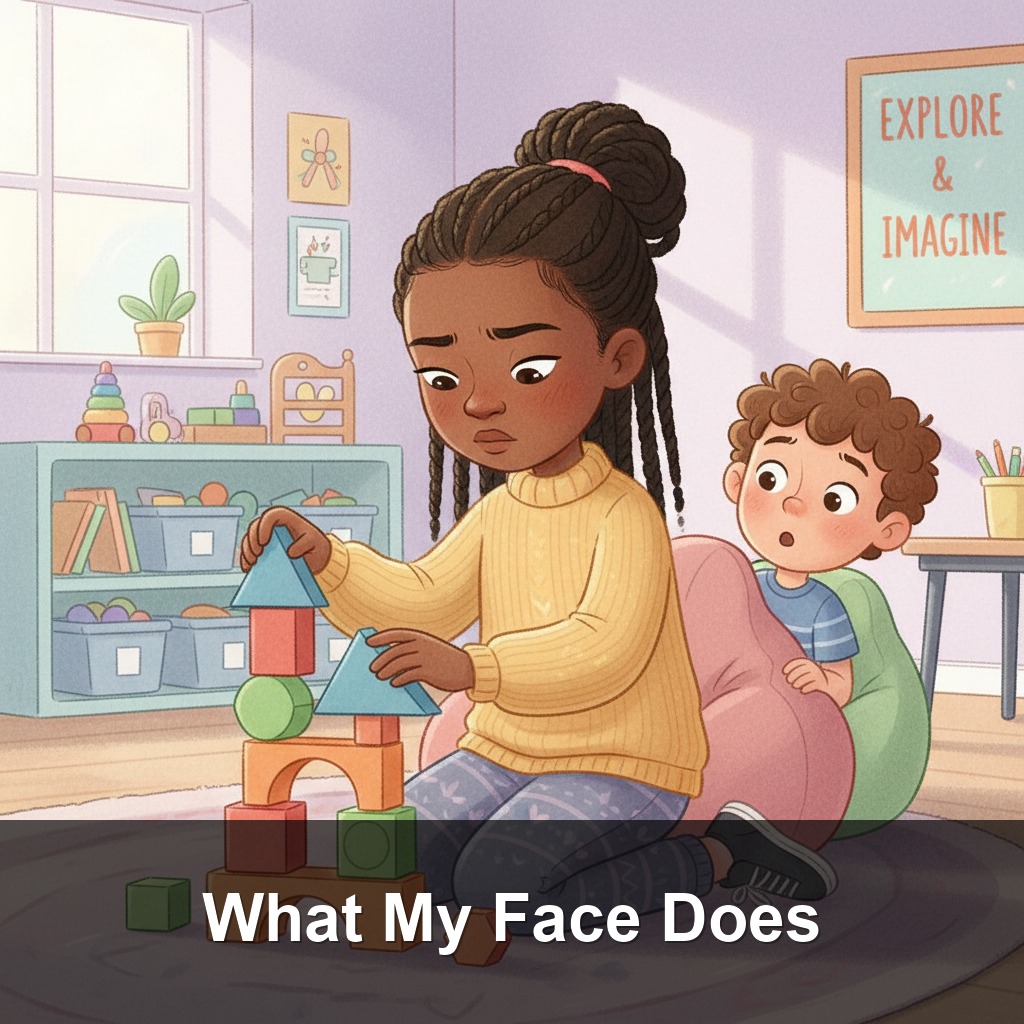
Sam was sitting on the rug in Ms. Chen's classroom, building a tower of pattern blocks. The blue ones made a smooth clack sound when they touched. The yellow ones made a sharper click. Sam liked the way they fit together — edges matching edges, corners finding corners.
"Sam?" said Priya, who was sitting nearby. "Are you sad?"
Sam looked up. "No. I'm building a tower."
"Oh," said Priya. She looked at Sam's face for a long moment. Then she turned back to her drawing.
Sam thought about this for a while. The tower was at the point where it needed to be very careful — one more block on top, but only if it was centered exactly right. Sam lined up the green triangle and placed it.
There. Perfect.
"You seem upset," said Marcus, walking past with his backpack. "Did something happen?"
Sam shook their head. "I'm not upset. I'm pleased. The tower is finished."
"Oh," said Marcus. He squinted at Sam's face. "You don't look pleased."
Sam touched their own face. It felt like it always felt. Like a face. How did you look pleased?
At home that afternoon, Sam sat at the kitchen table, sorting seashells by size. The moon snail shell was the biggest. The periwinkle was the smallest. They went in rows, like a staircase.
"You're quiet," said Mama, sitting down across from Sam. "Everything okay?"
"Everything is great," said Sam. "These shells are beautiful. Do you want to see them?"
"I'd love to," said Mama.
Sam held up the moon snail shell.
"Honey," said Mama, "you look sad. Are you sure you're okay?"
"Not sad," said Sam, frowning. "Happy. I'm telling you I'm happy."
Mama looked at Sam's face the way Priya had looked at it. The way Marcus had looked at it. Like it was a book written in a language nobody had taught Sam to read.
"Your face," said Mama, slowly, "doesn't always show how you feel inside."
Sam put down the shell. "My face is my face. It's the same face I've always had."
"I know," said Mama. "And I'm so glad you have it. It's just — when most people feel happy, their face does a certain thing."
"What certain thing?"
Mama pulled her mouth into a wide shape. "A smile. Look — this is what faces do when people are happy."
Sam looked at Mama's face. The shape was interesting. Sam tried to copy it — pulled the mouth the same way.
"Yes!" said Mama. "That's a smile!"
Sam let the smile go. It felt like a lot of work. Like holding your arms out straight for a long time.
"And when people are sad," said Mama, "sometimes faces do this." She pushed the corners of her mouth down.
Sam tried it. It felt strange, like wearing shoes on the wrong feet.
"That's a frown," said Mama.
Sam touched their own cheeks. "Faces do a lot of things."
"They do," said Mama. "But not everyone's face does the same things. And sometimes — like yours — a face just... rests. It doesn't tell the story."
Sam thought about this. "So my face is quiet."
"Yes," said Mama. "Your face is quiet. But that doesn't mean you're not feeling things. You feel big things, Sam. I know you do. You just feel them somewhere deeper than your face."
The next day at school, Sam built a spaceship out of Legos. It had a navigation array, a soil sampler, and purple wings for flying in low gravity. It was the best spaceship Sam had ever built.
"It's done," Sam announced to the classroom.
Ms. Chen came over. "Wow, Sam, that's fantastic. Are you excited about it?"
Sam considered the question. "Yes," Sam said. "I'm excited."
Ms. Chen looked at Sam's face. She didn't say anything — just looked. Then she smiled, a real smile, and said, "I can tell."
Sam blinked. "You can? My face is quiet."
"Maybe your face is quiet," said Ms. Chen, "but you just told me you were excited. And you built the most detailed spaceship I've ever seen. That tells me a lot."
Jordan came over and knelt beside the spaceship. "Whoa, Sam. This is amazing."
"Thank you," said Sam. "The purple wings are for Vopnar-Prime. The gravity is so low there that you need extra lift on the lateral axis."
"Cool," said Jordan. "You know what I like? How you put the little engine light on the side. It's such a small detail. I would never have thought of that."
Sam felt something warm in their chest. That — that was what happy felt like. Not the face shape. The warm feeling.
"Do you want to see how the landing gear folds?" Sam asked.
"Yes," said Jordan. "Show me."
That night, Sam sat on the floor of their room, drawing stars on a piece of black paper with silver glitter pen. Mama came in and sat on the bed.
"Hey, Sam," said Mama. "You look deep in thought."
"Mm-hm," said Sam, not looking up.
"How was school?"
"Good." Sam drew three stars in a row. Then added a fourth, smaller one. "People keep looking at my face."
"Ah," said Mama.
"Marcus thought I was upset. Priya thought I was sad. But I wasn't."
"Did that feel bad?"
Sam stopped drawing. "It felt strange. Like everyone else has a face that talks and mine is a face that's just... a face."
Mama was quiet for a moment. Then she said, "You know what I love about your face, Sam?"
"What?"
"I love that it's yours. And I've learned how to read it — not the way other people read faces, but the way you write on it. Your eyes get brighter when you're interested. You tilt your head when you're thinking. When you've figured something out, you go completely still, like a heron waiting for a fish."
Sam looked up. "I do?"
"You do. You don't have a face that tells everyone everything. You have a face that tells people who pay attention." Mama smiled. "And the people who pay attention are the best people to know."
The next morning, Sam went to school with a plan.
Jordan was coloring at the art table when Sam sat down. "Hey, Sam. You want to see my drawing?"
"First," said Sam, "I have something to show you."
Sam pulled a piece of paper out of their backpack. On it was a kind of chart — with a happy sun on one side and a dark cloud on the other.
"What is it?" asked Jordan.
"My face is quiet," said Sam. "So I'm going to show people how I feel another way. When I feel happy, I'll draw a sun on the board. When I feel frustrated, I'll draw clouds. When I feel worried, I'll draw rain. When I feel good, I'll draw a flower."
Jordan studied the chart. "That's really smart, Sam."
"And if I'm feeling so mixed up that I can't even choose?" Sam pointed to the bottom of the chart. There was a scribble of tangled lines. "That means I need a minute."
Jordan nodded slowly. "I think I get it. Can I use your chart too? Sometimes my face does things I don't mean it to."
Sam thought about it. "Yes. But you have to draw. You can't just talk about it. Talking about it is not the same."
"Deal," said Jordan.
They shook hands — a firm, official shake.
And when Sam felt happy that afternoon — standing in the hallway with Jordan, explaining the difference between cirrus clouds and stratus clouds — Sam went to the board and drew a tiny sun.
Then Sam drew another sun, just because.
It felt better than smiling ever had.
Author's Note for Parents and Readers: This book is about facial expression differences — some people naturally show feelings on their faces more than others, and that's okay. Autistic children sometimes have faces that don't broadcast their emotions the way neurotypical children's faces do, which can lead to misunderstandings. This story shows that there are many ways to communicate feelings, and that a quiet face doesn't mean a quiet heart. It also highlights the importance of people who take the time to learn your unique way of communicating — those are the people who truly see you.