The Number Kingdom
The Algebra Archway
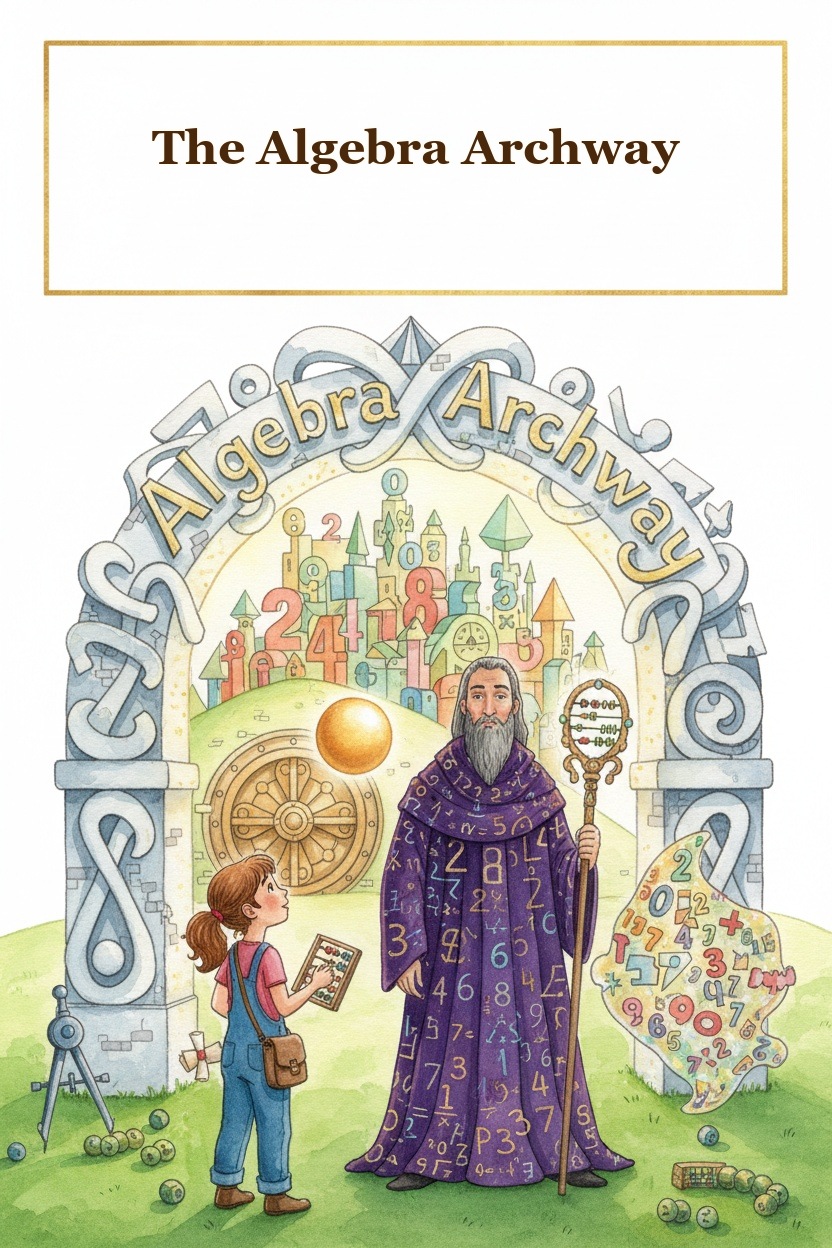
The Ancient Door
"Right. Let's see what's broken," Mira said, sliding down from the carriage that had carried her and the Count to the edge of the kingdom.
Before her stood the Algebra Archway—the oldest structure in the entire Number Kingdom. It was older than the palace, older than the counting districts, older than anyone could remember. Massive stones curved overhead, covered in carvings so old that moss grew in the letters. But the archway's most important feature was the lintel: the great stone beam across the top, where numbers and symbols were carved deep into the rock.
And there was the problem.
The lintel's carvings were glowing. Not with an even, steady glow, but with a strange, flickering light that pulsed like a heartbeat. And the symbols themselves were different from how Mira remembered them.
Normally, the lintel read: Two plus three equals five. It was a statement of truth, a promise that the archway would hold.
Now it read: Two plus something equals five.
The "something" was a shape Mira had never seen before—a small, hollow square, like a window waiting to be filled.
"The archway will not open," the Count said gravely, "until the unknown value is correctly determined. I have consulted every record in the palace. I have studied the ancient texts. There is, I regret to say, no precedent for this."
"No precedent," Mira repeated, walking closer to the archway. She pulled out her notebook and pencil. "So the archway is asking us a question. It's telling us that two plus something makes five, and we have to figure out what that something is."
"Precisely. And without knowing the correct answer—"
"The archway won't open. Got it." Mira studied the glowing symbols. "Okay, so if two plus this shape equals five, then this shape has to be whatever you add to two to get five. Three."
The moment she said it, the hollow square flashed bright and filled itself in with the number 3. The archway's stones groaned, and Mira felt the ground tremble beneath her feet.
But the archway did not open.
Instead, the glowing symbols shifted, rearranging themselves like leaves blown by wind. When they settled, a new equation had appeared:
Something minus four equals three.
The Riddle in the Stone
Mira frowned. "Okay, that's different. Now we have a shape for the unknown, and it's saying that something minus four gives us three."
She sat down on a stone bench near the archway and opened her notebook. The Count watched with formal patience, his robes shifting as the numerals on them rearranged themselves into patterns that reflected his worry.
"So I need to find a number where, if I take away four, I'm left with three," Mira said, writing carefully. "Let's think about this. If I had seven, and took away four..."
She wrote: 7 − 4 = 3
"That works! Seven take away four is three. So the answer is seven."
The hollow square glowed, filled with a 7, and the archway trembled again. But once more, the symbols rearranged.
Three plus three equals something.
"Well, that's easy," Mira said. "Three plus three is six." She started to say it out loud, but stopped. "Wait. That's not an unknown, is it? That's just an answer. The unknown is on the other side."
The Count stepped forward. "That is correct, Mira. The unknown value can appear anywhere in the equation—the beginning, the middle, or the end. The challenge is always the same: find the value that makes the statement true."
Mira thought about this. "So even though the shape is in a different place, I'm still doing the same thing. I'm finding the number that makes the equation balance."
"Balance?" The Count's eyebrows rose.
"Yeah. Like a scale." Mira drew a picture in her notebook—a simple balance with a line down the middle. "The equation says one side equals the other side. So whatever I do, I have to keep them equal. That's what equals means."
She looked at the archway. "Three plus three equals something. Three plus three is six. So the something is six."
The hollow square glowed and filled with 6. But this time, the archway did something different.
It opened.
The Halfway Point
Beyond the archway, a long corridor stretched into darkness, lined with more glowing carvings. But the archway itself had not fully opened—it had only opened a few feet, leaving a gap just wide enough to walk through, yet clearly not the final state of things.
"Interesting," said a voice. A familiar, gleeful voice.
The Remainder materialized on top of the archway, draping itself over the stone like a puddle of half-finished thoughts. It looked even more incomplete than usual—one arm was missing, its edges frayed into fractions that didn't quite add up.
"The archway is half-open," the Remainder said, sounding delighted. "The door is neither open nor closed. How delicious! How beautifully unfinished! It's almost like a question that doesn't know whether it wants an answer!"
Mira put her hands on her hips. "You did this."
"I did nothing! Well, I did a little something. I added parentheses. No—" The Remainder giggled. "I added unknowns. That's far more interesting. Imagine a door that asks you a question before it opens. Imagine a kingdom where you can't go forward until you figure out what you don't know. Isn't that WONDERFUL?"
"It's an archway," Mira said. "It's supposed to open. That's what archways do."
"Is it?" The Remainder tilted its head. "Or is it supposed to make you think about opening? I mean, look at it. It could open all at once, but where's the fun in that? Where's the mystery? Where's the—"
"The algebra," Mira finished.
The Remainder blinked. "I suppose you could call it that."
"I do call it that." Mira walked through the half-open entrance and into the corridor beyond. The walls were covered in glowing equations—more unknowns, more hollow shapes, more questions waiting to be answered.
"Algebra is just finding what's missing," she said, more to herself than to the Remainder. "When I don't know something, I can use a symbol to stand for it. Then I can write down what I do know, and use it to find what I don't."
"Simplification!" the Remainder scoffed. "You're making it sound easy. But what if there are multiple unknowns? What if the equation is a trick? What if—"
"Then I'll take it one step at a time." Mira reached the first equation in the corridor. It read:
Four plus something equals nine.
"Four plus something equals nine," she said. "So something is five."
The symbol glowed and filled with 5. The corridor hummed, and a faint light appeared at its far end.
The Remainder floated alongside her, its half-formed face twisted in thought. "But you don't know what the unknowns MEAN. A five could be anything—a distance, a time, a quantity of treasure. You're just filling in numbers."
Mira stopped and considered this. The Remainder was right, in a way. She had been solving the equations, but she hadn't thought about what the answers represented.
"Okay," she said slowly. "But does it matter right now? The archway doesn't care what the five means. It just cares that the equation works. Algebra is about finding the value that makes everything balance, even if you don't know what the value is for."
The Remainder seemed unsatisfied. "But—"
"What if you're walking into a dark room and you don't know how many steps it takes to reach the other side?" Mira said. "You can still write it as 'something.' Then you can take a step, and another step, and count them as you go. The 'something' becomes a known number when you figure it out. The symbol is just a placeholder—a way of keeping track of what you're trying to find."
The Remainder stared at her. Then, slowly, it began to smile.
"That's actually rather good," it said. "A symbol for what you don't know. Carrying the question with you while you search for the answer. I like that. I like that very much."
It vanished with a small pop, leaving a single fraction behind that faded into nothing.
The Balancing Act
The corridor continued, and with each equation Mira solved, the light at the far end grew brighter. The equations became a little more challenging, but always the same shape: find the value that made both sides equal.
Something plus six equals ten. (Four.)
Nine minus something equals two. (Seven.)
Something times three equals twelve. (Four—Mira had to pause on this one, because it was multiplication instead of addition or subtraction. But then she remembered: three times four is twelve. It was still the same idea.)
At the end of the corridor, a final equation glowed on the wall beside a heavy door:
Something plus nothing equals five.
Mira laughed. "That's Zero's favorite kind of equation," she said. "Adding nothing doesn't change anything. If something plus nothing equals five, then something is five—because adding zero leaves it exactly the same."
The symbol filled with 5, and the door swung open.
Beyond it, the last stretch of the corridor opened onto the far side of the archway. Mira could see the rest of the kingdom beyond—the familiar landscape of the Algebra Borderlands, with its strange terrain of shapes and symbols.
But more importantly, she could see the archway itself transform. The lintel glowed brightly as all its equations resolved, and the great stone door swung fully open, no longer half-anything.
The whole archway hummed with order.
"Remarkable," the Count said, stepping through behind her. "You solved every equation, and the archway is fully restored."
Mira looked at her notebook, where her process panels showed her thinking: the possible answers crossed out, the strategies tried and adjusted, the final solutions circled. "I didn't do anything special," she said. "The archway told me what it needed. I just had to find the missing pieces."
A small silver figure appeared beside her—Zero, as quiet as ever, standing in the shadow of the great archway.
"People always think algebra is hard," Zero said softly, "because it uses symbols they haven't seen before. But all you did was answer questions you already knew how to answer. The symbol didn't make the problem harder. It just gave you a way to write down what you were looking for."
Mira smiled down at Zero. "You didn't interfere at all this time. You just let me figure it out."
"I gave you nothing," Zero agreed. "And sometimes, that's exactly what you need."
"Plus," Mira added, "the equations with 'nothing' in them were the easiest of all. When you add zero, nothing changes. The answer is just whatever was already there."
"Yes," Zero said, and Mira could have sworn it was smiling behind its perfect circular symmetry. "Yes. That tends to work."
The Open Archway
The Remainder reappeared on top of the archway, sitting cross-legged in its half-finished way. For a long moment, it just looked at the solved equations glowing contentedly in the stone.
"You know," it said thoughtfully, "I used to think that algebra was cheating."
"Cheating?" Mira said.
"Telling the world what you don't know and making it fill in the answer. It seemed too easy. Like you were getting help from the problem itself." The Remainder shrugged, its edges dissolving slightly. "But now I see it differently. Writing a symbol for an unknown isn't hiding from the question. It's being honest about what you don't know yet. And there's something... interesting about that."
Mira considered this. "It's not about knowing all the answers," she said. "It's about being able to work with the ones you don't know yet. You can still do mathematics even when there are missing pieces. You just use a symbol to hold the place, and you work around it until you can figure it out."
"Like a placeholder," the Remainder said.
"Like a promise," Mira said. "A promise that there is an answer, and that you can find it."
The Remainder was quiet for a long moment. Then it nodded slowly.
"Alright," it said. "I think I like your archway better open anyway. It's harder to make mischief in a doorway that's already open—there's no mystery in what's on the other side."
"Oh, there's always mystery," Mira said. "The archway is just the beginning of the Algebra Borderlands. There are whole regions out there with unknowns we haven't even met yet."
The Remainder's eyes widened with delight. "Really? More unknowns? More symbols? More—"
"More algebra, yes." Mira smiled. "And I'll find them all."
"Then the adventure continues," the Remainder said, and dissolved into a shower of half-formed digits that rained down and vanished before touching the ground.
The Count placed a formal hand on Mira's shoulder. "The archway is restored. The kingdom's ancient passage is open once more. You have done this kingdom a great service, Mira Vasquez."
Mira looked at the open archway—its glowing lintel, its satisfied stones, its solved equations shining in the afternoon light. Then she looked at her notebook, with its crossed-out wrong approaches, its adjusted strategies, its circled and confirmed answers.
"Algebra isn't a subject," she said. "It's a way of thinking. When you don't know something, you don't just give up. You give it a name. You write it down. You work with it until you understand it."
She closed her notebook and tucked it into her satchel, next to the golden compass that pointed toward mathematical problems.
"Right," she said. "Let's see what's next."
And she walked through the open archway, into the Algebra Borderlands, ready for whatever unknowns awaited her.