Professor Plunks Impossible Lab
The Flight That Wasnt
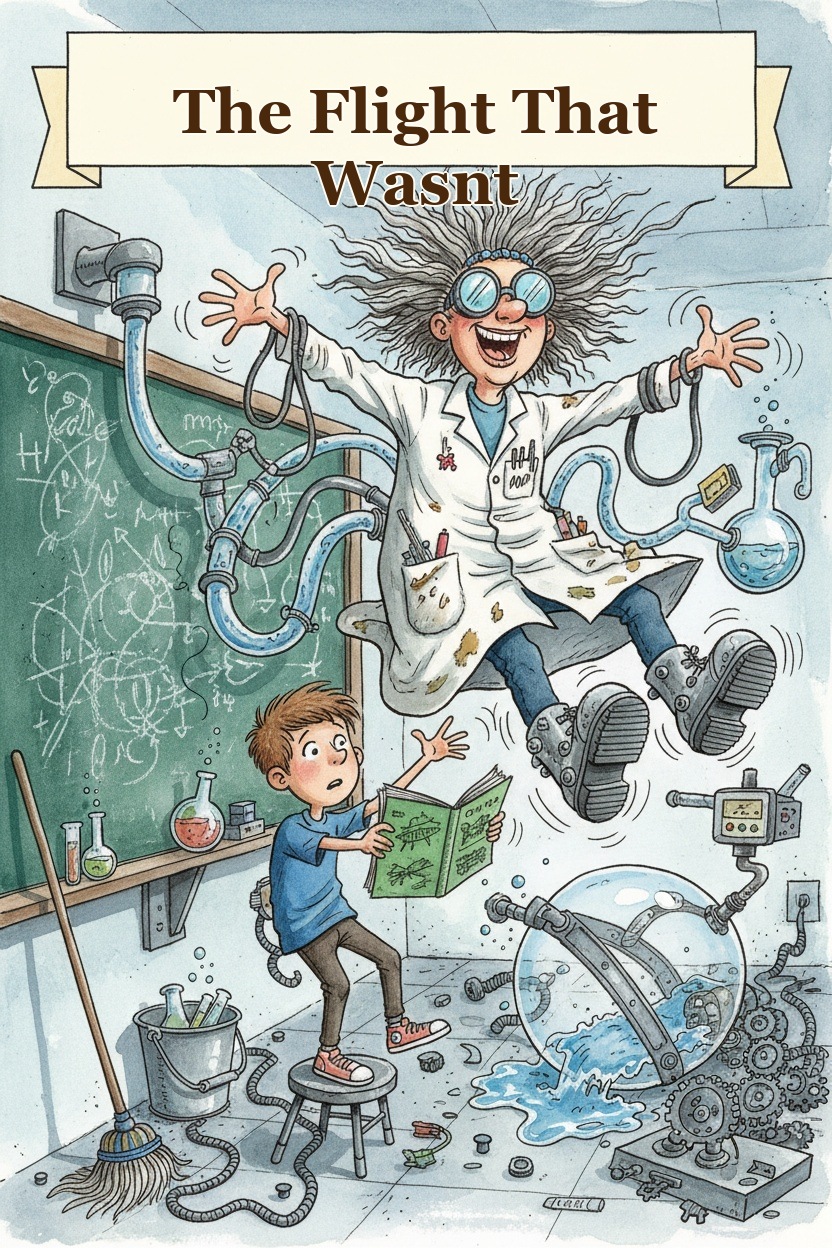
Section 1: The Announcement
Professor Plunk burst through the lab door with a paper aeroplane balanced on her nose.
"Otto! My careful colleague! Today is the day we conquer the skies!"
Otto looked up from his lab notebook. He had been drawing a careful diagram of the ceiling fan, which had been making a suspicious clicking sound for three days.
"Conquer the skies?" Otto asked. "From inside the lab?"
"Exactly!" Plunk set the paper aeroplane on the workbench. It was not a very good paper aeroplane. Its wings were lopsided, and it had a coffee stain on one side. "I have built a magnificent model aircraft to demonstrate the four forces of flight!"
Otto studied the paper aeroplane. "Is this the magnificent model aircraft?"
"Don't be silly. This is a snack." Plunk pulled a tarp off the corner of the lab with a flourish.
Underneath was a machine. It had wings — lots of wings. It had a propeller — actually, three propellers, at different angles. It had a tail fin shaped like a spoon. And it had a sign on the side that read: PLUNK'S PERFECT FLYING MACHINE (MARK ONE) .
"It's beautiful," Otto said carefully. "What does it do?"
"It flies! Obviously." Plunk adjusted her goggles, which were on her forehead as always. "Flight, Otto, requires four forces to work together. Can you name them?"
Otto flipped to a fresh page in his notebook. "Lift pushes up. Weight pulls down. Thrust pushes forward. Drag pushes backward."
"Exactly right!" Plunk beamed. "And my Perfect Flying Machine has all four forces perfectly balanced! The propeller provides thrust. The wings provide lift. The shape provides drag. And the materials provide weight."
Otto looked at the machine again. The propellers were pointing in three different directions. The wings were different sizes. One of them appeared to be attached with what looked like chewing gum.
"Professor," Otto said slowly, "in what sequence will the forces happen?"
"Sequence?" Plunk laughed. "Sequence is for trains, Otto! Flight is about balance! All four forces at once, in perfect harmony!"
Otto wrote in his notebook: Professor says sequence is for trains. I think she may be confused about trains.
Section 2: The Launch
"The Perfect Flying Machine, Mark One!" Plunk announced. "Launch sequence begins!"
She pressed a big red button.
Nothing happened.
"Ah," Plunk said. "The launch sequence is the button-pressing sequence. Now we wait for the propeller to spin up."
The propeller on the front began to rotate. Slowly at first, then faster. It made a wonderful humming sound.
"Thrust!" Plunk cheered. "Forward force! Once we have enough thrust, the wings will create lift, and—"
The first propeller fell off.
It didn't fall to the floor. It flew across the room and stuck in the ceiling. Otto watched it spin there for a moment before it fell into the jam cupboard.
"Interesting!" Plunk said. "The thrust was stronger than the glue. Note that, Otto — force always wins against glue."
Otto wrote: Force wins against glue. This seems like important information.
The second propeller, which had been pointing upward, began to spin. The machine rose off the table. Not very high — just about a centimetre.
"Lift!" Plunk shouted. "Upward force! The wings are generating—"
The machine tipped sideways and crashed into a stack of books.
"No, wait," Plunk said, peering at the wreckage. "The wings weren't generating lift properly. The airflow over the top of the wing was—"
She stopped. The third propeller had started spinning.
It was pointing backward.
The Perfect Flying Machine shot backward across the lab like a startled rocket. It crashed into a filing cabinet, bounced off, spun around twice, and then — very surprisingly — took off.
Section 3: The Interesting Indoor Flight Path
It flew.
Not in a straight line. Not in the way Plunk had planned. But it definitely flew.
The machine zoomed upward, banked left, swooped under the chalkboard, and then performed a loop that Otto had never seen any machine do before.
"It's achieving lift!" Plunk shouted, running after it. "Look at the wings! The curved top surface creates lower pressure above the wing, and the flat bottom creates higher pressure below! That difference in pressure pushes the wing upward!"
Otto was trying to write this down while also watching the machine crash into a bookshelf. "The wings are working, Professor, but they seem to be working in the wrong order!"
"Wrong order, right physics!" Plunk dodged as the machine swooped past her head. "Lift isn't a sequence, Otto — it's a balance! Four forces working together!"
The machine did a barrel roll. It had not been designed to do a barrel roll.
"In balance?" Otto ducked as the machine passed over him. "This doesn't look balanced!"
"Watch!" Plunk pointed. "The propeller provides thrust — forward force. The air pushing against the machine creates drag — backward force. The weight of the machine pulls down. And the wings provide lift — upward force. All four are working!"
The machine hit a shelf of beakers. They shattered spectacularly.
"Four forces!" Plunk was beaming. "Perfectly balanced!"
The machine crashed through Otto's carefully arranged stack of reference books, bounced off the chalkboard, and then — very suddenly — stopped.
It hovered in the middle of the air.
Otto stared. "Professor. It's not falling."
"No, it isn't!" Plunk was delighted. "The wings are generating exactly enough lift to counteract the weight! The thrust is balanced by the drag! It's in perfect equilibrium!"
"What about the third propeller?" Otto asked.
The third propeller was still pointing backward. It was still spinning. The machine was moving forward — but the forward movement was being balanced by something else.
"The drag!" Plunk explained. "The drag from the body is exactly equal to the thrust from the propeller! And the lift from the wings equals the weight of the machine! Every force is balanced!"
Otto looked at the machine hovering serenely. It was, he had to admit, incredible.
"But it's flying," Otto said. "It's flying indoors. It's flying backward."
"Backward?" Plunk looked at the machine. "No, no — the thrust is forward, and the drag is backward, so—"
She stopped.
The machine was hovering perfectly still. Then it began to move. Toward the window. Backward.
"The thrust propeller is backward!" Plunk laughed. "Of course! The third propeller is providing forward thrust, the wings are providing lift, the weight is pulling down, and the drag is pushing back — and they're all balanced! The machine is flying backward because the thrust is pointing the wrong way!"
Otto wrote very carefully in his notebook: The forces are balanced. The machine is flying backward. The machine is also flying indoors. THIS WAS NOT IN THE PLAN.
Section 4: The Landing (And What It Taught Them)
The machine flew backward through the open window.
"Oh no," Otto said.
"Oh yes!" Plunk ran to the window. "It's flying! Look at it go!"
The Perfect Flying Machine flew backward across the street, did a graceful flip, and landed in a hedge belonging to their next-door neighbour, Mrs. Abernathy.
There was a pause.
Then Mrs. Abernathy's voice floated up from outside: "PROFESSOR PLUNK!"
Plunk turned to Otto. "I believe the demonstration is complete."
Otto wrote: The demonstration is complete. Mrs. Abernathy is involved.
Gloriana appeared at the door. She was holding a pair of garden shears and a very large bag.
"Hedge rescue," she said.
Plunk nodded. "The machine is in the hedge."
"Yes," Gloriana said. And left.
Otto looked at Plunk. "So... what did we learn?"
Plunk's face lit up. She always loved this part.
"We learned that flight is about balance, Otto! Four forces working together! The wings generate lift because of their shape — the curved top creates lower pressure above and the flat bottom creates higher pressure below, and that pressure difference pushes the wing upward! The propeller pushes air backward, which creates thrust — the reaction force pushes the machine forward! The weight of the machine pulls down, and the air resistance creates drag, pushing backward!"
She paused, picking a piece of beaker out of her hair.
"But we also learned something else," she said more quietly. "The forces don't have to happen in a particular sequence. They happen simultaneously. All at once. The machine flew backward because the thrust was pointing backward. But it flew! It achieved lift! It balanced all four forces!"
Otto looked at his notebook. He had been drawing diagrams — arrows pointing up, down, forward, and backward. All of them around the machine.
"Four forces," he said slowly. "But they were all working at the same time. The machine flew backward because the thrust was backward. But it also flew forward — because the wing shape still created lift."
"Exactly!" Plunk beamed. "