Professor Plunks Impossible Lab
The Shocking Experiment
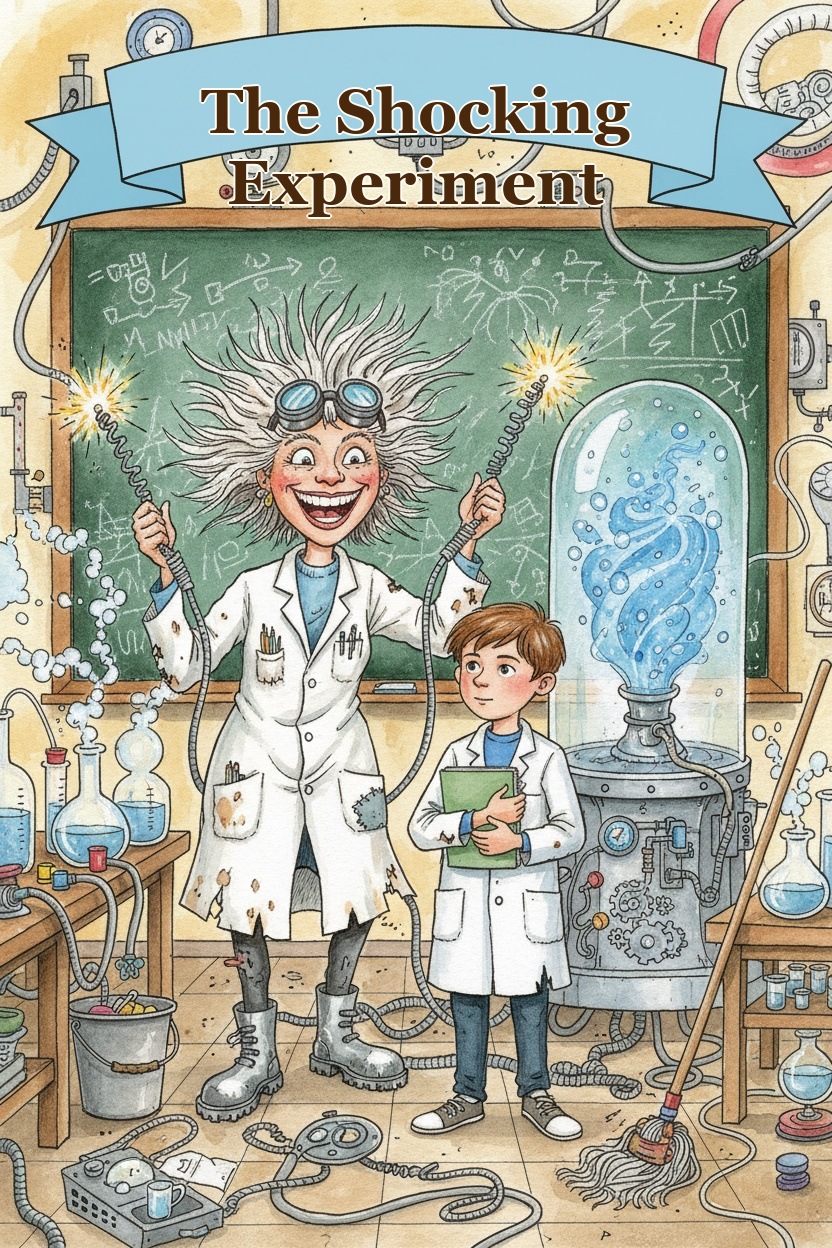
Section 1: A Spark of an Idea
The smell of burnt toast had finally drifted away from the Plunk Institute of Physics and Related Mishaps. Otto Finch, age eight, sat at the workbench with his green notebook open to a fresh page. The mirror maze from Book 10 had been dismantled. The rainbow from Book 12 had faded from the neighbourhood's windows. Today was a new day.
"I call it the HAND-CRANKED ELECTRICITY DEMONSTRATION APPARATUS, MARK ONE!" Professor Plunk announced, setting a heavy metal box on the table with a thunk that rattled Otto's teacup.
Otto looked at the box. It had a crank on the side, two wires sprouting from the top, and a small light bulb attached to the end of one wire. It looked innocent enough. This made Otto suspicious.
"Professor Plunk," he said carefully, "is this... safe?"
"Safe?" Plunk adjusted her goggles from her forehead to her eyes and back again. "My careful colleague, safety is just another word for 'not yet demonstrated to be dangerous'!"
Otto wrote in his notebook:
Today Professor Plunk says we will demonstrate electricity. I have cleared the area within three metres. I have also checked the location of the fire extinguisher, the first aid kit, and the door. This seems like a sensible number of precautions.
"Now then!" Plunk rubbed her hands together. "Electricity, Otto, is the flow of electrons through a conductor. When I turn this crank, I am converting mechanical energy—my arm muscles—into electrical energy. The generator inside uses magnets and coils of wire to push electrons along the wire. That's called current electricity!"
Otto drew a diagram of the crank and wires in his notebook.
"And the light bulb," he said, pointing, "will light up because the electrons flow through the filament and make it hot enough to glow, right?"
"Exactly!" Plunk beamed. "The bulb is a RESISTOR—it resists the flow of current, and that resistance creates heat and light. And the wires are conductors, because they let electrons flow freely. Metals are excellent conductors!"
Otto added to his notebook:
Key facts: Electrons flow through conductors. Generators convert mechanical energy to electrical energy. Resistors like light bulbs convert electrical energy to heat and light.
"We should also discuss insulators," Plunk continued, lifting the generator. "Insulators are materials that don't let electrons flow—rubber, glass, plastic, wood. That's why these wires have rubber coating. It keeps the electrons where we want them!"
Otto looked at the generator again. Something about the crank's handle bothered him.
"Professor," he said, "the crank handle. What's it made of?"
"Metal, of course!" Plunk pulled it proudly. "Strong iron, grips well, gets the job—"
She stopped. Otto stared at her.
"Metal," she repeated slowly.
"Conducting," Otto added.
"Electrons," Plunk finished.
There was a moment of silence. Then Plunk's face split into a wide grin.
"Oh, don't worry, my careful colleague! The electrons will follow the wires. They won't just leap off and go wandering!"
Otto wrote in his notebook:
Professor Plunk says electrons won't go wandering. She has never been more wrong about anything in her life.
OTTO'S LAB NOTEBOOK
Experiment 13: The Shocking Experiment
Goal: Demonstrate that generators convert mechanical energy to electrical energy, and that electricity flows through conductors.
Prediction: The light bulb will light up when I turn the crank.
Probability of things going wrong: 37.2% (I'm being generous.)
Section 2: The Crank Turns
The lab was filled with the click-clack of gears as Otto's hands worked the crank. He had to admit—it felt satisfying. Each turn of the handle made the light bulb glow brighter, and Otto watched the wire with fascination as the connection grew.
"Faster! Faster!" Plunk encouraged, dancing around the demonstration bench. "Feel that mechanical energy converting to electrical energy! The generator's magnets are spinning past coils of copper wire, pushing electrons forward!"
Otto cranked harder. The bulb glowed warmly. Outside the window, the neighbourhood's lights flickered briefly.
"See how the current flows through the wires!" Plunk pointed. "Through the copper—an excellent conductor—and through the bulb's filament until it gets so hot it produces—"
The room went dark.
"—light," Plunk finished quietly.
For a moment, everything was silent. Then Plunk's silhouette by the window pointed outside.
"Look!"
Otto let go of the crank and joined her at the window. Across the street, the street lamps were blinking in a pattern. On—off—off—on—on—off. Then again. Then again.
"That's the interval I was cranking at," Otto said slowly. "I was going slow, then fast, then slow..."
"The electricity is backing up into the building's wiring!" Plunk clapped her hands. "Marvellous! The current is flowing backward through the mains, creating a fluctuating magnetic field that's inducing charge in every conductor connected to the building!"
Otto didn't know what "inducing" meant, but he read it in Plunk's tone as "extremely exciting" or "probably dangerous." He picked up his notebook.
Observation: The lights are blinking in the same pattern as my cranking. This means the electricity is leaving our lab and travelling through the building's wires. I would feel better if it stayed here.
"What's causing it?" Otto asked, turning back to Plunk.
"Ah!" Plunk tapped her nose. "Electricity doesn't like to be trapped. When you cranked, you created a flow of electrons. Those electrons had to go somewhere—so they followed every available conductor, including the building's electrical wiring. And the building's wiring connects to the street wiring, which connects to..."
"The whole neighbourhood," Otto finished.
"The whole neighbourhood!" Plunk confirmed.
NOT IN THE PLAN: The lights are blinking in Morse code across the street.
The plan was: the light bulb lights up.
The reality is: everything with a wire in this building is probably involved.
Section 3: The Thing With the Metal Objects
Otto noticed it first on the workbench. A screwdriver began to roll—not fall, roll—across the steel table. Then a pair of scissors. Then the metal spoon that had been resting in his abandoned teacup.
"Professor Plunk," Otto said, his voice very calm and precise, "the tools are moving."
Plunk whirled around. Her eyes grew wide with delight rather than alarm.
"The electrons are flowing through the metal objects!" She laughed joyously. "The building's wiring has become saturated with charge, and the metal objects in the lab are picking up some of that charge through the workbench! The current is flowing through them—from one object to the next—because the metal is conducting!"
Otto looked at the screwdriver. It rolled to the edge of the workbench and fell off, clattering to the floor.
"Everything made of metal," Otto said slowly, "is now carrying a charge?"
"Precisely!" Plunk spun around, her lab coat flapping. The metal zipper on her pocket gleamed, but Otto noticed—with a very specific kind of horror—that Plunk's boots had magnetic soles that were also highly conductive.
"Professor Plunk," Otto said, "your boots—?"
The door to the lab swung open. Gloriana stood there, her immaculate grey coveralls perfectly pressed despite the chaos, her tool belt containing a roll of electrical tape, a pair of rubber gloves, and something Otto couldn't identify.
"Rubber mat," she said, holding out a large grey mat. "For standing."
Plunk blinked. "But Gloriana, we're demonstrating the flow of electrons! We want the current—"
"Not through you," Gloriana said. She laid the mat flat on the floor. Then she stood on it, pulled on the rubber gloves, and began systematically unplugging the lab equipment with a calm efficiency that at any other moment Otto would have found deeply reassuring.
"Gloriana!" Plunk protested. "You're interrupting the experiment!"
"Finishing it," Gloriana said. She unplugged the last machine. The lights in the building stopped flickering.
OTTO'S LAB NOTEBOOK
Update: The metal objects are now conducting electricity unintentionally.
The screwdriver rolled.
The scissors rolled.
The spoon is now attached to the wall.
THIS WAS NOT IN THE PLAN.
Gloriana has arrived with rubber gloves and a mat.
I am standing on the mat with her.
The mat is for people who don't want to be part of the circuit.
I am very glad I'm on the mat.
Section 4: The Explanation
The lab had gone quiet. The light bulb sat on the workbench, no longer glowing. The metal objects rested in the positions where Gloriana had deliberately placed them—all now safely disconnected from anything that could carry a charge. Otto stood on the rubber mat, notebook in hand, while Plunk sat cross-legged on the floor with her boots in her hands.
"I was testing the generator," Plunk explained, turning the crank slowly, "by connecting it to the building's mains through the demonstration bench."
Otto wrote this down.
"The bench is metal," he said.
"The bench is very metal," Plunk agreed.
"So when you connected the generator to the bench—"
"The electrons had a much bigger conductor to flow through than just our little wire," Plunk finished. "The building's wiring became a giant circuit—our generator as the voltage source, and every metal object in the lab as a conductor on that circuit."
Gloriana stepped silently onto her mat and picked up a walkie-talkie. "Done," she said. Then she left.
"So the whole building was a circuit?" Otto asked, still writing.
"Exactly! And the most important thing about that is—" Plunk stopped. She looked at the rubber mat under the generator. She looked at her boots in her hands. She looked at Otto.
"The rubber," she said. "The insulator. It stops electricity from flowing through things you don't want it to flow through. That's the real lesson here—the wires conduct, the bulb resists, but the insulator is what makes the circuit safe."
Otto looked at the rubber mat under his feet. He looked at the rubber gloves Gloriana had left on the workbench. He looked at the generator, now unplugged and harmless.
"Right," he said. "Electricity only flows where you give it a conductor to flow through. If you want it to stop, you break the circuit or use an insulator to block its path."
"And if you use a really good insulator," Plunk added, "you become someone who is not part of the circuit. Which is much better for you."
Otto wrote:
The rubber mat saved me from becoming part of the circuit.
Section 5: The Wonder
Later, when the building's lights glowed steadily and the neighbours had stopped phoning, Otto and Plunk sat on the roof of the Plunk Institute, looking at the city spread out below them. Every window was lit. Every streetlamp glowed. Every light that wasn't flickering looked peaceful and ordinary.
"That was a lot," Otto said.
"It was a demonstration," Plunk said proudly.
Otto smiled. Then he thought of something. "Professor Plunk, where do the electrons come from? The generator pushes them—but where do they start?"
Plunk's eyes grew thoughtful. "The electrons are already in the metal, Otto. That's why it conducts—because there are electrons freely available to move. When I turn the crank, I'm using mechanical energy to push the magnetic field that nudges those free electrons along. They don't appear from nowhere—they're already there, just waiting for a push."
Otto looked at the metal rung of the roof's railing. He touched it lightly.
"Wait," he said. "So all the metal in the city is full of electrons?"
"Billions and billions of them," Plunk said. "Every wire on every street. Every spoon in every restaurant. Every bike in every shed. All of them ready to carry a current the moment they're given a path and a push."
Otto's eyes widened. He looked at the city—at the lights, at the wires, at the trams humming along their tracks.
"So when I switch on a light," he said slowly, "I'm not summoning anything from somewhere else. I'm just directing what's already there."
"Exactly!" Plunk stood up, her boots now firmly on the roof, not on any conductive surface. "Electricity isn't something you create. You rearrange it. You direct it. You give it a path and a push, and it goes. The whole city—every conductor we can see—is filled with electrons waiting to be told what to do."
Otto took out his notebook and wrote:
Everything with metal in it is holding electrons, waiting for a circuit to travel through.
The whole city is full of electricity.
There might be a simpler way to show that.
But the generator worked.
The lights are steady now.
Gloriana unplugged everything.
The rubber mat really works.
THIS WAS NOT IN THE PLAN— but the plan was: light one bulb.
We lit the whole building.
That's what the electricity did.
It's beautiful.
He closed his notebook and looked up at the sky. Down below, the city hummed with hidden currents—electrons travelling through wires, lighting windows, humming through trams, doing exactly what electrons were supposed to do.
"A whole city of electrons," Otto said.
"A whole city of electricity," Plunk agreed. "We just reminded every metal object in a three-block radius that it's part of the action." She swept her arm in a grand gesture.
Otto smiled. The last blinking light in the neighbourhood went steady.
"Good demonstartion," he said.
"Good demonstration!" Plunk's boots squeaked cheerfully on the roof. "Tomorrow, Otto, we'll learn about circuits—and I've got a design for a parallel circuit that will make lunch ten times more efficient!"
Otto opened his notebook to a blank page.
Need to take more precautions tomorrow, he wrote, then paused, and added at the bottom:
Actually, need to take the rubber mat.