Professor Plunks Impossible Lab
The Bending Beam
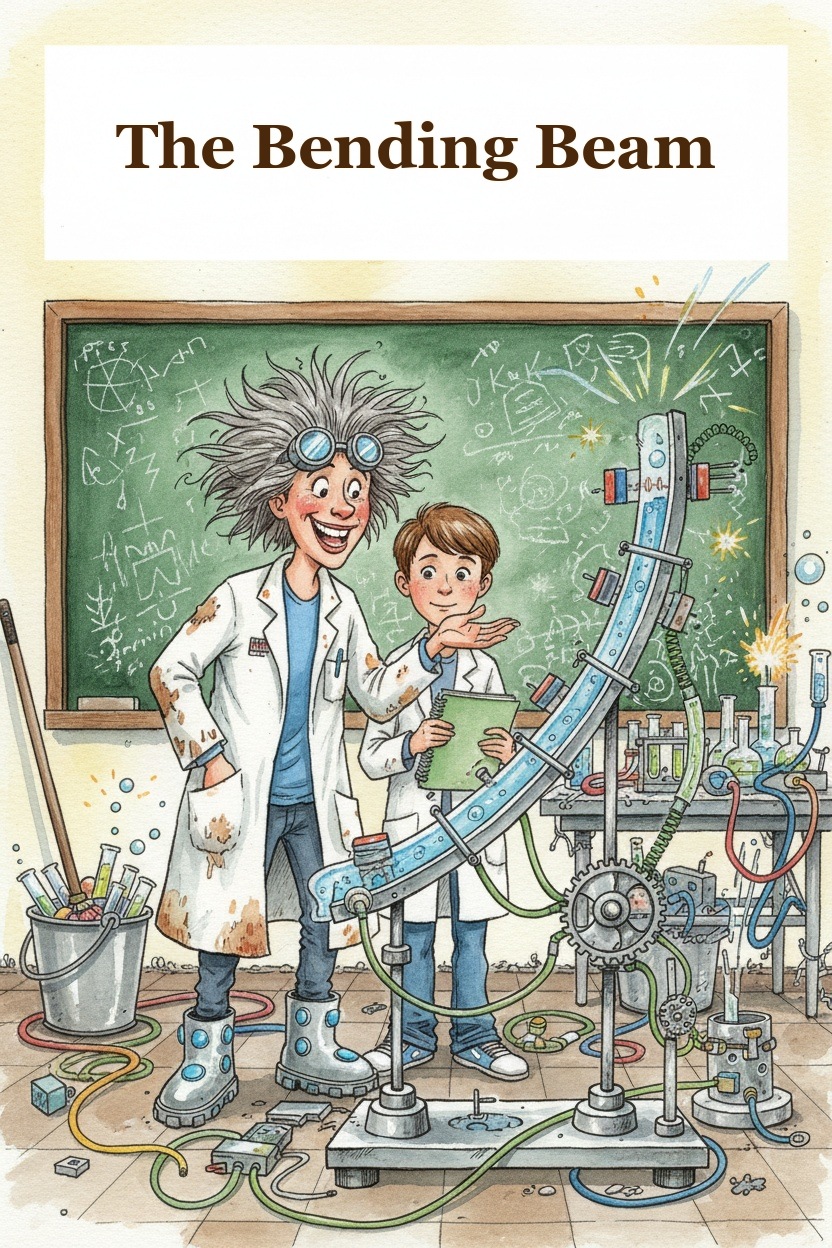
The Announcement
"Otto! My careful colleague! Today we make light disobey!"
Otto looked up from his lab notebook, where he had been drawing a very careful diagram of the lab's window. It was a bright Tuesday morning, and sunlight was streaming through in long golden rectangles.
"Light doesn't disobey, Professor," he said. "Light follows rules. Light is—"
"Predictable?" Professor Plunk's wild grey hair seemed to crackle with excitement. "Dull? Boring? YES! All of those things! And today, we change that forever!"
She threw open the door to the supply closet with a dramatic flourish. Inside, propped against a stack of beakers, was the largest prism Otto had ever seen.
It was enormous—as tall as Otto himself, made of perfectly clear glass, with three rectangular faces and two triangular ends. It glittered in the sunlight like a frozen waterfall.
"I call it the GRAND REFRACTION APPARATUS!" Plunk announced. "Or GRAPPLE for short!"
Otto wrote in his notebook:
Today: Professor Plunk has acquired a very large triangular glass object. She says it will make light "disobey." I have concerns. The prism is bigger than I am.
"Now," Plunk said, dragging the prism toward the window, "you know that light travels in straight lines, yes?"
Otto nodded. "Book 9," he said. "Shadows. Giraffe incident."
"Exactly! But what happens when light passes from one substance to another? From air to glass, for instance?"
Otto thought. "I don't know. Does something happen?"
"OH, SOMETHING HAPPENS!" Plunk's goggles slid down from her forehead and she pushed them back up. "Light slows down when it enters a denser medium. And when light slows down at an angle, it BENDS!"
She positioned the prism directly in the path of the sunbeam. "Watch closely, Otto! The light will enter this glass, slow down, and bend. When it exits the other side, it will bend again!"
Otto watched as the sunlight hit the first face of the prism.
Nothing happened.
Then—yes!—the beam of light that emerged from the other side of the prism was definitely not going in the same direction as the beam that entered. It had bent.
"See!" Plunk crowed. "REFRACTION! The light is bending because it's moving from air—a less dense medium—into glass—a more dense medium—and then back again! And look—the angle of entry determines how much it bends!"
The beam of light, now traveling at a sharp angle, crossed the lab in a perfectly straight line and disappeared through a small doorway.
Plunk squinted. "Where does that lead?"
Otto checked his mental map of the lab. "That's..." He paused. "That's the jam cupboard."
The jam cupboard was a small closet where Gloriana kept the supplies for the lab's mid-morning toast breaks. Raspberry jam. Marmalade. Honey. The good strawberry preserves that Otto's grandmother had sent.
"Hmm," said Plunk. "Well! That demonstrated refraction rather more vividly than I intended. But never mind the jam! Think of the possibilities!"
"I'm thinking about the jam," Otto said. "That cupboard is going to get very warm."
"Pish posh," said Plunk. "Light is an energy beam, but it's not a heating beam. It's merely—"
There was a small pop from the jam cupboard.
Gloriana appeared in the doorway, holding a jar of raspberry jam. The lid had popped off.
"Warm," she said.
The Wrong Experiments
That afternoon, Plunk decided to demonstrate how refraction could be useful.
"Imagine!" she said, adjusting her goggles. "What if we could control where light goes? What if we could redirect sunlight to places that need it? Dark corners! Plant shelves! The filing cabinet where I keep my snack stash!"
She had set up a series of smaller glass blocks on the workbench. Each one was a different shape—triangular, rectangular, curved.
"I will create a path of light that reaches every corner of this lab!" she declared. "Using refraction, I'll bend the beam again and again until—"
"The jam cupboard?" Otto suggested.
"That was ONE time!" Plunk said. "And it was a demonstration of principle! The principle of light bending when it changes medium! The angle of entry determines the amount of bending! We simply need to choose the right angles!"
She arranged the first glass block. "This block will refract the sunlight by..." She did some calculations on the chalkboard. "Approximately fifteen degrees!"
She placed a second block. "This one, twenty degrees!"
A third block. "And this beautiful curved piece will spread the light into a lovely even glow across the—"
The beam of light hit the first block, bent, hit the second block, bent again, and then struck a metal knob on the wall that Otto had never noticed before.
The knob turned.
A panel in the ceiling opened.
A bucket of glitter—leftover from last month's "Sparkle and Science" workshop—tipped over and emptied itself directly onto the workbench.
"Oh dear," said Plunk. "Well. That was... angle-related. The reflective surface redirected—"
"The jam cupboard is much more direct," Otto said. "It's just sitting there. Being warm. Probably making the jam very nice and spreadable, actually."
"NO!" Plunk shook her head firmly. "We are not giving up on refraction! We are going to show that this phenomenon is USEFUL! That we can PREDICT where light will go!"
She moved to the window and adjusted the angle of the GRAND REFRACTION APPARATUS. "The key is the angle of entry! When light hits the glass at a steep angle, it bends a little. When it hits at a shallow angle, it bends a lot! So if we calculate exactly—"
She rotated the prism slightly.
The beam of light moved.
It swept across the lab like a searchlight, past the workbench, past the chalkboard, past Otto's careful stack of notebooks—
—and stopped at a small shelf on the far wall, where Plunk kept her collection of experimental magnets.
"Ha!" Plunk cried. "The light is now illuminating your magnets! See? Useful!"
The beam of light struck a horseshoe magnet and bounced off in a completely unexpected direction, hitting a thermos that Otto had brought for lunch.
The thermos contained soup.
Hot soup.
The soup warmed. The lid of the thermos popped off with a soft thunk. Soup began to dribble down the side of the thermos and onto the workbench.
"Not the soup," Otto moaned.
"Interesting," said Plunk. "The light wasn't refracted by the magnet—that was reflection. But the thermos is metal, and—"
Gloriana appeared beside them. She was holding a rag and a new jar of jam.
"Lunch postponed," she said.
A Very Strange Day
"Right!" Plunk announced. "Clearly, we need to think about this differently! Refraction isn't just about bending light for practical purposes. It's about understanding how light behaves in different materials!"
She marched to the supply cupboard and began pulling out containers. "Water! Oil! Syrup! Gelatin! Each of these is a different medium, with a different density! Light will slow down and bend differently in each one!"
Otto looked at the containers. "You want to demonstrate that light bends more when it moves through denser materials."
"EXACTLY!" Plunk beamed at him. "That's why my brilliant young colleague earns his title! The denser the medium, the more the light slows down, the more it bends! And the angle of entry matters too! A shallow angle means more bending!"
She arranged the containers in a row. Otto noticed, with a sinking feeling, that they were all positioned so that any refracted light would travel in a very particular direction.
Toward the jam cupboard.
"Professor," he said carefully, "maybe we should turn the containers the other way."
"Nonsense! The light will pass through each container and bend at a different angle! We'll be able to compare—"
The beam of light hit the first container—water—and bent slightly.
It passed through the water and entered the oil, bending a little more.
The syrup bent it even more.
The gelatin bent it a lot.
And then the refracted beam, now traveling at a sharp angle across the lab, passed through the doorway of the jam cupboard and struck something inside.
There was a long pause.
A gentle humming sound began to fill the lab.
"What's that?" Otto asked.
Plunk frowned. "I don't know."
The humming grew louder. The light seeping from the jam cupboard began to pulse—on, off, on, off—like a heartbeat.
Gloriana walked past carrying a mop. She paused, looked at the jam cupboard, and said, "Fish tank."
"WHAT?" Plunk and Otto said together.
"Fish tank. Behind the jam," Gloriana said. She walked away.
Otto and Plunk exchanged glances. They walked to the jam cupboard and peered inside.
Behind the jars of jam—behind the marmalade, the honey, and the strawberry preserves—was a fish tank.
It was a small fish tank, probably no bigger than a bread box, with a single goldfish swimming lazy circles inside. There was a small plastic castle, some gravel, and a little filter that burbled happily.
"Where did THIS come from?" Plunk asked.
"I don't know," Otto said. "I've never seen it before."
"Neither have I!"
They stared at the fish tank.
The fish swam to the side of the tank and looked at them.
"Goldie," Otto said. "I think. We have to call it Goldie."
The goldfish swam a figure-eight and then returned to its castle.
But something strange was happening. The beam of light was passing through the fish tank, and as it passed through the water—and then the glass, and then back through the water, and then through the gravel, and then—
"Is it ME?" Plunk whispered. "Or is the light doing something odd?"
"Definitely odd," Otto confirmed.
The light coming through the fish tank was not just bending anymore.
It was splitting.
The Discovery
The beam of light that emerged from the fish tank had separated into colours.
A rainbow. A small, perfect rainbow, spilling out of the jam cupboard and painting itself across the chalkboard.
"Oh," breathed Otto. "Oh, it's beautiful."
Plunk was completely still for once. She stared at the rainbow with wide eyes.
"The water in the fish tank," she said slowly, "is a different medium from air. And the glass of the tank is another medium. Each one slows the light down more—or less—and each boundary bends it. But the different colours in white light... they slow down by different amounts!"
"The light is white," Otto said, remembering. "But it's really all the colours mixed together. And when it bends..."
"The colours bend by different amounts!" Plunk clapped her hands. "Violet bends the most! Red bends the least! That's why we get a rainbow instead of just one beam of light!"
Otto looked at the rainbow on the chalkboard. Then he looked at the jam cupboard. Then he looked at the fish.
"Professor," he said, "I think the fish has been doing experiments behind our backs."
Plunk laughed—a big, delighted laugh. "RAINBOWS! We created ra—"
She stopped.
She looked at the rainbow.
She looked at the jam cupboard.
She looked at the fish.
And then she said, in a voice of pure wonder: "Because light is FINALLY where I wanted it."
"What do you mean?" Otto asked.
"The jam cupboard," Plunk said. "The light beam bent into the jam cupboard—I couldn't figure out why it kept happening. But now I see! It wasn't the prism at all! It was this—this fish tank—the goldfish, the water, the glass—the light was refracted by the water and the glass all along, and the way it bent was DEPENDENT ON THE ANGLE OF ENTRY and the DENSITY of the medium it entered through!"
"Every time?" Otto asked. "Every experiment?"
"Every time! The GRAND REFRACTION APPARATUS was the beginning, but the water and the glass and the angle—they were the REAL demonstration! Light bending through different media!"
Otto looked at the goldfish, swimming contentedly in the small tank.
"And the rainbow?" he asked.
"Beauty," Plunk said simply. "Pure beauty. The physics of beauty."
The Notebook
That evening, Otto wrote in his lab notebook by the light of the small rainbow still painting itself across the chalkboard.
Today, I learned about refraction. Light bends when it moves from one medium to another—air to glass, air to water, water to glass. Denser media slow light down more, so the light bends more. The amount of bending also depends on the angle at which light hits the new medium.
The GRAND REFRACTION APPARATUS was the largest prism I have ever seen. It was very impressive. It bent light directly into the jam cupboard.
There is a fish in the jam cupboard. His name is Goldie. He lives in a tank that refracts light in many different ways. He has been there all along, probably watching us.
We made a rainbow today. Not on purpose, exactly. But we made one. The rainbow was beautiful.
The rainbow was not in the plan.
THIS WAS NOT IN THE PLAN.
But I'm glad it happened.
Gloriana appeared at the doorway with a tray. On it were three slices of toast, a jar of strawberry preserves, and a small piece of fish food.
"Breakfast," she said.
"The sun's going down," Otto said.
"Yes," Gloriana agreed. She set the tray down and paused, looking at the rainbow. "Tomorrow," she said, "new one."
Plunk looked up from her calculations. "A NEW rainbow? In the morning? When the sun comes up and hits the prism again?"
Gloriana nodded.
"Every day," she said.
Plunk's face lit up with delight. "Every day! Sunshine, refraction, the fish tank—every single morning, a rainbow in the lab!"
Otto thought about this. Every morning, the sun would rise and shine through the prism, and the light would bend—through glass, through air, through water—and paint a rainbow across the chalkboard.
A daily physics miracle.
He looked down at his notebook.
Addendum: I now work in a lab with a permanent rainbow. I have decided this is a good thing.
The fish approves.
The Wonder
That night, Otto stood alone in the dark lab while Professor Plunk was downstairs having tea with Gloriana.
The rainbow had faded when the sun went down, but the light from the streetlamps outside was still bending through the prism—and through the fish tank—projecting soft, faint colours onto the far wall.
The goldfish swam in its tank, making small ripples that shifted the light patterns above it.
Otto watched the colours move.
"Light bends," he said to the fish. "When it moves from one medium to another. It slows down and it bends."
The fish considered this.
"And the denser the medium," Otto went on, "the more it bends. And the angle of entry matters too. That's why the rainbow happens—different colours of light bend by different amounts."
The fish continued swimming.
"And the fish tank—the water, the glass—it's been bending light this whole time," Otto said. "Making tiny rainbows we never noticed."
The light shifted, and for a moment, a small rainbow appeared directly above the fish tank, arcing over the goldfish like a halo.
Otto smiled.
"Physics is everywhere," he said.
He wrote one last thing in his notebook, very small, in the corner of the page:
Sometimes the best experiments are the ones that surprise you.
Even the goldfish knows that.