Chef Sparks Kitchen Lab
THE PLATE
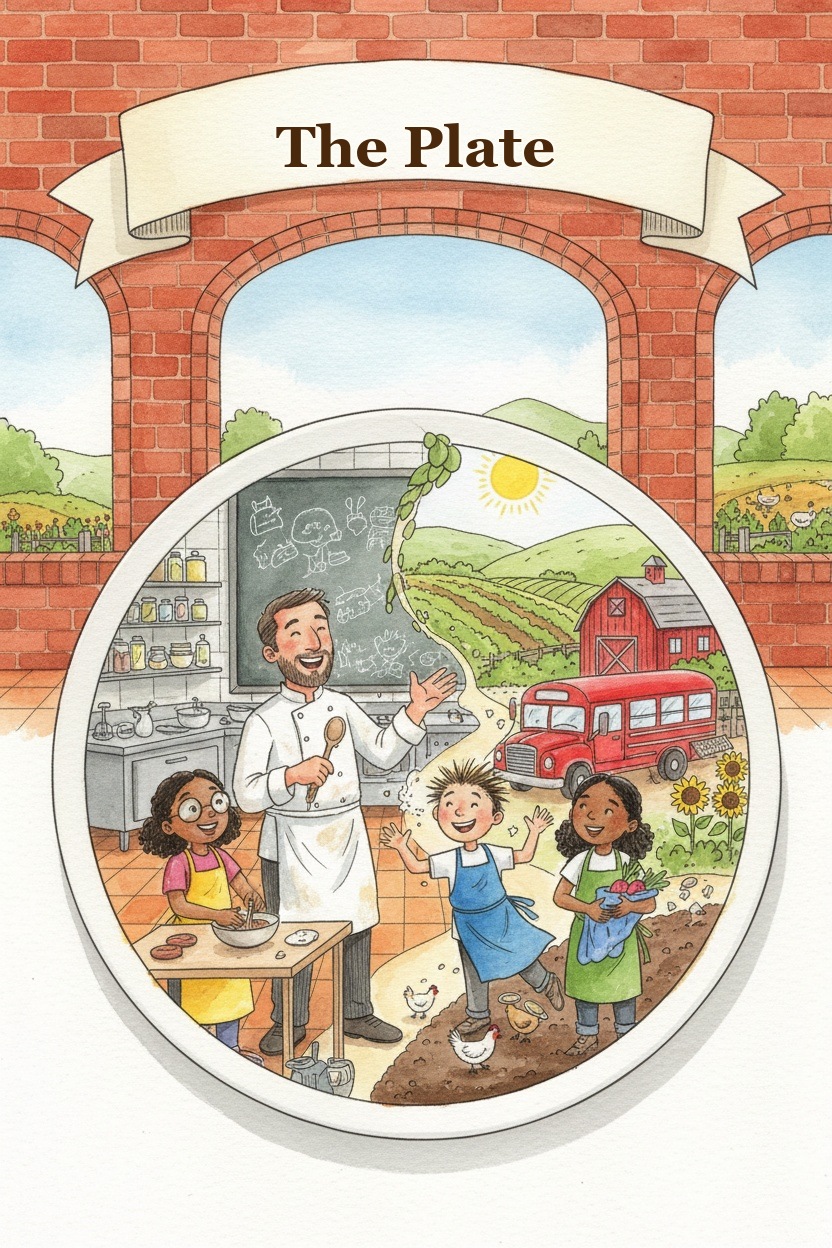
The Chalkboard Problem
The Riverside Fire Station kitchen smelled like Saturday morning: butter melting on the great range, bread toasting in the oven, and something sweet that Tommy claimed was "definitely cinnamon, I'd bet my left shoe on it."
Maya was already at the big prep table, inspecting the vegetable drawer. "Chef Iggy," she said, holding up a bag, "these sesame seeds need to stay away from my station. I'll make my plate from the other side of the kitchen."
"Noted, labeled, and respected," Iggy said, moving the seeds to the far counter. "Today, Maya, you're my safety officer. You check everything before anyone eats."
Tommy bounced in, sniffing the air. "What are we making? Is it the cinnamon thing? Please let it be the cinnamon thing."
"We are making plates," Iggy said.
Tommy stopped bouncing. "Plates? Like... from the cupboard?"
"Not the plates themselves," Iggy laughed. "What goes on them. But first—" He turned to the chalkboard, where a large drawing had been waiting all morning. "What is this?"
The class gathered around. The chalkboard showed a big triangle, divided into horizontal bands. At the bottom was a thick band labeled "BREAD, RICE, PASTA." Above it, a thinner band said "FRUIT AND VEGETABLES." Above that, an even thinner band: "MILK, CHEESE, MEAT, FISH." And at the very top, a tiny triangle labeled "FATS AND SWEETS."
"That's the food pyramid," Priya said. "My Ammamma has one stuck to her fridge. It's older than my dad."
"Exactly," Iggy said. "The food pyramid was created in 1992. That makes it older than all of you. And while it wasn't wrong exactly, nutrition scientists have learned a lot since then." He picked up an eraser. "For one thing, it puts all the foods at the bottom, as if they're the foundation. But your plate doesn't look like a pyramid, does it?"
He erased the pyramid completely. The chalk dust puffed into the air like a small snow cloud.
"When you sit down to eat," Iggy said, "you don't eat in layers. You eat from a plate. And a plate is a much better map of what your body needs."
Priya raised her hand. "My Ammamma also says the pyramid was too focused on one kind of food. She says Indian food doesn't fit on it very well."
"Your Ammamma is a very smart woman," Iggy said. "Which brings me to our problem."
He drew a large circle on the chalkboard. Then he divided it into four sections.
"Look at this. This is the balanced plate model. It's how nutrition scientists think about food now. Two quarters of your plate should be fruits and vegetables." He filled in one quarter with little circles. "One quarter should be protein—meat, fish, eggs, beans, tofu." He filled in the next section with small squares. "One quarter should be whole grains—rice, bread, pasta, quinoa." He filled that in with wavy lines. "And alongside, a small side of dairy or another calcium source." He drew a small circle next to the plate.
"Now," Iggy said, spinning around with his characteristic sweep of the arm, "what do you notice?"
The class studied the drawing. Dev counted the sections. Lucia traced the shapes with her finger.
"It's simple," Sam said.
"It's not divided by food," Maya said slowly. "It's divided by how much of your plate—"
"Exactly!" Iggy's arm swept again, and the chalk tray clattered as the eraser hit the floor. Nobody moved. The Spark Effect continued.
"So," Tommy said, "when do we eat?"
"Right now," Iggy said. "But first, I want to show you something." He turned back to the chalkboard and drew another circle. "This is called ichiju sansai. It's a traditional Japanese way of composing a meal."
He divided the circle differently—not into quarters, but into sections: a large one for rice, a smaller one for soup, and two small ones for side dishes.
"See how the proportions are similar? The rice is the grain. The soup has vegetables and sometimes tofu. The side dishes are fish and vegetables. When Keiko—the chef who'll visit us later this year—when Keiko eats dinner, her plate looks different from this plate"—he pointed to the balanced plate—"but it actually gives her body the same things."
He drew another circle. "And this is a thali." He divided it into little bowls. "From India. Priya, can you tell us what goes on a thali?"
Priya stepped forward. "Ammamma has one. A big metal plate with little bowls." She pointed to each section. "There's dal—that's lentils, so protein. Rice or roti—that's grain. Vegetables—often two kinds. And sometimes a small sweet or chutney."
Iggy was nodding so hard his hair bounced. "And what does that give you?"
"Protein," Priya said. "Grain. Vegetables." She paused. "And something small that's just for taste."
"Which is also important!" Iggy said. "Food should taste good. Nutritional science forgets that sometimes. A meal that no one wants to eat isn't nourishing anyone."
He drew a third circle, divided into large sections. "And this is a traditional West African plate. You'll see it when Auntie Grace visits us later this year. Starchy root vegetables or rice, a sauce full of vegetables and fish or meat, and greens."
He stood back and looked at all his drawings. "Food pyramids make it look like there's one way to eat. But we have a whole world of ways. A balanced plate from Japan looks different from a balanced plate from India, which looks different from a balanced plate from Ghana. But they all do the same job."
Lucia raised her hand. "So there's no such thing as 'the right plate'?"
"There's no single right plate," Iggy said. "There are right patterns. Ways of eating that give your body what it needs, using the foods your culture knows and loves." He tapped the chalkboard. "The pattern is what matters. The foods can change."
Building Your Own Plate
"In a minute," Iggy said, "you're each going to build your own balanced plate from everything you can find in this kitchen. I've set up food stations over the whole kitchen. One for grains, one for proteins, one for vegetables, one for fruits, and one for small sides that give you calcium and other extras."
The kitchen had been transformed. On the big range, pots steamed and simmered. On the prep tables, bowls were arranged in a colorful map.
"Grain station," Iggy pointed, "has brown rice, quinoa, and soft flatbread. Protein station has grilled chicken, crispy tofu, and boiled eggs. Vegetable station has roasted carrots, sautéed greens, and fresh cucumber. Fruit station has orange slices and berries. And the small-side station has yogurt and cheese."
Tommy's eyes were wide. "We just... pick what we want?"
"You follow the pattern," Iggy said. "Half your plate vegetables and fruit. One quarter grain. One quarter protein. And a small side of dairy or calcium." He grinned. "What you choose from each station is up to you."
The class scattered. Tommy went straight for the grain station, then the protein station, then the vegetable station, then back to the grain station.
"Tommy," Iggy called, "I can see what you're doing. That's not half a plate of vegetables."
"But the rice is so good!"
"The rice will still be there tomorrow. The pattern is the pattern."
Tommy sighed dramatically and added extra roasted carrots.
Maya moved carefully. She checked the tofu label. She checked the chicken label. She examined the yogurt container and then set it down.
"Iggy," she said quietly, "is there a calcium side that isn't dairy?"
Iggy's face lit up. "I'm so glad you asked." He opened the refrigerator and pulled out a small bowl. "Calcium-fortified coconut yogurt. No sesame, no nuts, no dairy. I got it just in case."
Maya took it carefully, reading the label twice. Then she smiled.
"Thank you," she said. "That's my small side."
Priya moved slowly around the stations, composing her plate like a painting. She took a small scoop of rice, a piece of flatbread, some tofu, and roasted carrots.
"That looks like a small version of Ammamma's thali," Iggy said.
"It is," Priya said. "She would be happy I'm doing this." She paused. "Actually, can I bring her here? Next time we do something like this, I mean."
"I would be honored," Iggy said.
When everyone had built their plates, they gathered at the long table. Tommy's plate was, as predicted, the largest. His quarter of protein was nearly everyone else's full portion. His vegetables were piled high.
"That's a lot of food," Sam observed.
"I'm growing," Tommy said, and began eating.
For a while, everyone was quiet. The morning light came through the big engine-bay windows, making the food glow.
The Taste of Understanding
"This is delicious," Tommy said, his mouth full. "What did you put in the carrots? Why are they so good?"
"Roasted at high heat," Iggy said. "Remember Book 15? The Maillard reaction. The browning makes them taste sweeter and more complex."
"Oh right," Tommy said, and took a bite of tofu. "And the tofu is crispy on the outside and soft on the inside. That's also Maillard, right?"
"That's also Maillard," Iggy confirmed.
"So," Tommy said, chewing thoughtfully, "I'm eating... chemistry?"
"You're always eating chemistry," Iggy said. "Now you know which kind."
Priya was eating slowly. She looked at her plate, then at Iggy's chalkboard drawings, then back at her plate.
"It's like a translation," she said finally.
"A what?"
"A translation. Ammamma's thali—I never knew why it was put together the way it was. I just knew it was good, and that when I ate it, I felt good, and that she's been making it the same way for sixty years." She gestured at her plate. "Now I know what it's doing. It's the same pattern. The same knowledge, just... in a different language."
Iggy was quiet for a moment. The Spark Effect had happened already this morning, but something about this moment felt delicate, like he didn't want to break it with movement.
"That's exactly right," he said. "That's exactly what it is."
Maya looked up from her plate. "I used to think eating was scary," she said. "Because I have to check everything. And I can't eat so many things. And sometimes I felt like my plate was the wrong plate because it looked different from other people's."
"And?" Iggy prompted gently.
"And now I see that my plate is the same pattern as everyone else's. Just different foods." She looked at her coconut yogurt. "The pattern is what matters. The foods change."
"Tommy," Iggy said, "what's your plate look like?"
Tommy looked down at his plate, which was now nearly empty. "Big?" he offered.
"Bigger than the pattern," Iggy said, "but the same pattern. Your body is growing, and it asked for more fuel, and your plate delivered the same balance in a bigger size. That's one of the beautiful things about the plate model—it scales. A tiny plate for a toddler, a medium plate for Maya, a mountain for Tommy. Same pattern, different amounts, exactly right for each body."
"Is my body exactly right?" Tommy asked.
"Your body," Iggy said, "is growing, strong, and incredibly efficient at turning food into energy and building material. And it knows what it needs. Today, it needed a mountain."
Tommy beamed.
The Plate That Teaches
When everyone had finished, Iggy gathered the students around the chalkboard. He looked at his three drawings—the balanced plate, the ichiju sansai, the thali, and the West African plate.
"A food pyramid tells you what to eat," he said. "A plate tells you how to think about eating. The pyramid was a rule. The plate is a question: What's on my plate? Is it a pattern that will help my body?"
He picked up a piece of chalk.
"When you eat, you're not just feeding yourself. You're carrying forward a pattern that every human culture has figured out, in its own way. The Japanese figured it out with rice and soup and small sides. The Indians figured it out with dal and roti and vegetables. The West African cooks figured it out with roots and sauce and greens. Your families figured it out in their own kitchens."
He turned to the class, and here he didn't sweep his arm. He just stood there, chalk dusty on his fingers, looking at them.
"We live in a world with a lot of rules about food," he said. "Eat this, don't eat that, this is good, this is bad. But the plate is not a rule. It's a map. And maps you can fill in yourself."
He drew one more plate on the chalkboard, in the center of all the others. This one had no food in it at all. Just the divided sections, waiting.
"Your plate," he said. "The one you'll fill in every day. With your family's foods. Your culture's foods. The foods that are available to you, that you can afford, that you enjoy, that your body tolerates and loves. That plate—the one you make for yourself—that's the plate that matters."
Lucia stepped forward. "Can I draw what we ate today?" she asked. "On the plate?"
Iggy handed her the chalk.
Lucia filled in the sections: colorful vegetables, grain, protein, a small side. She drew Tommy's plate as a bigger version, with extra everything. She drew Maya's with coconut yogurt. She drew Priya's looking like a small thali.
"Beautiful," Iggy said. "A plate that teaches."
When the class started to clean up, Iggy realized the chalk tray was empty. The eraser he'd knocked off earlier was still on the floor. He picked it up, set it back on the tray, and said nothing.
But the students saw. They always saw.
"One eraser this morning," Tommy whispered to the others. "The chalk tray. That's the Spark Effect for today."
"One," Maya confirmed, washing her plate. "But it was a good one."
The After-Taste
After the class ended, Priya lingered. She stood in front of the chalkboard, looking at all the plates Iggy had drawn—and the one Lucia had filled in.
"Chef Iggy?" she said.
"Yes, Priya?"
"When I bring Ammamma to class," she said, "could I make her thali? The real one? With her recipe?"
"You could," Iggy said. "But she has to tell us the recipes herself. I want to learn them from the source."
Priya smiled. "She'll like that. She likes explaining things to people who listen properly."
"And Priya?"
"Yes?"
"The fact that you want to share your grandmother's thali with us—that's what this whole class is about. Understanding food isn't just about science. It's about learning what the people who made you know, and carrying it forward. You're already doing it."
Priya looked at the chalkboard. "She always says the thali isn't a recipe. It's a way of thinking."
"Your grandmother," Iggy said, "is exactly right."
RECIPE CARD: IGGY'S BUILD-YOUR-OWN BALANCED PLATE
Serves: 1 (make your own version! Main recipe serves 4)
Ingredients
The Grain Quarter (choose one):
- 1 cup cooked brown rice, quinoa, or soft flatbread
The Protein Quarter (choose one):
-
1 small grilled chicken breast, sliced
-
OR 4 oz crispy pan-fried tofu cubes
-
OR 2 boiled eggs, halved
The Vegetable Half (choose at least two):
-
Roasted carrots: 1 cup carrots, 1 tsp olive oil, pinch of salt, roasted at 200°C/400°F for 25 minutes
-
Sautéed greens: 2 cups spinach or kale, 1 tsp olive oil, 1 clove garlic (minced), sautéed 3–4 minutes until wilted
-
Fresh cucumber slices: ½ cucumber, sliced, no cooking needed!
The Fruit (optional but fun):
- ½ cup orange slices or berries
The Small Side (choose one):
-
2 tbsp plain yogurt
-
Small slice of cheese
-
2 tbsp calcium-fortified plant-based yogurt (dairy-free option)
Directions
-
Build your grain quarter: Place your cooked grain on one quarter of your plate.
-
Build your protein quarter: Add your protein choice to the opposite quarter.
-
Fill the rest with vegetables: Use the other half of your plate for at least two different vegetables. The more colors, the better!
-
Add fruit if you like: Small amounts of fruit can round out the plate.
-
Finish with your small side: Put your yogurt or cheese at the edge of the plate or in a small bowl alongside.
Chef Iggy's Note: "The pattern is the recipe. The foods are up to you. Your plate should look like your life—full of foods you love, from a tradition that's yours. That's the whole secret."
KITCHEN LAB NOTES
Dear Students,
Today we learned that a balanced plate isn't one particular plate—it's a pattern. A way of thinking about food that works across cultures, across kitchens, across generations. When you sit down to eat tonight, look at your plate. What pattern do you see? What foods fill it? What tradition is it from? You don't have to change anything. You just have to notice: this is the pattern your body needs, filled with the foods your life provides.
Here's my question for you to think about until next time: If you had to design a balanced plate from your favorite foods—the foods you'd choose on your very best day—what would it look like? What would fill your quarter and your half? There are no wrong answers. I'm just curious.
See you next class.
—Chef Iggy Spark, who tonight is having a plate of roasted vegetables over rice with a yogurt sauce, which is the same pattern as the Japanese ichiju sansai, the Indian thali, and the West African plate, all at once.