The Capy Series 2
Squeaky’s School
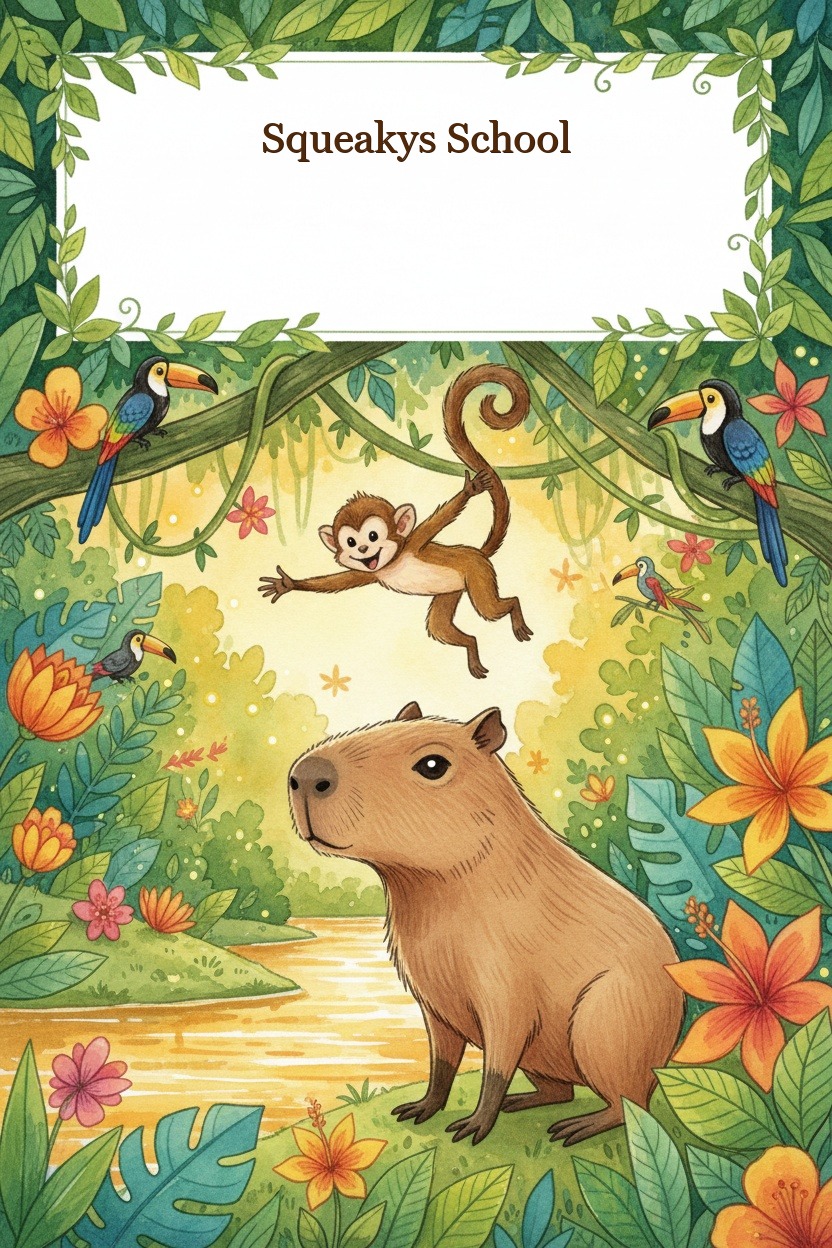
The morning sun dripped like honey through the leaves of the Amazon, turning the Great Waterway into a shimmering ribbon of gold. Caper, the young capybara, stood at the water’s edge, his nose twitching. He took a deep breath.
He felt it.
Not a bad feeling, exactly. Just a still feeling. A quiet, sleepy tug at the edges of the water, like the river was yawning and couldn’t quite wake up.
“Caper! Caper! Caper!” Squeaky, the little squirrel monkey, swung down from a vine and landed on Caper’s back with a thump. “I’ve had the most amazing idea! It’s brilliant! It’s revolutionary! It’s—are you listening?”
“Yes, Squeaky,” Caper said, but his eyes stayed on the water. “I’m just… checking.”
“Checking what?” Squeaky leaned forward, his tiny hands on his hips.
“I don’t know,” Caper admitted. “The water feels… sleepy.”
Squeaky sniffed. “Sleepy is good! Sleepy means rest. Rest means more energy for my next idea!”
A low, grumbling voice came from the reeds. “If your next idea involves building another ‘invention’ out of my shed skin, I’m going to coil you into a pretzel.”
Hisss, the massive green anaconda, slithered out, his head held high, his expression permanently grumpy.
“It doesn’t involve your skin!” Squeaky said. “It’s even better!”
Flora, the quetzal bird, landed gracefully on a low branch, her rainbow tail trailing like a living waterfall. She flicked her head, adjusting her feathers. “Oh, do tell. I could use some entertainment. The view from up there is stunning, but the conversation is dreadfully quiet.”
Squeaky puffed out his chest. “I’m going to start a school!”
There was a pause.
Hisss blinked slowly. “A school.”
“Yes! A school!” Squeaky bounced on Caper’s back. “A school to teach everyone how to spot the early signs of stagnation!”
Caper’s ears perked up. “Stagnation?”
“You know, the Blight!” Squeaky said. “The grey, sleepy stuff we keep finding. It doesn’t just appear out of nowhere. It starts small. A little slowness here. A little fogginess there. If we can teach everyone to spot the signs early, we can stop it before it becomes a big, grey swamp!”
Flora tilted her head. “A school, you say? With… students?”
“Yes!”
“And a teacher?”
“Me!”
Hisss snorted. “You’re going to teach animals? You can’t even sit still for more than two seconds.”
Squeaky gasped. “That’s not true! I sat still for a whole minute yesterday! When I was eating a mango. And thinking.”
“You were chewing,” Hisss said flatly.
Caper, however, was nodding slowly. “Squeaky, that’s actually a wonderful idea. We can’t be everywhere at once. But if everyone knows what to look for, we can help more places.”
“See!” Squeaky said, pointing a tiny finger at Hisss. “Caper gets it!”
Hisss grumbled but said nothing. Flora preened her feathers. “Fine. But if we’re doing this, I must be the head of the Department of Visual Observation. I have the best eyesight in the entire rainforest.”
“And I’ll be the Head of Muscle,” Hisss said with a sigh. “I suppose teaching is exhausting. Someone will need to nap under a tree while appearing to supervise.”
Caper smiled. “I’ll help too. I can feel the water’s memory. I can teach everyone to listen to the river.”
And so, Squeaky’s School was born.
The first day of school, Squeaky assembled everyone under the Great Fig Tree, right by the bend in the river.
There was an otter family, three sloths (who had arrived early because they left yesterday), a family of river turtles, a young jaguar named Juju, and a toucan who kept pecking at his own reflection in the water.
“Welcome! Welcome!” Squeaky announced, swinging from a branch above them. “I am Professor Squeaky, and this is the inaugural class of Squeaky’s School for the Early Detection of Stagnation!”
The animals stared blankly.
A sloth slowly raised a claw. “Stagnation? Is that a type of fruit?”
“No!” Squeaky said. “It’s what happens when the water stops moving. When it gets quiet and grey and makes everyone sleepy and sad.”
The river turtle blinked. “Sleepy? I like sleepy.”
“But this isn’t the good, cozy, nap-in-the-sun sleepy,” Caper said, stepping forward. He waded into the shallow water and closed his eyes. “It’s the heavy, stuck, can’t-feel-anything sleepy. It’s like the water forgets how to be a river.”
The animals grew quiet. Even the toucan stopped pecking.
“That’s why we’re going to learn the five signs!” Squeaky said, holding up five tiny fingers. “Sign number one!”
He pointed to the water. “Colour. Healthy water is clear or a little bit golden or even muddy-brown. But stagnant water turns grey. Like an old, wet sock.”
Flora swooped down. “Allow me to demonstrate. From above, I can see that the water near the bank, just past the lily pads, is turning slightly grey.”
Everyone turned to look. Sure enough, there was a faint, greyish film creeping along the edges.
“Ooh,” said the youngest otter, wide-eyed. “I see it!”
“Good!” Squeaky said. “That’s sign number one! Now, sign number two: the feel. Caper, would you explain?”
Caper waded closer to the grey patch. He dipped a paw in and shivered. “It feels… cold. Not the good, cool water cold. The heavy, sad cold. Like if you hugged someone and they didn’t hug back.”
The sloths exchanged glances. “That sounds terrible,” one whispered.
“It is,” Caper said softly.
“Sign three!” Squeaky said, holding up a third finger. “The sounds. Or, rather, the lack of sounds. Healthy water giggles and gurgles and splashes. But stagnant water is quiet. Too quiet.”
Everyone listened. The river near the grey patch was silent. No chattering fish. No gentle ripples.
“I hear a bird,” said the toucan hopefully.
“That’s me,” said Flora. “I’m practising my aria. That’s not the water.”
“Oh.”
“Sign number four!” Squeaky said, bouncing. “The plants! Stagnant water makes plants droopy and weird. They lose their colour and look tired. And sign number five—the animals! When the fish get sluggish and the frogs stop croaking, something’s wrong.”
Juju the jaguar, who had been lounging, sat up. “So, if I see grey water, feel it being cold, hear it being quiet, see tired plants, and notice sleepy animals, that’s the Blight?”
“Exactly!” Squeaky said, clapping his hands. “You get a gold star!”
“What’s a gold star?” asked one of the sloths.
“It’s a star, but gold,” Squeaky said. “I’ll make one out of a leaf later. Anyway, who wants to practise?”
They practised all afternoon. The animals split into groups.
Flora led the “Sky Scouts,” showing everyone how to look down from high branches to spot grey patches. The toucan, who was rather good at flying, found a tiny grey swirl near a creek mouth.
“Excellent!” Flora declared. “Report!”
“Um,” the toucan said. “It’s grey-ish and swirl-ish?”
“Passable,” Flora said. “We’ll work on vocabulary.”
Hisss led the “River Patrol,” teaching the otters and turtles how to feel the water with their bodies.
“You’re looking for cold,” Hisss said. “Not the good cold. The bad cold.”
“How do I tell the difference?” asked a young turtle.
Hisss thought for a moment. “The good cold wakes you up. The bad cold makes you want to go back to sleep and never wake up again.”
“That’s not very cheerful,” the turtle said.
“I’m not a cheerful snake,” Hisss replied. “Now, practise.”
Caper worked with the sloths, teaching them to listen.
“Close your eyes,” Caper said gently. “Feel the water with your toes, like I showed you. What does it tell you?”
One sloth, after a very long pause, said, “I feel… a picnic. From three days ago. Someone dropped a mango.”
Caper smiled. “That’s not quite the water’s memory, but… good effort.”
By sunset, everyone was tired but happy. The grey patch near the lily pads had not grown. In fact, because the animals had stirred up the water and drawn attention to it, the little bit of Blight had started to break apart.
“Look!” Caper said, pointing. “It’s fading!”
“We did it!” Squeaky cheered, doing a backflip off a branch. “The school works! The water is waking up!”
“Hmph,” Hisss said, but his eyes were soft. “Perhaps these students aren’t completely hopeless.”
Flora fluffed her feathers. “I must say, I was an excellent teacher.”
Even the sloths managed to clap.
But the next morning, something was wrong.
Caper woke up and immediately felt it. Not just a sleepy feeling near the lily pads. The whole river felt sluggish. The memory of the water was thick and grey, like trying to think through a fog.
He hurried to the Great Fig Tree. Squeaky was already there, looking uncharacteristically worried.
“Caper, the stream near the old fallen log—the one where the turtles play—it’s got a big grey patch over it. Bigger than yesterday.”
“Let’s go look,” Caper said.
They rushed to the stream. The grey film was spreading, slowly but surely, over the little pool where the turtle babies learned to swim.
“This is bad,” Squeaky said, pacing. “This is very bad. Did we miss something? Did we not teach the right signs?”
Caper studied the water. He closed his eyes. The memory felt… different. Not cold and heavy. It felt lost. Confused.
“Squeaky,” Caper said slowly. “The Blight here isn’t from the water forgetting. It’s from the water being scared.”
“Scared?” Squeaky repeated. “Water doesn’t get scared.”
“It can echo,” Caper said. “It doesn’t really feel emotions, but it remembers the big ones. Someone was very sad here. Recently.”
Squeaky looked at the grey patch and then at the surrounding forest. “Who would be sad at the turtle playground?”
Just then, they heard a tiny sniffle. It came from behind the fallen log.
Caper and Squeaky crept closer. There, huddled in the roots, was a young monkey. Not a squirrel monkey like Squeaky, but a spider monkey. He was small and grey-ish, and his fur was slightly dull.
“Oh no,” Squeaky whispered. “A student? Did we miss a student?”
“Hey,” Caper said gently, wading a little closer. “Are you okay?”
The spider monkey looked up. His eyes were wet. “Nobody came to my tree. All the other animals went to your silly school, and I wasn’t invited.”
Caper’s heart melted. “Oh. Oh, we didn’t mean to leave you out. Come sit with us. We can teach you everything we learned!”
“But the water is grey here,” the little monkey whimpered, pointing at the stream. “I was crying over here all morning, and I think I made the water sad. Just like the animals we were learning about. The sad, sleepy ones.”
Squeaky blinked. Then he gasped. “The fifth sign! We taught everyone to look for sleepy animals, but not sad or lonely ones!”
Caper nodded. “The Blight doesn’t just come from nowhere. It comes from hurt. From being forgotten. And when you cry into the water, the water remembers.”
The little spider monkey sniffled. “So, I made the Blight?”
“No,” Caper said firmly. “You felt sad. That’s okay. But the Blight is what happens when sadness gets stuck and never moves. We need to help it move again.”
Squeaky, for once, was quiet. He walked slowly to the little monkey and sat beside him. “Hey. I’m sorry we forgot to invite you. That wasn’t fair. You’re part of this forest, too.”
The monkey wiped his eyes. “Really?”
“Really,” Squeaky said. “And you know what? You just gave us a new lesson. One we didn’t have before.”
“What is it?” the monkey asked.
“That stagnation doesn’t only happen to water,” Caper said gently. “It happens to hearts, too. When a heart stops moving, it gets grey too. And the best way to fix that is to make sure no one feels left out.”
At that moment, Hisss and Flora arrived, followed by the whole class of animals.
“We felt the water getting sadder from my perch,” Flora said. “What did we miss?”
“We missed a friend,” Caper said. He turned to the spider monkey. “What’s your name?”
“Milo,” the monkey whispered.
“Milo,” Caper said warmly. “Welcome to Squeaky’s School. You’re our newest student. And actually, you just taught us the most important lesson yet.”
Milo’s eyes went wide. “I did?”
“You did,” Squeaky said. “You taught us that the first sign isn’t grey water. It’s a lonely feeling. If we look out for each other and make sure everyone feels included, we can stop the Blight before it ever starts.”
The grey patch in the stream began to shimmer. Slowly, the water started to clear. The little turtle babies poked their heads out, blinking in the bright sunshine.
“I feel better,” Milo said, smiling.
“Of course you do,” Hisss said gruffly, but he nudged Milo gently with his snout. “Now, come along. I’ll teach you how to swim with your head so you don’t dunk under like a rock.”
And just like that, Squeaky’s School had one new student and a brand-new lesson that wasn’t in any of the plans.
That evening, as the sun turned the river to gold, Caper stood at the edge of the water with Squeaky.
“Do you think our school really works?” Squeaky asked quietly.
Caper looked at the clear, laughing water. He watched the otter babies chasing each other, the turtles sunning on the log, and Milo, the spider monkey, playing tag with the young jaguar.
“The water isn’t just moving today, Squeaky,” Caper said. “It’s dancing. And that’s because we remembered the most important thing of all.”
“What’s that?”
“That a river is a community. It only stays healthy when everyone feels included.”
Squeaky beamed. “I’m going to make that the school motto!”
“You should,” Caper said.
As the stars began to peek through the leaves, the Great Waterway sparkled and flowed, full of life and sound. A group of friends—a little log, a hyperactive monkey, a grumpy snake, a lovely bird and one very brave little spider monkey—had learned the greatest lesson of all.
A river, much like a heart, just needs to be loved to keep flowing.