Professor Plunks Impossible Lab
The Lever of Doom
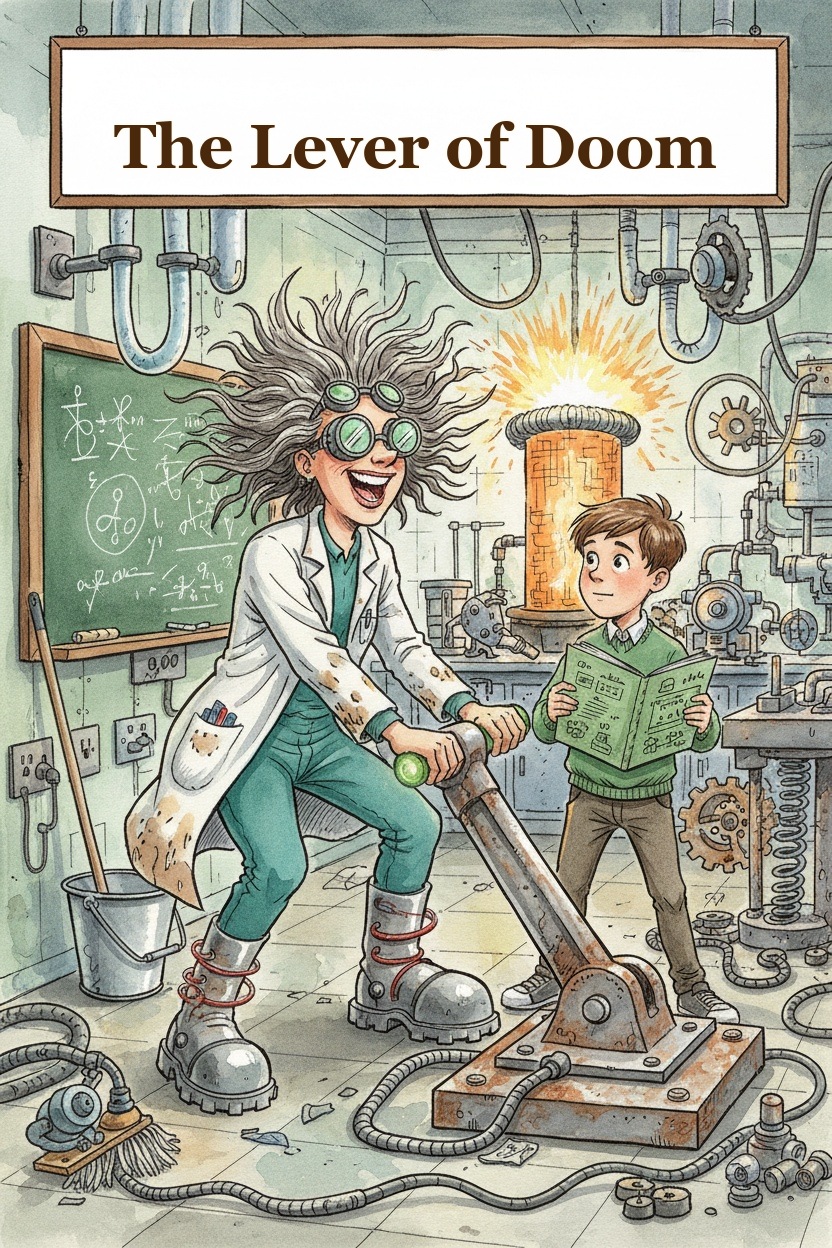
Chapter 1: The Boulder Problem
"Otto! My careful colleague! Today we conquer size itself!"
Professor Plunk burst through the lab door with a wheelbarrow. In the wheelbarrow sat a boulder the size of a small car. It was grey. It was lumpy. It was enormous.
Otto looked up from his notebook. He had been drawing a diagram of the lab's ceiling fan, which had been behaving strangely ever since the Magnet Incident of Book 15.
"Professor," Otto said carefully, "is that a boulder?"
"It is a demonstration boulder, Otto! Fresh from the quarry!" Plunk patted it affectionately. The boulder did not move. "I call this the Gravitational Challenge Specimen, Mark One!"
Otto wrote in his notebook:
Today's experiment: Something involving a very large rock.
Prediction: This will not end well.
"Now," Plunk continued, rolling up her sleeves, "I know what you're thinking. 'Professor Plunk, how can one person possibly lift that enormous boulder?'"
"Actually, I was thinking—"
"WRONG!" Plunk declared cheerfully. "The answer is physics! We shall lift this boulder using nothing but a single finger!"
Otto stared at her finger. It was a perfectly ordinary finger.
"Professor," he said, "that boulder weighs more than our building."
"Exactly!" Plunk beamed. "Which is why we need a lever!"
She pulled a long iron bar from behind the door. It was taller than Otto. It was taller than Plunk. It had clearly been used for something else before, because one end was slightly bent and the other had a mysterious green substance on it.
"And this," Plunk announced, holding up a small wooden block, "is our fulcrum!"
Otto knew what a fulcrum was. He had read about levers. He had even drawn diagrams of them. But he had never seen one used to lift something the size of a small car.
"Professor," Otto said, "are you sure this is safe?"
"Safe?" Plunk looked genuinely confused. "Otto, we are scientists! We don't do safe. We do accurate!"
She set the wooden block on the floor. She slid the iron bar under the boulder. She positioned the fulcrum so that the bar rested across it, with only a tiny bit of bar sticking out on the boulder's side.
"Now watch closely!" Plunk said. "I will press down on this long end of the lever with one finger, and the boulder will rise!"
Otto opened his notebook to a fresh page.
Chapter 2: The Physics of Lifting
Otto's notebook entry, written carefully:
Levers work by using a bar and a fulcrum. The fulcrum is the pivot point. The effort is where I push. The load is the thing being lifted.
Professor Plunk says that the longer the effort arm (the part of the lever from fulcrum to effort), the less force I need. The load arm is the part from fulcrum to load.
She says: "The fulcrum closer to the load = more mechanical advantage. More distance from fulcrum to effort = more force multiplication."
I have written this down. I hope I do not have to use it to rescue anyone.
"Ready?" Plunk called.
Otto looked up. Plunk was standing at the very end of the long iron bar. The boulder sat patiently on the other side of the fulcrum. Between them, the bar stretched like a seesaw — but a seesaw where one end held a mountain.
"Professor," Otto said, "the boulder is much heavier than you. The lever will multiply your force, but—"
"BUT NOTHING!" Plunk shouted happily. "Watch!"
She placed one finger on the end of the bar. She pressed down.
And the boulder rose.
Otto's jaw dropped. The enormous, lumpy, building-sized boulder lifted off the ground as if it were made of paper. It rose six inches. It rose a foot. It hovered in the air, impossibly light, supported by nothing but Plunk's single finger and a long iron bar.
"HA!" Plunk crowed. "Did you see that, Otto?! The force I apply here," she tapped the end of the bar with her other hand, "is multiplied because my effort arm is so much longer than the load arm! The fulcrum is very close to the boulder, which means I get maximum mechanical advantage! Force and distance trade off, you see — I push down a long distance with small force, and the boulder rises a short distance with large force!"
Otto was scribbling furiously:
IT WORKS. THE LEVER WORKS. THE BOULDER IS IN THE AIR.
Professor Plunk is lifting a building with her finger.
THIS WAS NOT IN THE PLAN. THIS WAS NOT SUPPOSED TO WORK.
"Now," Plunk said, "let me demonstrate how to lower it gently—"
Chapter 3: The Other Side
The problem with a lever, Otto would later write, is that it has two ends.
While Plunk had been pressing down on her end, she had been building up something called "force." The lever didn't create energy — it just moved it. The force she applied on her side was transferred through the bar, multiplied by the mechanical advantage, and applied to the boulder on the other side.
Force and distance trade off exactly.
Which means that when Plunk stopped pressing down, the boulder had to come down.
But levers don't just go down on one side.
"Professor!" Otto shouted. "Look out!"
Plunk looked up. She saw, too late, what was happening.
The boulder was descending on its side of the fulcrum — slowly, gently, controlled by the lever. But because the fulcrum was so close to the boulder, the force that had lifted it was enormous. And that force had to go somewhere.
Plunk's end of the bar was already in the air. The boulder's weight was coming down. And the lever was going to apply that same multiplied force to whatever was on the other end.
Which was Plunk.
"OH NO—" Plunk said.
The bar swung upward. Plunk, who had been standing on the end of it, was launched into the air. She flew in a perfect arc across the lab, her lab coat flapping, her goggles spinning, and landed in the extremely convenient pile of cushions that Gloriana had placed in the corner approximately ten minutes earlier.
The boulder settled gently onto the floor.
The bar clanged to the ground.
And Otto, for the first time in his life, had been completely right about what would go wrong.
Chapter 4: The Crash Landing Explained
"WELL!" Plunk shouted, emerging from the cushions with feathers in her hair. "That demonstrated levers rather more vividly than I intended!"
Otto ran over. "Are you okay?"
"I'm FANTASTIC!" Plunk declared. "I flew! I soared! I demonstrated the principle of force transfer with my entire body!"
Gloriana appeared in the doorway. She held a feather duster. She looked at the cushions. She looked at the boulder. She looked at Plunk, who was now removing a cushion feather from her left ear.
"Told you so," Gloriana said.
Otto opened his notebook. "Professor," he said, "can you explain what just happened?"
Plunk dusted herself off and pushed her goggles up. Her eyes were bright with excitement.
"Of course, Otto! You see, a lever doesn't create force. It transfers it. When I pushed down on my end of the bar, I applied a certain amount of force. The lever multiplied that force because my effort arm was so much longer than the load arm. The mechanical advantage was huge!"
She picked up the iron bar and walked over to the boulder.
"But here's the crucial part: force and distance trade off exactly. I pushed my end of the bar down a very long distance — say, three feet. The boulder only rose six inches. That's the trade! I traded distance for power. My small force over a long distance became a large force over a short distance."
She tapped the bar.
"But when the boulder came down, all that force had to go somewhere. The bar was still resting on the fulcrum. The boulder's weight pushed down on one end, and the bar transferred that force to the other end — MY end. The same multiplication that helped me lift the boulder helped the boulder launch me!"
Otto wrote:
Force and distance trade off exactly.
The lever multiplies force by increasing the distance from the fulcrum to the effort.
The closer the fulcrum is to the load, the greater the mechanical advantage.
But the force has to go somewhere.
Conclusion: Do not stand on the short end of a lever.
"Exactly!" Plunk said, reading over his shoulder. "You've got it, Otto! The lever amplifies force in both directions. That's what makes it so powerful! And so dangerous!"
She grinned.
"Now, who wants to try it again with a bigger fulcrum?"
"No," Otto said firmly.
"