Just Like Me
I Know What I Know
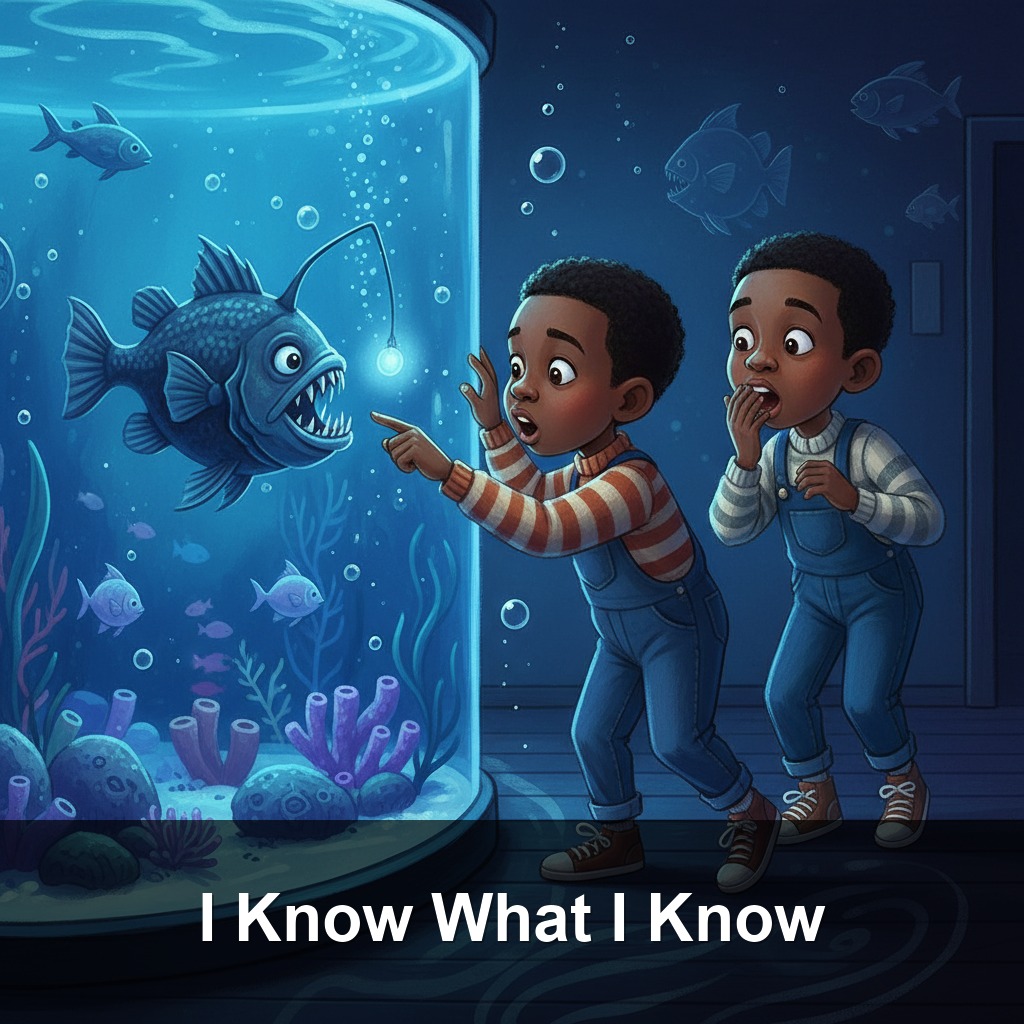
Sam and Jordan were at the aquarium, standing in front of the deep-sea exhibit. The room was dim and blue, like being underwater. Sam loved this room. The glass hummed with the sound of filtered water, and the creatures moved in slow, silent circles.
"Look at that one!" Jordan pointed at a creature with a glowing lure dangling from its head. "That's an anglerfish, right? They live at the bottom of the ocean."
"Actually," Sam said, leaning close to the glass, "they live in the bathypelagic zone. That's between one thousand and four thousand meters deep. The pressure down there is about one hundred times the pressure at the surface. Imagine an elephant standing on your thumb. That's what it feels like."
Jordan's eyes went wide. "Wow. An elephant on your thumb? That's crazy."
"An African elephant weighs about six thousand kilograms. Your thumb is about two square centimeters. So the pressure would be—"
"Sam."
A man standing nearby had turned to look at them. He was tall, with a camera around his neck. He smiled down at Sam.
"That's a good guess, kiddo," he said. "But anglerfish actually live in the shallower part of the ocean. Right near the top. I read it somewhere."
Sam felt the words rise up like bubbles.
"That's not correct," Sam said. "Anglerfish are found at depths below three hundred meters. Some species live at over two thousand meters. The ones with the bioluminescent lures are almost always in the aphotic zone, where sunlight doesn't reach. If they lived near the top, they wouldn't need the light at all."
The man's smile got smaller. "Well, I'm pretty sure I read it in a book."
"That book might have been wrong," Sam said. "Or you might have misremembered it. Misremembering happens about thirty percent of the time with facts learned from—"
"Sam." Jordan tugged at Sam's sleeve. "Maybe we should go see the jellyfish."
On the bus ride home, Sam sat very still.
Jordan sat next to Sam and watched the window go by.
"You were right," Jordan said. "About the anglerfish. I looked at the sign when we left."
"I know I was right," Sam said.
"Then why do you look upset?"
Sam didn't answer for a long time. The bus hummed. The windows rattled.
"Because I was right," Sam said finally, "but he got mad. He smiled smaller. His shoulders went tight. He said 'kiddo' in a voice that meant 'stop talking.' I don't understand."
Jordan nodded slowly. "Yeah. That happens."
"But why?" Sam turned to look at Jordan. "The information was correct. I said it clearly. I even explained why the light proves it. If he said something wrong and I corrected it, everyone has more true information now. That's good."
Jordan chewed on their lip. "I think... sometimes when you correct someone, they feel like you're saying they're dumb."
"But I didn't say he was dumb."
"I know."
"I said the book might have been wrong."
"He heard 'I'm wrong and you're wrong and you're bad at remembering.'"
Sam blinked. "That's not what I said at all."
"I know," Jordan said. "But it's what people hear sometimes."
At home, Sam sat on the couch. Mama came in and sat down.
"Jordan told me about the aquarium," Mama said. "You were right about the fish."
"I know," Sam said.
"And you told the man he was wrong."
Sam nodded.
"That must have been hard," Mama said.
"No," Sam said. "It was easy. It was saying it that was easy. It was after that was hard."
Mama waited. Sam had learned that Mama would wait. That was one of the good things about Mama.
"He got small," Sam said. "When I corrected him. His face got small and tight. And I didn't know what to do. I knew the fact was right. But the way everyone looked after... I felt like I'd done something wrong. But I didn't do anything wrong."
"You didn't," Mama said.
"Then why does it feel bad?"
Mama thought for a moment.
"Do you know the difference between being right and being useful?" she asked.
Sam frowned. "They're the same thing."
"Not always," Mama said. "Being right is when your words match the truth. Being useful is when your words help the person you're talking to. Sometimes they're the same. Sometimes they're not."
Sam thought about the man at the aquarium. "He didn't want to be helped."
"He didn't want to be corrected," Mama said. "Those are different things."
"So I should have just not said anything? Even though he was wrong?"
Mama was quiet for a moment.
"What do you think?" she asked.
Sam thought about it. Really thought about it.
"People share facts for different reasons," Sam said slowly. "Before I corrected him, he was happy. He thought he was sharing something true. And I took that away from him."
Mama nodded.
"But I can't just let wrong information stay in the world. What if he tells someone else? And they tell someone else? And then everyone has wrong information?"
"That's a real worry," Mama said.
"So what do I do?"
Mama reached out and put her hand on Sam's arm.
"Maybe sometimes you ask first," she said. "Before you correct someone, you can ask: 'Do you want to know what I know?' If they say yes, you tell them. If they say no, you hold it inside."
Sam thought about this.
"Like keeping a toy in my pocket until someone wants to play with it?"
Mama smiled. "Exactly like that."
The next day, Sam went to the library. Jordan came along.
At the information desk, a librarian was helping a kid find books about whales. The kid asked about the biggest whale.
"That's the blue whale," the librarian said. "They can grow up to a hundred feet long."
Sam knew that was wrong. The largest blue whale ever recorded was about ninety-eight feet. But that was very close. The librarian was almost right. Almost-right was different from wrong.
Sam looked at Jordan. Jordan looked at Sam.
Sam held the fact in the pocket of their mouth.
The librarian looked up. "Did you need something?"
Sam paused. Then asked: "Do you want to know what I know?"
The librarian tilted their head. "Sure. I always like learning new things."
"One hundred and ten feet," Sam said. "That's the length of the longest blue whale ever measured. It was found near Antarctica in 1909. It weighed about one hundred seventy-three tons. That's heavier than thirty elephants."
The librarian's eyes went wide. "Wow. I didn't know that. Thank you, Sam."
And Sam felt something new: being right, and being welcomed.
The librarian wrote it down on a notecard and taped it to the whale display.
Jordan grinned. "You did it."
"I asked first," Sam said.
"Good practice."
That night, Sam thought about the man at the aquarium. Maybe the man would never learn about anglerfish. Maybe that was okay. Sam had done the thing that was right, and then learned the thing that was useful.
Inside, Sam still knew everything about deep-sea creatures.
And that was still exactly right.
Author's Note for Parents and Readers: This book explores the difference between factual accuracy and social timing. Many autistic children experience a deep sense of responsibility for sharing correct information — and can be genuinely puzzled when corrections are unwelcome. This story models a gentle strategy (asking before sharing) without asking children to suppress who they are. Being right is a gift. Learning when to offer it is a skill. Both can coexist.