Chef Sparks Kitchen Lab
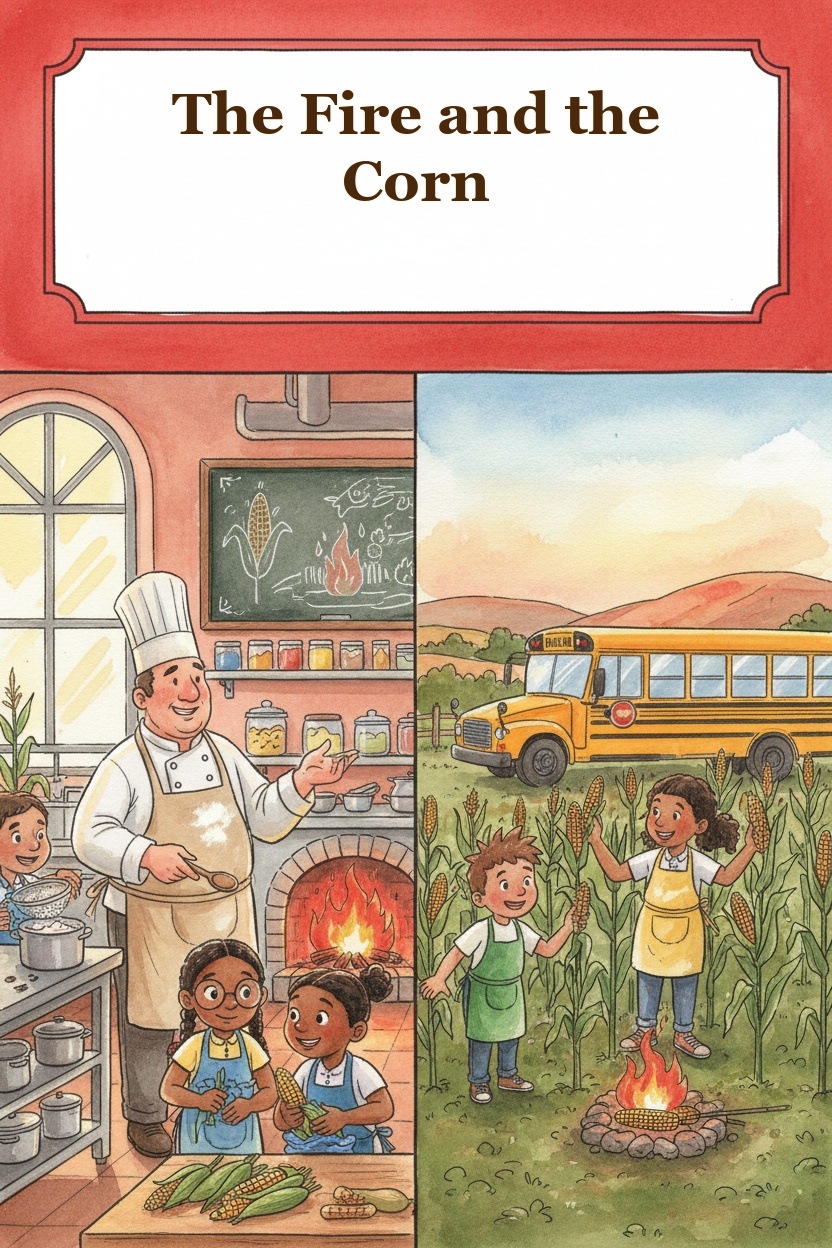
THE FIRE AND THE CORN
Part One: The Visitor
The Riverside Fire Station smelled like Saturday.
That was what Priya always thought when she walked through the big red doors. On Saturdays, the old engine bay smelled like flour and onions and whatever Iggy had been testing the night before. Today it smelled like something else — something warm and toasty and slightly sweet, like the bottom of a popcorn bag.
"What is that smell?" Tommy asked, sniffing the air as he dropped his backpack by the coat rack. "It smells like— like—"
"Like corn," Priya said.
She knew the smell. It was the smell of her mother's kitchen on certain mornings, the ones that started with a plastic bag full of white corn flour and a heavy iron pan.
Maya arrived next, doing her usual circuit of the kitchen: checking the counters, reading the ingredient labels Iggy had laid out, making sure nothing had been opened near her allergens. She paused at the bag of white powder Iggy had placed on the prep table.
"Calcium hydroxide?" Maya read. "That's lime. That's not food."
"It will be," said a voice from the doorway.
Everyone turned. Standing there was a woman Priya recognized immediately — the same dark hair, the same way of tilting her head when she was about to explain something.
"Mama?" Priya said.
Mrs. Subramaniam smiled. She was carrying a basket covered with a cloth, and she set it down on the table next to Iggy's ingredients.
"I invited your mother to teach with me today," Iggy said. He emerged from the pantry wearing his usual apron, which had a new scorch mark on the sleeve that nobody asked about. "We're making tortillas. Real ones. The kind that start with the corn itself, not the flour."
Tommy's hand shot up. "Tortillas! My uncle makes tortillas at his taqueria! He has a machine and everything!"
"He probably does," Priya's mother said. "But today we're going to do it the old way. The way my grandmother's grandmother did it."
She lifted the cloth from her basket, revealing a collection of dried corn kernels — some white, some yellow, some a deep reddish-blue that made Lucia reach for her sketchbook.
"This," Priya's mother said, holding up a handful of yellow kernels, "is what tortillas are made from. Not flour. Corn."
"But I've seen tortilla flour in the store," Dev said. "It's called masa harina. It's already powder."
"Exactly," said Priya's mother. "Masa harina means 'dough flour.' But the flour is made from corn that has already been through a special process. A very old process. And that process is the whole secret."
Iggy was practically vibrating. "THE WHOLE SECRET!" he repeated. "The whole secret of one of the most important food science discoveries in human history! And it happened right here, in the Americas, thousands of years before anyone had ever heard of chemistry!"
He swept his arm toward the chalkboard — and the Spark Effect claimed its victim: a small jar of paprika, which tipped off the corner of the prep table and shattered on the floor.
"Paprika," Dev said, writing something in his notebook. "No one predicted paprika."
Iggy didn't seem to notice. "Class, we are about to make history. Literally. We are about to cook the exact same way people were cooking eight thousand years ago."
Part Two: The Problem and the Solution
Priya's mother set out a bowl of dried corn. "First," she said, "you need to understand the problem."
"The problem?" Tommy looked confused. "Corn is corn. It's delicious. What problem?"
"The problem is that corn, in its natural state, is not as nutritious as it could be," said Priya's mother. "The kernel has a hard outer layer called the pericarp. It's mostly cellulose — like wood, almost. Humans can't digest it well. But that's not the real problem."
She picked up a kernel and held it up to the light. "The real problem is niacin."
"Niacin?" Maya repeated, her label-reading brain kicking in. "That's vitamin B3. It's in the ingredient lists of enriched flour."
"Exactly," said Priya's mother. "And in your body, niacin helps your cells use energy. If you eat only untreated corn and nothing else, you can get a disease called pellagra. It makes you weak, causes skin rashes, and makes you sick in your stomach and your head. And the strangest part is — the corn can look perfectly fine. It's just that your body can't use the nutrients inside it."
"Wait," Dev said. "The corn has the niacin in it, but your body can't use it?"
"Right. The niacin is trapped. It's bound up in the corn in a form your body can't absorb. Like a present that's locked in a box with no key."
Maya frowned. "So how do you unlock it?"
Priya's mother smiled. She reached for the bag of calcium hydroxide — the lime Iggy had set out. "That's where the ancient genius comes in."
Iggy stepped forward, unable to contain himself. "Our friend the lime!" he announced. "Calcium hydroxide! An alkali — a base, the opposite of acid. And do you know where people got this stuff three thousand years ago? From limestone rock. They cooked limestone in fire until it became ash, then mixed it with water."
"The fire and the corn," Priya said softly.
Her mother nodded. "That's what my grandmother called it. The fire makes the lime stone into something powerful. And then the corn meets the fire."
She poured the dried corn kernels into a large pot, covered them with water, and added a spoonful of the white lime powder.
"This is nixtamalization," she said. "The ancient process."
"Nix-tam-al-i-zation," Tommy sounded it out carefully. "That's a big word."
"It's from the Nahuatl language," Priya's mother explained. "The Aztec language. The word nixtli means ashes or lime, and tamalli means cooked corn dough. That's where we get the word tamale, too."
"Hold on," Maya said. "The Aztecs figured out how to use chemistry to unlock the nutrition in corn, thousands of years ago?"
"They didn't know it was chemistry," Iggy said. "They knew it worked. They knew that corn cooked with lime made people strong and healthy, and corn cooked without it made people sick. They had a whole system of food knowledge — recipes passed down for generations — that was as precise as any chemistry formula. They just didn't have the same words for it."
Priya's mother stirred the pot. "And the process does more than just unlock the niacin. It also—" she looked at Iggy.
"You tell them," she said. "You're the scientist."
Iggy beamed. "The lime water does three things. First, it softens the hard outer shell of the corn kernel — the pericarp. It loosens it and dissolves part of it. That means the corn can be ground into a soft, flexible dough — masa."
He picked up a chalk and started drawing on the board. A corn kernel, a pot of bubbling water, a flat round patty.
"Second," he continued, "the alkali changes the chemistry of the corn. It releases the niacin from the bound-up form so your body can absorb it. It also changes the proteins in the corn, which actually increases how much calcium is available."
"The lime adds calcium," Maya said. "That's why it's called calcium hydroxide."
"Correct!" Iggy spun around. "White corn cooked with white lime stone. The corn gets more calcium from the lime — and your body can use the magnesium and iron better, too."
Tommy was staring at the pot. "So... the ancient people figured out that if you cook corn in stone water, you don't get sick, and your bones are stronger, and your body can use the food?"
"That's exactly right," said Priya's mother.
"And they did it for thousands of years?"
"Thousands."
Tommy shook his head in awe. "That's like... that's like finding a treasure map every time you cook dinner."
Iggy's eyes got suspiciously bright. "Tommy, that's beautiful. That's exactly what it is."
Part Three: The Turning and the Patting
The corn cooked for a long time.
While it simmered in the lime water, Priya's mother told them about Mexico — the real Mexico, the huge one with deserts and mountains and coastlines and rainforests. The Mexico where her grandmother was born.
"Food is different everywhere," she said. "In the north, they make flour tortillas — big, thin ones, because wheat grows well there. In the south, where I'm from, corn rules. In Oaxaca, they make tlayudas — enormous tortillas, as wide as your arm span, crisp and toasty. In the Yucatán, they make a sauce called recado rojo, and they use it to make cochinita pibil — pork cooked with oranges and achiote until it's as soft as butter."
"What's the best one?" Tommy asked, completely sincere.
Priya's mother laughed. "That's like asking which star is the best star. There are thousands of Mexican kitchens, and every single one makes tortillas a little differently. Because every family has their own way. Their own pinch of this, their own splash of that."
"My grandmother used to say," Priya added, "that a tortilla remembers the hands that made it."
"That's right," her mother said. "Now come see."
The corn was done. It had swollen and softened, and the lime-colored water had turned thick and cloudy. Priya's mother drained the corn and rinsed it, rubbing the kernels between her hands — the skins sliding off, pale and papery.
"Now this," she said, "this is nixtamal. Cooked corn, transformed. Watch."
She carried the warm, slippery kernels to the grinder — an old stone mill that Iggy had set up on a heavy table. The class gathered around as she fed the corn through, the stone wheels turning, pressing the soft corn into a thick, smooth dough.
"Smell it," she said.
They did. It smelled like corn, but not like the dried kernels they'd started with. It smelled soft and warm and slightly sweet — like a fresh morning, Priya thought.
"Masa," her mother said. "The dough. This is what tortillas are made of."
She picked up a small handful of the dough and rolled it into a ball. Then she patted it — not with a rolling pin, not with a press, but with her hands. Clap-clap-clap. She passed the dough back and forth between her palms, flattening it into a perfect round circle.
"Now you," she said.
Everyone tried.
Tommy's tortilla looked like the shape of a small, sad potato. Dev's was impressively circular until he dropped it on the floor. Maya's was thin in the middle and thick at the edges, but she held it up with pride anyway. Lucia's was, unsurprisingly, the most artistic — a slightly lopsided oval that she said was meant to be a cornfield from above.
Priya's was almost perfect, because she'd done this before.
"You practice at home," her mother said softly, and Priya nodded.
"Don't be upset if yours isn't round," Iggy said, patting his own — which was almost exactly square. "In the old days, people said a tortilla's shape was like the person who made it. We all start out irregular. The heat and the hands shape us."
"That's very philosophical, Iggy," said Maya.
"That's what food science does to you," he said. "It makes you philosophical. Or maybe it just makes you hungry."
The comal — a flat round griddle — was heating on the stove. The first tortilla went on with a soft hiss. It puffed up slightly, then blistered in dark spots. When Priya's mother flipped it, they could smell the toasting corn — the smell that had greeted them at the door.
"One minute per side," she said. "Not too long. You want it cooked through but still soft."
The tortillas piled up in a basket lined with a cloth. By the end, the kitchen smelled like a Mexican market, warm and rich and golden.
Part Four: The First Bite
They sat around the big wooden table — fifteen kids, Priya's mother, and Iggy, who had somehow produced a tray of toppings without anyone noticing: crumbled queso fresco, black beans, roasted salsa, sliced radishes, and big handfuls of cilantro.
"No forks," Priya's mother said. "And no plates. The tortilla is your plate."
She demonstrated: a warm tortilla in her palm, a smear of beans, a sprinkle of cheese, a spoonful of salsa. Fold. Bite.
Tommy had finished two tortillas already and was hummed his two-note approval. "THAT'S how tortillas are supposed to taste!" he said. "Not the ones from the store! These are— I mean— food, but actually FOOD."
"There's something wrong with the ones from the store?" Maya asked.
"Not wrong," Iggy said. "Just different. Commercial tortilla production often cuts corners — uses corn flour that wasn't really lime-treated, or adds preservatives and gums to hold the dough together. When you make it the old way, from nixtamal, you don't need any of that. The lime-treated corn dough holds together naturally. Because the natural chemistry was set up thousands of years ago to work perfectly."
Priya took a bite of her own tortilla. It was chewy and tender, with a faint hint of something — she could taste the lime, tiny and bright, at the back of her mouth. It tasted like her grandmother's kitchen. Like mornings with those plastic bags of masa. Like the smell of the comal heating before anyone else was awake.
"Mama," she said quietly. "Do you think Abuelita would be proud?"
Her mother smiled. "Your great-grandmother never stopped making tortillas by hand. Even when she could buy them. She said the hand-made ones were lovelier because they were slower." She put a hand on Priya's shoulder. "She would be very proud."
At the end of the table, Iggy was drawing a diagram on a napkin. "You see this?" he said, holding it up. "This is the tortilla as food technology. It's wheat bread's completely independent invention — corn was domesticated in Mesoamerica, wheat in the Middle East, and they developed separate but equal solutions to the same problem: making grain digestible and nutritious."
He paused, tilting his head. "Actually, they're not equal. Nixtamalization is genius. Corn without it is a poor food — but corn with it is a foundation for entire civilizations." He shook his head in wonder. "The people who figured this out didn't have laboratories or microscopes. They had observation, and patience, and love of their food."
Priya's mother nodded. "And they gave the whole world — not just Mexico — some of the most important crops on earth. Corn, beans, squash, tomatoes, chocolate, avocados, vanilla, chili peppers. The foods of the Americas changed everything everywhere."
She picked up another tortilla. "But today, we're eating one kind."
She folded it, filled it, and took an identical bite to the one she'd been making for her own grandmother since she was Priya's age.
Sometimes, Priya thought, food science is just memory.
Recipe Box: Iggy's Handmade Tortillas
Ingredients:
-
1 cup dried corn kernels (white, yellow, or blue)
-
1 tablespoon calcium hydroxide (food-grade lime)
-
4 cups water (for cooking)
-
1/2 cup water (for mixing the dough, if needed)
Equipment:
-
Large pot
-
Colander
-
Food scale (optional)
-
Grinder or blender
-
Comal or heavy skillet
Instructions:
-
In a large pot, combine the corn with 4 cups water and the calcium hydroxide. Stir well.
-
Bring to a boil, then reduce to a simmer. Cook for 20-30 minutes, until the corn kernels are soft and their skins are loosening. The water will become cloudy and dark yellow.
-
Drain the corn in a colander and rinse thoroughly with cool water, rubbing the kernels between your hands to remove the softened skins.
-
Grind the nixtamal in a blender or food processor (or use a hand grinder) until it forms a soft, pliable dough. If it's too dry, add a little water. If too sticky, add a pinch of salt.
-
Roll the masa into balls about 1 inch wide. Flatten them in a tortilla press lined with plastic, or pat them into rounds with your hands (clap-clap-clap!).
-
Heat a comal or skillet over medium-high heat. Cook each tortilla for 30-60 seconds per side, until it's puffed, blistered, and cooked through. Keep them warm in a cloth-lined basket.
-
Eat immediately, with whatever you love on top.
Chef's Note: The lime water works chemically to release the corn's niacin and calcium. But it also changes the protein structure — which is why dough made from nixtamal rolls into a ball and holds its shape, while corn flour that hasn't been lime-treated turns crumbly and dry.
Iggy's Kitchen Lab Notes
Dear students,
Today we traveled thousands of years into the past and brought back a technology so perfect it's still the best way to make corn ready for our bodies. Nixtamalization solved a problem that no one was even able to name for centuries — but everyone could see the results in the health of the people who used it. Ancient food knowledge is real science, discovered through the most powerful tool we have: paying attention.
Here's your question for the week: What other foods in your kitchen started as an ancient problem-solving process? (Hint: think about how milk becomes cheese, or how cabbage becomes sauerkraut.) The answers might surprise you.
Until next time — taste everything like it's the first time.
—Iggy Spark