Professor Plunks Impossible Lab
The Lens Event
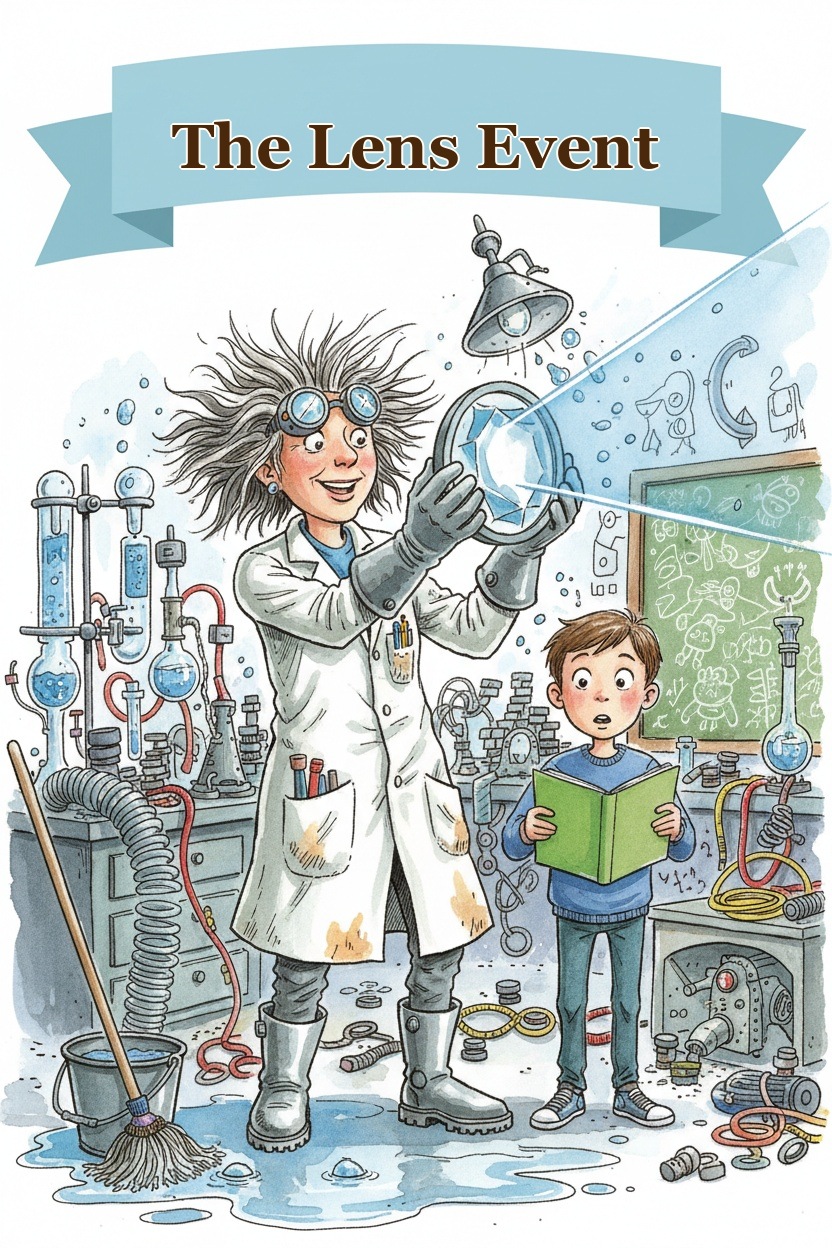
The Announcement
Otto was halfway through his cheese sandwich when Professor Plunk burst through the lab door with a cardboard tube under her arm and a gleam in her eye that Otto had learned to recognize as Trouble.
"My careful colleague!" she announced, setting the tube on the workbench with a dramatic thump. "Prepare yourself for the most illuminating experiment of your scientific career!"
Otto put down his sandwich and reached for his lab notebook. "What is it this time, Professor?"
Plunk unrolled the tube and produced a thick, curved piece of glass with metal frames around the edges. "A lens!" she proclaimed. "Not just any lens, Otto. This is the demonstration lens from the telescope on the roof. I've borrowed it for a very important experiment about how lenses bend light."
Otto wrote carefully in his notebook: Professor Plunk has obtained a telescope lens. She says "borrowed." The roof telescope is visible from her office window.
"Now," Plunk continued, ignoring Otto's raised eyebrow, "this is a convex lens. It's thicker in the middle than at the edges. Watch what happens when sunlight passes through it."
She held the lens up to the window where the afternoon sun streamed in, and tilted it until a small, brilliant spot of light appeared on the workbench.
"See how the lens bends all the light rays together?" Plunk said, adjusting the angle. "They converge. They meet at a single point—the focal point!"
The spot of light got smaller and smaller until it was a tiny pinprick of brilliance, dancing right next to Otto's abandoned sandwich.
Then something remarkable happened.
That tiny point of light grew hot. Then hotter. Then—
Pffft.
A neat, perfect circle of scorch mark appeared on the corner of Otto's cheese sandwich. A tiny wisp of smoke rose from the bread.
Otto stared. "Professor. My lunch."
Plunk stared too—but with delight, not alarm. "Magnificent! Did you see that, Otto? The focused sunlight concentrated all its energy into a single point. The light was so concentrated that it heated your sandwich to its burning point instantly!"
The Demonstration Continues
Otto retrieved his notebook and wrote: Convex lens focuses sunlight to a point. Sandwich now has a geometric hole. Lunch ruined. THIS WAS NOT IN THE PLAN.
"Don't worry about lunch," Plunk said, waving a hand. "We're just getting started! A convex lens converges light, but what about a concave lens?" She pulled another lens from the tube—this one thinner in the middle and thicker at the edges. "A concave lens does the opposite. It diverges light. It spreads the rays apart!"
She held the concave lens in the sunlight, and the beam spread out into a wide, soft pool of light instead of concentrating to a point.
"See? No burning sandwiches with that one," Plunk said. "It's much safer."
Otto wanted to point out that the convex lens had already done enough damage, but Plunk was already moving to the next demonstration.
"Now!" Plunk said, picking up the convex lens again. "Focal length! The distance from the lens to the focal point determines where an image forms. Let me show you with something very interesting."
She scanned the lab, and her eyes landed on Otto's mug of hot chocolate. "There! That'll work perfectly. If I use the lens to project an image of the mug onto that wall—"
She positioned the lens between the mug and the far wall, then adjusted the distance. A fuzzy blob appeared on the white wall.
"One more adjustment," Plunk muttered, moving the lens slightly. The blob sharpened into...
An upside-down mug.
"My mug is upside down!" Otto said.
"The image is inverted!" Plunk corrected happily. "That's what a convex lens does when the object is beyond the focal point. The light rays cross over and form an upside-down image. Every camera lens does this. Even your eyes do this!"
"With respect, I'm trying not to think about my eyes rearranging my hot chocolate," Otto said.
The Lens Goes Mobile
Plunk was already racing toward the next demonstration. "Magnification!" she announced. "The shape of the lens and the distance to the object determine how large the image appears. Watch!"
She grabbed a bowl of fruit from the bench. "If I hold this lens close to the orange, the light rays from the orange are bent more sharply, and—"
She held the lens a few centimeters from the orange. "This is what a magnifying lens does when it's close to an object. The image appears larger and upright!"
The orange looked enormous through the lens, its dimpled skin like a giant landscape.
"Now, if I move the lens further away..." Plunk stepped back, holding the lens at arm's length. "The image will be smaller, but the focal point is now somewhere behind me, and the light that doesn't pass through the lens keeps going in straight lines, and the image of the orange appears on that shelf over there!"
The orange's upside-down ghost appeared crisply on the shelf, next to a box of paperclips.
Otto wrote: The orange has been replicated, inverted, and deposited on the shelf. The original orange is still in the bowl. There are now two oranges, one of which is wrong.
But Plunk was not finished. "Now let me show you what happens when we combine lenses! If I use the convex lens to gather light and then the concave lens to spread it out at exactly the right distance—"
She held both lenses up, one in each hand, trying to balance them in the sunlight. The light went through the convex lens, converged, then hit the concave lens and scattered.
The scattered light hit three things simultaneously: a cup of pencils (which glowed oddly), the chalkboard (which lit up with a bizarre, distorted rainbow), and Otto's notebook (which, thankfully, only reflected a strange shadow).
But the beam that fell on the pencils had concentrated enough heat to make the metal pencil sharpener feel very warm. Very, very warm. And the pencils were rolling toward Otto's feet.
"Interesting!" Plunk said, lowering the lenses. "Did you see how the concave lens changed the direction of the converging rays? That combination created a completely different light path than either lens alone."
"My notebook is fine," Otto said, checking it. "The pencils are alive and hot. The chalkboard is showing a colour pattern that I did not predict. And my sandwich now has TWO holes because the sun has moved and the focal point relocated."
Otto Takes Charge
The sun had shifted. The beam of concentrated light through the convex lens—still sitting where Plunk had left it—had moved across the workbench and was now focused on a roll of paper towels.
Tiny wisps of smoke started rising from the paper.
"Professor Plunk!" Otto shouted. "The lens is still doing the thing!"
Plunk spun around. "So it is! It's continued demonstrating optical physics without us. Excellent—another data point!"
The paper towel roll began to scorch.
"Forget data!" Otto grabbed the convex lens and moved it out of the direct sunlight. "This lens has been making sun-beams all over the lab for the past five minutes! We've demonstrated converging, diverging, focal points, inverted images, and magnification!"
Plunk blinked. "So we have. And what did we learn?"
Otto held up his notebook. "Can I tell you what I learned?"
"Please, my careful colleague. Enlighten me."
Otto read from his notebook: "Convex lenses converge light to a focal point—" He pointed at the scorched sandwich. "And this was on the wrong object."
"Correct!"
"Concave lenses diverge light—" He pointed at the soft pool of harmless light on the floor. "Which is much less dangerous."
"Also correct!"
"Focal length determines where the image forms—" He pointed at the upside-down mug on the wall, the ghost orange on the shelf, and the new scorch mark on the paper towels. "Which means the distance between the lens and the object changes what happens."
"All correct! You're a natural optical scientist!"
Otto took a deep breath. "And magnification depends on the lens shape and the distance from the object. A convex lens can magnify when it's close—" He picked up the lens and looked at his own handwriting through it, the letters enormous and clear. "But it can also burn things and turn things upside down when it's not."
Plunk clapped her hands together. "You've understood it all! The lens is a magnificent tool for controlling light—when you know what you're doing!"
Otto put the lens down and picked up his ruined sandwich. "The problem, Professor, is that you never know what you're doing."
"True!" Plunk said cheerfully. "But you're beginning to!"
The Wonder Moment
Gloriana appeared in the doorway, a metal bucket in one hand. She looked at the scorched sandwich, the upside-down mug, the ghost orange, the warm pencils, and the smoking paper towel roll. She said nothing.
"Gloriana!" Plunk said. "We had a most productive demonstration of optical physics! The lens demonstrated converging, diverging, focal length, and magnification all in a single afternoon!"
Gloriana walked to the workbench, pulled a fresh stack of paper towels from her tool belt, and replaced the scorched roll. She looked at Otto's sandwich. She looked at the lens. She reached into her tool belt and produced a small rectangle of cardboard.
"If you'd put this in front of the lens," Gloriana said, "light still focuses, but you control when and where." She set the cardboard down and walked out.
Otto stared at the cardboard. "A lens cap," he said quietly. "She had a lens cap."
"A wonderful idea!" Plunk said. "And you know something else wonderful about lenses, Otto? When the sun sets, and the light comes in differently, and you look through the telescope lens at the stars—they're so far away that you can't burn anything. You can only see. And what you see is enormous and beautiful and full of light that has been travelling for thousands of years just to reach your eye."
Otto thought about that. Sunlight travelling across space, hitting the lens, concentrating into a perfect point. It had burned his sandwich. But the same physics—the same converging rays, the same focal length, the same magnification—could also show him the rings of Saturn or the craters of the moon.
He wrote in his notebook:
Lenses bend light. Convex brings it together. Concave spreads it apart. Magnification makes small things big and distant things close.
Sometimes this burns lunch.
Sometimes it shows you the stars.
I think both are the same experiment.
Then, because he was Otto, he added at the bottom in large, careful letters: THE LENS IS MINE NOW. I AM PUTTING A CAP ON IT. THIS IS NOW IN THE PLAN.