Inside Out Academy
THE BEGINNING OF THE END
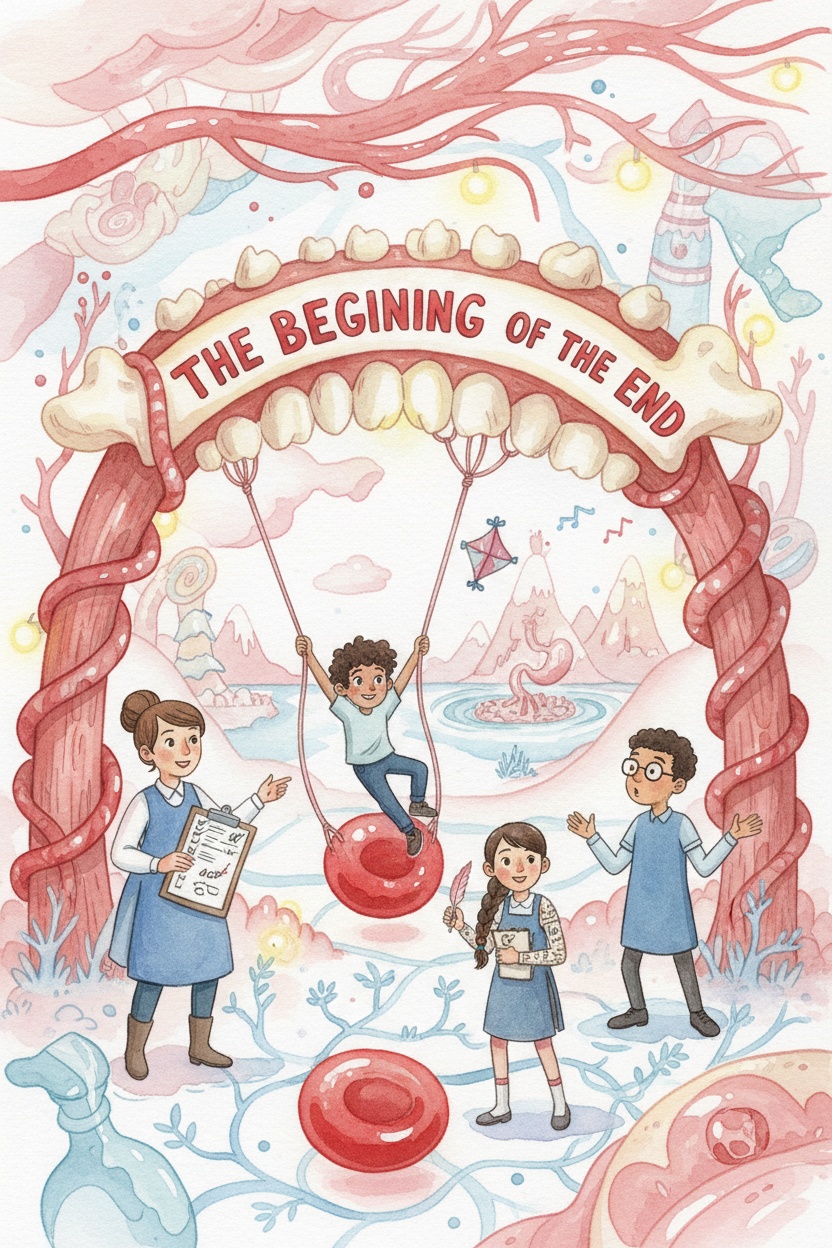
MS. VANCE'S CURRENT CHECKLIST STATUS:
-
Location: The oral cavity (mouth) — technically inside the left cheek, near the lower molars
-
Date: Day 9 of the Journey (Week 2, Tuesday)
-
Students Accounted For: All 22 (Leo is currently on the tongue. Again.)
-
New Checklist Items Added: 14 (Mouth-related hazards: teeth, tongue movement, swallowing reflex)
-
Ms. Vance's Note: "We have entered the digestive system. This is, as the children keep pointing out, the beginning of the end. They mean this literally. I am choosing to interpret it optimistically."
Part One: The Enormous White Cliffs
The class stood at the edge of the lower gum line, looking up.
"Okay," Marcus said, craning his neck. "Okay. I knew teeth were big. I've seen teeth. I brush teeth. But I did not know — I did not KNOW — that teeth were THIS big."
They were enormous. Not like the tidy diagrams in textbooks, arranged in neat rows like a fence. These were living structures, each one the size of a small building. The molars at the back rose up like rounded mountains, their crowns worn smooth and slightly yellowed despite Mr. Gomez's excellent brushing habits. The incisors at the front were flatter, like cliffs with sharp edges. And the canines — Leo had already named them "the fangs," and nobody had come up with a better word.
"The technical term is 'canine,' Leo," Sadie said, adjusting her emergency medical kit. "Because in most mammals, these are the teeth used for tearing meat. Human canines are less developed but still —"
"Fangs," Leo repeated happily. He was standing at the base of one, looking up at its point. "Definitely fangs. Mr. Gomez has fangs."
From the earpiece, Mr. Gomez's voice came through, calm and slightly amused. "I can feel you near my teeth. It's a strange tickle. Like I ate something fuzzy."
"That's us, Mr. Gomez," Ms. Vance said. "Standing near your lower left molar." She consulted her checklist. "Now. Before we begin the tour, let's review what we know about teeth. Marcus, what are the four types?"
Marcus snapped to attention like a soldier. "Incisors for cutting, canines for tearing, premolars for crushing, molars for grinding."
"Twenty seconds, and you actually got them all right," Sadie said. Marcus chose to ignore this.
Fatima, who had been silent, pointed at the surface of the tooth beside them. "It's not dead," she said. "Like bone. It has layers."
"Correct," Ms. Vance said approvingly. "The outer layer is enamel — the hardest substance in the human body. Harder than bone. Underneath is dentin, which is living tissue. And at the very center is the pulp, which contains blood vessels and nerves."
"Can we see the pulp?" Leo asked, already looking around the base of the tooth for an entrance.
"No."
"But—"
"No, Leo. We are not tunneling into Mr. Gomez's tooth."
"I wasn't going to tunnel—"
"You were absolutely going to tunnel. I saw you take out your rope."
Leo put the rope away, muttering something about how a rope was a perfectly normal thing to have out.
The class moved along the gum line, which Ms. Vance explained was the gingiva. They walked carefully, because the gums were soft and slightly springy beneath their feet, and every few steps Mr. Gomez would report a new tickle.
"Now you're near the front," he said. "I can feel it in my incisors."
"Teeth have nerves," Ms. Vance said, as they approached the front of the mouth. "That's why you can feel when something touches them — and why toothaches hurt so much. But that's a lesson for another day." She paused. "Preferably a day when we are not inside the tooth."
Part Two: The Pink Muscle
They stopped at the edge of the tongue.
It was, Marcus declared, "the most disgusting thing I've ever seen in my life, and we've seen a vein from the inside."
The tongue was a massive pink mountain range, covered in thousands of tiny bumps. It moved constantly — not dramatically, but in small, continuous adjustments, pressing against the roof of the mouth, rolling back, settling.
"The bumps are papillae," Sadie said, her voice taking on a lecturing quality. "Some of them contain taste buds. The small ones are filiform papillae — they don't have taste buds, they just help grip food. The larger ones, the fungiform papillae, those are the taste buds. We have about 10,000 taste buds when we're born, and they regenerate every couple weeks, but as we get older—"
"Dr. Sadie is doing it again," Marcus whispered to Fatima.
"Doing what?"
"Lecturing. It's like she can't stop."
Fatima shrugged. "She knows a lot."
"It's the tongue," Marcus said. "This is not a scientific landmark. This is the meat muscle that makes the mouth work."
"Actually, it's called the tongue," Sadie said, overhearing. "And it's a muscular organ — eight muscles working together. It's the only muscle group in the body that's anchored at only one end."
"That's why it can move in so many directions," Ms. Vance added. "It helps with speaking, swallowing, and moving food around the mouth."
Leo had been creeping closer to the tongue, which was not moving very much at the moment. He was within arm's reach of its surface when Ms. Vance spotted him.
"Leo, step away from Mr. Gomez's tongue."
"I'm just looking—"
"The last time you were 'just looking' at something, you got swept into a vein and we had to fish you out with Marcus's belt."
"That was memorable," Leo agreed. He stepped back.
A sound came through the earpiece — Mr. Gomez clearing his throat. "You're on my tongue?" he asked. "It feels strange. Like there's a popcorn kernel under there that won't budge."
"We're near the tongue, Mr. Gomez," Ms. Vance said. "We're going to need you to eat something soon."
"Any requests?"
"Bread. Plain bread, if you have it. We need to observe the beginning of carbohydrate digestion."
There was a pause, then a rustling sound from outside. "I've got some bread in my lunch. It's a bit stale."
"That's perfect. Actually, stale bread might be better. More resistant to chewing, which will give the class more time to observe."
The class exchanged glances.
"Ms. Vance," Fatima said quietly. "What exactly are we going to observe?"
Ms. Vance smiled. It was the smile she got when she was about to teach something she genuinely loved. "The beginning of the end, Fatima. The very first step of digestion."
Part Three: The Bread Descends
Mr. Gomez's voice came through the earpiece again. "Bread's ready. I've got it in my hand. When should I put it in my mouth?"
"Now, please, Mr. Gomez. And try to chew slowly — as slowly as you can manage."
"Slow chewing. Got it."
The class watched as the tongue moved, pressing upward toward the hard palate — the smooth, ridged ceiling of the mouth. They scrambled back toward the gum line as a shadow fell over them.
"This is the cheesiest movie moment I've ever seen," Marcus whispered.
"I'm going to start narrating," Sadie said. "Okay, so technically — the food has entered the oral cavity. The first stage of digestion is mechanical — that means physical breakdown. The teeth will cut, tear, and grind the bread into smaller pieces."
The bread lowered into view.
It was a piece of bread. An ordinary, slightly stale piece of white bread. But at this scale, it looked like a landed aircraft — a pale, pillowy, enormous mass descending toward the lower teeth.
"Oh, that's a lot of bread," Leo said.
"It's one small piece," Ms. Vance corrected. "It just looks large because we're — Leo, what are you doing?"
Leo had started moving toward the bread, his rope already out. "I want to see the teeth bite it."
"Leo, I have asked you to —" Ms. Vance stopped. "Fine. But you stay behind the molars. You are not going to be part of the chewing."
"I wasn't going to—"
"Thank you, Leo. The rest of us will observe from the cheek."
The class hurried back to a ledge on the inside of the cheek — a shelf of tissue that gave them a clear view of the lower molars. They had barely settled when the first bite happened.
The upper teeth descended like a closing gate.
There was no other word for it. The upper molars, mirrors of the ones below, came down and met the bread with a force that the class felt through the floor of the gum — a deep, resonant vibration that traveled through the entire jaw.
"That's the masseter muscle," Sadie said, her voice slightly strained. "It's the strongest muscle in the body relative to its size. It can generate up to 200 pounds of force on the molars."
"Hundreds of pounds," Marcus repeated. "And we're just... sitting in the middle of it."
The bread broke apart. The class watched the heel of Mr. Gomez's tongue press the pieces together, rolling them toward the molars. The tongue, they realized, was doing all the work — moving the food into position, pushing it between the teeth, catching the pieces that escaped.
"Mechanical digestion," Ms. Vance said, her voice almost reverent. "The physical breaking down of food into smaller pieces. The teeth cut, tear, and grind. The tongue moves the food into place. And at the same time —"
"Chemical digestion," Sadie interrupted. "Saliva."
It was coming from everywhere. From the walls of the cheeks, from beneath the tongue, from the roof of the mouth — small tubes were releasing a clear, slightly viscous fluid. It pooled in the gaps between the gums and the teeth, spreading slowly across the surface of the bread.
"The salivary glands," Ms. Vance confirmed. "The parotid glands, the submandibular glands, and the sublingual glands. They produce about one to two liters of saliva every day."
"A liter," Leo said, who had rejoined the group at the first sign of moisture. "Of spit. Every day."
"Saliva is not just spit, Leo. Saliva contains an enzyme called salivary amylase."
Marcus's hand shot up. "Amylase breaks down starch into sugar. That's why bread tastes sweet if you chew it long enough."
"Excellent, Marcus. Exactly right. Salivary amylase begins the chemical breakdown of carbohydrates — converting starches into simpler sugars. It's the very first chemical digestion that happens to food."
"Is the bread... dissolving?" Leo asked.
"Not dissolving. Digesting. The enzymes are breaking down the long starch molecules into shorter ones. The bread is becoming more chewable, easier to swallow."
The tongue crushed the pieces again. The teeth came down, and this time the class could see small droplets of moisture spraying from between the molars — the bread had become a paste, mixed with saliva.
"Sensory neurons are sending information to the brain," Sadie said, watching the tongue's careful movements. "Taste buds are detecting the sweetness from the sugar being released. The tongue is forming the food into a ball — a bolus, technically — preparing it for swallowing."
"Look," Fatima said.
They all looked. The tongue had rolled the bread into a small, smooth ball and pressed it against the hard palate. The teeth were still. The chewing was done.
"Incisors," Marcus said, pointing. "The front teeth — that's where the cutting happened first. Then it moved back to the premolars and molars for grinding."
"Exactly. Different teeth for different jobs. The incisors cut, the canines tear, the premolars crush, and the molars grind. Every tooth plays its role."
"And then the tongue rolls it into a ball and shoves it down the throat," Leo said.
"Shoves it down the pharynx," Ms. Vance corrected. "But suddenly, the tongue moves backward, the soft palate rises to close off the nasal cavity, the epiglottis —" she paused. "We'll see the epiglottis in the next book. The point is, the mouth's job is done. The bolus is swallowed, and it begins its journey through the esophagus to the stomach."
The class watched as the bolus disappeared from view. The tongue settled. The teeth stopped.
Silence, except for Mr. Gomez's voice through the earpiece.
"That was interesting," he said slowly. "I've never thought about chewing that much before."
"How did your mouth feel, Mr. Gomez?" Ms. Vance asked.
"Different. The bread is sweeter now. I've never noticed that."
"That's the amylase at work. The starches broke down into sugar."
"Ah." A pause. "That's why the bread tastes better if you chew it slowly. I always rushed."
Ms. Vance smiled. "That's why chewing matters, Mr. Gomez. Every action in the mouth — cutting, tearing, crushing, grinding, and the release of amylase — is the first step of digestion. If you don't chew properly, the rest of the system has to work harder. And the enzyme activity begins here, not in the stomach."
"Best not to rush the mouth," Mr. Gomez agreed.
Part Four: The Pocket of the Cheek
The class spent the next half-hour exploring the oral cavity. Marcus made a detailed map of the teeth, labeling each one with its name and function. Sadie pointed out the openings of the parotid ducts — the small tubes that released saliva from the glands in the cheeks. Leo was forbidden from climbing the uvula, the small fleshy projection that hung from the soft palate, after he tried to use it as a rope swing.
"But it looks like a perfect rope swing," he protested.
"It's part of Mr. Gomez's body, Leo."
"Mr. Gomez, can I swing from your uvula?"
The earpiece crackled. "I'd rather you didn't."
"There," Ms. Vance said. "Even Mr. Gomez said no."
"I was just asking."
"Twenty-four times. You asked twenty-four times."
Fatima sat on the gum line near a premolar, watching the tongue move. It had been several minutes since the bread had been swallowed, but the tongue was still active — pressing against the teeth, sweeping across the gums, gathering microscopic remnants of the food.
"It's cleaning," she said quietly.
Sadie nodded. "The tongue acts as a natural cleaner. It sweeps food particles off the teeth and gums, which helps prevent bacteria from building up."
"It's not finished." Fatima watched the tongue make another slow sweep. "It's still working."
Mr. Gomez's voice came through the earpiece. "I can feel that. Like my tongue is doing something on its own."
"Your tongue is doing something on its own," Ms. Vance confirmed. "It spends most of the day cleaning your mouth, repositioning food, and helping you speak. You just don't notice because it's automatic."
There was a long pause from outside.
"How long have we been in my mouth?" Mr. Gomez asked.
"About forty minutes."
"Forty minutes. And I didn't notice my tongue doing anything."
"That's the beauty of the body, Mr. Gomez. Most of what it does, you never have to think about."
"I was going to bite my sandwich for lunch."
"The class is nearly ready to leave the oral cavity. Give us fifteen minutes."
"Okay. I'll wait."
The Final Checklist Update
Ms. Vance gathered the class at the base of the canine, which Leo had insisted on naming "Mr. Pointy."
"We have reached the end of the mouth," she announced. "We have seen the teeth — incisors, canines, premolars, molars — and their functions in mechanical digestion. We have seen the tongue and its role in positioning food and forming the bolus. We have seen the salivary glands and the production of saliva, including the enzyme salivary amylase, which begins the chemical digestion of carbohydrates. And we have learned why chewing matters."
"Why does chewing matter?" Marcus asked, already knowing the answer.
"Because mechanical digestion makes chemical digestion possible," he answered himself, slightly annoyed. "The smaller the food particles, the more surface area for enzymes to work on. Chewing properly literally makes digestion more efficient."
Ms. Vance nodded. "Which is why you should all chew your food slowly and thoroughly."
"But how do we know if we're chewing enough?" Leo asked.
"A good rule is to chew until the food feels like a smooth paste and is easy to swallow," Ms. Vance said. "Some experts suggest chewing up to thirty times per mouthful for very tough foods."
"Thirty times," Leo repeated. "I usually chew like four times."
"And that is why your stomach has to work extra hard, Leo."
Leo considered this. "So if I chew more, my stomach works less?"
"Exactly."
"Huh." Leo looked at the teeth around them — the enormous, slightly terrifying structures that had seemed so dangerous just an hour ago. "Okay. I'll try to chew more."
"That's very grown-up of you, Leo."
"Can I climb Mr. Pointy first?"
"No."
"Can I at least touch it?"
"No."
"How about—"
"Leo, the answer is no. We're leaving the mouth."
Mr. Gomez's External Log — Day 9
I have to admit, when they said they wanted to study my mouth, I was a little nervous. I didn't know what they'd find in there. I've been brushing twice a day since Dr. Patel told me I had a "borderline cavity situation" last year, but I still wasn't sure what the inside of my mouth looked like to someone one millimeter tall.
The class was very polite about it. Leo told me my canines are "pretty impressive, Mr. Gomez," which I was not expecting, but I'll take it.
They had me chew a piece of stale bread slowly. I could feel them watching. It was like being in a restaurant where the chef comes out to critique your meal, except the chef was inside my mouth.
The bread tasted sweeter than I remembered. Ms. Vance explained why — the saliva breaks down the starch into sugar. I've been eating bread my whole life and I never noticed that. Now I can't stop noticing it.
They've moved on to the esophagus now. I can feel them somewhere in my throat. It feels like I swallowed a very small, very curious marble.
The principal called about my sick leave again. I told him I was recovering from a "gastrointestinal event." He asked if I could be back by Friday. I told him I'd try. From inside my throat, I heard someone say, "Friday is optimistic." I agreed with them, but I didn't say so out loud.
Tomorrow, they'll reach the stomach.
I'm going to eat something soft for dinner.
END OF BOOK 21
NEXT: BOOK 22 — THE LONG JOURNEY